The discussion surrounding the documentary film “Pesta Babi: Kolonialisme di Zaman Kita (Pig Feast: Colonialism in Our Times)” moved from social media feeds and community conversations into a police building this week.
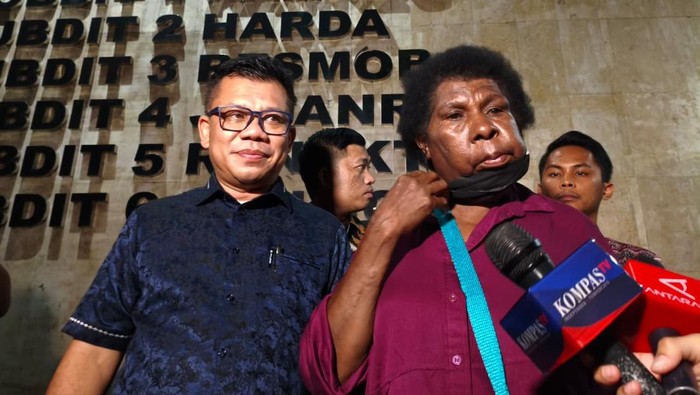
Wearing traditional Papuan accessories and accompanied by supporters, Yasinta Moiwend, better known across Merauke as Mama Sinta, arrived at Polda Metro Jaya carrying documents she said represented months of frustration.
Her complaint was straightforward.
She said she never knowingly agreed to become part of the documentary that later circulated publicly.
On Friday, May 29, Mama Sinta officially reported a man identified by the initials JTW, chairman of a legal aid institution in Merauke, accusing him of involvement in a process she described as deceptive.
“I feel deceived,” she told journalists after submitting her report.
For Mama Sinta, she said, the issue was not simply appearing on camera.
It was about how and why she appeared.
From Documentary Footage to Police Complaint
Mama Sinta Says She Did Not Understand How Footage Would Be Used
Standing outside police headquarters after filing the complaint, Mama Sinta repeated that she never intended to participate in a documentary film.
She said she believed conversations conducted at the time had different purposes.
According to her explanation, she only realized the scale of her appearance after the documentary began circulating publicly.
Several photographs published by national media showed her holding documents after completing the police report process.
Speaking to reporters, she questioned why her image and statements appeared publicly without what she described as clear permission.
“I never gave permission like that,” she said while surrounded by journalists.
Police have confirmed receiving the report.
Investigators have not announced findings.
The allegations remain part of an ongoing legal process.
Why The Case Quickly Drew Attention
The complaint immediately attracted wider discussion because Mama Sinta became one of the recognizable faces appearing inside Pesta Babi.
Her appearance created public assumptions.
Her police report complicated those assumptions.
What initially began as discussion surrounding the documentary itself gradually shifted toward something else.
Consent.
Representation.
And whether participants fully understood what they were participating in.
Who Is Mama Sinta?
In Merauke, Mama Sinta is known as an Indigenous community figure.
That status partly explains why her complaint generated attention beyond legal circles.
Community figures in Papua often speak not only as individuals but also as representatives of broader social networks.
Because of these dynamics, disagreements involving representation frequently create larger conversations.
Following her report, Mama Sinta also spoke about development issues in South Papua and her hopes regarding economic opportunities for communities in Merauke.
Her recent statements gained attention because some viewers previously interpreted her appearance inside the documentary differently.
Legal Experts Say Investigation Will Determine Facts
Police investigators have not publicly discussed possible legal conclusions.
As the process moves forward, legal observers note that documentary-related disputes rarely reach criminal investigations in Indonesia.
That alone makes the case unusual.
Several legal observers quoted by Indonesian media stressed that investigators will eventually determine whether evidence supports allegations submitted by complainants.
Until then, claims remain claims.
Questions About Consent Become Central
Documentary production often depends on relationships.
Interviews.
Long conversations.
Trust.
Researchers and journalists working in remote regions frequently spend considerable time building access before recording begins.
Because of that, allegations involving consent often create broader ethical debates.
Several observers following the case argue the controversy highlights challenges surrounding documentary production involving Indigenous communities.
How consent is explained.
How footage is used.
Additionally, it is important to consider whether participants understand the contexts in which the final publication will be presented.
These questions now sit at the center of discussions surrounding Pesta Babi.
Debate Continues Beyond the Police Investigation
Outside legal proceedings, discussions continue across Papua.
Some people defend documentary work as important forms of public storytelling.
Others argue community participation requires clearer communication and stronger safeguards.
The police report filed by Mama Sinta has not ended those debates.
If anything, it has expanded them.
Several local observers argue that the controversy demonstrates how quickly media production, activism, and community politics can intersect.
Once that happens, separating legal questions from public perceptions becomes difficult.
What Happens Next
Police investigators are expected to continue reviewing evidence and statements connected with the report.
No official timeline has been announced.
For now, investigators remain at the early stage.
Mama Sinta says she wants accountability.
The reported party has not publicly responded in detail to the allegations cited by media reports.
Meanwhile, conversations surrounding the documentary continue.
The discussions extend beyond the audience’s viewing experience.
But about what happened before filming ended.
Conclusion
By afternoon, the cameras outside police headquarters began disappearing.
Journalists moved toward other assignments.
Supporters slowly left.
Mama Sinta briefly stopped before entering a vehicle.
She repeated why she came.
“I only want the truth explained,” she said.
Whether investigators eventually agree remains a question for legal procedures.
The wider debate surrounding consent, trust, and representation in Papua appears far from over.