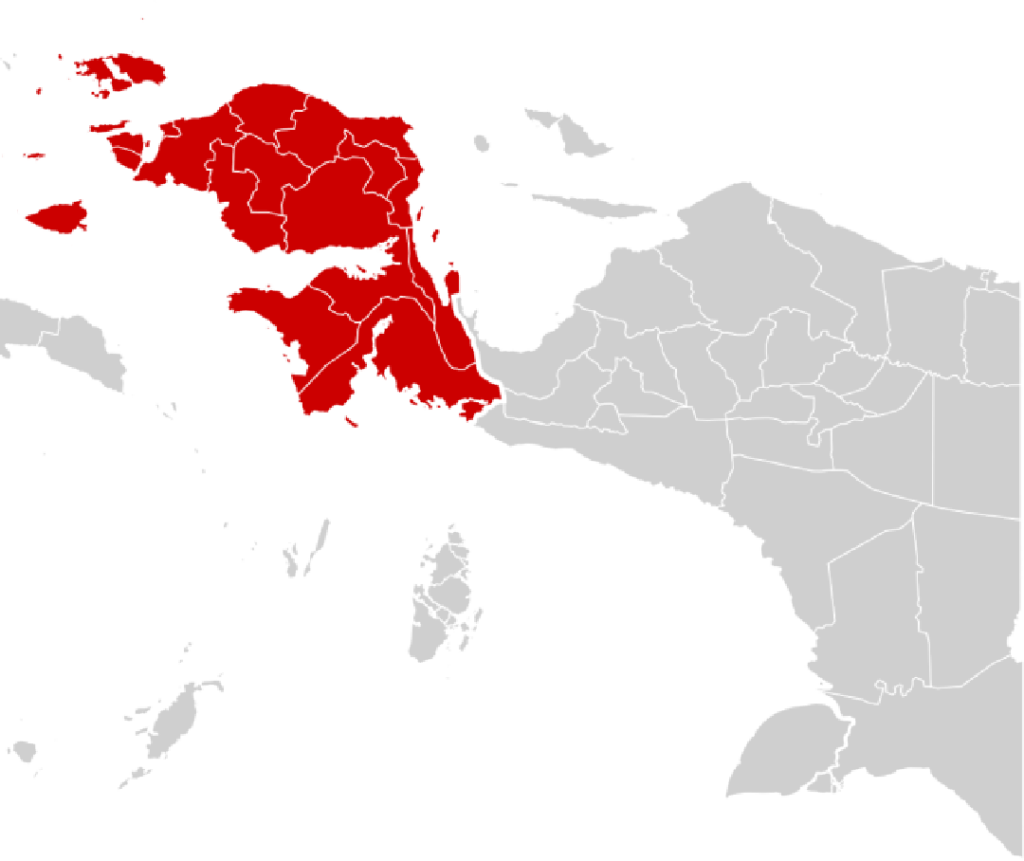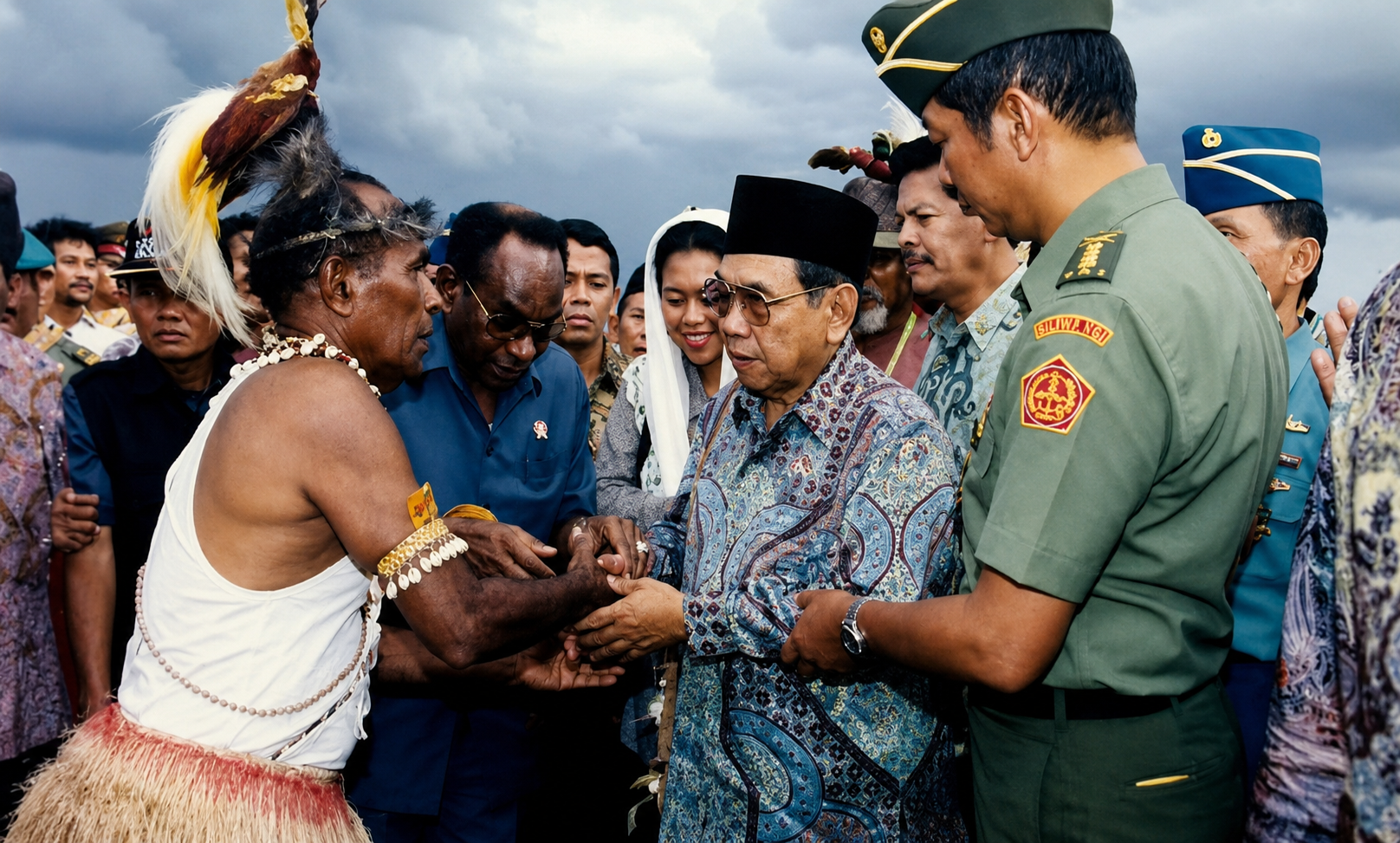
On December 30-31, 1999, former Indonesian president Abdurrahman Wahid arrived in Papua during one of the most sensitive moments in the province’s modern political history.
At the time, distrust toward Jakarta remained deep following years of political tension, security operations, and unresolved grievances. Many Papuans felt isolated from decision-making at the national level, while separatist sentiment and social frustration were becoming increasingly visible across several regions.
But Gus Dur approached Papua differently.
Instead of opening his visit with security language or political warnings, he chose dialogue and cultural respect. During meetings with religious leaders, community figures, and Papuan representatives in December 1999, Gus Dur repeatedly emphasised that Papuans were part of Indonesia’s national family and deserved dignity, communication, and equal treatment.
More than 25 years later, many Papuan leaders and members of the Nahdlatul Ulama (NU) still point to that approach as one of the foundations for peaceful engagement in Papua.
Gus Dur’s 1999 Visit Left a Strong Impression in Papua
Papua Was Experiencing Deep Political Distrust
When Gus Dur visited Papua, then still formally known as Irian Jaya, Indonesia was entering a difficult political transition after the fall of former president Suharto in 1998.
Across Papua, demands for political recognition and frustration toward Jakarta had intensified. In several areas, tensions between security forces and local communities remained high.
Indonesian media later revisited historical accounts, revealing that Gus Dur deliberately avoided confrontational rhetoric during his Papua visit in December 1999.
Instead, he focused on communication.
During meetings with Papuan leaders, Gus Dur acknowledged the importance of listening directly to local concerns. He also encouraged a wider dialogue between Jakarta and Papua during a period when many residents felt politically marginalised.
Several Papuan figures later recalled that the visit felt different from previous interactions with national leaders because Gus Dur approached Papua through humanity and respect rather than suspicion.
Gus Dur Allowed the Use of the Name “Papua”
One of the most symbolic moments in Gus Dur’s Papua policy occurred when he approved the broader official use of the name “Papua” instead of Irian Jaya.
At the time, the decision carried emotional significance for many Papuans because the word “Papua” was viewed as more closely connected to local identity and history.
Although symbolic, the policy helped reduce tensions temporarily and was widely interpreted as a gesture of recognition toward Papuan cultural dignity.
National media revisited accounts years later, revealing Gus Dur’s belief that the state could not build trust by entirely ignoring local identity.
Gus Dur Became Associated With Papua’s Special Autonomy
Early Foundation of Otsus
In 2001, after Gus Dur’s political power weakened, the government formally passed Papua’s special autonomy framework, widely known as Otsus.
But many Indonesian analysts and Papuan leaders continue describing Gus Dur as one of the most important figures behind the early political foundation of the policy.
During his presidency, Gus Dur encouraged dialogue-based approaches toward Papua rather than relying exclusively on security responses.
According to political observers quoted in several discussions about Papua, Gus Dur understood that development programmes alone would not resolve tensions if Papuans continued to feel excluded politically and culturally.
That perspective later became part of broader discussions surrounding Special Autonomy.
Today, Otsus remains one of Indonesia’s central frameworks for governance and development policy in Papua.
The NU Continues Promoting Peace and Social Harmony
The NU Leaders Stress Unity Across Communities
As the oldest Islamic civil society in Indonesia that was founded in 1926 by K.H. Hasyim Asy’ari (grandfather of Gus Dur), the NU has continued expanding educational, religious, and social activities across Papua.
The NU leaders often describe the organisation’s role as strengthening social cohesion in regions shaped by tribal diversity, religious pluralism, and periodic political tension.
During remarks quoted by the NU media, Papua Barat Governor Dominggus Mandacan said the NU had helped spread unity and togetherness among communities in Papua.
He stated that organisations promoting moderation and tolerance remain important because Papua consists of many tribes, cultural groups, and religious communities that must continue living peacefully side by side.
The comments reflected broader recognition that social stability in Papua depends heavily on intercommunity trust.
The NU Emphasises Humanitarian Islam
Several of the NU scholars and religious leaders have also promoted what they describe as “humanitarian Islam” in Papua.
The approach emphasises dialogue, coexistence, and social services rather than ideological confrontation.
In practice, NU activities in Papua frequently involve cooperation with churches, traditional institutions, youth organisations, and local communities.
Observers say this approach resembles many of the values long associated with Gus Dur himself.
According to the NU figures quoted in public discussions, Papua cannot be approached only through formal politics or security frameworks. Social trust and cultural understanding remain equally important.
Papua’s “One Furnace, Three Stones” Philosophy
Cultural Values Align With Gus Dur’s Approach
Many Papuan leaders see similarities between Gus Dur’s leadership style and the Papuan philosophy, known as “satu tungku, tiga batu (one furnace, three stones)”.
The philosophy symbolises balance and cooperation between different elements of society, especially religion, customary authorities, and government.
In many Papuan communities, the concept represents the importance of coexistence despite differences in ethnicity or belief.
Several of the NU figures have argued publicly that Gus Dur’s pluralist worldview aligned naturally with this local philosophy.
That partly explains why he remains respected by many Papuans years after his presidency ended.
Papua’s Diversity Requires Sensitive Engagement
Papua remains one of Indonesia’s most culturally diverse regions, with hundreds of tribes and local languages spread across mountainous, coastal, and island communities.
Because identity remains deeply important in everyday life, local leaders often warn that insensitive approaches can quickly increase mistrust or social tension.
Several observers quoted in discussions surrounding Papua peacebuilding have argued that dialogue and cultural respect remain essential in maintaining long-term stability.
The NU leaders continue repeating similar messages today.
Peace in Papua Depends on More Than Security
Social Trust Remains Crucial
Papua continues to face periodic challenges involving armed separatist violence, political polarisation, and local social tensions.
Indonesian authorities have consistently stressed the need for development, education, and stronger community relations to ensure security and stability.
Within that broader context, the NU’s role has largely focused on strengthening social trust rather than on political confrontation.
Several community leaders also note that Papua’s diversity requires organisations capable of peacefully connecting different groups.
Preventing Polarisation
Observers continue to warn that polarisation in Papua can deepen if ethnic, religious, or political tensions are exploited irresponsibly.
That concern has become particularly relevant during periods of heightened security tension in several regions.
The NU leaders have repeatedly stated that maintaining Indonesia’s unity in Papua requires fairness, dialogue, and respect for local identity rather than inflammatory rhetoric.
Those ideas strongly reflect the legacy associated with Gus Dur’s approach toward Papua more than two decades ago.
Conclusion
More than 25 years after his historic December 1999 visit, Abdurrahman Wahid continues holding a unique place in discussions about peace and reconciliation in Papua.
His emphasis on dignity, communication, and cultural respect helped shape early approaches toward Papua’s special autonomy framework and influenced organisations like the NU to promote tolerance and coexistence across the region.
Today, as Papua continues facing complex political and social challenges, many local leaders still point to Gus Dur’s approach as a reminder that long-term peace often depends not only on policy or security but also on trust between communities and the state.