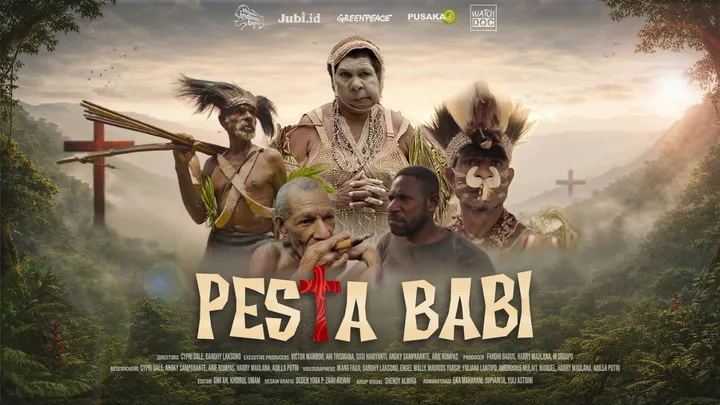
This week, Yasinta Moiwend, better known as Mama Sinta from Wanam Village, Ilwayab District, appeared in several social media videos, sounding emotional but firm.
Sitting among community members in Papua Selatan (South Papua), the indigenous elder said she never expected her appearance in the documentary film Pesta Babi (Pig Feast) would trigger national controversy or place her at the center of a heated political debate about Indonesia’s food estate project in Merauke.
“I support development in Merauke,” she said in one of the videos circulated publicly in May 2026. “I was disappointed because my words were not presented as I intended.”
Her statement quickly spread across Indonesian media platforms after several outlets reported that Mama Sinta regretted participating in the documentary and believed she had been misled during the filming process.
The issue quickly escalated beyond the confines of a single documentary film.
It reopened larger debates surrounding the government’s food estate program in Papua, indigenous land disputes in Merauke, the role of activist filmmakers, and growing efforts by business groups to improve infrastructure and welfare in villages surrounding the project area.
At the center of the discussion is a difficult question that continues dividing opinion in Papua itself: whether large-scale agricultural development in Merauke represents a threat to indigenous communities or an opportunity for long-neglected regions to grow economically.
Mama Sinta Publicly Distances Herself From “Pesta Babi.”
Indigenous Elder Says She Felt Misled
The controversy surrounding Pesta Babi intensified after Mama Sinta publicly clarified her position through interviews, public statements, and videos circulated on social media during May 2026.
Several Indonesian news outlets quoted Yasinta Moiwend saying she felt uncomfortable after discovering how the documentary portrayed the situation in Merauke.
In videos shared online, including Instagram reels widely reposted by community groups and local activists, Mama Sinta appeared visibly upset while discussing her experience.
She said she never intended to oppose development programs designed to improve local welfare.
According to reports published by regional and national media between May 20 and May 23, Mama Sinta emphasized repeatedly that communities in Merauke still need roads, healthcare access, schools, electricity, and economic opportunities.
“We want our children to have a better future,” she said in one of the publicly circulated statements.
Her comments became important because Pesta Babi had been promoted online as a documentary highlighting criticism toward the food estate project and broader development activities in Papua Selatan.
Mama Sinta’s clarification complicated that narrative.

Social Media Videos Shifted Public Conversation
The debate accelerated after several clips from interviews and gatherings involving Mama Sinta circulated widely on Instagram and local online media platforms.
In one of the videos referenced by local media reports, she explained that she initially believed the filmmakers wanted to document indigenous life and environmental concerns fairly.
Instead, she later felt the final narrative focused too heavily on conflict and opposition.
Several local residents commenting online also expressed frustration that outside narratives about Papua often ignore the diversity of opinion among indigenous communities themselves.
In Merauke, reactions toward the food estate project remain mixed rather than uniform.
Some communities oppose parts of the development because of land concerns, while others openly support the project because they hope it can improve local living conditions.
Haji Isam Expands Welfare and Infrastructure Support
Assistance Programs Reach Villages Near Project Area
At the same time the documentary controversy unfolded, businessman Andi Syamsuddin Arsyad, commonly known as Haji Isam, became increasingly visible in discussions surrounding Merauke’s development.
Through Jhonlin Group, he publicly committed to supporting communities living around food estate zones, especially in remote areas such as Kampung Wanam in Ilwayab District.
According to local reports and videos shared online during May 2026, the support includes renovation programs for damaged homes, road improvements, and expansion of electricity access.
For many villagers, infrastructure remains one of the biggest daily challenges.
Several roads in southern Merauke become difficult to access during heavy rain, while electricity coverage in isolated areas remains limited.
Community representatives interviewed by regional media said many residents welcomed practical improvements rather than prolonged political debate.
“We need roads and housing improvements,” one local resident said in footage shared through social media channels connected to the development activities.
Government Sees Merauke as Strategic Food Region
Indonesia’s central government continues treating Merauke as one of the country’s most important long-term food security areas.
Officials argue the district possesses extensive agricultural potential capable of helping Indonesia strengthen domestic food production amid global uncertainty and climate-related disruptions.
Supporters of the project also say southern Papua has historically lagged behind western Indonesia in infrastructure development.
For that reason, several regional leaders believe agricultural investment could create jobs, transportation access, and broader economic activity if implemented carefully.
The Jagebob Land Conflict Reflects Older Customary Disputes.
Opposition Linked to Clan Boundary Issues
Another layer of controversy surrounding the Merauke development debate involves land disputes in Jagebob District.
Public attention focused partly on Vincen Kwipalo, a figure from the Kei community who opposed plans for developing sugar plantations connected to sugarcane plantation investment projects in the region and appeared in the documentary film Pesta Babi.
However, local media reports and community discussions closely tie the issue to older customary boundary conflicts between clans.
Local media reports say that PT Murni Nusantara Mandiri got permits and legal approvals for investments in 2023 that were previously gotten by PT Hardaya in 2010, which did not continue with the investment plan. PT Murni Nusantara got permits and legal approvals for sugarcane plantation investment projects in Jagebob District, including environmental approvals and impact analysis (AMDAL) documents.
Local reports stated the company received support from 8 major clans to 22 major clans in the area, except for Kwipalo clans.
At the same time, ongoing disagreements between the Kwipalo and Galjai clans are said to still influence how people view land ownership and traditional territory lines in some areas of the project zone.
Several local figures interviewed by regional media stressed that customary land disputes in Papua are often historically complex and cannot always be simplified into purely political narratives.
Community Leaders Call for Dialogue
As tensions surrounding development debates grew online, several indigenous leaders and local observers urged communities to prioritize dialogue and customary mediation.
Some community figures argued that land disagreements should not automatically escalate into broader political polarization capable of damaging social stability in Merauke.
Others warned that outside narratives sometimes fail to understand the complicated relationships between clans, customary agreements, and overlapping territorial histories in Papua.
Dandhy Dwi Laksono Again Faces Political Criticism
Documentary Filmmaker Remains Controversial Figure
The release of Pesta Babi also renewed national debate surrounding documentary filmmaker Dandhy Dwi Laksono.
Laksono previously became one of Indonesia’s most controversial media figures after producing Sexy Killers in 2019 and Dirty Vote in 2024, both of which generated strong political reactions nationally.
Critics accuse his productions of framing Indonesian policy issues selectively while benefiting from political controversy and online attention. The Free Papua Movement (OPM) can exploit several selective issues to support their separatist agenda in Papua.
In the latest debate, some groups that support development programs in Papua criticized the partnerships between Watchdoc, Greenpeace, Jubi, Cypri Paju Dale, and Lembaga Bantuan Hukum (LBH), or legal advocacy organizations that were publicly involved in discussions about Pesta Babi.
Some local commentators argued the documentary amplified negative portrayals of government development efforts while overlooking communities supporting infrastructure and economic expansion in Merauke.
Supporters of the film, meanwhile, defended documentary activism as part of public oversight and environmental accountability.
The disagreement once again showed how Papua remains one of Indonesia’s most politically sensitive regions when questions involving development, indigenous identity, and environmental policy intersect.
Papua’s Development Debate Remains Deeply Divided
For many residents in Merauke, the argument surrounding the food estate project is not simply about politics.
It is about uncertainty over the future.
Some indigenous families worry about customary land protection and environmental sustainability. Others believe economic isolation has lasted too long and that development opportunities should not automatically be rejected.
That complexity was visible throughout the public statements made this month.
Mama Sinta herself repeatedly emphasized that indigenous communities want development while still protecting dignity and customary identity.
Her message reflected a reality often overlooked in polarized national debates: communities in Papua rarely speak with one voice.
Conclusion
The controversy surrounding the food estate project in Merauke has evolved into a broader national debate involving indigenous rights, environmental activism, media narratives, infrastructure development, and economic expectations.
During May 2026, Mama Sinta or Yasinta Moiwend publicly said she regretted her involvement in the documentary Pesta Babi and reaffirmed her support for development efforts in Papua Selatan.
At the same time, businessman Andi Syamsuddin Arsyad expanded welfare and infrastructure assistance in villages surrounding food estate areas, while land disputes in Jagebob continued exposing longstanding customary tensions between clans.
The situation also reignited political debate surrounding documentary filmmaker Dandhy Dwi Laksono and activist networks involved in development criticism.
For now, Merauke remains a symbol of Papua’s larger crossroads between economic expansion, indigenous identity, environmental concerns, and competing visions about the future of development in eastern Indonesia.