
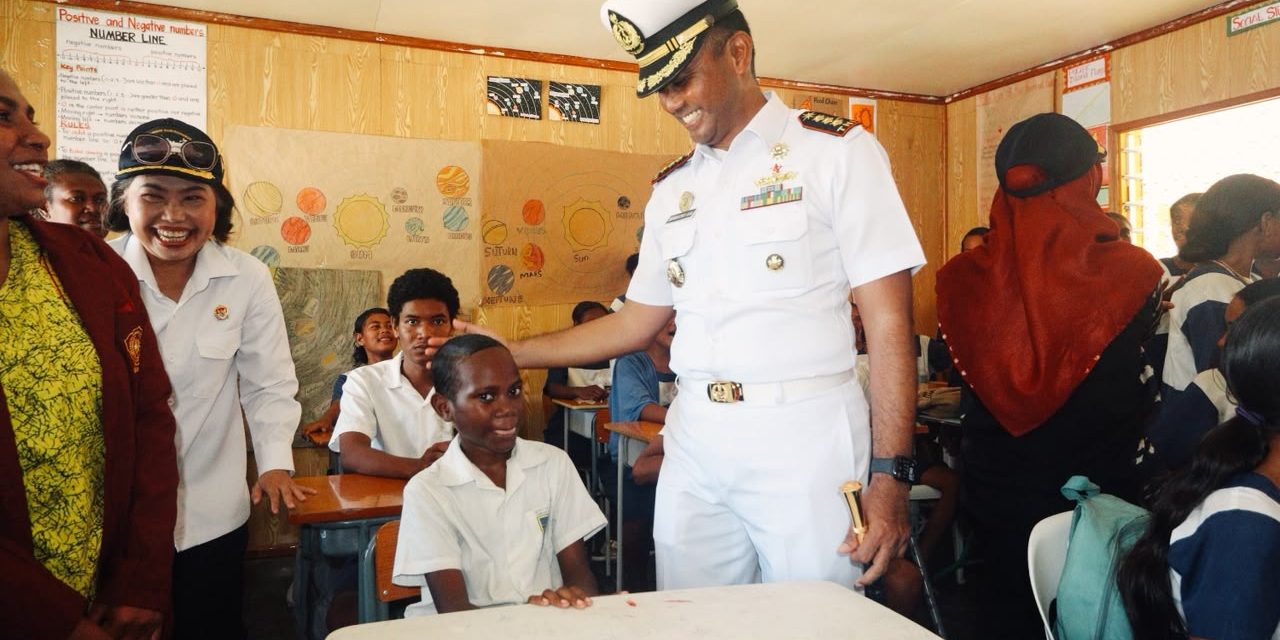
Indonesia’s KRI, Dr. Wahidin Sudirohusodo-991, has brought its humanitarian mission to the Solomon Islands, delivering medical equipment and community assistance while opening new opportunities for cooperation between the two countries. The hospital ship arrived at Point Cruz International Wharf in Honiara on the evening of October 18, 2026, as part of Indonesia’s Port Visit 2026 mission across the South Pacific.
The visit has combined several forms of engagement. Solomon Islands officials toured the vessel’s medical facilities and received an X-ray unit for the country’s health authorities. The Indonesian Navy task force subsequently distributed essential supplies and community support items, helped renovate a basketball court, and visited local religious and educational institutions. On October 21, the task force commander also paid a courtesy visit to the Solomon Islands Police Headquarters to discuss strengthening institutional ties.
Together, these activities illustrate how Indonesia is using maritime engagement to connect humanitarian assistance with diplomatic relations. Rather than limiting the visit to formal meetings between government and military representatives, the mission has also involved residents, schools, religious communities, and local institutions.
For Indonesia, the Solomon Islands visit is part of a broader effort to strengthen relations with Pacific Island countries through practical cooperation. For the host country, the arrival of a hospital ship offers an opportunity to examine medical capabilities, receive equipment, and expand contact with Indonesian institutions.
From Sorong to Honiara: The Port Visit 2026 Mission
A 60-Day Humanitarian and Diplomatic Voyage
The Port Visit 2026 task force departed from Pier 106 at Tanjung Priok, North Jakarta, on September 14. Led by Navy Colonel Benedictus Hery Murwanto, the mission was scheduled to visit Vanuatu, Fiji, the Solomon Islands, and Papua New Guinea before returning to Indonesia on November 12.
The deployment brought together 318 personnel from Indonesia’s armed forces, police, government ministries, and agencies, alongside academics, students, volunteers, and journalists. This broader composition distinguishes the 2026 mission from earlier port visits that were conducted primarily by Indonesian Navy personnel.
The mission operates under the theme “Health, Humanity, and Diplomacy,” with the accompanying message “Bridging Nations, Serving Humanity.” Its program combines medical assistance, social outreach, cultural exchange, professional engagement, and activities intended to strengthen relations with host communities.
Before reaching the Solomon Islands, the task force visited Vanuatu and Fiji. In Fiji, the medical team treated 504 patients during two days of healthcare services on October 11 and 12, according to Indonesian Navy reporting. The ship then continued its journey towards Honiara.
The mission therefore arrived in the Solomon Islands with experience from earlier stops, but each country’s activities were shaped by its circumstances and engagement opportunities.
Arrival and Official Welcome
KRI Dr. Wahidin Sudirohusodo-991 reached Honiara on the evening of October 18. The arrival was welcomed by Hon. Johni Junior Tuhaika, the Solomon Islands Minister of Police, National Security, and Correctional Services, who also serves as the supervising minister for Health and Medical Services. Other officials and representatives of the Indonesian Embassy to Papua New Guinea and the Solomon Islands attended the reception.
Benedictus welcomed Tuhaika aboard and guided him to the ship’s VIP room for an official meeting. The discussions took place in a cordial atmosphere and introduced the visiting officials to the mission’s combined humanitarian and diplomatic purpose.
“First of all, welcome aboard our hospital ship,” Benedictus said during the meeting, according to RRI’s report. He explained that the task force included military personnel, police officers, civilians, and students working together under the mission’s humanitarian and diplomatic agenda.
Tuhaika expressed appreciation for Indonesia’s decision to send the vessel to his country.
“It is a great honor to welcome you to our port. We are grateful to your government for sending this vessel to our country and for the opportunity it provides to serve and support our people,” he said.
His remarks reflected the practical importance of the visit: the ship’s presence was intended to offer support to local communities while creating opportunities for closer bilateral engagement.
After the meeting, Tuhaika toured the ship’s medical facilities. The visit allowed him to inspect the vessel’s healthcare capabilities and learn how it could support medical services during the wider South Pacific mission.
Medical Equipment and Healthcare Cooperation
An X-ray Unit for the Solomon Islands
One of the first major activities following the ship’s arrival was the handover of an X-ray unit to the Solomon Islands Ministry of Health and Medical Services. The transfer took place on October 18 after the official welcome, according to the Indonesian Navy’s account of the visit.
The equipment handover gave the visit a tangible healthcare component beyond the ship’s diplomatic presence. Medical imaging can support the examination and diagnosis of a range of conditions, although the equipment’s practical contribution will depend on its installation, staffing, maintenance, and integration into local health services.
The visit also gave Solomon Islands officials an opportunity to inspect the hospital ship’s facilities directly. KRI Dr. Wahidin Sudirohusodo-991 is designed to support medical services at sea and during humanitarian deployments, providing a platform for health assistance and professional engagement with partner countries.
The Indonesian Navy’s broader mission includes general medical and dental services, health consultations, and treatment according to clinical needs and operational capacity. The vessel is equipped to support medical teams during the deployment, including personnel with specialist expertise.
It is important, however, to distinguish the ship’s readiness to provide healthcare from the services actually delivered at each stop. Reports on the Honiara arrival confirm the medical equipment handover and inspection of the ship’s facilities but do not establish a specific number of patients treated in the Solomon Islands during the first days of the visit.
The longer-term value of the X-ray donation will similarly depend on whether the equipment can be put into routine service and supported by trained personnel and adequate supplies. While equipment can enhance a health system’s capabilities, its true value lies in practical use and patient access.
Health Diplomacy Beyond Emergency Assistance
Medical cooperation can help build relationships that continue after a ship leaves port. The exchange of equipment, professional contact, and discussions about healthcare needs can create a foundation for future engagement between institutions.
For Indonesia, the hospital ship provides a practical way to contribute to cooperation in a region where maritime distances shape access to services and international contact. For the Solomon Islands, the visit creates an opportunity to learn about Indonesia’s medical capabilities and consider areas where the two countries may work together.
Connecting such engagement to local priorities proves especially useful. The effectiveness of health diplomacy depends not only on the generosity of an initial contribution but also on whether assistance meets an identified need and can be maintained over time.
Community Assistance in Honiara
Support for neighborhoods, religious institutions, and schools
On October 19, the task force expanded its engagement beyond official meetings through visits to the White River community, Mbokonavera Mosque, Vura Anglican Church, and Transfiguration Vura School. The activities focused on community assistance, practical cooperation, and direct interaction between Indonesian Navy personnel and local residents.
The team distributed essential supplies, building materials, religious equipment, sports equipment, and other items to support the communities and institutions visited. The assistance was formally handed over by Benedictus to representatives of White River, Mbokonavera Mosque, and Vura Anglican Church.
The range of recipients was significant. By engaging with a neighborhood, a mosque, a church, and a school, the program reached different parts of community life rather than concentrating solely on government institutions.
At White River, Indonesian Navy personnel joined residents to renovate and repaint a basketball court. The work offered a visible example of cooperation: personnel and local community members worked side by side on a shared public facility.
Such activities are modest in scale compared with major infrastructure projects, but they can provide a setting for informal interaction. Working together on a basketball court, exchanging greetings at a school or sharing a meal can create opportunities for people to learn about one another beyond formal diplomatic settings.
The program concluded with a communal meal involving Indonesian personnel and local residents. The gathering provided additional space for conversation and cultural exchange, reinforcing the people-to-people dimension of the mission.
Why Community Engagement Matters
Humanitarian diplomacy is most meaningful when it reaches beyond official ceremonies and creates opportunities for local participation. The Honiara activities brought the Indonesian contingent into contact with residents in familiar community settings.
The distribution of supplies addressed immediate practical needs, while the joint basketball court renovation offered a form of cooperation in which residents participated directly. Visits to religious institutions and a school also recognized the role these organizations play in community life.
These activities do not replace long-term development programs or establish that wider social needs have been met. Their contribution is more limited but still relevant: they create opportunities for cooperation, show respect for local institutions, and help build personal connections alongside government-to-government relations.
The Indonesian Embassy in Port Moresby, which is also responsible for relations with the Solomon Islands, welcomed the humanitarian activities as a contribution to bilateral friendship and people-to-people relations.
Strengthening Cooperation with Solomon Islands Police
A Courtesy Visit Focused on Future Engagement
The mission’s diplomatic activities continued on October 21, when Benedictus visited the Solomon Islands Police Headquarters in Honiara. The meeting aimed to strengthen communication and foster future cooperation between the institutions of the two countries.
Solomon Islands Police Commissioner Ian Vaevaso welcomed the Indonesian delegation and expressed an interest in developing the relationship.
“I was very pleased to welcome you to my office today, as I look forward to our future cooperation. I hope that we can further strengthen our cooperation in the future,” Vaevaso said, according to RRI.
Benedictus thanked the host institution for receiving the Indonesian delegation and described the meeting as an opportunity to maintain mutual respect and friendship. The encounter concluded with the presentation of a commemorative plaque symbolizing the relationship between the two sides.
The police meeting added an institutional dimension to the port visit. While medical assistance and community activities were directed towards health and local engagement, contact with police leadership provided a channel for dialogue between public security institutions.
The meeting should not be interpreted as the signing of a new security agreement. The available report describes a courtesy visit and an expression of interest in future cooperation. Any further collaboration would require subsequent discussion and agreement through the appropriate channels.
Nevertheless, regular institutional contact can be useful in building familiarity, identifying areas of common interest, and maintaining communication between partner countries.
A Broader Pacific Strategy for Indonesia
The Honiara visit is part of Indonesia’s broader engagement with Pacific Island countries.
The Honiara visit forms part of Indonesia’s wider engagement with Pacific Island countries. The mission’s route through Vanuatu, Fiji, the Solomon Islands, and Papua New Guinea provides several opportunities for cooperation in health, maritime affairs, education, culture, and community development.
The use of a hospital ship gives the mission a practical focus. A vessel designed for medical support can bring healthcare personnel and facilities to locations across the region, while port visits create opportunities for official meetings and community engagement.
Indonesia’s Coordinating Minister for Political and Security Affairs, Djamari Chaniago, said during the mission’s departure ceremony that the deployment was intended to build trust and strengthen relations with Pacific countries.
“Indonesia is present in the Pacific not to demonstrate its strength, but to show care, build trust, and deliver tangible benefits to local communities,” Djamari said, as reported by RRI.
The statement captures the mission’s declared approach: combining Indonesia’s maritime presence with activities intended to benefit communities and encourage cooperation.
For Indonesia’s eastern provinces, including Papua and Southwest Papua, stronger relationships with Pacific countries also have a regional dimension. Their geographical position makes the Pacific an important setting for maritime connections, cultural exchange, and cross-border engagement. The participation of personnel and students from Papua in earlier Port Visit missions has also linked the voyage to Indonesia’s eastern regions.
That regional connection should be understood as one element of Indonesia’s broader Pacific engagement, not as a claim that a single port visit can resolve complex diplomatic or development questions. Long-term relations depend on sustained dialogue, reliable cooperation, and mutual respect for the priorities of each country.
From a Ship Visit to Lasting Partnerships
The challenge for the mission now is to ensure that its immediate activities create a basis for continued contact. Medical equipment must be put to effective use, community relationships should be maintained, and institutional exchanges need follow-up if they are to develop into lasting cooperation.
The Solomon Islands’ welcome, the X-ray handover, community assistance, and the police courtesy visit offer several starting points. Each addresses a different aspect of the relationship, from healthcare to local community life and public institutions.
The next steps may involve further discussions between health authorities, continued contact between police institutions, and opportunities for educational or cultural exchanges. Such possibilities should be treated as areas for future engagement rather than as confirmed agreements arising from the current visit.
Conclusion
KRI Dr. Wahidin Sudirohusodo-991’s visit to Honiara has brought together medical support, community assistance, and institutional diplomacy under Indonesia’s Port Visit 2026 mission. Since arriving on October 18, the hospital ship and its task force have handed over an X-ray unit, introduced Solomon Islands officials to the vessel’s medical facilities, supported neighborhood and religious institutions, helped renovate a basketball court, and engaged with the country’s police leadership.
The activities show how humanitarian engagement can complement formal bilateral relations. Medical equipment addresses a practical need, community work creates opportunities for direct interaction, and official meetings provide channels for further dialogue.
The visit’s success will ultimately depend on what follows. The equipment must be used well, clear plans must be made for future cooperation, and the personal connections made during the visit must have chances to grow.
For Indonesia and the Solomon Islands, the port visit offers a practical platform for strengthening friendship through visible acts of service. For the wider South Pacific, it illustrates how maritime capabilities can support cooperation that extends beyond defense and into health, education, culture, and community life.
The ship will eventually leave Honiara for the next stage of its voyage. The more enduring measure of the mission will be whether the relationships established during its stay continue to produce useful cooperation after the vessel has departed.
Read Also
Indonesia’s KRI Wahidin Sudirohusodo-991 Treats 504 Patients in Fiji Port Visit
KRI Wahidin Brings Humanitarian Diplomacy to Vanuatu
Indonesian Navy Rescues 11 PNG Fishermen in Pacific

