
Improving healthcare access in Papua requires more than building facilities. In remote communities, residents may still face long journeys, unreliable mobile signals, uncertain medicine supplies, and limited access to information about available services. To address some of these challenges, the Patriot Expedition Team (Tim Ekspedisi Patriot, or TEP) of the Bandung Institute of Technology (ITB) is introducing digital tools and practical health education in Yapsi District, Jayapura Regency.
At the center of the initiative is Lerehfarma.id, a locally developed digital platform designed to help residents find information about healthcare facilities, medicine availability, disease prevention, and ways to report service problems. The project combines technology with direct engagement in villages, including education about sanitation, water quality, and diseases such as malaria, acute respiratory infections (ARI), and scabies.
The work is part of the Ministry of Transmigration’s Patriot Expedition program, which involves universities in supporting development in transmigration areas. In Yapsi, the ITB team has sought to respond to needs identified through field surveys rather than introduce technology without first understanding local conditions.
That distinction is important. A website cannot replace a health worker, supply missing medicines, or repair a damaged road. But when it is accessible and kept up to date, it can help residents obtain information before travelling, provide a channel for communicating problems, and strengthen coordination between communities and healthcare providers.
The initiative’s longer-term value will depend on whether local residents can use the platform consistently, health facilities respond to the information they receive, and community members continue the education activities after the university team leaves.
From Field Surveys to a Local Digital Health Platform
Identifying the Problems
The initiative began with field surveys and observations conducted by the ITB Patriot Expedition health cluster in August 2026. The team examined healthcare access, medicine availability, transport conditions, water and sanitation, digital literacy, and health concerns reported by residents across Yapsi. The findings provided the basis for developing Lerehfarma.id and planning subsequent educational activities.
Yapsi covers a substantial area of approximately 1,291.28 square kilometers, according to a report by detikJabar. The district comprises nine villages, including six settlement units associated with transmigration areas and three local villages. Its hilly terrain, road conditions, and uneven telecommunications coverage create practical obstacles for residents seeking public services.
Some communities have access to auxiliary health centers, known locally as puskesmas pembantu or pustu, and community health centers, or puskesmas. However, the presence of a facility does not automatically mean that residents can obtain the medicines or information they need when they arrive.
The team’s findings identified several interconnected concerns: medicine stocks that may be unavailable at local facilities, difficult journeys to healthcare services, limited access to clean water, and a need for stronger preventive health education. Malaria, acute respiratory infections, and scabies were among the health problems highlighted in reports about the area.
These findings shaped the team’s approach. Instead of focusing exclusively on a website, it planned a combination of digital information, community training, and practical education that could be used by residents, local health workers, and village cadres.
Introducing the Platform to Communities
The next phase involved introducing Lerehfarma.id to residents and gathering feedback from prospective users.
In September, the team conducted community outreach in locations including Bumi Sahaja and Purnawajati, as well as education activities at SMKN 4 Yapsi. These sessions involved community health cadres, members of the Family Welfare Movement (PKK), youth groups, school representatives, and healthcare personnel. Participants were introduced to the platform and shown how digital information could support their everyday health needs.
In Bumi Sahaja, residents raised concerns about medicine shortages and access to clean water. Asbur Djailani, a local resident, welcomed the educational activities and expressed hope that similar programs would continue so that more people could benefit.
The team also engaged students at SMKN 4 Yapsi, including those studying computer networking and technology. The idea was to help young people use their technical skills for a practical community purpose by sharing information about health services with their families and neighbors.
This approach recognizes that digital literacy is not simply about knowing how to operate a device. It also involves understanding which information is useful, how to access it, and how to communicate it to others.
The September activities helped the team explain the platform in familiar settings and collect feedback from potential users. They also established the groundwork for the broader program of health and sanitation education that continued into October.
Lerehfarma.id: Making Health Information Easier to Find
Six Features Designed Around Local Needs
Lerehfarma.id was developed to consolidate information about health services across the nine villages of Yapsi. According to ITB’s official report, the platform has six principal features: information about healthcare services and facilities, medicine information, public complaints, news, health articles, and disease data.
For residents, the practical benefit is having a central place to search for information that might otherwise require several phone calls or an in-person visit.
Users can identify available healthcare locations through the service and facility information. Medicine information can help residents verify reported availability before making a journey. Educational materials provide guidance on health risks and prevention, while the complaint feature offers a digital channel through which residents can raise concerns about services.
For example, someone who needs a particular medicine may want to know whether it is available at the nearest auxiliary health center before traveling there. If the medicine is unavailable, information about other facilities may help the person consider alternatives.
Bidan Sinta, a local midwife, said the platform could save residents time and effort. She explained that people sometimes travel to an auxiliary health center only to discover that the medicine they need is out of stock.
“If the medicine is unavailable at the auxiliary health center, residents can seek alternatives at another pharmacy. This makes things much easier,” she said, as reported by JPNN.
The platform’s complaint feature is another important element. Susanto, a Yapsi resident, welcomed the opportunity to report problems involving healthcare services and limited medicine availability. He said the website could make it easier for residents to communicate concerns that might otherwise be difficult to convey.
These accounts highlight the issues that the platform aims to resolve. They should not, however, be interpreted as evidence that medicine shortages have already been resolved or that all reports are receiving immediate responses. Those outcomes depend on the availability of supplies, the quality of information entered into the system, and the capacity of health facilities to follow up.
Connecting Residents with Healthcare Workers
The team also intends the platform to improve communication between residents and healthcare providers. Complaints submitted digitally can help health workers identify recurring problems and communicate relevant information to the appropriate authorities.
According to the team’s explanation reported by detikJabar, the system is intended to bring together information from the nine villages and support communication among local facilities and healthcare personnel. The team has also discussed arrangements for health centers to designate administrators who can coordinate incoming reports and communicate with district health authorities.
This is potentially valuable in a setting where physical distance can delay communication. However, a digital complaint is useful only when someone is responsible for receiving it, assessing the issue, and providing an appropriate response.
For the platform to function reliably, information about medicine stocks and service availability must also be updated regularly. Out-of-date information could lead residents to make unnecessary journeys or assume that a service is available when it is not.
The team has described plans for the platform to connect with the Ministry of Health’s Satu Sehat program and pharmaceutical information systems. These plans could facilitate broader coordination, but one should not confuse the intended integration with the confirmation that a complete technical connection is already operational.
Bringing Digital Health and Sanitation Education to Villages
Activities in Nawa Mulya and Nawa Mukti
On October 12, the ITB team conducted another health education and platform outreach session at the village hall in SP3 Nawa Mulya, serving residents from Nawa Mulya and SP4 Nawa Mukti. The event brought together 25 participants, including health workers, health cadres, village officials, PKK members, and youth representatives.
The session began with a presentation of findings from the field survey by Ranip Fahmi. The presentation covered medicine access, the availability of healthcare facilities, transport and geographical constraints, water and sanitation issues, preventive healthcare, and digital literacy.
Participants were then introduced to Lerehfarma.id by Muhammad Rizqi, who explained how the platform could be used to obtain information and submit complaints. The session included practical guidance so that participants could do more than simply learn that the website existed.
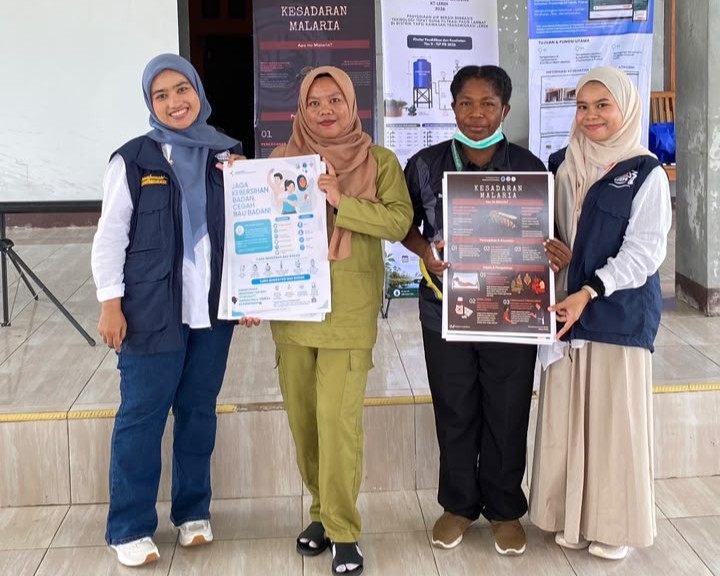
The activity also included sanitation education and an introduction to checking water pH using indicators. Health education posters were distributed for use at auxiliary health centers, while water-testing indicators were provided to support initial educational checks of water samples.
The water component tackled a concern closely linked to community health. Reliable access to clean water and appropriate sanitation can help households reduce exposure to environmental health risks. Teaching residents how to examine water characteristics can also encourage them to ask informed questions about the water they use.
However, pH testing alone cannot establish whether water is safe to drink. Water may have an acceptable pH and still contain harmful microorganisms or chemical contaminants. The activity is therefore best understood as an initial educational measure, not a substitute for comprehensive water-quality testing.
Reaching Taqwa Bangun and Kwarja
The program continued on October 17, at the village hall in Taqwa Bangun. The session involved residents from Taqwa Bangun and Kwarja, including village officials, healthcare personnel, health cadres, youth groups, and PKK members. ITB reported that the activity combined digital platform outreach with education about sanitation, water quality, and disease prevention.
Cindy Avici Hutauruk introduced participants to Lerehfarma.id and its functions, while the team explained how the information could be used to identify facilities, access health education, and submit concerns about services.
Participants also received guidance on preventing malaria, acute respiratory infections, and scabies. The sessions encouraged residents to recognize possible symptoms, understand preventive measures, and seek appropriate medical advice when necessary.
The team provided universal indicator materials for initial pH checks and handed over health education posters to local healthcare representatives. These resources are intended to help local personnel continue sharing information after the outreach activities end.
Ahmad Khairi, head of Taqwa Bangun village, welcomed the initiative and expressed hope that the activities would increase residents’ knowledge and help improve their access to health information.
Suster Ellen, representing residents of Kwarja, said the sessions had provided new knowledge about health and the use of digital technology to access service information. She also welcomed the practical education about water pH, which she considered useful for understanding water conditions in everyday life.
The October activities demonstrate how the program has expanded beyond website promotion. The team has sought to link digital access with practical skills, preventive education, and community participation.
The Challenge of Connectivity and Digital Literacy
Technology Must Work in Difficult Conditions
The digital approach faces a basic constraint: connectivity in Yapsi is inconsistent.
Muhammad Yudhistira Azis, head of the ITB team’s health cluster, told detikJabar that mobile signals can frequently weaken or disappear in the district’s hilly areas. The team itself had to rent Starlink equipment from Jakarta and move it between locations during its four-month assignment to support connectivity and training.
This experience highlights the distinction between creating a digital service and ensuring its reliable usability. Residents can’t rely on a website if they have no connection when they need information.
The team has therefore placed emphasis on direct training and community support rather than assuming that all residents already have the necessary digital skills. It has involved youth groups, PKK members, health cadres, and students, with the aim of spreading knowledge through existing community networks.
Yudhistira has also stressed the importance of preparing people to use technology effectively. His approach places human capacity alongside infrastructure: connectivity matters, but residents and local service providers must also understand how to use the information available to them.
For long-term reliability, the project will need to consider what happens when internet access fails. Residents should retain access to essential health services through conventional channels, and urgent medical concerns must not depend on a website or digital response.
Lerehfarma.id is best viewed as an additional information and communication tool that can complement, rather than replace, in-person healthcare and established emergency arrangements.
Building Local Ownership for the Future
From a University Project to a Community Resource
One of the main questions facing community-based digital projects is what happens after the field team leaves.
The ITB program is part of the wider Patriot Expedition initiative supported by the Ministry of Transmigration. DetikJabar reported that the team contributed to development in transmigration areas by working on health, education, infrastructure, and agricultural commodities.
The ITB team has sought to address sustainability by involving local health workers and residents from the outset. Training community representatives and students can create a broader group of people capable of explaining the platform and helping others use it.
The team has also discussed cooperation with Universitas Cenderawasih, including expertise in information systems, to help sustain the platform after the current assignment. Its stated plans include a trial period in November during which residents and healthcare personnel would test the system before results are reported to the program’s central organizers.
That phase will be important for identifying practical problems. The trial can help determine whether residents can access the website, whether the information is accurate, how quickly reports are handled, and whether health facilities can maintain the necessary data.
Local ownership will require clear responsibilities. Someone must take on the responsibility of maintaining the platform, updating service and medicine information, monitoring complaints, and ensuring the appropriate handling of sensitive health-related information. These are continuing tasks, not one-off training activities.
The project’s long-term contribution will depend on whether the institutions and communities involved can maintain those functions with the resources available to them.
Conclusion
The Patriot Expedition Team of ITB is bringing together digital innovation, sanitation education, and community training to address practical healthcare information challenges in Yapsi, Jayapura Regency. From the field surveys in August to village outreach activities in September and October, the program has developed in response to concerns about medicine availability, healthcare access, water quality, and digital literacy.
Lerehfarma.id offers a potentially useful channel for finding service information, checking reported medicine availability, accessing educational material, and submitting complaints. Its value, however, will depend on reliable data, responsive healthcare providers, and internet access that allows residents to use it when needed.
The sanitation component is equally important. Teaching residents about disease prevention, the properties of water, and household filtration can raise awareness, as long as educational checks are not confused with final tests of drinking-water safety.
The next stage should focus on implementation and evaluation. The planned trial, local partnerships, and continued involvement of health cadres and village representatives will help determine whether the platform can be maintained and whether it makes access to information more efficient.
For Indonesia’s broader development agenda, the Yapsi initiative offers a useful lesson: digital transformation in remote areas cannot be measured by the launch of a website alone. It must be assessed by whether people can use the service, whether local institutions respond, and whether the technology complements improvements in healthcare delivery.
In Yapsi, the ambition is not simply to bring a digital platform to Papua. It is to help residents become better informed, strengthen communication with healthcare providers, and build the local capacity needed to sustain those gains. The project’s lasting success will depend on how effectively that ambition is translated into everyday practice.
Read Also
Papua Barat Trains 30 Village Peace Mediators
Papua Tengah Trains 40 Health Workers in Primary Care

