
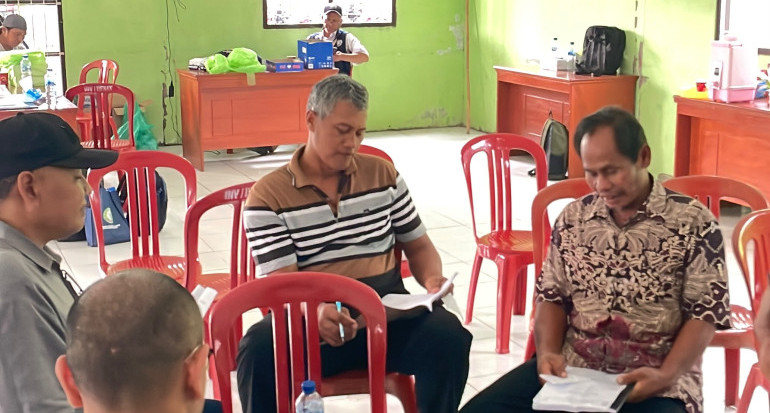
Land disputes can remain unresolved for years when residents lack a trusted forum to discuss competing claims. In Papua Barat (West Papua), a new community-based initiative is seeking to address that problem by equipping village officials with practical mediation skills. Thirty village leaders, administrative officials, and members of village consultative bodies have received training to help them facilitate peaceful discussions over land disputes in the Prafi District of Manokwari Regency.
Organized by the Patriot Expedition Team (Tim Ekspedisi Patriot, or TEP), affiliated with Universitas Airlangga (UNAIR), the two-day programme took place on October 9 and 10, 2026, in Desay Village, SP 2, Prafi District. The initiative was conducted in cooperation with the Papua Barat Regional Office of the National Land Agency (BPN) and the Manokwari Regency Office of Manpower and Transmigration.
The training reflects a practical understanding of local development: economic opportunities are harder to sustain when land ownership, boundaries, and competing claims remain uncertain. By strengthening the ability of village officials to facilitate dialogue, document complaints, and refer complex cases to the relevant authorities, the program seeks to establish a more orderly first step towards resolving disputes.
The initiative does not assume that every land conflict can be settled at the village level. Instead, it aims to help communities distinguish disputes that may be addressed through dialogue from cases requiring formal examination by land authorities or other competent institutions.
Why Land Mediation Matters in Prafi
Addressing Disputes Before They Escalate
The program followed findings from TEP’s earlier fieldwork in the transmigration area. According to the team, its observations in 2025 indicated that land disputes could become more difficult to manage because villages lacked both established forums and sufficient capacity to mediate disagreements. Unresolved disputes could also delay land administration and planning.
For farmers, land is more than a physical asset. It is the basis of agricultural production, household income, and long-term investment. Questions about boundaries, land certificates, or overlapping claims can therefore affect not only the parties directly involved but also the wider community.
In areas where agricultural activities and local businesses depend on secure access to land, unresolved disputes may discourage investment or delay efforts to improve productivity. Uncertainty can also complicate planning for farms, community facilities, and other local development initiatives.
Prafi’s experience illustrates why dispute prevention needs to be part of local development planning. Administrative procedures and legal documents remain essential, but communities also need accessible ways to communicate concerns before disagreements become entrenched.
Village officials are particularly well placed to contribute because they are close to residents and often become aware of emerging problems before they reach higher levels of government. With appropriate training, they can help create a structured environment in which parties explain their positions, review available information, and consider possible solutions without intimidation or pressure.
That role must nevertheless be clearly defined. Village officials are not automatically empowered to determine legal ownership or replace the National Land Agency, courts, or other authorities. Their contribution is to facilitate communication, maintain records, and direct cases to the appropriate institution when necessary.
Connecting Land Certainty with Economic Development
The training also reflects the relationship between orderly land administration and economic development in transmigration areas.
The TEP team argued that village economic institutions and local enterprises are more likely to develop when land status is clear and communities have reliable ways to manage disagreements peacefully. The program is consistent with the broader policy direction of the Ministry of Transmigration, which places legal certainty over land among the considerations for preparing transmigration areas for further development.
The relationship is straightforward. Farmers need to understand which land they can cultivate and what rights apply to it. Businesses need predictable conditions before committing resources. Local administrations need reliable information when planning infrastructure and public facilities.
However, mediation is only one component of this process. It cannot replace accurate land records, transparent administrative procedures, legal review, or enforcement of valid decisions. Its value lies in helping parties communicate and, where possible, reach an agreement without unnecessary escalation.
By building mediation capacity at the village level, the program seeks to make local institutions more responsive while maintaining links to formal land administration.
How the Two-Day Training Was Conducted
Day one: Understanding Land Law and Administrative Procedures
The first day focused on the legal and administrative foundations of land management. Representatives of the National Land Agency explained land certification procedures, problems involving overlapping or duplicate ownership certificates for the same parcel, and questions concerning customary land, known in Indonesia as tanah ulayat, where it intersects with transmigration areas.
These subjects are important because land disputes can involve different types of claims and documentation. Some may concern uncertainty over boundaries, while others may involve competing certificates or questions about the relationship between customary land rights and formally administered land.
For village officials, understanding these distinctions helps establish the limits of their role. A mediator may assist parties in explaining their claims and identifying relevant documents but should not declare a contested certificate invalid or decide a question of legal ownership beyond their authority.
The training therefore emphasized the need to understand applicable rules and refer cases to the competent authorities when required. Such an approach can help reduce misunderstandings and prevent informal mediation from being mistaken for a legally binding determination of land rights.
The Manokwari Regency Office of Manpower and Transmigration also presented information about spatial planning within the transmigration area, including Lahan Usaha I and Lahan Usaha II, as well as public and social facilities.
This part of the program connected land disputes with the broader organization of settlements and economic activity. When residents understand how land is allocated and what administrative arrangements apply, local officials have a stronger basis for explaining procedures and directing questions to the right institutions.
The prevention message was equally important. Better communication between transmigrant residents and established local communities can help clarify expectations and identify potential disagreements before they become more serious.
Day two: Practicing Impartial Mediation
After the first day’s legal and administrative sessions, participants moved to practical exercises on the second day. They learned about non-litigation mediation, which seeks to resolve disputes through facilitated discussion outside formal court proceedings, and about the ethical responsibilities of a neutral mediator.
Participants were then divided into groups to simulate the handling of land-dispute complaints through role-playing exercises.
The simulations recreated situations in which a complainant and another party might hold conflicting positions. Participants practiced receiving complaints, listening to competing accounts, and managing conversations in which emotions could run high.
The exercise reportedly remained lively despite heavy rain outside the venue. Some participants playing complainants portrayed anger and frustration convincingly, raising their voices as they presented their cases. According to the report, the scenarios demonstrated why mediators need patience, attentive listening, and neutrality rather than an instinct to decide immediately which party is right.
That practical component is significant. Land disputes often involve years of accumulated frustration, family interests, livelihood concerns, or different interpretations of documents and boundaries. A mediator who appears to favor one side can undermine confidence in the process before a meaningful discussion begins.
Role-playing allows participants to practice responding to difficult conversations in a controlled environment. It also helps reveal the difference between listening to a claim and accepting it as proven.
The objective is not to guarantee that every disagreement will end in a settlement. Rather, it is to equip village officials with a more structured way to receive complaints, maintain a calm discussion, and identify the next appropriate step.
A Standardized System for Recording and Referring Disputes
Developing a Village Mediation Administration Kit
One of the program’s practical outcomes is a plan to develop a standardized mediation administration kit in cooperation with the participating villages.
According to the report, the proposed kit will include a pocket guide to land mediation, a complaints register, and four types of official minutes or records, identified as BA-MD 1 through BA-MD 4. The forms are intended to be adapted to the circumstances of SP 1 and SP 2 in Prafi.
The planned system is designed to make the handling of complaints more consistent. Rather than relying solely on verbal exchanges or informal recollections, village officials would have a defined process for receiving, recording, and following up on disputes.
Under the proposed approach, the village hall would serve as the first place where residents could meet and attempt to resolve disagreements through discussion. If the parties reach a mutually acceptable settlement, the agreement would be recorded in a formal agreement report.
Documentation matters because it helps clarify what was discussed and what the parties agreed to do. It can also provide a record for subsequent follow-up, reducing the risk that the terms of a settlement will be misunderstood or disputed later.
The process must, however, protect the rights of everyone involved. Participation should not be coerced, and an agreement should not be treated as evidence of a valid transfer of land ownership unless the relevant legal requirements have been met. Clear records and proper referrals are essential safeguards.
Knowing When to Refer a Case
Not every land dispute can be resolved through village-level dialogue. The program specifically recognizes that complicated cases, including overlapping certificates or extensive claims involving customary land, may require further examination by the National Land Agency and the Manokwari Regency Office of Manpower and Transmigration.
In such circumstances, the proposed system would allow village officials to issue a referral record so that the matter can be taken to the relevant authorities.
This distinction is crucial. Mediation can help clarify issues, reduce hostility, and identify areas of agreement, but it cannot substitute for legal processes where ownership, certification, or other formal rights are contested.
A reliable referral mechanism can also prevent village officials from carrying responsibility for decisions beyond their expertise or legal authority. Instead of allowing difficult cases to remain unresolved through repeated informal meetings, they can document the dispute and direct it to the institution equipped to examine it.
The TEP team has acknowledged that the administrative kit is not yet complete and will need to be developed with village governments so that it reflects actual conditions in SP 1 and SP 2. The training is therefore an initial step rather than a finished dispute-resolution system.
Its long-term usefulness will depend on whether the proposed forms are finalized, adopted by village administrations, and used consistently after the team has completed its assignment.
Cooperation Between Universities, Government, and Communities
A Field-Based Approach to Local Development
The initiative demonstrates how university-led field programs can support local governance when they work alongside government agencies and village institutions.
Universitas Airlangga’s Patriot Expedition Team is involved in wider community assistance in the Prafi transmigration area. Other initiatives associated with the university have included support for local economic development and digital marketing, illustrating the broader effort to strengthen community capacity in the area.
The land-mediation program addresses a different but related aspect of development: the institutional capacity needed to manage local problems. Economic assistance may help residents improve production or reach new markets, but those opportunities can be undermined if disputes over land remain unresolved.
By involving the National Land Agency and the Manokwari Regency Office of Manpower and Transmigration, the mediation training connects community-level dialogue with government institutions responsible for land administration and transmigration planning.
That coordination is especially important when disputes involve more than one set of records, competing interpretations of land status or questions requiring formal administrative review.
For local communities, the objective should be an accessible process that respects both legal certainty and the legitimate interests of those involved. For government, it offers an opportunity to improve early complaint handling while ensuring that complex matters reach the proper authorities.
Respecting Customary Rights and Community Relationships
The inclusion of tanah ulayat in the training is particularly relevant in Papua, where customary land relationships can be central to community identity, livelihoods, and social organization.
Customary land questions may involve collective interests, historical relationships with territory, and procedures for representing a community. They should not be reduced to a simple administrative disagreement without careful attention to the circumstances and applicable law.
The workshop’s emphasis on understanding customary land issues alongside certification and transmigration planning provides a starting point for more informed discussion. It does not mean that training alone resolves the legal or social complexities of every case.
Effective mediation requires impartiality, meaningful participation, and respect for the applicable legal framework. Where a claim cannot be resolved through discussion, the parties must retain access to the relevant administrative or legal procedures.
This is also important for relations between transmigrant residents and established local communities. Early communication can help clarify expectations and reduce the risk that misunderstandings develop into wider disputes. Yet lasting confidence depends on whether all parties believe that procedures are fair and that their concerns are taken seriously.
What Comes Next for Prafi?
The immediate priority is to turn the training into a functioning village-level system. The proposed administration kit must be completed, village officials need to agree on how it will be used, and referral arrangements with the relevant government agencies must be clear.
The next stage should also establish how complaints will be monitored, how agreements will be followed up, and how cases requiring formal review will be tracked. These measures would help distinguish between disputes that have been discussed, disputes settled by agreement, and disputes that remain subject to administrative or legal processes.
The program’s success should not be judged solely by the number of people trained. More meaningful indicators would include whether villages use the standardized records, whether complaints are referred appropriately, whether parties can participate without pressure, and whether disputes are managed more transparently.
Continued technical support may also be necessary. Village officials will encounter cases that differ from the scenarios used during training, and they may need guidance when confronted with complicated documents or competing claims.
The initiative offers a promising starting point because it recognizes that peace and development depend partly on the capacity of local institutions to handle disagreements before they become entrenched. Its lasting value, however, will be determined by the quality of implementation and the confidence residents place in the process.
Conclusion
The training of 30 village officials in Prafi represents a practical effort to strengthen local capacity for peaceful land-dispute resolution. Through cooperation between the Patriot Expedition Team of Universitas Airlangga, the Papua Barat National Land Agency, and the Manokwari Regency Office of Manpower and Transmigration, the program combines legal awareness, mediation practice, and plans for standardized complaint records.
Its most important contribution is the recognition that village officials need both the skills to facilitate dialogue and clear procedures for knowing when a case must be referred elsewhere. That balance can help communities address disagreements more systematically without replacing the formal institutions responsible for land administration and legal decisions.
The next challenge is implementation. The proposed mediation kit must be completed and adopted, village officials need continued support, and government agencies must remain accessible when disputes exceed village-level authority.
If these steps are sustained, the initiative could help make local dispute handling more orderly and transparent while supporting the conditions needed for agriculture, local enterprise, and community development in Prafi. It cannot guarantee that all land conflicts will be resolved, but it offers a constructive way to begin addressing them.
For Papua Barat, development is not only a question of infrastructure or investment. It also depends on the ability of communities and public institutions to manage differences fairly, protect legitimate rights, and maintain channels for peaceful dialogue. Building that capacity at the village level is a modest but meaningful contribution to a more stable foundation for local progress.
Read Also
Papua Tengah Names Eight Tribal Leaders as Peace Partners
Agrarian Reform Bill Seeks to Protect Indigenous Papuan Land Rights
TNI’s Commitment to Stability and Peace in Papua

