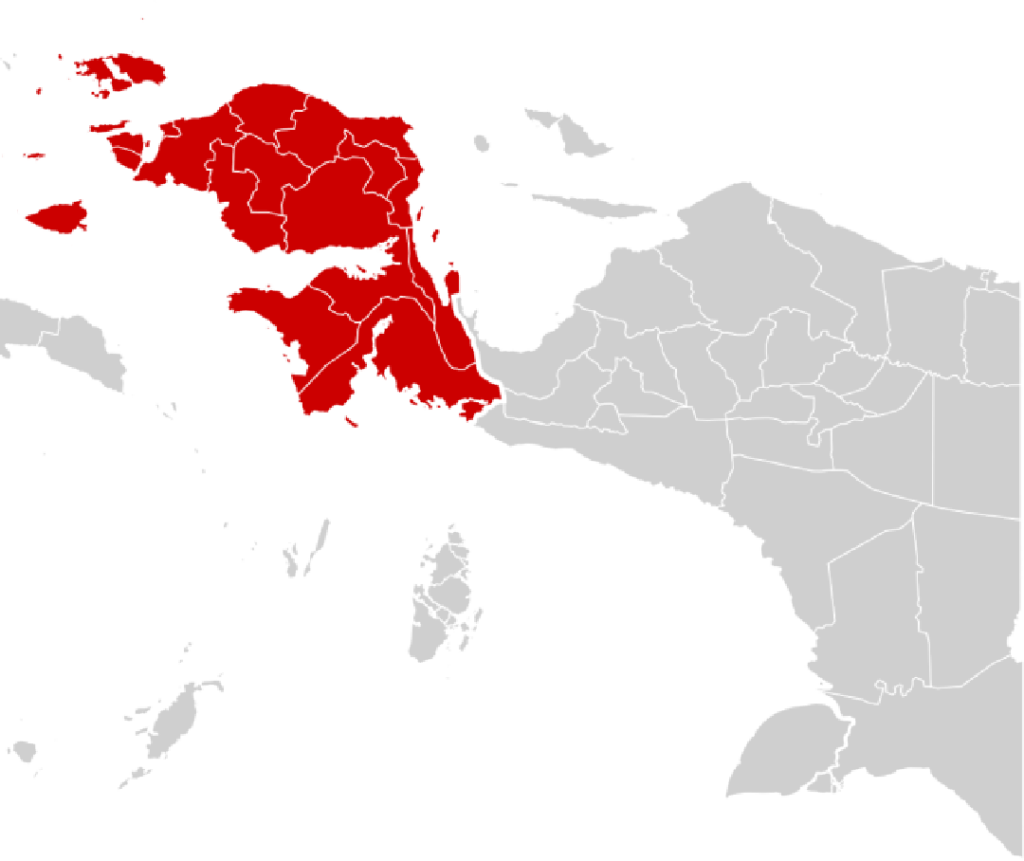
The Papua Tengah’s (Central Papua) conflict prevention strategy is taking a distinctly local turn. Instead of relying solely on government institutions, the provincial administration is placing eight major tribal leaders at the centre of efforts to maintain social harmony, protect customary land and ensure that community grievances reach officials before they escalate.
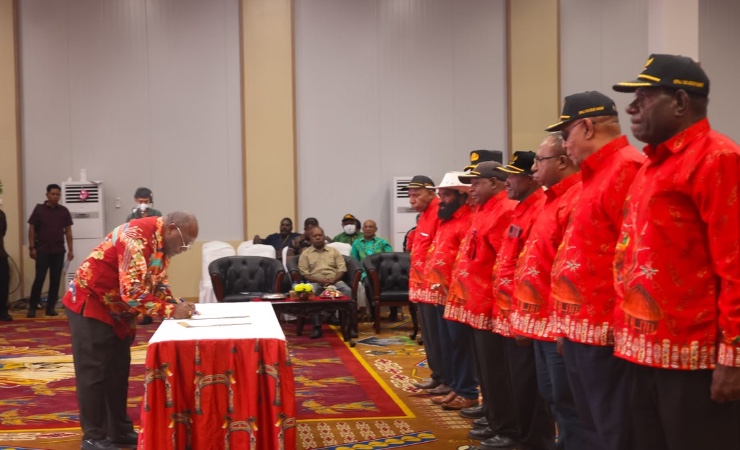
The initiative took shape in Nabire on September 18, 2026, when Papua Tengah Governor Meki Nawipa formally recognised eight major tribal leaders as government partners. The gathering at the Ballroom of the Papua Tengah Governor’s Office was not presented as the government appointing traditional leaders. Rather, officials described it as recognition of existing customary leadership and the creation of a stronger channel between Indigenous communities and the provincial administration.
The eight groups identified by ANTARA and Papua Bangkit are the Mee, Moni, Wolani, Lani, Wate, Damal, Amungme and Kamoro. The Papua Tengah’s National and Political Unity Agency (Kesbangpol) chief Albertus Adii stressed that the government was not taking over customary authority or selecting the tribal leaders. The leaders and their deputies would remain outside the provincial bureaucracy and instead serve as partners in communication, mediation, social problem detection and early conflict prevention.
For Nawipa, the significance goes beyond a ceremony.
He wants traditional leaders to become the first bridge when disputes emerge, allowing problems involving land, social relations, development or community interests to be discussed before they become larger conflicts.
A Different Way to Address Social Conflict
The decision comes as Papua Tengah continues to manage a complicated mixture of social, customary and development issues.
Nawipa argued that problems emerging at the community level should be communicated quickly to the government rather than being allowed to develop into larger disputes. He also called on tribal leaders to communicate with one another and with other community figures to preserve unity and public order.
That approach gives customary institutions a preventive role.
Rather than waiting until a dispute has become a confrontation, the provincial government wants tribal leaders to identify tensions earlier and encourage dialogue.
This is particularly relevant in disputes involving customary territory, where questions of land ownership and access can carry social significance beyond the immediate parties.
ANTARA reported that Nawipa expects tribal leaders to help address issues ranging from customary land and education to health, employment and economic empowerment. They are also expected to advise the government on development programs and the implementation of Papua’s Special Autonomy framework.
The idea is therefore broader than conflict mediation.
The provincial government is attempting to connect customary leadership with development policy.
The Meeting in Nabire
The process formally unfolded on Friday, September 18, at the provincial government complex in Nabire.
The event was titled around the recognition of tribal leaders and their deputies as government partners in creating a Papua Tengah that is safe, peaceful and orderly. CEPOS reported that Nawipa used the occasion to explain the responsibilities he expects the leaders to carry.
One of the most important responsibilities is representation.
Nawipa said communities should not always have to express their concerns through street demonstrations. Tribal leaders, he argued, can provide a recognised channel through which communities can bring their concerns to the provincial government or the legislature.
He suggested that tribal leaders could formally write to the DPR to request meetings, allowing residents to explain their needs and grievances through institutional forums.
The proposal creates a more structured pathway for community participation.
For instance, customary leaders could initially discuss a land dispute. If the matter requires government intervention, the tribal leader could communicate the issue to provincial officials or lawmakers.
The objective is not to prevent criticism or disagreement. Rather, it is to create a channel through which disagreement can be managed before it becomes destructive.
Why Neutrality Matters
Nawipa placed particular emphasis on neutrality.
When disputes involve different ethnic or tribal groups, he said tribal leaders should not automatically defend members of their group.
Instead, they should meet with other leaders and work toward a resolution.
“Jangan sampai kepala suku Mee dengan Dani ada konflik. Mee pertahankan Mee, Dani pertahankan Dani. Tidak bisa,” Nawipa said, according to CEPOS. He urged leaders to meet and resolve problems rather than allowing tribal identity to determine their response.
The principle is important because customary leadership carries social authority.
A tribal leader who is perceived as taking sides may deepen an existing dispute. A leader who is accepted as neutral may have greater room to bring the parties together.
Nawipa described his experience as a former Paniai regent, recalling efforts to conduct what he called “normalisation” to prevent conflict between community groups. He linked that experience to his current expectation that tribal leaders should help maintain unity and public order.
The government’s strategy therefore relies partly on social legitimacy rather than administrative authority.
The Kapiraya Dispute Becomes an Early Test
The dispute in Kapiraya District, Deiyai Regency, serves as one of the most immediate examples of the role envisaged for tribal leaders.
Kamoro tribal chief Yance Yohanis Boyau said he was prepared to bring Kamoro and Mee communities together to address a customary land boundary dispute in Kapiraya.
Yance said he wanted to pursue a customary and dialogue-based settlement and set October 2026 as his target for resolving the issue.
The dispute concerns the boundary of customary land involving the Kamoro and Mee communities in Kapiraya.
Yance described the current dispute as something that had not historically been a major problem between the two communities. He said traditional arrangements had previously allowed people to use land or natural resources while respecting customary authority and seeking permission.
He argued that customary leaders should be involved early because local communities understand and respond to customary mechanisms.
The Kapiraya case could therefore provide an early practical test of the partnership announced in Nabire.
If the two communities can reach an agreement through dialogue and customary processes, it would demonstrate how traditional institutions can complement government conflict-prevention efforts.
At the same time, the October target remains a stated objective rather than a completed settlement. The outcome will depend on the willingness of the communities involved and the ability of customary leaders to maintain dialogue.
Protecting Customary Land
Land protection was another major theme in Nawipa’s message.
The governor warned about the long-term implications of uncontrolled transfers of customary land, particularly around Nabire. CEPOS reported that he was concerned that Indigenous communities could eventually lose access to land if decisions were made without considering future generations.
He raised the possibility of communal certification as one way to strengthen collective customary ownership.
Nawipa cited Intan Jaya as an example where communal certification could potentially provide a stronger basis for protecting customary interests. He also discussed the possibility that people holding customary rights could have a recognised stake when outsiders enter an area.
The proposal reflects a broader issue in Papua: land is not simply an economic asset.
Many Indigenous communities connect their identity, family history, livelihoods, and social organisation to their customary territories.
That makes land disputes particularly sensitive.
A policy that ignores those dimensions can produce mistrust even when the underlying development objective is economic.
By involving tribal leaders, the Papua Tengah administration is attempting to incorporate customary perspectives into the development process before disputes become more difficult to resolve.
From Conflict Prevention to Development
The partnership also has an economic dimension.
ANTARA reported that Nawipa expects tribal leaders to provide input on economic empowerment for Indigenous Papuans, education, healthcare, employment, customary land and natural resource management.
This reflects the provincial government’s effort to connect conflict prevention with development.
A community that feels excluded from economic opportunities may express its concerns through social pressure. A community that sees development taking place without adequate consultation may raise questions about land and resource ownership.
By creating a communication channel through traditional leaders, the government hopes to address those concerns earlier.
The approach also connects to Special Autonomy, or Otsus.
Nawipa told CEPOS that the strengthening of customary leadership should remain within the framework of Special Autonomy, particularly regarding protection and affirmative policies for Indigenous Papuans.
The message is that customary participation should not exist separately from government policy. Instead, it should form part of the wider institutional framework governing development in Papua.
Young People Are Part of the Strategy
Nawipa also sees tribal leaders as having a role in communicating with younger generations.
He argued that formal advice alone cannot always reach young people. CEPOS reported that he suggested creating spaces where young people and community leaders could meet, eat together and talk informally.
It is a small but significant detail.
Conflict prevention does not always begin with a formal mediation meeting. It can begin through relationships.
For communities where social ties remain important, regular interaction between elders and younger people can provide an opportunity to discuss local concerns before rumours or grievances become entrenched.
Nawipa’s approach therefore assigns tribal leaders a role that extends beyond traditional dispute settlement.
They are expected to help maintain communication between generations and reinforce customary values while also connecting those values to contemporary government programmes.
Government Recognition Without Taking Over Customary Authority
Albertus Adii, head of Kesbangpol Papua Tengah, stressed that the government’s recognition should not be confused with the appointment of tribal leaders.
This distinction is central to the programme.
According to ANTARA, the government recognised the results of customary processes rather than selecting the leaders themselves. The tribal leaders and deputy tribal leaders are not structural government officials or civil servants.
Their proposed functions include communication, aspiration delivery, mediation, social problem identification and early conflict prevention.
That arrangement allows the government to engage with traditional institutions without formally converting them into government bureaucracies.
It also acknowledges that customary leadership has its own mechanisms and authority.
The model could be particularly relevant in areas where formal institutions and customary institutions operate alongside each other.
For the provincial administration, the challenge will be ensuring that the new partnership remains genuinely consultative rather than becoming merely symbolic.
Building a Formal Channel for Community Aspirations
The government wants the eight tribal leaders to create a direct communication route between communities and policymakers.
Nawipa described the leaders as a channel through which questions about customary rights, development priorities and community needs can reach government.
This could become especially important as Papua Tengah develops its infrastructure and economic programmes.
Development projects frequently involve land, employment, environmental concerns and access to resources. Each issue can affect different communities in various ways.
Involving tribal leaders early may help the government gain a clearer understanding of local concerns before finalising decisions.
For communities, the arrangement could provide a recognised route for presenting grievances and proposals without immediately resorting to confrontation.
The effectiveness of the model, however, will depend on how consistently government agencies respond to the information brought forward.
A communication channel only becomes meaningful if the other side listens.
A Broader Model of Social Stability
The Papua Tengah initiative reflects an understanding that social stability cannot be created solely through security measures.
Police and other government institutions retain their formal responsibilities, but customary leaders can play a different role based on community relationships and social legitimacy.
That does not mean customary mechanisms replace Indonesian law.
ANTARA reported that Nawipa expects leaders to address disputes through customary mechanisms while also respecting the law.
The two systems can therefore operate alongside one another.
Customary dialogue may help bring communities together. Formal institutions can provide legal authority when required.
The combination creates a broader conflict-prevention framework.
For Papua Tengah, the framework may be particularly relevant because disputes can involve not only individual interests but also collective identities and customary territories.
An Opportunity for Indigenous Participation
At the centre of the programme is a simple proposition: development policy should include the people most directly affected by it.
Nawipa has asked tribal leaders to advise the government on Indigenous economic empowerment, education, health, employment, land and natural resources.
This gives traditional leaders a role in development planning as well as social stability.
It also creates an opportunity for the provincial government to obtain information from communities that may not always reach formal administrative structures.
The initiative therefore sits at the intersection of culture, governance and security.
Its success will depend less on the ceremony itself than on what happens afterward.
Will tribal leaders meet regularly? Will disputes be reported early? Will government agencies respond? Will customary processes be respected? And can the leaders maintain neutrality when disputes involve their communities?
Those questions will determine whether the new partnership becomes an effective institution of conflict prevention.
The Road Ahead
The recognition gives Papua Tengah a new framework for engaging traditional leadership.
Eight major tribal groups have been recognised as partners, while the provincial government has outlined expectations covering conflict prevention, customary land, public aspirations, development, youth engagement and Indigenous welfare.
The Kapiraya dispute provides an immediate example of how that framework could be tested, with Kamoro leader Yance Boyau targeting October for a customary resolution involving Kamoro and Mee communities.
The case will be watched closely because it illustrates the central principle behind the new arrangement: local problems may require local voices to help resolve them.
At the same time, government recognition alone cannot guarantee peace.
Trust must be built through repeated communication. Customary authority must be respected. Government institutions must respond to community concerns. And tribal leaders must maintain the neutrality Nawipa has demanded.
Conclusion
Papua Tengah’s decision to recognise eight major tribal leaders as government partners represents an effort to place customary leadership closer to the centre of regional governance.
Governor Meki Nawipa has given the leaders a broad mandate: protect customary identity, communicate community aspirations, help prevent disputes, safeguard customary land, advise on development policy and encourage younger generations to remain connected to community values.
The government has also made an important institutional distinction. The eight leaders are not government officials, and their recognition does not mean the provincial administration has taken control of customary leadership. They are intended to serve as partners and communication bridges.
That distinction could prove important for the credibility of the initiative.
If the partnership develops into regular consultation and effective mediation, Papua Tengah could strengthen its capacity to identify social tensions before they become larger conflicts. The Kapiraya dispute may become an early measure of whether that ambition can translate into results.
For a young province facing complex questions of land, development, identity and social cohesion, the strategy offers a practical lesson: peace is not built only inside government offices.
Occasionally, it begins with leaders who can speak to their communities, listen to competing concerns and bring people back to the same table.
Read Also
Papua Peace Dialogue Puts Religious Harmony First
UIN Jakarta Graduates Call for Peace in Papua
Jusuf Kalla Urges Dialogue for Peace in Papua