
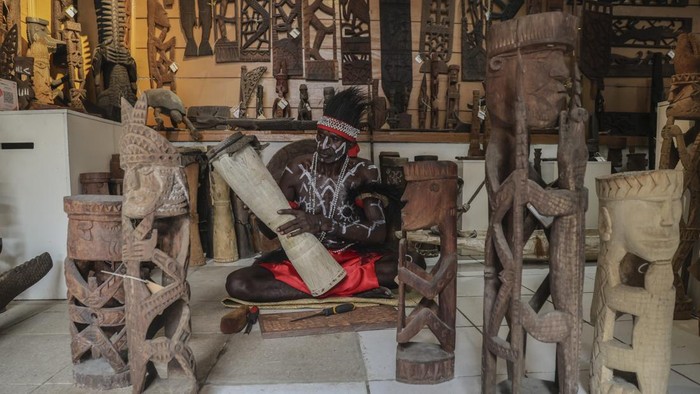
A piece of wood can carry an entire history. In the hands of a Kamoro artisan, its surface gradually reveals human figures, animals, and intricate patterns inspired by the natural world. What emerges is more than a decorative object. It is a cultural expression shaped by ancestral knowledge, customary values, and the relationship between the Kamoro people and their environment.
The beauty of Kamoro carving in Papua Tengah (Central Papua) is increasingly attracting attention beyond its place of origin. In Nawaripi Village, Mimika Regency, artisans such as Yanuarius Waneni and Simson Samin continue to work with wood at the Maramowe Foundation, where traditional craftsmanship is being preserved and developed for wider audiences.
Photographs published by ANTARA Foto on November 3, 2026, documented the two artisans working on wooden crafts at the foundation. Supported by PT Freeport Indonesia, the organization assists Kamoro artists in maintaining their carving traditions and developing locally produced cultural artworks. According to the agency’s report, the works are marketed at prices ranging from Rp200,000 to Rp25 million and have reached buyers in different parts of Indonesia and overseas.
The growing interest offers an opportunity for Kamoro artists to turn cultural knowledge into sustainable economic activity without losing the meaning behind their work. It also highlights the importance of preserving traditional craftsmanship as part of Indonesia’s wider cultural heritage.
An Art Form Rooted in the Southern Coast of Papua
The Kamoro people, also known as Mimika Wee, inhabit the southern coastal region of Papua, particularly the area surrounding Mimika. Their traditional territory stretches along approximately 250 kilometers of coastline, from the Otakwa River in the east to Potowaiburu in the west.
The environment has played an important role in shaping their artistic imagination. Rivers, mangrove forests, coastal ecosystems, and the animals that inhabit them provide recurring sources of inspiration for Kamoro artisans.
Unlike some other Papuan carving traditions, Kamoro works often feature more abstract forms. Their designs may appear simple at first glance, but the patterns and figures carry cultural associations that cannot always be understood through appearance alone.
Wooden sculptures, shields, ceremonial staffs, drums, and ancestral figures are among the objects associated with the tradition. Some were historically created for customary ceremonies, while others served practical purposes in everyday community life.
The official Indonesia Travel portal describes Kamoro carving as one of the surviving coastal woodcarving traditions of Papua, alongside the artistic traditions of the Asmat and Sempan communities.
Its significance lies not only in the skill required to shape wood but also in the cultural knowledge that determines how particular objects are made, interpreted, and used.
Mbitoro: The Ancestral Foundation of Kamoro Carving
Among the most recognized forms of Kamoro carving is mbitoro, a carved wooden ancestral pole regarded as a fundamental form of the tradition.
Mbitoro is usually made from mangrove trunks and roots and has human figures carved into the wood. The work is associated with remembrance and respect for deceased members of the community. It may be placed in front of a traditional house or used in connection with the customary karapau ceremony.
For the Kamoro, such a sculpture is not simply an artistic representation of a person. It can carry a more profound relationship with ancestors and the spiritual world.
Other forms include ote kapa, a carved ceremonial staff decorated with symbolic elements, and pekaro, an elongated wooden plate traditionally used for serving food. Yamate, a carved board or shield, is another important form that has been associated with customary ceremonies and protection.
Each type has its shape, function, and cultural context. Some motifs are connected to family or clan identity, while others refer to particular elements of the natural environment or customary beliefs.
The meanings are not necessarily interchangeable. Certain patterns and forms are connected to customary rights and inherited knowledge, meaning that the authority to reproduce them may depend on family lineage and community traditions.
This is one reason why Kamoro carving cannot be understood solely as a commercial handicraft. Its cultural value is closely connected to the people who hold the knowledge and responsibility to preserve it.
The Distinctive Beauty of Crocodile-Scale Motifs
One feature frequently associated with Kamoro woodcarving is the crocodile-scale motif.
In a 2021 report published by Langit7, Herman Kiripi, chairman of the Maramowe Foundation, identified the crocodile-scale pattern as a distinctive feature of wooden sculptures produced at the foundation.
The motif provides the carved surface a recognizable texture and demonstrates the precision required from the artisan. Repeated patterns must be shaped carefully, particularly when the work is made from a solid piece of wood.
The same report explained that Kamoro sculptures are traditionally produced by Kamoro artisans. Their craftsmanship is therefore closely connected to cultural identity and the transmission of knowledge within the community.
Herman said that producing a sculpture could take between one and three days, depending on its dimensions and complexity.
He explained that the artisan works from a solid piece of wood, carving and removing the interior material to create the intended form. The process requires patience and careful attention rather than speed.
At the Maramowe Foundation, the work was being undertaken by Kamoro artisans who were also receiving support to improve the quality of their products.
The distinctive patterns, together with the cultural meanings attached to particular forms, help distinguish Kamoro carving from other woodcraft traditions.
Timotius Samin: A Lifetime Dedicated to Preserving Tradition
The story of Kamoro carving is closely connected to the dedication of individual artisans who have spent decades keeping the tradition alive.
One of them is Timotius Samin, a respected Kamoro carver whose work and cultural advocacy have helped introduce the tradition to audiences beyond Mimika.
In a detailed interview published by Timika eXpress on September 25, 2026, the newspaper visited Timotius at his home in Kampung Iwaka, Mimika. At 77, he reflected on a lifetime spent promoting and protecting the carving heritage inherited from his ancestors.
For Timotius, tradition cannot be separated from lineage and customary rights. “Kamore carvings are the inheritance and rights held by someone who has a carving lineage from their ancestors, and these rights cannot be taken away. My work, inherited from my ancestors, will continue to be carried on,” he said, explaining that inherited carving rights should be respected rather than taken from their rightful holders.
His commitment to promoting Kamoro art began in 1991, when he was still serving as village head in Kiyura, Kokonao, in West Mimika District.
That year, he read a newspaper report about Asmat artists travelling to the United States to introduce their culture and woodcarving tradition. The story prompted him to consider why Kamoro artists could not also bring their own cultural heritage to a wider audience.
“Kenapa dorang (mereka) bisa, orang Kamoro juga harus bisa karena punya budaya,” he recalled.
The thought would eventually influence the direction of his life.
The Turning Point in 1993
An important opportunity emerged in 1993, when then Minister of Education and Culture Wardiman Djojonegoro visited Timika.
During that period, PT Freeport Indonesia was appointed as a supporting partner for the development of the Kamoro community, including efforts to strengthen its traditional carving practices.
Timotius recalled working with representatives of the company to bring wooden panels from Kokonao for carving. The project involved residents from four villages: Kiyura, Mimika, Migiwiya, and Kokonao.
The panels measured approximately 40 centimeters wide, four centimeters thick, and four meters long. They were transported from Kokonao by helicopter before being decorated with traditional Kamoro ornaments.
Two respected elders, Yakob Nawiyuta and Yohanis Waniyau, encouraged Timotius after seeing his early work, including a sacred Bitoro sculpture.
The experience strengthened his determination to dedicate more time to cultural preservation. In the same year, he stepped away from his village leadership responsibilities and became increasingly involved in artistic and cultural activities.
He later participated in exhibitions at the Sheraton Hotel in Timika, now known as Rimba Papua Hotel, and worked with other Kamoro artists through the Sanggar Budaya Kamoro in Timika Indah.
Kamoro Art Finds a Place in Kuala Kencana
Another significant stage in Timotius’s career came in 1995, when he and fellow artisans contributed sculptures and carved panels to the Kuala Kencana area, which is associated with PT Freeport Indonesia.
The area was officially inaugurated by President Soeharto on December 5, 1995.
Large wooden sculptures, some measuring between three and five meters, were installed along the area from Check Point 32 to its central roundabout. Carved panels were also incorporated into office buildings, including the company’s main office building.
Timotius said that he and his fellow artisans were responsible for producing the sculptures and decorative panels.
The works were made primarily from ironwood sourced from the surrounding area. Their scale and placement created a visible connection between the modern built environment and the cultural identity of the Kamoro community.
The sculptures were not merely decorative additions. They brought traditional artistic expressions into a public setting where visitors, workers, and residents could encounter them.
This collaboration also demonstrated how cultural heritage could become part of the visual identity of a developing urban area.
From Mimika to International Exhibitions
Timotius’s work gradually reached audiences beyond Indonesia.
In 2003, he and a group of traditional artists were invited to participate in a special exhibition at the Museum Volkenkunde in Leiden, the Netherlands. The museum holds a collection of Kamoro woodcarvings, including ancestral figures, human sculptures, masks, drums, boats, and paddles.
The exhibition gave the artists an opportunity to present their cultural heritage while encountering objects from their tradition that had been preserved in a museum far from their homeland.
His international activities continued in the years that followed.
In 2007, Timotius promoted Kamoro carving in Bulgaria. He took part in an exhibition at a gallery owned by Mr. Werner in Germany in 2010. He returned to the Netherlands in 2014 for a cultural exhibition at Dam Square in Amsterdam and later brought Kamoro works to Geneva, Switzerland, in 2018.
In 2020, he participated in an exhibition in Canberra, Australia, in connection with the anniversary of the Indonesian National Police.
These events helped introduce the distinctive visual language of Kamoro carving to international audiences.
Timotius said that hundreds of sculptures had been sold during exhibitions, but he did not consider financial value the most important measure of success.
“Yang penting karya ukir Suku Kamoro bisa dipromosi sampai ke luar negeri,” he said, explaining that promoting Kamoro art internationally mattered more to him than the money earned from individual sales.
His experience illustrates how traditional artists can become cultural ambassadors, bringing local stories and artistic knowledge into international spaces.
Maramowe Foundation Supports the Next Generation
The preservation of Kamoro carving has also become more organized through the work of the Maramowe Foundation.
The foundation, established on September 9, 2014, provides a platform for artists to continue developing their skills, producing traditional works and accessing broader markets.
Its activities build on earlier efforts to revive interest in Kamoro carving during the 1990s. The foundation has worked with artists and artisans from different villages in Mimika, helping them maintain their craftsmanship while adapting to changing economic opportunities.
A report by Langit7 in 2021 highlighted the foundation’s role in providing guidance to Kamoro carvers and promoting their work through cultural exhibitions in Jakarta, Bali, Surabaya, and other locations.
The organization also helps connect artisans with potential buyers, allowing their work to reach collectors and cultural enthusiasts outside Papua.
More recently, ANTARA Foto reported that the foundation, with support from PT Freeport Indonesia, continued assisting Kamoro artists in Nawaripi Village. The works produced there are marketed at prices ranging from Rp200,000 to Rp25 million, depending on their size, complexity, and artistic characteristics.
This initiative provides an economic dimension to cultural preservation. When artisans can earn a livelihood from their skills, there is a stronger incentive to continue practicing and passing on the tradition.
However, commercial opportunities must remain consistent with customary ownership and the cultural meanings attached to particular designs.
Passing the Knowledge from One Generation to Another
Perhaps the most important challenge facing Kamoro carving is ensuring that young people continue to learn the tradition.
Timotius has passed his knowledge to his children, including Damianus Samin, Nelson Samin, Mince Samin, Debora Sain, Simson Samin, Thomas Samin, and Irawani Samin.
His son Simson Samin is among those continuing the family tradition. In a recent ANTARA Foto report, Simson was documented making wooden crafts at the Maramowe Foundation in Nawaripi.
Timotius explained that passing on the tradition requires more than teaching someone how to use a chisel. Young artisans must also understand the meanings of the patterns and customary rights and responsibilities associated with the work.
“Jaga baik tentang garis-garis ukir, bedakan negatif dan positif atau makna dari patung itu,” he advised, urging carvers to understand and respect the meanings represented by their designs.
He also expressed concern that interest among younger generations could weaken without stronger support.
For him, cultural education must develop alongside formal schooling, healthcare, and economic opportunities. He wants young Kamoro people to have access to a better future without losing their cultural identity.
“Children must go to school so that they can become people who are useful to the nation and the country,” he said.
The message reflects an important point: preserving tradition should not mean limiting the ambitions of younger generations. Instead, cultural knowledge can become a source of confidence and identity as they pursue education, employment, and new opportunities.
Cultural Heritage as an Economic Opportunity for Mimika
The development of Kamoro carving also offers an alternative perspective on the future of Mimika’s economy.
The regency is widely associated with its mineral resources, particularly gold. Yet Timotius believes that cultural heritage has long-term value that should not be overlooked.
He recalled a message from a former expatriate employee of Freeport who encouraged him to maintain the carving tradition because mineral resources would eventually be exhausted, while cultural heritage could continue to provide value for future generations.
“Emas ini akan selesai, tapi kau punya ukiran Kamoro yang akan jadi tambang kayu di hari depan. Pertahankan budaya ini,” Timotius recalled.
The phrase “a wood mine” captures his vision of cultural creativity as a resource that can continue generating opportunities without depending on the extraction of finite minerals.
The idea does not suggest that traditional carving can replace the wider economy of Mimika. Rather, it emphasizes the ability of cultural industries to complement existing economic activities through tourism, exhibitions, education, creative production, and the sale of authentic artworks.
For that potential to be realized, sustained cooperation is needed between artisans, customary communities, local government, cultural organizations, and private-sector partners.
Timotius specifically called for stronger government support through cultural and cooperative institutions, particularly in marketing and assistance for artist workshops.
Such support could help artisans improve product quality, develop professional business management, protect customary intellectual property, and reach international markets without losing control over their cultural heritage.
Conclusion
The beauty of Kamoro carving lies not only in its intricate patterns but also in the skill required to transform solid wood into remarkable sculptures. Its deeper value comes from the ancestral knowledge, customary identity, and relationship with nature that each work represents. From Timotius Samin’s decades of dedication to the younger generation of artisans working at the Maramowe Foundation in Nawaripi, the tradition demonstrates how cultural heritage can survive through commitment, education, and collaboration. Support from institutions, including local government and private-sector partners, can help strengthen this process while creating meaningful economic opportunities for Kamoro communities. Ultimately, preserving Kamoro carving means protecting more than an artistic tradition. It means ensuring that the stories, values, and wisdom of the Kamoro people remain part of Papua’s cultural identity and Indonesia’s rich heritage, shared with future generations and audiences around the world.
Read Also
Noken: The Living Philosophy of Papua’s Heritage
Kota Nica: Papua’s Colonial Past and National Struggle

