
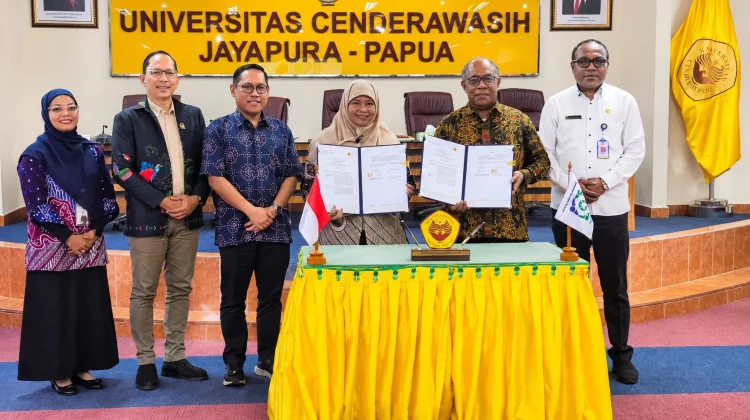
Improving access to healthcare is not only about building hospitals, providing medical equipment or increasing the number of healthcare professionals. It also depends on whether people understand their rights, know how to access medical services and recognise the importance of maintaining health insurance coverage. Recognising this challenge, Indonesia’s Social Security Agency for Health (BPJS Kesehatan) has partnered with Cenderawasih University (Universitas Cenderawasih or Uncen) in Jayapura to strengthen public understanding of the National Health Insurance Programme, known as Jaminan Kesehatan Nasional (JKN).
The partnership was formalised through a Memorandum of Understanding (MoU) signed on November 25, 2026, at the university’s Rectorate building in Jayapura. The agreement brings together BPJS Kesehatan and one of Papua’s leading higher education institutions to expand health insurance literacy through education, research and community service.
The initiative goes beyond conventional public awareness campaigns. It introduces opportunities to integrate social security education into university curricula, organise community-based learning activities, involve industry practitioners in teaching and develop collaborative research addressing healthcare protection.
For Papua, where geographical distances and differences in access to public services present particular challenges, the involvement of universities could provide an additional channel for bringing information about national healthcare programmes closer to communities.
The collaboration also reflects a wider development priority in Indonesia: ensuring that national social protection programmes are understood and accessible not only in major urban centres but also in geographically dispersed regions.
BPJS Kesehatan and Uncen Formalise Strategic Partnership
The agreement was signed during an official visit to Jayapura by Dr Vetty Yulianty Permanasari, Director of Human Resources and General Affairs at BPJS Kesehatan.
Representing Universitas Cenderawasih was Dr Basir Rohrohmana, Vice Rector IV for Cooperation and Planning.
The signing took place at the Senate Meeting Room on the third floor of the Uncen Rectorate building on November 25, 2026.
The MoU covers the implementation of the university’s three core responsibilities, commonly known in Indonesia as the Tri Dharma Perguruan Tinggi: education, research and community service. It also includes efforts to optimise the implementation of the JKN programme and expand participation among the university’s academic community and administrative staff.
Vetty said universities had an important role in supporting the long-term sustainability of the national health insurance system.
She explained that BPJS Kesehatan could not work independently to ensure that the programme remained effective. Cooperation with educational institutions, government bodies and other stakeholders was therefore necessary.
“BPJS Kesehatan cannot work alone to ensure the sustainability of the JKN Programme. Support and collaboration from various parties, including universities, are needed,” Vetty said after the MoU signing, as reported by ANTARA on November 26.
She added that Uncen’s academic resources could contribute to developing new ideas, strengthening research and improving public knowledge about national health insurance.
The partnership is expected to create opportunities for students and lecturers to become more actively involved in communicating the importance of social protection.
Social Security Education to Enter University Curricula
One of the most significant elements of the agreement is the planned implementation of the Social Security Curriculum, known as Kurikulum Jaminan Sosial or Kurjamsos.
The programme is designed to introduce social security concepts into the academic environment rather than relying exclusively on occasional public information campaigns.
Under this approach, students will have opportunities to learn about the principles of social protection, the role of national health insurance and the importance of maintaining active participation in the JKN programme.
The curriculum is also intended to provide a broader understanding of how social security systems contribute to individual welfare and national development.
For students preparing to enter professional careers, knowledge of social protection can be particularly relevant. Future educators, healthcare professionals, administrators, economists and public officials may encounter social security issues in their respective fields.
By introducing these subjects during university education, the partnership seeks to develop a generation that is better informed about healthcare protection and the responsibilities associated with participating in national insurance programmes.
The programme also recognises that knowledge gained at universities can extend beyond campus boundaries. Students can share information with their families, neighbourhoods and communities through academic and social activities.
Why Health Insurance Literacy Matters in Papua
The importance of the initiative becomes clearer when considered in the context of Papua’s geographical and social conditions.
Across the region, communities live in coastal settlements, mountainous districts, island areas and urban centres. Access to healthcare facilities and information can differ based on transportation infrastructure, distance, medical personnel availability, and local economic conditions.
In such an environment, understanding how to access healthcare services is an important part of improving public health outcomes.
People need to understand how JKN membership works, how to maintain active participation, where to seek treatment and how referral procedures operate within the national healthcare system.
Health insurance literacy can also help prevent misunderstandings regarding the rights and responsibilities of participants.
For example, individuals who understand their membership status and the procedures for accessing healthcare services may be better prepared when seeking treatment.
The partnership between BPJS Kesehatan and Uncen seeks to address these informational challenges by using the university as an educational and research partner.
Rather than limiting outreach to government offices or healthcare facilities, the collaboration creates an additional platform through which information can be distributed to younger generations and the wider community.
Preventive Healthcare and the Rising Cost of Serious Illness
Another consideration behind the collaboration is the growing importance of preventive healthcare.
Vetty highlighted concerns over the increasing trend of catastrophic diseases, which can require expensive and prolonged medical treatment.
Conditions requiring complex interventions can place considerable financial pressure on patients and the healthcare financing system.
She argued that public awareness and preventive measures should be strengthened before health problems develop into more serious conditions.
Through the Social Security Curriculum, BPJS Kesehatan hopes to encourage students and the wider academic community to understand the relationship between maintaining excellent health, accessing appropriate healthcare services and preserving active insurance membership.
The approach places greater emphasis on health promotion and prevention rather than focusing exclusively on treatment after illness occurs.
For Papua, the initiative is particularly relevant because public health challenges require cooperation between healthcare institutions, educational organisations, local administrations and communities.
Universities can contribute by supporting health-related research, disseminating reliable information and encouraging students to participate in community education.
The partnership therefore creates opportunities to connect health insurance literacy with broader efforts to improve public awareness of healthy lifestyles and preventive healthcare.
KKN, Research and Practitioners to Support Implementation
The MoU provides several practical opportunities for collaboration.
One of the proposed activities involves integrating social security education into the university’s existing community service programmes, including Kuliah Kerja Nyata (KKN).
Through KKN, students can participate in activities outside the classroom and engage directly with communities.
Under the proposed collaboration, students could help communicate information about JKN participation, explain the importance of active membership and introduce basic knowledge about social protection.
The programme also opens opportunities for BPJS professionals to participate in university teaching activities.
Through practitioner-led lectures, students can receive information from people with direct experience administering social security programmes.
This arrangement is expected to complement academic instruction with practical knowledge of how national health insurance operates.
Collaborative research is another important component.
Uncen’s academic community can explore relevant social protection issues, while BPJS Kesehatan can contribute institutional experience and practical information.
Research activities could help identify challenges in public understanding, examine the effectiveness of educational programmes and develop recommendations for improving communication with communities.
Such cooperation can make the relationship between the university and BPJS Kesehatan more substantial than a formal institutional agreement.
Basir Rohrohmana: Universities Must Contribute Beyond the Classroom
Basir Rohrohmana welcomed the partnership, describing it as an opportunity for Uncen to contribute more actively to government programmes, particularly in the healthcare sector.
He said that students needed a comprehensive understanding of JKN and social protection because they would eventually become professionals and future leaders in different parts of the region.
According to Basir, the university’s contribution should extend beyond providing information in lectures.
Academic expertise can be combined with the practical experience of professionals working in social security institutions to develop programmes that are relevant to society’s needs.
He expressed the hope that the agreement would be translated into concrete activities that could benefit students and the wider community.
“Through this cooperation, we are committed to continuing sustainable collaboration to support the optimisation of the JKN Programme and improve the quality of healthcare services in Papua,” Basir said, as reported by ANTARA.
The university also expects the partnership to support different educational pathways, including academic, professional and vocational programmes.
This approach could allow social security education to reach students from different disciplines and prepare them to communicate relevant information in their future workplaces.
Expanding Awareness Beyond Health Insurance
Another important feature of the programme is its broader social protection perspective.
Vetty explained that the educational coverage would not be restricted to JKN or health insurance alone.
The initiative also provides opportunities to introduce students to employment-related social security programmes administered by BPJS Ketenagakerjaan.
These include protection related to employment injuries, old-age benefits and other forms of employment-based social security.
This wider approach is important because social protection involves several dimensions of individual and family welfare.
Health insurance helps protect individuals against healthcare expenses, while employment-related social security programmes provide different forms of protection against risks associated with working life.
By introducing these concepts together, the partnership seeks to improve understanding of Indonesia’s broader social protection framework.
Students can gain a better appreciation of how different programmes complement one another in supporting economic security and social welfare.
For Papua’s growing workforce, including graduates entering formal employment and other professional sectors, knowledge of these arrangements can be useful when making decisions about employment and social protection.
Uncen’s Role in Strengthening Human Resources in Papua
Universitas Cenderawasih occupies an important position in Papua’s higher education landscape.
Based in Jayapura, the university serves students from different parts of Papua and provides an academic environment for developing regional human resources.
Its involvement in the JKN literacy initiative, therefore, creates an opportunity to connect national social protection programmes with local academic networks.
The collaboration also reflects the increasing importance of partnerships between universities and public institutions in addressing development challenges.
Higher education institutions are not only responsible for producing graduates. They can also contribute to policy research, public education, professional development and community empowerment.
In the healthcare sector, this role is particularly relevant because improving health outcomes requires cooperation between medical institutions, government agencies, educational organisations and the public.
Through the partnership, Uncen can help translate complex information about health insurance into educational activities that are more accessible to different segments of society.
The university’s research capacity may also contribute to identifying specific challenges affecting healthcare literacy in Papua.
The initiative’s success will depend on follow-up programmes, student and lecturer participation, and the institutions’ ability to cooperate over time.
Turning an MoU into Tangible Benefits for Communities
Although the signing of the MoU establishes an institutional framework, its long-term value will depend on how effectively the agreement is implemented.
Both institutions will need to develop practical activities, establish clear responsibilities and evaluate the results of their programmes.
The integration of social security subjects into relevant courses, for example, will require coordination between BPJS Kesehatan professionals and university academic departments.
Similarly, KKN activities will need to be designed around the actual informational needs of communities.
Public education should explain not only the benefits of JKN but also the procedures for registration, membership maintenance, healthcare access and the responsibilities of participants.
It will also be important to ensure that information reaches communities beyond Jayapura, including people living in remote districts and areas with limited access to educational resources.
Digital communication can complement direct engagement, but face-to-face activities remain relevant where internet connectivity and access to information are limited.
Monitoring participation and measuring changes in public understanding will help determine whether the programme is achieving its objectives.
Conclusion
The partnership between BPJS Kesehatan and Universitas Cenderawasih represents an important development in efforts to strengthen public understanding of Indonesia’s National Health Insurance Programme.
By combining education, research and community service, the agreement creates opportunities to introduce social security knowledge into university curricula and extend public awareness beyond academic institutions.
The planned implementation of Kurjamsos, together with KKN programmes, practitioner-led teaching and collaborative research, provides a framework for connecting academic knowledge with the practical needs of communities.
For Papua, where geographical conditions and differences in access to public services require flexible development approaches, universities can serve as valuable partners in expanding health literacy.
The initiative also stresses the need for younger generations to be more aware of preventive healthcare, how to get involved with JKN, and social protection in general.
Ultimately, the success of the agreement will be measured not by the signing ceremony alone, but by whether more students understand the national health insurance system, more families know how to access healthcare protection and more communities can make informed decisions about their health.
Through sustained cooperation, BPJS Kesehatan and Universitas Cenderawasih have an opportunity to turn social security education into a practical contribution to human development and the improvement of healthcare awareness throughout Papua.
Read Also
Ko Harus Sehat Programme Expands Health Access in Papua Tengah
Australia Backs KITA SEHAT in Papua Barat Daya

