
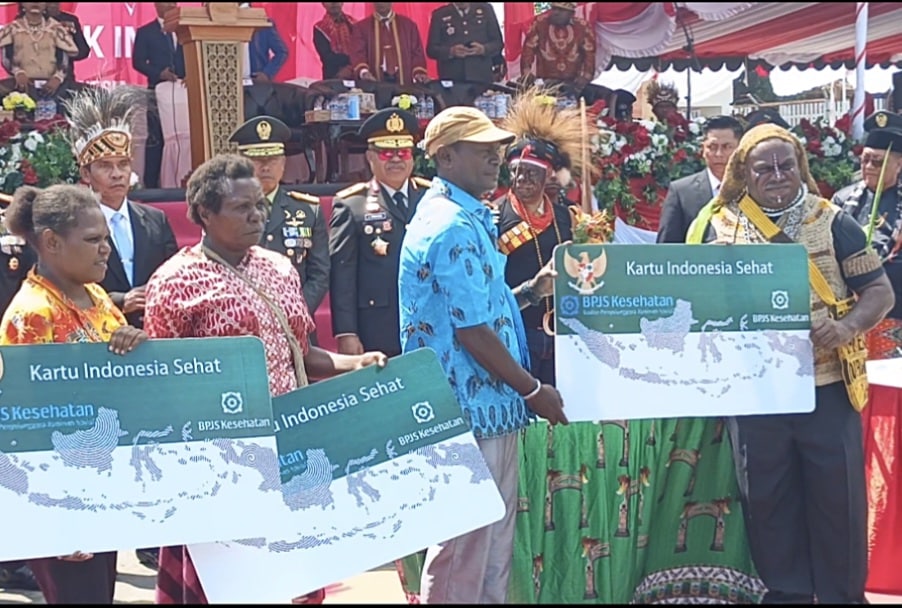
In Papua Tengah (Central Papua), where geography can make access to public services difficult, Ko Harus Sehat is emerging as a practical effort to bring health protection closer to communities. The provincial government, working with the Social Security Agency on Health (BPJS Kesehatan), has enrolled 50,000 residents across eight districts into the National Health Insurance programme, Jaminan Kesehatan Nasional (JKN). Of those participants, 44,720 are Indigenous Papuans, or Orang Asli Papua (OAP).
The programme, formally known as Kartu Otsus Harapan Baru Sehat, is one of Governor Meki Fritz Nawipa’s efforts to make healthcare protection more accessible at the grassroots level. The provincial government has allocated around Rp22.7 billion for the 50,000 participants.
For Papua Tengah, the policy is significant not simply because of the number of people covered. It also illustrates how regional governments can use special autonomy policies alongside Indonesia’s national health insurance system to address local conditions.
A Health Programme Designed for Papua Tengah
The idea behind Ko Harus Sehat is relatively straightforward: people should not have to choose between seeking medical treatment and protecting their household finances.
For communities living in remote parts of Papua Tengah, however, access to healthcare is influenced by more than the availability of insurance. Distance, transportation, geography and the distribution of medical facilities can all determine whether an insured resident can actually receive treatment.
That is why the provincial government has presented Ko Harus Sehat as complementary to JKN rather than as a separate programme.
Governor Meki Nawipa said JKN provides the foundation for health protection, while Ko Harus Sehat serves as a regional policy designed around the specific needs and characteristics of Papua Tengah’s population.
The distinction matters.
Insurance coverage is an important first step, but effective healthcare also requires functioning clinics, hospitals, medical personnel, medicines and transportation. The provincial administration’s challenge now is to ensure that expanded coverage translates into real access to quality services.
50,000 Residents Covered
According to BPJS Kesehatan, 50,000 residents in eight districts have been registered through the collaboration between Ko Harus Sehat and JKN. The programme is funded with approximately Rp22.7 billion. ANTARA reported that 44,720 participants are Indigenous Papuans.
The figures demonstrate the programme’s emphasis on communities that the provincial government considers a priority under Papua’s special autonomy framework.
The available reporting also shows that Papua Tengah’s overall JKN participation has expanded significantly. As of August 1, 2026, reported JKN coverage stood at 117.06 percent, while the proportion of active participants reached 95.82 percent.
The coverage figure above 100 percent reflects the way JKN participation is recorded and should not automatically be interpreted as meaning that more people physically reside in the province than its population. What is particularly relevant for service delivery is the active participation rate, which indicates whether registered participants remain actively covered.
For policymakers, maintaining that active status is just as important as increasing registration.
Why Indigenous Papuans Are Central to the Programme
The fact that more than 44,000 of the reported Ko Harus Sehat participants are OAP gives the programme a particular social dimension.
Healthcare is one of the most direct ways in which government policy affects household welfare. When families can access treatment through a health insurance system, the financial consequences of illness can potentially be reduced.
For Indigenous communities in Papua Tengah, the issue is also connected to the broader objective of improving human development.
A child who can receive medical treatment is more likely to remain in school. A parent who can obtain treatment without facing an overwhelming financial burden may be better able to continue working. Pregnant women can benefit from access to maternal services, while elderly residents can seek treatment for chronic conditions.
These individual effects accumulate.
Healthier communities are better positioned to participate in education, employment and local economic activity. In that sense, health insurance is not merely a welfare policy. It is also part of a wider development strategy.
Governor Nawipa has framed health protection as a basic right that should reach people at the grassroots level.
That approach places healthcare within the broader development agenda of Papua Tengah.
Moving Beyond Registration
The next question is whether people who receive health coverage can use it easily.
Papua Tengah has significant geographic challenges, and the provincial government and BPJS Kesehatan acknowledge the need to adapt services to local conditions.
According to ANTARA, around 267,000 JKN participants in Papua Tengah can access primary healthcare through community health centres, primary clinics, independent medical practices and Class D Pratama hospitals. Approximately 28,000 cases a year are handled by hospitals distributed across the province’s eight districts.
The figures provide a sense of the scale of the healthcare network supporting the programme.
By July 2026, JKN healthcare service expenditure in Papua Tengah had reached Rp124.8 billion, according to the same report.
That level of expenditure also highlights the importance of ensuring that public funding is translated into effective services.
For a provincial government, expanding insurance participation is relatively measurable. The harder task is improving the experience of patients once they enter the healthcare system.
This includes waiting times, availability of medicines, referrals, quality of diagnosis and treatment, and the ability of residents in remote villages to reach facilities.
Digital Services Could Help Close The Distance
One of the approaches being used to address Papua Tengah’s geography is a combination of face-to-face and digital services.
BPJS Kesehatan has continued to develop digital channels, including Mobile JKN, as well as administrative services such as PANDAWA through WhatsApp and VIOLA, or Virtual Office Layanan Peserta. These services are intended to bring administrative access closer to residents, including at village level.
Digitalisation cannot replace doctors, nurses or hospitals. But it can reduce unnecessary administrative travel.
For someone living in a remote community, travelling several hours simply to resolve an insurance administration issue can represent a significant cost. Digital services can potentially reduce that burden.
This is particularly relevant in Papua, where public service delivery increasingly depends on a combination of physical infrastructure and digital connectivity.
The same principle is visible in other sectors. Education programmes are expanding access for students, subsidised flights are being introduced for remote communities, and the government is investing in electricity and transportation infrastructure.
Healthcare is therefore becoming part of a broader effort to reduce the disadvantages associated with geographic isolation.
Prevention Is as Important As Treatment
Ko Harus Sehat is also being positioned around the principle that healthcare should not begin when a person becomes seriously ill.
Earlier in 2026, Papua Tengah’s health authorities described the programme as emphasising promotive and preventive healthcare. This includes health screening, immunisation, healthy lifestyle education and community health campaigns.
The logic is familiar worldwide.
Preventing disease or detecting it at an early stage is generally less disruptive than waiting until a condition requires intensive treatment.
For Papua Tengah, preventive healthcare may be especially valuable because geographical barriers can make emergency treatment more difficult.
A resident who receives early screening for a health problem may be able to begin treatment at a local facility rather than requiring a complicated referral to a larger hospital.
The provincial government has also previously organised free health examinations, including checks for blood sugar, cholesterol, uric acid and malaria where medically indicated.
Such initiatives complement the insurance component of Ko Harus Sehat.
Insurance provides financial protection. Prevention attempts to reduce the likelihood that serious illness develops in the first place.
The Wider Meaning of Health Protection
The programme also has implications for Papua Tengah’s economic development.
Illness can impose costs on families that go far beyond medical bills. A parent who becomes sick may be unable to work. Children may miss school to care for relatives. Families may have to travel long distances to obtain treatment.
When health services become more accessible, some of those indirect costs can be reduced.
That makes health policy part of the province’s human capital strategy.
Papua Tengah is simultaneously pursuing initiatives in education, transportation and other public services. Ko Harus Sehat fits into that broader framework by addressing a fundamental condition for participation in development: people need to be healthy enough to study, work and support their families.
The policy is therefore more significant than its Rp22.7 billion allocation alone might suggest.
Its potential impact lies in connecting health protection with other elements of social development.
A Special Autonomy Policy with A Practical Focus
Papua’s special autonomy framework provides regional governments with additional policy and fiscal instruments to respond to local priorities.
Ko Harus Sehat represents one example of how those instruments can be directed toward a basic public service.
The provincial government has deliberately linked the programme with JKN rather than creating an entirely separate insurance structure. That approach can reduce duplication and allow regional resources to support the national health insurance architecture.
Nawipa has stressed that Ko Harus Sehat and JKN should reinforce each other. In his view, JKN is the foundation, while the provincial programme provides additional regional support adapted to local needs.
This model may offer a useful lesson for other geographically challenging regions: national programmes can provide the institutional foundation, while local governments can tailor implementation to circumstances on the ground.
The Challenge Ahead
The achievement of registering 50,000 people is important, but it should not be treated as the endpoint.
The real test will come when participants need healthcare.
Can residents in remote villages reach a primary healthcare facility? Are medicines available? Can referrals be processed quickly? Are hospitals sufficiently equipped? Are medical workers distributed according to need?
Those questions will determine whether insurance coverage becomes meaningful protection.
The reported 95.82 percent active participation rate provides an encouraging starting point. Yet maintaining that rate requires continuous data verification, public information campaigns and coordination between provincial and district authorities.
There is also a need to ensure that communities understand how to use their JKN membership.
Insurance programmes can only work effectively when residents know where to go, what services are covered and how referrals operate.
This is where village level outreach becomes important.
A Broader Development Story for Papua
Ko Harus Sehat should also be understood within the changing development landscape of Papua Tengah.
The province is relatively new within Indonesia’s administrative structure, and its government is attempting to build systems that can serve a population spread across eight districts with very different geographic conditions.
Healthcare is one of the clearest tests of that effort.
A government office can be established in a provincial capital relatively quickly. Building an effective public service network across mountains, forests and remote settlements is much harder.
That is why the combination of insurance, local government financing, healthcare facilities, digital services and preventive programmes matters.
No single intervention can solve the problem.
But together, they can gradually reduce the distance between government policy and people’s everyday lives.
Conclusion
The expansion of Ko Harus Sehat to 50,000 residents represents an important step in Papua Tengah’s effort to widen access to healthcare. According to government and BPJS Kesehatan data reported by ANTARA, 44,720 of the participants are Indigenous Papuans, with approximately Rp22.7 billion allocated to support the programme.
The programme’s significance, however, will ultimately be measured not by registration numbers alone. Its success will depend on whether people can actually use the healthcare system when they need it, particularly those living in remote communities.
For Governor Meki Nawipa’s administration, the challenge is now to build on the existing coverage by strengthening primary healthcare, improving referrals, expanding preventive services and ensuring that digital and face-to-face assistance reach communities beyond provincial and district capitals.
The partnership between Ko Harus Sehat and JKN provides a foundation for that effort. If sustained effectively, it can help turn special autonomy resources into a service that residents experience directly in their daily lives.
For Papua Tengah, that is the larger promise of the programme: not simply giving more people a health insurance card, but making healthcare protection more tangible, accessible and responsive to the realities of life in Papua.

