
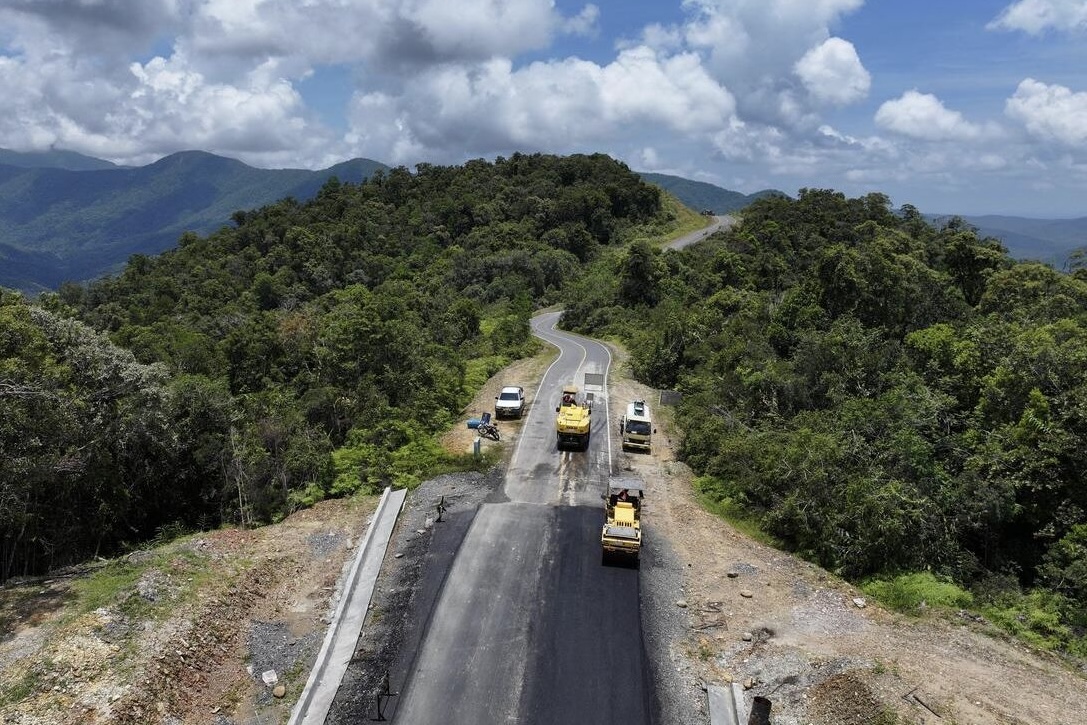
The Trans-Papua Jayapura-Wamena road project is approaching a key milestone, with Indonesia targeting April 2027 to complete the remaining 47.29 kilometres of unpaved road along the route. The project is part of the government’s broader effort to improve connectivity, reduce barriers to economic activity and promote more balanced development across Papua.
The target was highlighted during a working visit by Commission V of Indonesia’s House of Representatives and the Ministry of Public Works in Jayapura on October 12, 2026. During the meeting, Denny Firmansyah, head of the National Road Implementation Agency for Papua and Papua Pegunungan, reported that the region’s national road network extends for 594.56 kilometres, with 72.49 percent classified as being in satisfactory condition. A government-business cooperation scheme for the Trans-Papua project is addressing the remaining unpaved section on the Jayapura-Wamena route.
For communities and businesses across Papua, the significance of the project extends beyond the construction of a road. Reliable transport links can influence how quickly agricultural produce reaches markets, how easily residents access health and education services, and how much it costs to move essential goods between coastal cities and highland settlements.
Yet the April 2027 deadline remains a target rather than a completed result. The route’s long-term benefits will depend not only on finishing the unpaved section but also on maintaining bridges, managing difficult terrain and ensuring that the road remains dependable after construction.
A Road Project with Regional Significance
Connecting Jayapura and Wamena
Jayapura, the capital of Papua Province, is a major administrative and commercial centre on Indonesia’s northern Pacific coast. Wamena, in Papua Pegunungan Province, serves as an important centre for communities in the central highlands. The two locations occupy different geographic settings, and reliable overland connectivity is important to linking their economic and social activities.
The road corridor forms part of Indonesia’s wider Trans-Papua infrastructure effort, intended to improve access across a region where mountains, forests, rivers and remote settlements make transport infrastructure particularly challenging.
In such an environment, road construction is not simply a matter of laying asphalt. Engineers must contend with steep slopes, difficult ground conditions, heavy rainfall and the possibility of landslides. Bridges and drainage systems are equally important because a road that cannot withstand seasonal weather will struggle to deliver consistent economic benefits.
The remaining 47.29 kilometres of unpaved road have therefore become a significant part of the route’s development agenda. Completing this section would reduce one of the remaining gaps in the road corridor and improve the prospect of more continuous road travel between Jayapura and Wamena.
The InvestorTrust report framed the April 2027 target around the prospect of the route becoming accessible to ordinary passenger cars, including sedans. That prospect would represent a practical improvement for travellers, although actual journey conditions will still depend on the quality of the finished road, bridge readiness, weather and ongoing maintenance.
The Latest Government Review
The project’s latest reported milestone emerged from a broader review of infrastructure needs in Papua Pegunungan. On October 12, Commission V of the House of Representatives conducted a recess working visit in Jayapura, bringing parliamentary representatives together with officials from the Ministry of Public Works to discuss roads, bridges, water infrastructure, public facilities and oversight.
The discussions reflected the scale of the infrastructure challenge. According to Denny Firmansyah, the national road network in Papua Pegunungan totals 594.56 kilometres, with a road-condition or serviceability rate of 72.49 percent. The remaining unpaved section on the Jayapura-Wamena corridor is scheduled for treatment under the Trans-Papua government-business cooperation scheme, with April 2027 set as the completion target.
The meeting also addressed bridges that remain a concern for reliable transport. Officials identified 43 semi-permanent bridges requiring attention along the Jayapura-Wamena route. Fifteen are being handled during the 2025-2027 period, while eight more are planned for treatment during 2027-2028. Another 20 bridges requiring permanent construction do not yet have allocated funding, with estimated needs of approximately Rp 344.8 billion.
These figures show why the road’s completion must be understood as part of a wider transport system. A paved road can improve travel, but if a bridge remains structurally inadequate or a section becomes impassable after heavy rain, the benefits of the wider corridor can be reduced.
How Better Connectivity Could Support Papua’s Economy
Lowering Barriers to Trade and Distribution
Transport costs have a direct influence on economic opportunity. When roads are unreliable, businesses may need additional time, vehicles or logistical arrangements to move goods. Those expenses can be reflected in retail prices, reduce the competitiveness of local producers and make it harder for smaller enterprises to reach customers beyond their immediate communities.
A more dependable Jayapura-Wamena connection could help ease some of these constraints. Improved road conditions may allow goods to move with fewer interruptions, provide businesses with more predictable delivery schedules and support trade between coastal supply centres and highland markets.
For farmers, improved access can be particularly valuable. Agricultural producers need dependable ways to transport fresh produce to markets before it loses quality. Better connectivity could expand the range of buyers available to farmers while making it easier for traders to deliver seeds, tools and other production inputs to rural communities.
The economic effect, however, will depend on more than road quality. Farmers and small businesses also need information about the market, places to store their goods, cheap transportation, and ways to get to buyers. Without those supporting conditions, a new road may improve mobility without fully translating that improvement into higher household incomes.
For this reason, the Jayapura-Wamena project should be viewed as enabling infrastructure. It creates opportunities for economic activity, but the scale of those opportunities will depend on how effectively communities, businesses and public agencies make use of the improved connection.
Expanding Access to Essential Services
Connectivity also affects the delivery of public services. In areas where journeys are difficult or uncertain, reaching hospitals, schools, government offices and administrative centres can take more time and require greater expense.
A more reliable road corridor could help residents travel for medical appointments, support the movement of medicines and equipment, and improve the ability of service providers to reach communities. It could also make it easier for teachers, civil servants and other professionals to travel between population centres.
For emergency services, dependable road access can be particularly important. However, the extent of any improvement will depend on travel times, vehicle availability, the location of health facilities and the condition of the entire route, including bridges and connecting roads.
The government’s infrastructure agenda in Papua Pegunungan includes other initiatives intended to strengthen public services. During the same October review, the Ministry of Public Works discussed plans for community-orientated school facilities in Jayawijaya, Lanny Jaya, Pegunungan Bintang, Yalimo and Tolikara. The review also covered flood control, irrigation and other water infrastructure.
Together, these initiatives point to the importance of coordinating transport investment with the facilities people need at their destination. A road has greater social value when it connects communities to functioning schools, health services, markets and government institutions.
Geography, Bridges and the Cost of Construction
Why Finishing the Road is Only Part of the Challenge
Papua’s geography makes infrastructure development demanding. Mountainous terrain, remote work sites, difficult access for construction equipment and exposure to heavy rainfall can complicate both project delivery and future maintenance.
These conditions also influence construction costs. Materials and equipment may need to travel long distances before reaching work sites, while steep slopes and unstable ground can require additional engineering measures. Drainage, slope protection and appropriate pavement design are therefore essential to the durability of a road in this environment.
The government’s wider review acknowledged the need to address the region’s geographical challenges. Robert Rouw, deputy chairman of Commission V and head of the parliamentary working-visit delegation, emphasised that infrastructure development should take into account Papua Pegunungan’s terrain and the need to improve connectivity and access to basic services.
The bridge figures provide another indication of the work still required. While 15 semi-permanent bridges are being addressed during the 2025-2027 period and eight more are planned for 2027-2028, the 20 bridges awaiting funding for permanent construction represent a continuing infrastructure requirement. The estimated Rp344.8 billion needed for those structures illustrates the scale of the remaining challenge.
The implications are straightforward: completing the unpaved road section by April 2027 would be a major step, but it would not automatically resolve every issue affecting travel along the corridor. Continued bridge investment, routine maintenance and weather-related risk management will remain essential.
Oversight and Accountability
Large infrastructure projects require monitoring throughout their development, from planning and procurement to construction and handover. This is especially important in areas where work is technically complex and costs can be high.
During the October review, Maulidya Indah Junica, inspector general at the Ministry of Public Works, said oversight included budget reviews and risk-based performance audits, extending from the planning stage to project handover.
Such oversight can help identify potential problems early, support compliance with technical requirements and improve accountability for public expenditure. Progress reports should clearly differentiate between planned work, ongoing construction, and completed and verified work.
For the Jayapura-Wamena route, transparent reporting on the remaining 47.29 kilometres, bridge readiness and the condition of the completed sections would help residents and businesses understand what the April 2027 target means in practice.
The government-business cooperation model also highlights the importance of clear communication. The public must grasp the project’s scope, anticipated outcomes, and the responsibilities for road maintenance after construction concludes.
What Completion Could Mean for Papua Pegunungan
Turning Infrastructure into Inclusive Growth
The strongest case for completing the Jayapura-Wamena route lies in its potential to connect infrastructure investment with everyday economic and social needs.
For local businesses, more predictable transport could make it easier to plan deliveries and expand customer networks. For agricultural producers, improved road access could strengthen links with traders and markets. For residents, a more reliable connection could improve access to public services and reduce some of the difficulties associated with travel between the highlands and the coast.
The project could also support regional development by making transport planning more integrated. Better road access can help connect local economic activity with wider distribution networks while supporting the movement of construction materials, consumer goods and public-service supplies.
But these benefits are not automatic. To spread the gains more widely, infrastructure planning should be accompanied by support for local enterprises, agricultural value chains, market facilities and affordable transport services. Communities should also have opportunities to participate in decisions affecting access, land use, safety and the management of construction impacts.
Environmental protection will remain relevant as well. Road development through sensitive landscapes requires attention to drainage, erosion, slope stability and the impacts of construction on surrounding ecosystems. Responsible engineering and long-term maintenance can help protect both the infrastructure investment and the environment in which it operates.
April 2027: A Target to Measure Progress
The April 2027 deadline establishes a clear milestone for assessing progress in the Trans-Papua Jayapura-Wamena project. The remaining 47.29 kilometres of unpaved road represent a defined task, while the wider programme of bridge improvements shows that dependable connectivity requires sustained investment beyond the road surface itself.
The October review by the Ministry of Public Works and Commission V demonstrates that the corridor remains part of a broader national discussion about infrastructure and equitable development in Papua Pegunungan. The focus on road access, bridges, public facilities and water infrastructure reflects the interconnected nature of the region’s development needs.
If the target is achieved and the completed road is properly maintained, the route could become a stronger foundation for trade, public-service access and economic cooperation between Jayapura and Wamena. Its success should ultimately be measured not only by the kilometres completed but also by whether people can travel more reliably, businesses can move goods more efficiently and communities gain better access to essential services.
For Indonesia, the project represents a practical investment in connecting geographically separated communities and widening opportunities for regional growth. The next test is delivery: completing the remaining road works to the required standard, addressing the associated bridge needs and ensuring that the infrastructure continues to serve the public long after the construction deadline.
Conclusion
The targeted completion of the Trans-Papua Jayapura-Wamena road by April 2027 represents an important step toward improving connectivity and accelerating more balanced development across Papua. By addressing the remaining 47.29 kilometres of unpaved road, Indonesia aims to strengthen trade, reduce transportation barriers and improve access to essential public services for communities in the highlands and along the coast. However, lasting benefits will depend on completing construction to the required standards, maintaining bridges and road surfaces, and ensuring that local communities and businesses can take advantage of improved access. If supported by effective maintenance and inclusive economic policies, the project could become a vital foundation for sustainable growth and stronger regional integration in Papua.
Read Also
Trans Papua Highway Nears Completion in Key Sections
Jayapura-Wamena Trans Papua Road Transforms Economy and Connectivity

