
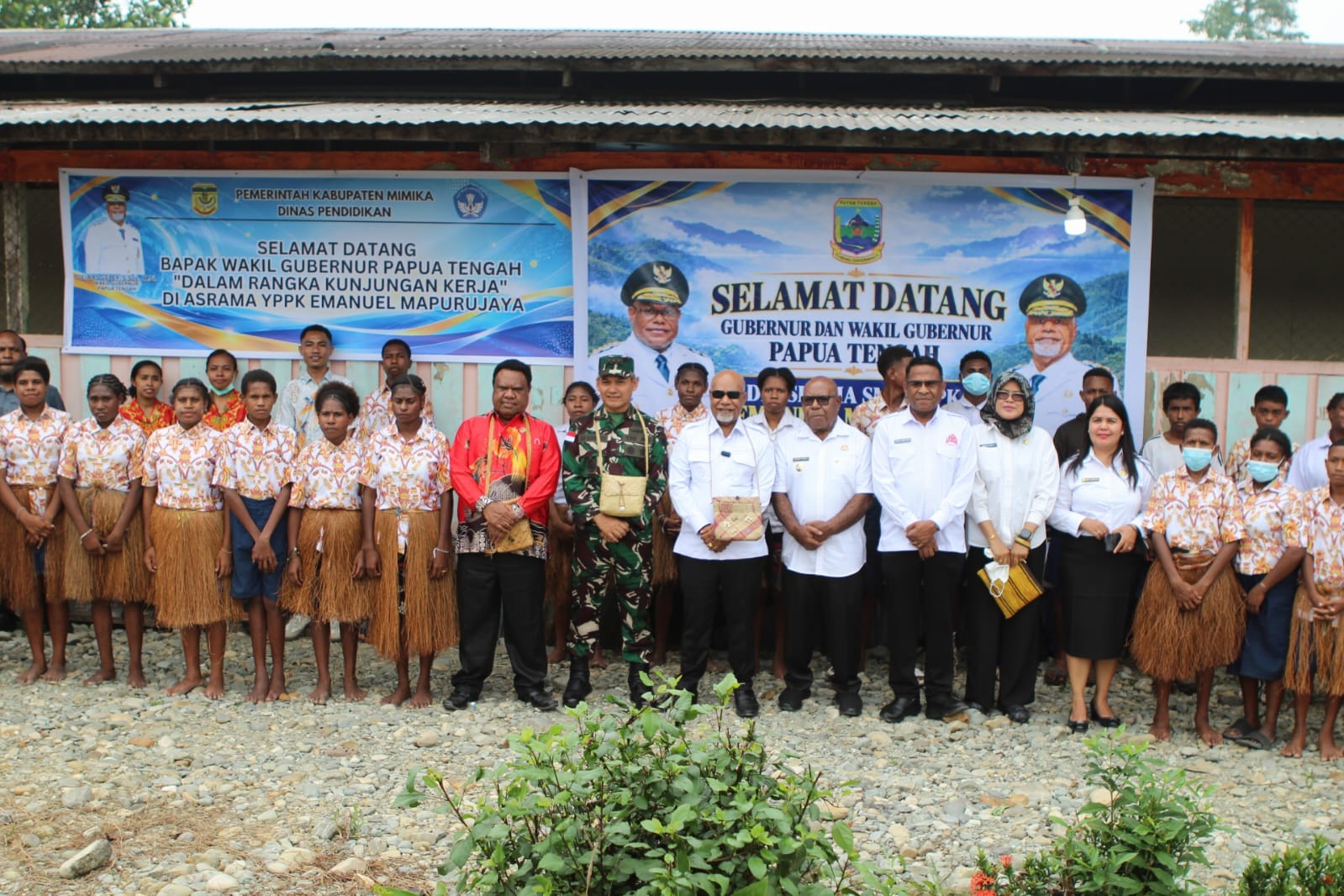
Deputy Governor Deinas Geley’s working visit to Mimika has put three development priorities in focus: vocational training for local communities, stronger infrastructure for the fisheries sector, and improved accommodation for students. The Deinas Geley Mimika development visit on October 14 brought provincial and district officials to industrial, maritime, educational, and proposed training-facility sites, as the Papua Tengah (Central Papua) administration seeks to connect local economic potential with practical opportunities for its residents.
Accompanied by Bekies Sony Kogoya, Deputy Speaker III of the Papua Tengah Provincial Legislative Council, Geley visited the Southern Industrial Area, the Poumako fishing port, Mapurujaya accommodation facilities, and the site proposed for a Cooperative and Micro, Small, and Medium Enterprises (MSMEs) Vocational Training Centre, known in Indonesia as a Balai Latihan Kerja (BLK) Koperasi UMKM.
Mimika Deputy Regent Emanuel Kemong, representatives of the regional leadership coordination forum, relevant government agencies, and the Papua Talent Development Foundation also took part in the program. The itinerary reflected a broad development agenda: increasing the value of local resources, improving the movement of fishery products, widening access to skills training, and supporting students’ educational needs.
The visit did not mean that all the proposed facilities were already completed. Several initiatives remain at the planning or development stage. Their significance will ultimately depend on follow-through, funding, construction, and whether the facilities deliver measurable benefits to communities.
Industrial Development: Adding Value to Local Resources
The visit began at Mimika’s Southern Industrial Area, where Geley received a briefing on the potential for downstream processing of mining products.
The discussion centered on the importance of developing industries that can add value to natural resources before they enter wider markets. Rather than relying solely on the extraction of raw materials, downstream processing can create opportunities for supporting businesses, technical employment, and local suppliers.
Geley stressed the need to develop downstream industries to increase the value of regional resources, encourage economic growth, and open business opportunities for local residents.
The emphasis is relevant to Mimika, whose economy is closely associated with mining and related industrial activity. A broader economic base can create opportunities for businesses and workers beyond the main extraction sector, although building that base requires investment, technical skills, reliable infrastructure, and access to markets.
The deputy governor’s visit was an opportunity to review the area’s potential rather than announce a completed industrial project. The government’s challenge is to translate that potential into viable economic activity, with local people equipped to participate in the opportunities that emerge.
That means development policy must look beyond physical infrastructure. Skills training, entrepreneurship, and coordination between the government and the private sector are important if local residents are to secure a lasting role in the regional economy.
Poumako Fishing Port: Strengthening the Fisheries Supply Chain
After the industrial-area visit, the delegation travelled to the Regional Technical Implementation Unit for Poumako Fishing Port. Officials reviewed the port’s infrastructure, supporting facilities, and the potential of Mimika’s fisheries sector.
During the inspection, Geley received information about local fisheries resources and the operational challenges facing businesses in the sector. He called for stronger support for port facilities to improve the distribution of fishery products from Mimika to other areas.
The fisheries sector can provide income for fishers, traders, transport operators, and other businesses. But the value of a catch depends not only on the quantity landed. Storage, handling, transport, and access to buyers also influence whether fish can reach markets in suitable condition and at competitive prices.
The delegation therefore examined the supporting infrastructure, including facilities associated with ice production and cold storage. Such facilities can help maintain the quality of fish before distribution, provided that they have reliable electricity, adequate maintenance, and practical arrangements for operation.
Plans for a Larger Cold Storage Facility
Papua Tengah officials have also outlined plans to build what local reporting described as the largest cold-storage facility in Mimika. The proposed facility aims to enhance the fisheries supply chain by increasing fish storage capacity and facilitating distribution. The available reports do not establish a confirmed capacity figure or a completed construction schedule, so those details should await formal confirmation.
The planned investment could help address a familiar challenge for fisheries businesses: maintaining product quality between landing and sale. More reliable cold storage can provide fishers and traders with greater flexibility in arranging transport and marketing their products.
However, a new facility alone will not guarantee better prices or higher incomes. Its performance will depend on operating expenses, access for small-scale fishers, the availability of ice and electricity, transport links, and the existence of buyers. These practical considerations will determine whether additional storage capacity translates into economic benefits.
Kemong also briefed the deputy governor on issues involving the management of the fishing port and coordination between district, provincial, and central government authorities. He said some matters required further discussion between the different levels of government. Geley welcomed the need for coordination and encouraged officials to address the issues promptly.
The exchange highlighted the importance of clear responsibilities. Fishing infrastructure can involve different agencies, and effective management requires agreement on maintenance, operational authority, and investment priorities. Stronger coordination can help ensure that facilities serve local businesses consistently rather than remaining underused.
Mapurujaya: Education and Student Accommodation
The next part of the visit focused on education. Geley and the delegation visited Mapurujaya accommodation facilities and the boarding facilities at High Junior School (SMP) YPPK Emanuel Mapurujaya, where the deputy governor interacted with students and encouraged them to study diligently, maintain discipline, and develop their abilities.
The Papua Tengah Provincial Government also plans to build accommodation at SMP YPPK Emanuel Mapurujaya during the visit. The proposed development reflects concern about the living and learning conditions available to students who attend school away from their homes.
For boarding-school students, accommodation is more than a place to sleep. Suitable facilities can provide a more stable environment for studying, resting, and maintaining regular school attendance. Their value depends on adequate space, sanitation, safety, supervision, and access to basic services.
The announcement of a planned dormitory should therefore be considered an initial step rather than evidence that the educational challenge has already been resolved. The next stages will involve detailed planning, budget allocation, construction, and arrangements for the facility’s long-term management.
Geley’s interaction with students added a personal dimension to the inspection. Encouraging young people to pursue education and develop their skills reinforced the visit’s purpose of ensuring development projects enhance both infrastructure and community engagement.
Education and economic development are closely linked. Students who complete their schooling and gain access to further training are better placed to explore employment, technical careers, or entrepreneurship. Yet this requires a pathway that connects education with real opportunities, including vocational programs relevant to local industries.
BLK Koperasi UMKM: Building Skills for Employment and Entrepreneurship
The final major focus was the proposed BLK Koperasi UMKM in Mimika. The facility is intended to serve as a hub for vocational skills development and economic empowerment, particularly for Indigenous Papuans from the Amungme and Kamoro communities, as well as residents from all eight regencies of Papua Tengah Province.
Representatives of the Papua Talent Development Foundation told the delegation that university graduates and young people who had left school were among those facing limited access to practical skills training and employment opportunities.
A vocational training centre could help address this gap by offering programmes that connect learning with the needs of local businesses and productive sectors. The proposed training areas include furniture-making, such as producing tables and chairs; rattan crafts; and technical skills such as vehicle repair. These activities could support both employment and the development of small enterprises.
Geley emphasized the importance of cooperation between government, the private sector, training institutions, and business operators in developing Papua Tengah’s human resources. He also called for the project to move forward through preparation, a groundbreaking ceremony, and phased construction in line with the plan.
The approach is intended to broaden the choices available to young people. Public-sector employment remains one possible career path, but vocational training and entrepreneurship can provide alternatives for people who want to establish their own businesses or develop specialized skills.
Training Linked to Local Potential
The proposed centre’s focus on furniture and rattan crafts is particularly relevant because it connects practical training with locally developed products. Vehicle repair, meanwhile, offers a technical skill that may serve households, transport operators, and businesses.
For these programs to succeed, the training curriculum will need to reflect demand. Participants need access to qualified instructors, appropriate tools, recognized competencies, and guidance on finding work or starting a business. Partnerships with employers and experienced practitioners could help trainees understand workplace standards and the costs involved in running an enterprise.
The foundation’s representatives also highlighted the difficulties experienced by some graduates and school leavers who lack access to relevant training. The BLK is expected to provide a place where these groups can gain practical skills and explore opportunities to become more economically independent.
Samuel Yogi, head of Mimika’s BLK Koperasi UMKM Office, welcomed the initiative and expressed hope that development of the training facilities would continue into the following year. He said he hoped Geley would be able to return to inaugurate the BLK once the work had progressed.
The hope reflects local expectations, but the decisive test will be whether the facility can open with a clear operating plan, sustainable funding, and courses that respond to the needs of trainees and employers.
Linking Infrastructure with Human Development
The four main elements of Geley’s visit point to a common policy objective: linking physical infrastructure with stronger human capacity and wider economic participation.
The industrial-area inspection addressed opportunities to increase the value of local resources. The visit to Poumako focused on fisheries infrastructure and distribution. The school visit highlighted student accommodation and educational support, while the BLK plan aimed to equip residents with practical skills and encourage entrepreneurship.
Taken together, these priorities reflect a view of development that goes beyond construction alone. A cold-storage facility needs skilled operators and reliable logistics. A vocational training center needs instructors, equipment, and a connection to employment opportunities. Better student accommodation is most effective when it supports consistent attendance and learning.
For Papua Tengah, coordination between provincial and district authorities will be crucial. The involvement of the deputy governor, a provincial legislative representative, the deputy regent, government agencies, and the Papua Talent Development Foundation provided a forum for reviewing local needs and discussing possible responses.
The visit also highlights the importance of transparent implementation following project announcements. Residents need to know when facilities are expected to be built, how they will be funded, who will manage them, and how progress will be measured. Clear information can help align public expectations with actual delivery.
A Change of Schedule During the Visit
The program had also been expected to include a dialogue with residents at the Mimika Regency Government Centre. However, the session could not proceed because Geley’s health condition did not allow him to continue with the remaining agenda. Through his representatives, he conveyed his apology to the community for being unable to meet and speak with residents directly as planned.
The cancellation did not change the main focus of the completed site inspections, but it left direct public dialogue for another occasion. Such meetings can be useful for collecting feedback from residents, particularly on projects that affect schooling, employment, and access to local economic opportunities.
Future consultations could help clarify the priorities of students, fishers, small-business operators, and training participants. Their input can help ensure that planned facilities are designed around real needs and that implementation responds to practical constraints.
Conclusion
Deinas Geley’s October 14 working visit to Mimika placed vocational training, fisheries infrastructure, and student accommodation at the center of Papua Tengah’s development agenda. The inspections brought provincial and district officials together to examine economic potential, identify practical challenges, and advance plans for facilities intended to support local communities.
The proposed BLK Koperasi UMKM could widen access to practical training and encourage entrepreneurship. Stronger cold-storage capacity could help fisheries businesses protect product quality and improve distribution, while planned accommodation at SMP YPPK Emanuel Mapurujaya could support students’ learning conditions.
None of these outcomes is automatic. Funding, timely implementation, capable management, and community participation will determine their success. The next stage must therefore move from inspection and planning to clear schedules, coordinated responsibilities, and measurable results.
If these plans are implemented effectively, Mimika could strengthen the connection between its natural resources, local skills, and economic opportunities. For Papua Tengah, the longer-term measure of success will be whether the investments help residents build lasting livelihoods, improve educational access, and take a more active role in the region’s development.
Read Also
Papua Tengah Funds Job Protection for 24,691 Workers
Papua Tengah Invests Rp6.3 Billion in Indigenous Papuan Job Training
Border Trade Fair 2026 Opens Export Doors for Papua MSMEs

