
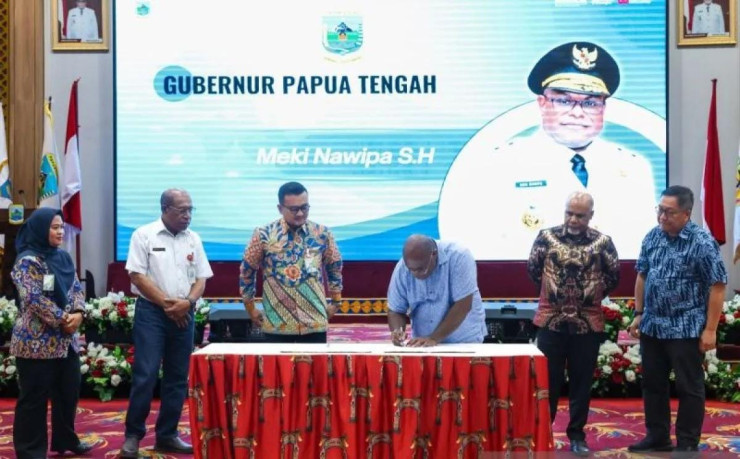
The Papua Tengah (Central Papua) provincial government has allocated Rp3.2 billion to provide employment social security for 24,691 people in 2026, expanding protection for workers whose livelihoods can be disrupted by workplace accidents, serious illness-related financial pressures or the death of a family breadwinner. The Papua Tengah worker protection programme is being implemented in cooperation with Indonesia’s employment social security agency, BPJS Ketenagakerjaan, under a memorandum of understanding signed in Nabire on Friday, October 9.
The programme covers three groups: 23,000 vulnerable workers, 941 religious leaders and 750 non-civil-service employees working within the provincial government. For many people in informal occupations, access to employment-related insurance can be difficult to maintain without assistance, particularly when income is irregular and household budgets leave little room for additional contributions.
The agreement represents an effort by the provincial administration to widen the social safety net beyond formal employment. Farmers, traders, fishers and other informal workers form part of the target population, alongside religious leaders and provincial contract staff. The scheme aims to provide financial protection against covered social risks, thereby alleviating the burden on workers and their families.
However, the programme also reveals the scale of the task ahead. Based on data from Indonesia’s Ministry of Manpower and Ministry of Home Affairs, 55,632 workers in Papua Tengah require employment social security coverage. The provincial government’s 2026 allocation can cover 24,691 people, leaving 30,941 still outside the provincial funding arrangement.
That gap places the agreement in a wider policy context. The immediate objective is to provide coverage to tens of thousands of people, while the longer-term challenge is to extend protection to more workers and ensure that the programme remains sustainable beyond the current budget year.
A Partnership Signed in Nabire
The Provincial Government Formalises Its Commitment
On Friday, October 9, 2026, the Papua Tengah provincial government and BPJS Ketenagakerjaan signed the agreement in Nabire. Governor Meki Nawipa attended the signing, which formalised cooperation to provide employment social security to selected groups in 2026.
Frets James Boray, head of the provincial Department of Manpower, Transmigration, and Energy and Mineral Resources, said the initiative reflected the administration’s commitment to expanding employment protection for local communities.
“This activity is a manifestation of the Papua Tengah provincial government’s commitment to expanding employment social security protection,” Boray said during the signing, as reported by Indonesia’s national news agency, ANTARA.
The agreement creates a framework for government funding and BPJS Ketenagakerjaan’s role in delivering the relevant protection. The provincial government allocates the budget for eligible participants, while the agency administers the employment social security programme according to its rules.
The arrangement is significant because the groups covered do not all share the same employment circumstances. A government contract employee may have a different working arrangement from a farmer, fisher or market trader. Religious leaders may also face particular financial pressures if an accident or death interrupts their ability to support their households.
By bringing these groups into a common social protection initiative, the government aims to address risks that can affect both individual workers and their families. The programme does not remove every financial uncertainty faced by participants, but it provides a formal mechanism for assistance when specified risks arise.
Why Vulnerable Workers Need Protection
For workers in the informal economy, earnings often depend on daily activity. A farmer may rely on seasonal production, a fisher on the ability to go to sea, and a trader on the regular movement of customers and goods. If an accident prevents someone from working, income can stop even as household expenses continue.
Without appropriate protection, the consequences may extend beyond the injured person. Families can face medical and other expenses, the loss of earnings, or the financial impact of a breadwinner’s death. Employment social security is designed to help manage some of these risks through defined benefits.
The Papua Tengah programme is therefore not simply an administrative agreement. It is a mechanism intended to connect public funding with practical support for people whose livelihoods may be exposed to unexpected disruption.
Its effectiveness will depend on more than the number of names registered. Participants need to understand what their coverage includes, how to report an incident and what documentation may be required to access benefits. Accurate registration and clear communication will be important in ensuring that the intended beneficiaries receive the protection provided under the scheme.
How the Rp3.2 Billion Budget Is Distributed
The provincial government has allocated the funding across three beneficiary groups. The figures released by ANTARA show that the largest share is directed towards vulnerable workers, while separate allocations cover religious leaders and non-civil-service staff.
The first group comprises 23,000 vulnerable workers, supported by a budget of approximately Rp2.7 billion. The second includes 941 religious leaders, with Rp414.5 million allocated for their coverage. The third group consists of 750 non-civil-service employees in the provincial administration, supported by Rp121.5 million.
Together, the reported allocations amount to approximately Rp3.236 billion, which is commonly described in reports as Rp3.2 billion when rounded. The budget figures are therefore best understood as a rounded headline total rather than an exact sum of the three detailed allocations.
The distribution reflects the programme’s focus on groups whose access to employment protection may depend on public assistance. Vulnerable workers account for the largest number of participants, while the inclusion of religious leaders and provincial contract staff broadens the scheme beyond informal-sector occupations.
These allocations also illustrate why public reporting on social programmes should distinguish between total funding and the specific groups covered. The number of beneficiaries alone does not reveal how much support is allocated to each category or what type of insurance protection is provided.
Seven Districts Included in the Programme
Reaching Workers Beyond the Provincial Capital
Muslika, head of the BPJS Ketenagakerjaan office in Nabire, said the vulnerable workers supported by the provincial government include farmers, traders, fishers and other informal workers across seven districts.
Those districts are Nabire, Dogiyai, Deiyai, Paniai, Intan Jaya, Puncak Jaya and Puncak. The geographic scope is intended to extend coverage beyond Nabire and reach workers living and earning a livelihood in different parts of Papua Tengah.
The inclusion of these occupations matters because informal workers may not have an employer responsible for arranging their insurance. A salaried employee in a formal organisation may have access to established workplace procedures, while an independent trader or farmer often has to manage work-related risks with limited financial reserves.
A government-supported scheme can help bridge that gap, provided eligible participants are correctly identified and registered. Local authorities and BPJS Ketenagakerjaan will need to maintain reliable records and communicate with communities to ensure that people understand the benefits and requirements.
The arrangement also recognises that the provincial government is not the only public institution financing employment protection in the region.
Mimika Has a Separate Funding Arrangement
According to Muslika, the protection of 20,000 workers in Mimika Regency is financed by the Mimika Regency Government rather than through the provincial allocation described in the agreement.
This distinction is important when interpreting the overall coverage figures. The 24,691 participants supported by the Papua Tengah provincial government should not be confused with every worker covered by public funding across the province. Mimika’s separate programme represents an additional local-government contribution.
The division of responsibilities allows provincial and regency administrations to support employment protection through their respective budgets. At the same time, coordination between government levels is necessary to avoid confusion over participant records, eligibility and the funding source for each group.
As the programme develops, clear information about the number of people covered by provincial and regency schemes will help authorities assess progress more accurately and identify communities where protection remains limited.
What Benefits Does BPJS Ketenagakerjaan Provide?
Protection Against Work-Related Accidents and Death
Andhika Catur Putra, head of the BPJS Ketenagakerjaan branch in Mimika, welcomed the provincial government’s financial support. He said the programme was expected to help vulnerable workers, religious leaders and non-civil-service employees work with greater peace of mind and improve productivity.
The employment social security scheme described in the agreement includes two main forms of protection for the covered groups: work accident insurance, known as Jaminan Kecelakaan Kerja (JKK), and death benefit insurance, or Jaminan Kematian (JKM). According to the reported details, the programme also covers Old-Age Security, known as Jaminan Hari Tua (JHT), for the included religious leaders.
JKK provides benefits in accordance with programme rules when a qualifying work-related accident occurs. JKM provides a benefit in eligible cases involving the death of a participant, helping ease the financial burden faced by surviving family members. JHT is designed to provide accumulated savings under the scheme’s applicable rules and is included specifically for the religious leaders covered by this arrangement.
The precise benefits available to an individual depend on the type of coverage, the circumstances of the claim and the applicable regulations. Participants should therefore receive clear explanations of what is covered and how claims can be submitted.
The value of this protection lies in providing a formal safety net rather than relying entirely on household savings or informal assistance from relatives and neighbours. When a covered risk occurs, access to the relevant benefit can help families manage a difficult period.
Andhika said BPJS Ketenagakerjaan remained committed to serving workers and their families when they face social risks.
“Our commitment is to provide the best possible services for the working community in Papua Tengah so that the benefits received can help ease the burden when social risks occur,” he said, according to ANTARA.
He also urged informal workers and employers to ensure that their workers were registered in BPJS Ketenagakerjaan programmes in accordance with the applicable requirements.
Registration and Awareness Remain Essential
An insurance programme can only deliver its intended value if eligible people are properly registered and understand how to use it. Participants need accurate information about their membership status, the benefits included in their coverage and the procedures to follow when a work-related incident occurs.
For the government and BPJS Ketenagakerjaan, registration data will be central to monitoring the programme. Errors in names, employment categories or other membership details can create administrative obstacles when a participant needs assistance.
Communication is equally important. Informal workers may not have regular contact with human resources departments or workplace administrators who can explain insurance procedures. Public information sessions, local government outreach and assistance from community organisations can help close that information gap.
The agency’s appeal to informal workers and employers to register eligible workers is therefore part of the broader effort to extend protection. Wider coverage requires both public financing for designated groups and participation from workers and employers who fall under other applicable arrangements.
The Remaining Coverage Gap
Despite the 2026 allocation, the provincial government has acknowledged that its programme does not yet cover everyone identified as needing employment social security.
The data cited by Frets James Boray show that 55,632 workers require protection in Papua Tengah. The provincial allocation covers 24,691 participants, leaving a reported shortfall of 30,941.
That difference represents a substantial continuing task. Expanding coverage will require decisions about future budgets, the identification of eligible workers and coordination among provincial and regency administrations.
The agreement signed in Nabire applies to 2026. Muslika said funding for 2027 would be adjusted again, meaning that continuation and the scale of the programme will depend on subsequent budget decisions.
This provision makes the next budget cycle especially important. A programme designed to protect workers against unexpected risks is more useful when participants can understand whether their coverage will continue and how any changes will be communicated.
The government will also need to balance the objective of reaching more workers with the need to ensure that current beneficiaries are properly registered and receive the protection for which funding has been allocated.
A clear assessment of results could examine the number of participants successfully registered, the timeliness of claims handling, the types of incidents reported and the degree to which coverage reaches the intended groups. These measures would provide a more complete picture than the budget and participant total alone.
Social Protection and Regional Economic Resilience
Employment security is closely connected to household stability. When a worker faces an accident or a family loses a breadwinner, the financial effects can extend to food purchases, children’s education, transport and other basic needs. Social protection cannot eliminate these pressures, but it can provide assistance in circumstances covered by the programme.
For Papua Tengah, the inclusion of farmers, fishers, traders and other informal workers is relevant to the structure of the local economy. These occupations support households and supply goods and services to communities, yet earnings can be uncertain and access to formal employment benefits may be limited.
A safety net can help households manage some risks without relying exclusively on savings or borrowing. It may also provide reassurance that a defined mechanism exists when a covered incident occurs. The extent of that benefit will depend on the coverage provided and the effectiveness of administration.
The programme should be viewed as one part of a wider approach to workforce welfare. Employment protection works alongside occupational safety, access to healthcare, skills development and efforts to expand sustainable livelihoods. Together, these measures can help workers participate in economic activity with a clearer understanding of the support available to them.
For government institutions, the challenge is to turn the agreement into an accessible service. That means maintaining accurate data, explaining benefits in language workers understand and reviewing the programme as new budget decisions are made.
Conclusion
The Papua Tengah provincial government’s Rp3.2 billion employment social security allocation provides coverage for 24,691 vulnerable workers, religious leaders and non-civil-service employees in 2026. The agreement with BPJS Ketenagakerjaan, signed in Nabire on October 9, sets out a framework for extending protection against work-related accidents and death, with old-age security also included for the religious leaders covered by the scheme.
The programme reaches vulnerable workers across seven districts, while Mimika Regency finances coverage for 20,000 workers through a separate local arrangement. These contributions demonstrate how provincial and regency governments can share responsibility for employment protection.
At the same time, the reported gap of 30,941 workers shows that the current allocation is not the end of the process. Future coverage will depend on budget decisions, accurate registration and coordination among public institutions. The fact that the current agreement applies only to 2026 makes planning for the next year particularly important.
For the programme to achieve its purpose, the number of registered participants must translate into accessible and reliable benefits when eligible workers and their families need them. Clear information, efficient claims procedures and transparent monitoring will help establish whether public funding is reaching its intended beneficiaries.
The broader objective is straightforward: workers should not have to face every employment-related risk alone. By connecting public financing with formal social security, Papua Tengah is seeking to provide a stronger safety net for people whose work sustains households and communities. The next test will be whether that protection can be maintained and extended to more of the workers who remain outside the current programme.
Read Also
Papua Tengah Invests Rp6.3 Billion in Indigenous Papuan Job Training
Papua May Day 2026 Stays Peaceful, Focuses on Workers

