
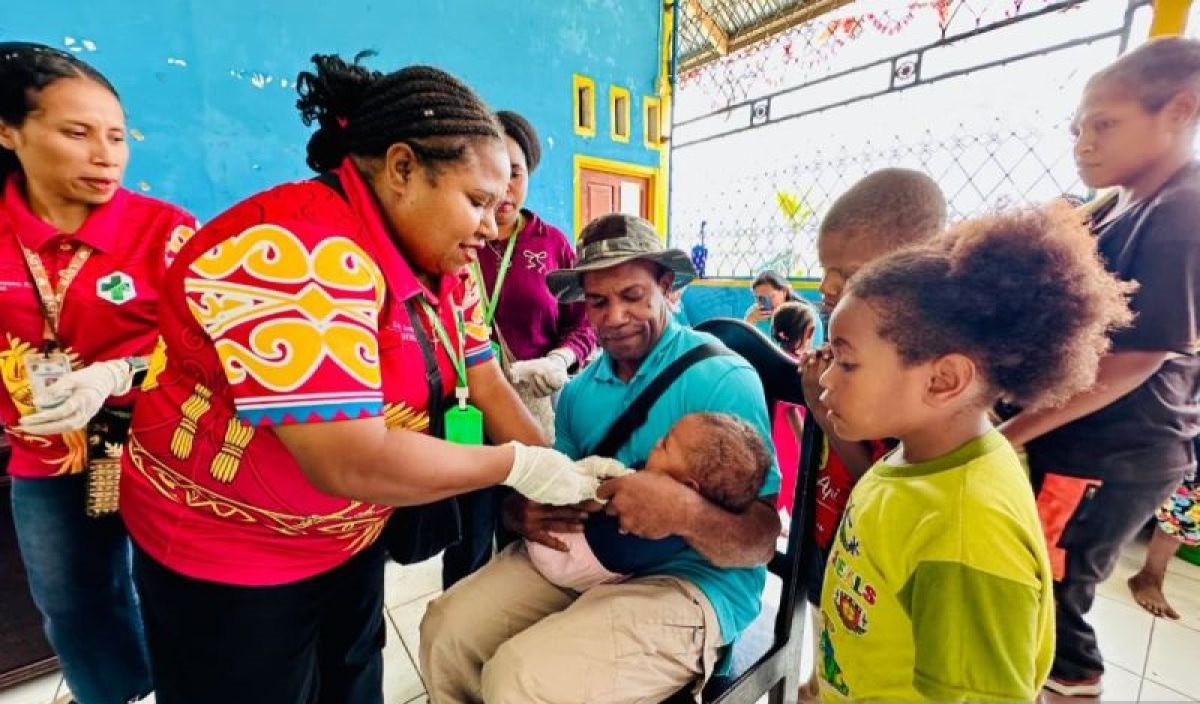
The Papua Barat (West Papua) Provincial Health Office has immunised 50 children from the Amber and Asarbey villages in Mokwam District, Manokwari Regency, as part of an emergency response to measles. The Papua Barat measles immunisation campaign was conducted on Friday, October 9, 2026, under the Outbreak Response Immunisation (ORI) programme, bringing health services closer to families and reinforcing efforts to protect children against a highly contagious disease.
Health officials, local administrators, and families gathered at the Amber Village Hall to support the vaccination session. The programme involved the provincial health office, the Manokwari Regency Health Office and Mokwam Community Health Centre, known locally as Puskesmas Mokwam.
For families in the two villages, the campaign offered an opportunity to access preventive healthcare within their community. For health authorities, it formed part of a wider response to a measles outbreak in Manokwari, where officials have been urging parents to bring eligible children to immunisation services and helping local teams reach those who might otherwise be missed.
The provincial health office’s initiative also highlighted the importance of cooperation between government institutions and village communities. Health workers delivered the vaccinations, while village leaders encouraged parents to participate and reminded residents that immunisation services were still available at local health facilities.
The immediate result was 50 children immunised during the activity. The broader objective, however, extends beyond a single vaccination session: authorities are seeking to increase coverage, reduce the risk of further transmission and ensure that children across the area have access to essential preventive healthcare.
From Outbreak Preparedness to Community Vaccination
Local Coordination Began Before the Campaign
The October 9 activity followed preparations by health authorities in Mokwam earlier in the month. On Saturday, October 3, the Mokwam Community Health Centre held an information session on measles and rubella and the response to the outbreak in Manokwari.
The meeting brought together representatives of the district and village administrations, community health volunteers, early childhood education teachers and health workers. Its purpose was to build a shared understanding of the outbreak response and prepare the community for the ORI campaign scheduled for October 5 to 17.
Mince Wilil, head of surveillance and immunisation at the Manokwari Regency Health Office, opened the preparatory session. Dr Samuel Kambuaya explained the characteristics of measles and rubella, the local outbreak situation, the reasons for conducting ORI and the role residents could play in identifying and reporting suspected cases.
The preparation phase was important because a vaccination campaign depends on more than the availability of vaccines. Health teams need to identify eligible children, communicate the schedule, coordinate with local authorities and ensure parents understand where services are available.
Village officials, teachers, and community health volunteers in Mokwam aimed to strengthen that process. These local figures can help spread information among families and identify children who have not yet received the recommended protection.
Michael Kafiar, head of the Mokwam Community Health Centre, said the facility was ready to implement the programme according to the established schedule. The health centre also planned to strengthen outreach so that immunisation would not depend solely on parents travelling to a healthcare facility.
The approach reflects a practical challenge in public health: a service can be available on paper without reaching every child who needs it. Active outreach, accurate registration and cooperation with families are therefore essential to translating a vaccination plan into effective coverage.
The October 9 session reached Amber and Asarbey
Six days after the preparatory meeting, the provincial health office conducted the mass immunisation activity at Amber Village Hall.
The event was attended by Frans Abidondifu, head of the Prevention and Disease Control Division at the Papua Barat Provincial Health Office; Billy Makamur, head of surveillance and immunisation; and Hendrik Marisan, the immunisation programme manager. Surveillance and immunisation staff also participated, alongside the head of Amber village, the head of Mokwam Community Health Centre and other local health personnel.
Families brought children from Amber and neighbouring Asarbey village to the session. Local reporting described a positive response from residents, with 50 children receiving immunisations during the event.
Holding the session at a village hall gave the campaign a community-based setting and placed local leaders alongside the health team. That cooperation matters when public health messages need to reach households that may not routinely visit a healthcare facility.
The activity also demonstrated how provincial and district-level institutions can work with local health services to implement a coordinated response. The provincial health office provided leadership, while the regency health office and Mokwam health centre helped connect the programme with residents.
The reports do not establish that all eligible children in both villages were vaccinated during this one session. The figure of 50, therefore, represents the number immunised at the reported activity, rather than proof that every child in the target population has already been reached.
That distinction is important as the campaign continues. Health teams still need to identify children who have not received immunisation and encourage their parents to access the services available during the ORI period.
Frans Abidondifu: Immunisation Is a Child’s Right
During the activity in Amber, Frans Abidondifu stressed that immunisation was a fundamental part of protecting children’s health. He urged parents to take responsibility for bringing their children to vaccination services rather than overlooking the programme.
“Immunisation is a child’s right to be healthy,” Frans said during his explanation to residents, according to Oridek News.
He warned that children who missed recommended immunisations could face greater risks if they were exposed to vaccine-preventable diseases. His message was directed at encouraging families to make use of services provided by the government.
Frans also addressed concerns among some parents about possible reactions after vaccination. He advised families not to panic if a child developed a mild fever after receiving a vaccine. However, parents should seek medical assessment at a healthcare facility if a fever becomes high, persists, or is accompanied by worrying symptoms.
The advice reflects the need for clear communication during immunisation campaigns. Parents need to understand both the benefits of vaccination and what to do if a child experiences symptoms afterwards. Reliable information from health professionals can help families make informed decisions and respond appropriately to potential concerns.
Frans called on residents who had already brought their children for immunisation to share information with other families who had not yet attended. He encouraged parents to visit the available vaccination services or the nearest health centre so that eligible children would not be overlooked.
“We hope all children receive immunisation so that Papuan children can grow up healthy. Health is the main asset for them to have a good and successful future,” he said.
The statement connected the immediate public health intervention with a wider development objective. Healthy children are better positioned to attend school, develop their abilities and participate in community life. Preventing disease is therefore not only a medical priority but also an investment in the region’s future.
Why the 95 Per Cent Target Matters
Building Protection Beyond Individual Children
The Manokwari Regency Health Office has set a target of at least 95 percent immunisation coverage during the measles and rubella ORI campaign. The target reflects the importance of reaching a high proportion of eligible children to reduce the opportunities for disease transmission.
Mince Wilil has urged parents to bring children aged nine months to under five years to the nearest immunisation service during the campaign. She said the participation of families and other sectors was essential to achieving the coverage target.
“The health team strongly supports this effort. It is not only the responsibility of parents, but also of other sectors, to bring our children aged nine months to under five years for measles ORI immunisation,” Mince said, according to RRI.
High vaccination coverage helps build community protection by reducing the number of susceptible people among whom an infection can spread. It cannot guarantee that every vaccinated child will avoid infection, but it is an important public health measure for reducing the risk of outbreaks.
Measles is highly contagious and can lead to serious complications, particularly among young children. Rubella is also a concern, especially because infection during pregnancy can cause serious harm to a developing baby. Health authorities have therefore encouraged parents to take the campaign seriously and seek professional advice about their children’s vaccination status.
The 95 percent goal is a benchmark, not a result that can be assumed from the number of children vaccinated at one event. To establish whether the target has been met, officials need reliable information about the number of eligible children, the number vaccinated and the remaining children who require follow-up.
That work may include reviewing vaccination records, identifying children who missed scheduled services and conducting outreach through local health workers and community representatives. The ORI period provides a defined opportunity to improve coverage, but its effectiveness depends on the accuracy of those activities.
Why Local Participation is Essential
A vaccination campaign can reach more families when health services work alongside people who understand their community. Village officials, teachers, community health volunteers and parents can help communicate schedules and identify children who may otherwise be missed.
The preparatory meeting in Mokwam brought several of these groups together before the campaign began. Their involvement helped establish that the response was a shared responsibility rather than a task left exclusively to medical personnel.
For communities in areas where travelling to a health facility can be difficult, information about where and when vaccines are available is particularly important. A village-based session can reduce some of the practical barriers, while continued services at the community health centre provide another option for parents who cannot attend a specific event.
Maintaining public confidence is equally important. Health workers need to communicate clearly, answer questions and explain when a child should receive immunisation. Parents should be encouraged to consult qualified health personnel if they are uncertain about their child’s vaccination history or have concerns about a possible reaction.
Village Government Supports Child Health
Amber Village Head Sarah Since Sayori welcomed the mass immunisation programme and expressed appreciation to the provincial health office, the Manokwari Regency Health Office and the head of Mokwam Community Health Centre for bringing the service to the village.
She said the village administration had also supported community health activities, particularly the Integrated Health Service Post programme, known as Posyandu. The monthly activities take place on the seventh day of each month and include weighing children and monitoring their growth and development.
The village also provides supplementary food, including mung beans, as part of its support for children’s nutrition.
These activities serve a different purpose from vaccination, but they contribute to a broader approach to child health. Immunisation helps protect against particular infectious diseases, while growth monitoring and nutritional support can help families and health workers identify other needs affecting a child’s development.
Sarah said she hoped similar health activities would continue in Amber. She also encouraged parents to make use of government services and asked those who had not yet brought their children for measles immunisation to visit Mokwam Community Health Centre during the ORI period.
Her appeal illustrates how local government can help bridge the gap between public programmes and household participation. Health agencies can supply expertise and organise services, but village leaders often have direct contact with residents and can help make public information more accessible.
The involvement of local government is particularly valuable when a campaign needs to reach families who have not yet attended. A reminder from a familiar community representative may encourage parents to verify their children’s vaccination status and seek assistance if they have missed the scheduled service.
Public Health as Part of Papua’s Development
The campaign in Mokwam demonstrates how local health interventions contribute to a wider development agenda in Papua Barat. Preventing disease helps protect children’s well-being, reduces the likelihood of serious illness and supports families in maintaining their daily routines.
For provincial authorities, the challenge is to ensure that public health services consistently reach communities, including those outside major urban centres. An emergency response can provide an important boost, but sustainable protection depends on routine immunisation, disease surveillance, reliable health facilities and continuing communication with residents.
The ORI programme aims to address the outbreak by providing protection to children in need. Its success should be assessed through measurable indicators, including the number of eligible children vaccinated, the proportion of the target population reached and the identification of children who remain unvaccinated.
Follow-up is particularly important after an intensive campaign. Health teams need to maintain surveillance for suspected cases and ensure that families know where to seek advice if a child develops symptoms consistent with measles or another illness. Suspected cases should be assessed by qualified health personnel rather than diagnosed by families or community members alone.
The experience in Mokwam also offers a reminder that public health outcomes depend on cooperation across several levels of government. Provincial leadership, regency coordination, community health services and village participation all have distinct roles. When those roles are connected, services can become more responsive to local needs.
Conclusion
The immunisation of 50 children from the Amber and Asarbey villages marks a practical step in Papua Barat’s response to the measles outbreak in Manokwari. The October 9 campaign brought provincial health officials, district health services and village representatives together to deliver preventive healthcare directly to families.
The programme followed preparations at Mokwam Community Health Centre on October 3, where health workers and community representatives discussed the outbreak, ORI implementation and the importance of identifying children who might otherwise miss vaccination. The wider campaign was scheduled for October 5 to 17, with authorities seeking to achieve at least 95 per cent coverage among the target population.
Statements from Frans Abidondifu, Mince Wilil and Sarah Since Sayori underline the shared responsibilities involved. Health authorities must provide reliable services and clear information, while parents and community leaders help ensure that eligible children are reached.
The 50 vaccinations reported in Amber are an important local result, but the wider objective is to ensure that every eligible child has the opportunity to receive the protection recommended by health professionals. Continued outreach, accurate records and routine immunisation will be essential to sustaining progress after the emergency campaign ends.
For the children of Mokwam, the value of the programme lies in more than just a single vaccination session. It lies in the opportunity to grow up healthier, with families and public institutions working together to reduce preventable risks. The next measure of success will be whether the campaign reaches the remaining eligible children and helps strengthen long-term protection across Manokwari.
Read Also
Papua Pegunungan Hospitals to Expand 11 Priority Services
18 Health Centers Expand HIV Care in Papua Selatan

