
The Papua Barat (West Papua) early education programme is entering a broader phase as Governor Dominggus Mandacan moves to extend access to quality early childhood education into remote villages, coastal communities and interior areas while strengthening a province wide literacy movement.
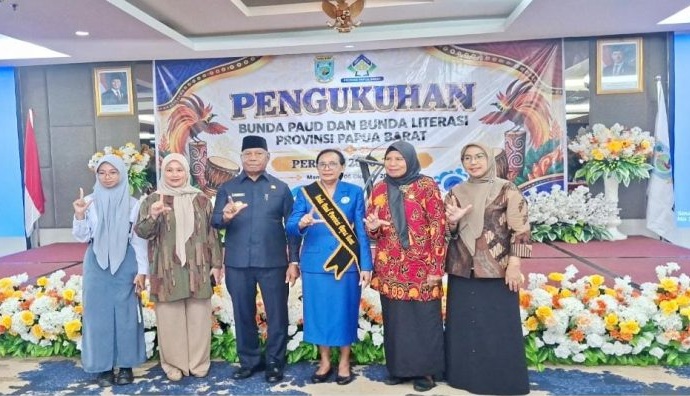
The policy was reinforced on October 6, 2026, in Manokwari, when Mandacan inaugurated Yuliana Mandacan as the province’s Bunda PAUD and Bunda Literasi for the 2026 to 2029 period at Swiss Belhotel Manokwari. The event also brought together education officials, teachers and prospective Reading Ambassadors from across Papua Barat.
For Mandacan, the ceremony was intended to signal something larger than a formal appointment.
He described children as Papua Barat’s greatest investment and said the early years are a critical period for shaping physical development, mental wellbeing and character.
“Children are the greatest investment for the future of Papua Barat,” Mandacan said, stressing the importance of building children’s physical, mental and character foundations during their golden years.
The governor’s message reflects a broader development strategy. Education is being linked with nutrition, healthcare, parenting, child protection and literacy, creating an integrated approach to human capital development rather than treating early childhood education as classroom learning alone.
October 6 Marks a New Phase
The programme gained momentum during the October 6 inauguration and literacy event in Manokwari.
Yuliana Mandacan was formally appointed Bunda PAUD Papua Barat for the 2026 to 2029 period and simultaneously entrusted with the role of Bunda Literasi Papua Barat. The event was held at Swiss Belhotel Manokwari and was attended by teachers, education stakeholders and prospective Reading Ambassadors from the province’s districts.
The literacy component was organised through cooperation between the Papua Barat Provincial Archives and Library Service and the Papua Barat Education Service.
The event carried the theme “Reading Identity, Building Achievement, Creating a Smart and Dignified Papua Barat.” The theme reflects the government’s intention to connect reading with identity, achievement and long-term human development.
The presence of students from seven districts in the Reading Ambassador selection added a youth dimension to the programme.
Rather than positioning literacy solely as a government responsibility, the provincial administration is seeking to develop young people who can become examples and promoters of reading culture in their communities.
Mandacan expressed particular appreciation for teachers who have supported students in developing their reading abilities.
“I am proud of the teachers who actively serve and of the Reading Ambassador candidates from the districts and cities who are here today. You are the face of a young generation that loves reading and is ready to become an example,” he said.
Four Pillars for Early Childhood Development
At the centre of the governor’s policy are four priorities for the Bunda PAUD movement.
The first is Holistic Integrative Early Childhood Education, known in Indonesia as PAUD Holistik Integratif. This approach brings education together with nutrition, healthcare, parenting and child protection.
The second is a more enjoyable transition from PAUD to elementary school.
The third is stronger action to reduce stunting and malnutrition.
The fourth is expanding access to early childhood education to villages, remote areas and other locations where basic services remain more difficult to reach.
Mandacan has instructed the Bunda PAUD and its working group to ensure that the four priorities do not remain policy statements.
He wants them implemented at the community level.
The emphasis on integration is important because a child’s ability to learn is affected by more than the availability of a classroom. Nutrition, health, family care and a safe environment all influence development during the early years.
The provincial government therefore views PAUD as part of a wider ecosystem.
Taking Education Beyond the Classroom
Papua Barat’s geography presents a practical challenge.
Communities are distributed across coastal areas, interior regions and remote villages, where distance can make access to public services more complicated.
For that reason, the provincial government has placed particular emphasis on bringing PAUD services closer to children regardless of where they live.
ANTARA reported that the government intends to expand access to PAUD in remote villages, coastal areas and interior communities while simultaneously improving service quality.
Mandacan stressed that expanding access should not mean simply increasing the number of educational facilities.
Quality must accompany geographical coverage.
He emphasised that every child should have the opportunity to grow and learn properly, regardless of where they live.
This approach places equity at the heart of the policy.
A child living in a provincial centre and a child growing up in a remote village should both have access to an early childhood development environment that addresses their basic educational and developmental needs.
A Healthier Start to Education
The focus on stunting and malnutrition gives the programme a public health dimension.
The provincial government recognises that physical health and nutrition can influence children’s development and learning capacities.
This is why the Bunda PAUD programme is expected to work closely with Posyandu and the Health Service.
The objective is not to turn PAUD teachers into health workers. Rather, the strategy is to connect education with existing community health systems so that children’s needs can be identified and addressed more comprehensively.
In practical terms, the strategy can help create a stronger bridge between families, education providers and health services.
This approach also aligns with a broader understanding of early childhood development, emphasising the interconnectedness of learning, nutrition, health, and protection.
For Papua Barat, the approach is especially relevant in communities where families may face geographical barriers to accessing multiple public services.
Making the Transition to Elementary School Less Stressful
Another important element is the transition from PAUD to elementary school.
Mandacan has called for a transition that is enjoyable and appropriate to children’s developmental stages.
He specifically cautioned against placing excessive pressure on young children to master reading, writing and mathematics before they are ready.
The objective is to ensure that the transition into formal schooling encourages curiosity rather than anxiety.
This approach also changes the way parents and teachers may understand school readiness.
Instead of measuring a child’s readiness only through academic skills, the focus becomes broader, including social development, emotional readiness, communication and the ability to adapt to a new learning environment.
For the provincial government, creating this smoother transition is part of building a stronger educational foundation from the beginning.
Literacy Begins at Home
The literacy movement is designed to complement the PAUD programme.
Mandacan has repeatedly emphasised that literacy should not be understood simply as the ability to read and write.
He describes it as the ability to understand information, think critically and apply knowledge to everyday problems.
That definition is particularly relevant in a rapidly changing information environment.
Children and teenagers increasingly encounter information through smartphones, social media, video platforms and other digital channels.
Reading culture therefore has to develop beyond formal lessons.
The governor believes the process begins at home.
“Reading culture grows from home, when parents read books and tell stories to their children, and is then strengthened in schools, libraries, and communities,” he said.
The message places parents at the beginning of the literacy chain.
Schools reinforce the reading habit, libraries offer resources, and communities create spaces that integrate reading into everyday social life.
Teachers Become Key Drivers
The provincial government is also placing considerable responsibility on teachers.
At the October 6 event, Mandacan praised teachers from PAUD through senior high school who have worked to develop prospective Reading Ambassadors.
The role is particularly important because teachers often see children’s development over long periods.
They can encourage students who are already enthusiastic readers while helping others discover books, stories and information that match their interests.
The Reading Ambassador programme adds another layer.
Selected students can serve as visible examples for their peers and communities.
According to the reports, candidates came from seven districts in Papua Barat and were expected to become literacy promoters and sources of inspiration in their respective areas.
This creates a peer-driven element within the provincial literacy movement.
Instead of relying exclusively on officials or teachers to promote reading, the government is encouraging young people themselves to become ambassadors of the culture.
From PAUD to Reading Ambassadors
The connection between early childhood education and youth literacy is deliberate.
PAUD focuses on establishing developmental foundations during the early years.
Literacy then becomes a continuing habit as children move through primary and secondary education.
Teachers, parents, libraries and communities form the supporting structure.
The Reading Ambassador programme represents a later stage, where students can begin taking responsibility for influencing their peers.
Viewed together, these programmes create a long-term pathway.
A child first develops curiosity and communication skills. The family introduces books and storytelling. Schools strengthen reading habits. Libraries broaden access to knowledge. Older students can eventually become literacy role models.
This is the kind of ecosystem the Papua Barat government is attempting to build.
Government Support and Local Collaboration
Mandacan has made clear that the provincial government cannot carry the programme alone.
He instructed provincial agencies, district and city governments, businesses and community elements to support the work of Bunda PAUD and Bunda Literasi.
The governor also called for cooperation involving the Family Welfare Movement, or PKK, and Posyandu.
We also encourage other sectors, such as religious organisations, customary community institutions, youth organisations, and women’s organisations, to contribute to early childhood education.
This reflects the cross-sector nature of the challenge.
A child spends only part of the day at school.
The rest of the child’s development occurs at home and in the community.
A successful education policy therefore requires consistency across those environments.
Funding As Part of Papua Barat Cerdas
The provincial government has also indicated that financial support will be part of the implementation strategy.
Under the broader Papua Barat Cerdas (Smart West Papua) framework, Mandacan said the provincial government would allocate funding according to applicable mechanisms and the region’s fiscal capacity to support the sustainability of PAUD programmes.
This commitment is important because expanding services into remote areas requires more than policy direction.
It can require teacher support, learning materials, facilities, transportation, coordination and community engagement.
The government must ensure that available resources reach the areas with the most limited access.
Why Early Childhood Investment Matters for Papua
The policy has implications beyond education.
Long-term economic and social development closely connects with human capital development.
Children who receive a strong foundation in health, nutrition, communication and learning enter later stages of education with better opportunities to develop their potential.
For Papua Barat, the stakes are particularly important because the province is continuing to build its human resources while managing the geographical complexity of service delivery.
Mandacan’s approach is therefore focused on reaching children earlier.
Instead of waiting until educational gaps become visible in later school years, the government is attempting to intervene during the period when physical, mental and character development is especially important.
The governor describes this period as the “golden age” of childhood.
A Policy that Depends on Communities
The most distinctive element of the programme is perhaps its reliance on collective action.
The government can establish policies and provide funding, but parents ultimately shape many of a child’s daily habits.
Teachers guide learning.
Libraries provide access to books.
Community organisations can create supportive environments.
Religious and customary institutions can reinforce values.
Young people can become role models for their peers.
This is why Mandacan has described the work as a broader cultural and national effort.
“Our work is cultural and national work to prepare a brighter future for the region. Bunda does not walk alone,” he said at the inauguration.
The statement captures the government’s intended model.
The Bunda PAUD and Bunda Literasi positions are not meant to function independently. They are intended to coordinate and encourage a wider movement.
The Challenge Ahead
The reach and consistency of PAUD and literacy programmes will ultimately determine their success.
Opening access in remote villages is one task.
Maintaining quality, supporting teachers and ensuring that families can participate is another.
The provincial government must coordinate with district administrations to ensure the delivery of education services across various levels of government.
ANTARA reported that Papua Barat plans to provide assistance for the implementation of PAUD and literacy programmes while strengthening coordination with district governments to improve human resource quality.
This coordination will be especially important in remote areas where logistical conditions can complicate programme delivery.
The government must therefore translate its commitment into sustained implementation, rather than limiting it to annual ceremonies or appointments.
A Longer Investment in Papua Barat’s Human Capital
The October 6 event in Manokwari offered a visible symbol of that ambition.
The appointment of a Bunda PAUD and Bunda Literasi for 2026 to 2029, the recognition of teachers, and the participation of young Reading Ambassador candidates all point toward a strategy that connects different stages of childhood development.
The programme begins with the youngest children but looks much further ahead.
Today’s PAUD students will eventually become the teenagers, workers, professionals, community leaders and parents who shape Papua Barat’s future.
That makes the investment more than an education programme.
It is an investment in the province’s long-term social and economic capacity.
Conclusion
Governor Domingus Mandacan’s push to expand Papua Barat early education and strengthen the provincial literacy movement reflects a broader effort to build human capital from the earliest stage of childhood.
The October 6, 2026, inauguration of Yuliana Mandacan as Bunda PAUD and Bunda Literasi for the 2026 to 2029 period provided the platform for the governor to outline the government’s priorities.
Those priorities are clear: develop Holistic Integrative PAUD, create a more enjoyable transition from PAUD to elementary school, accelerate efforts against stunting and malnutrition, and expand access to quality early childhood education into villages, coastal areas and remote communities.
At the same time, families, schools, libraries, and communities are collectively developing the literacy movement as a shared responsibility.
Teachers are being recognised as important drivers, while Reading Ambassadors are expected to become young role models who can encourage reading in their respective districts.
The approach is ambitious because it does not define education simply as what happens inside a classroom.
It connects education with health, nutrition, parenting, child protection, family participation and access to information.
For Papua Barat, where geographical conditions can make equal access to public services difficult, reaching children in remote villages and coastal and interior communities will be an important test.
But the direction set by the provincial government is clear.
The future of Papua Barat will depend heavily on the quality of its young generation, and that destiny begins long before a child enters secondary school or the workforce.
By putting early childhood education and literacy closer to the centre of its development agenda, the government is seeking to ensure that children across Papua Barat, regardless of where they live, have a stronger foundation on which to build their future.
As Mandacan put it, the effort is ultimately about joining hands and hearts for the future of Papua Barat’s children.
Read Also
Papua Pegunungan Urges Free Education and Free Nutritious Meals
Papua Pegunungan Invests Rp20 Billion in Student Education
Papua Tengah Pledges Rp56 Billion for Education
Papua Tengah Expands Free Education for 64,000 Students

