
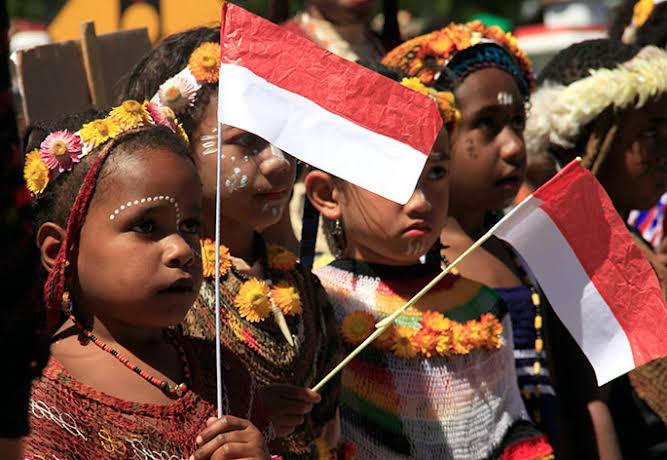
The 25th anniversary of Papua’s Special Autonomy, known locally as Otonomi Khusus or Otsus, has brought renewed attention to a central question: how can a policy designed to protect Indigenous Papuans and accelerate regional development deliver more visible improvements in people’s everyday lives?
Marked annually on November 21, the anniversary is more than a ceremonial occasion. It provides an opportunity for government officials, legislators, community representatives, and development institutions to assess the policy’s progress and identify what still needs to change.
Across Papua, several public figures have used this year’s commemoration to call for more effective implementation. Their messages share a common direction: special autonomy must translate into better education, healthcare, economic opportunities, stronger protection for Indigenous rights, and more equitable development across the region.
At the same time, they have stressed that the future of Papua should be built through cooperation, peaceful development, and a shared commitment to Indonesia.
From the 2001 Law to a Quarter-Century of Special Autonomy
Papua’s Special Autonomy framework was established through Law No. 21 of 2001. It introduced an asymmetric decentralization arrangement, granting Papua specific authorities and institutional mechanisms intended to accommodate the region’s distinctive social, cultural, and political circumstances.
The policy was meant to make it easier for people in the area to take part in government while also protecting and empowering Indigenous Papuans, who are often called Orang Asli Papua (OAP).
The framework emerged during a period of significant political and social change in Papua. It was intended to provide a legal and political response to longstanding concerns and aspirations expressed by Papuan communities during the late 1990s and early 2000s.
November 21 subsequently became the annual date for commemorating Special Autonomy Day. The provincial government under then-Governor Lukas Enembe established the observance, which began in 2017. The anniversary was intended to remind the public of the policy’s origins and encourage reflection on its implementation and future direction.
The next major development came with Law No. 2 of 2021, which amended the original Special Autonomy Law for a second time. Its implementing regulations, including Government Regulations Nos. 106 and 107 of 2021, further addressed institutional arrangements, government authorities, funding, and development planning.
Together, these legal instruments provide the framework for the current phase of Special Autonomy, often referred to as Otsus Jilid II.
By November 2026, the policy had reached its 25th anniversary. The milestone has prompted renewed discussion about whether its institutions, funding arrangements, and delegated authorities are producing the improvements originally envisaged.
John NR Gobai: Local Governments Must Turn Policy into Action
One of the clearest calls for implementation came from John NR Gobai, Deputy Speaker IV of the DPR Papua Tengah (Central Papua Provincial Legislative Council).
In remarks reported by Jubi on November 21, Gobai argued that the anniversary should become an opportunity for collective evaluation across Papua’s six provinces.
His central point was that the region does not necessarily need to begin by demanding more regulations or additional authorities. Instead, existing legal instruments must be implemented more consistently.
Gobai recalled that the first phase of Special Autonomy had already produced various Provincial Regulations (Perdasi) and Special Regional Regulations (Perdasus). These covered areas include customary justice, community mining, forestry, natural resource management, intellectual property, healthcare, and customary land rights.
However, he argued that the existence of regulations does not automatically guarantee their implementation.
Drawing on his experience as a member of the Papua provincial legislature from late 2017 to 2024, Gobai said that some regulations had been proposed and subsequently enacted, but their implementation remained uneven.
He also highlighted the division of responsibilities between provincial and regency or municipal governments as an area requiring greater clarity and consistency.
For Gobai, local governments are the principal executors of Special Autonomy. Their responsibility is to translate legislation, regulations, and budget allocations into programs that directly benefit communities.
He also pointed to the need for provincial and regional administrations to explain how special autonomy funding is being used. The public, he argued, should be able to understand whether the money allocated through regional budgets is reaching its intended beneficiaries.
His assessment offers a practical message for the next phase of the policy: the effectiveness of special autonomy depends not only on what is written in legislation but also on the ability and willingness of public institutions to carry it out.
Septinus Lobat: Put Indigenous Papuans at the Center
In Sorong, Papua Barat Daya (Southwest Papua), Mayor Septinus Lobat placed particular emphasis on strengthening government support for Indigenous Papuans.
Speaking during the 25th anniversary commemoration at the Sorong City Legislative Council (DPRK) compound on Saturday, November 21, Lobat said the occasion should inspire government institutions and the wider community to give greater attention to OAP.
He stressed that the anniversary should not be reduced to a ceremonial gathering. Instead, it should serve as a reminder of the original purpose of Special Autonomy and the responsibilities shared by those entrusted with implementing it.
Lobat’s message is significant because the success of affirmative policies depends on their ability to expand opportunities for Indigenous communities in practical terms.
That includes access to education, healthcare, employment, entrepreneurship, and participation in local decision-making. It also requires public institutions to understand the specific circumstances of communities across Papua, particularly those living far from major urban centers.
The Sorong commemoration also highlighted the importance of cultural preservation. Traditional bakar batu, a communal stone-cooking ceremony practiced in Papuan communities, formed part of the anniversary activities.
The tradition represents more than a method of preparing food. It reflects social relationships, collective participation, and cultural knowledge passed between generations.
By incorporating local traditions into a public commemoration, the event illustrated how development and cultural identity can reinforce one another.
Special Autonomy, therefore, is not solely a question of administrative authority or fiscal transfers. Its broader purpose also includes ensuring that Papua’s cultural heritage remains respected and visible as the region develops.
Albar Muges: Development Must Be Felt in Villages
Albar Muges, Secretary of the Regional Executive Board of the Partai Kebangkitan Nasional (National Awakening Party, or PKB) in Papua Barat Daya, offered another perspective on the anniversary.
He argued that the success of Special Autonomy should not be judged primarily by the size of government allocations. The more important measure is whether ordinary people experience meaningful improvements in their lives.
In a statement published by Koreri on November 21, Muges said that after 25 years, communities should be able to see tangible results in education, healthcare, employment, and economic opportunities.
He emphasized that children must have access to proper schooling, residents must receive adequate medical services, and young Papuans must have opportunities to work and develop their capabilities in their region.
His assessment places the everyday experiences of residents at the center of the policy debate.
For families in remote communities, development is often measured through practical changes: whether a school has qualified teachers, whether a health facility has sufficient medical personnel and supplies, whether roads connect villages to markets, and whether local people can participate in economic activities.
Muges also called for improvements in the management of Special Autonomy funding. Budget distribution and expenditure, he said, should be timely, transparent, and properly targeted.
Administrative reports and budget absorption figures are insufficient if communities cannot identify the benefits.
He also highlighted the importance of respecting Papuan history, identity, and dignity. Referring to former Indonesian President Abdurrahman Wahid, widely known as Gus Dur, Muges recalled the decision to restore the name Papua in place of Irian Jaya on January 1, 2000.
For him, recognition of cultural identity should remain part of the broader commitment to justice and inclusive development.
His message was straightforward: Special Autonomy should be judged by the number of lives it improves, not simply by the amount of money allocated.
BP3OKP Calls for Stronger Governance and Measurable Results
The anniversary also prompted an assessment from the Papua Special Autonomy Development Acceleration Steering Agency (BP3OKP).
Otto Ihalauw, a member of BP3OKP representing Papua Barat Daya, said November 21 should be used to evaluate development implementation and strengthen the shared commitment to improving the welfare of Indigenous Papuans and the wider population.
He acknowledged that Special Autonomy had supported various development initiatives. However, he identified several areas that still require attention, including governance, coordination between planning and budgeting, spending quality, and the distribution of essential public services.
Ihalauw said the policy’s success can’t be judged by funding or budget spending alone. The quality of programs and the benefits experienced by residents must also be considered.
BP3OKP has therefore encouraged improvements through its coordination, harmonization, evaluation, and coordination functions, known as SHEK. The agency also oversees the implementation of the Papua Development Acceleration Master Plan (RIPPP) and the Papua Development Acceleration Action Plan (RAPPP).
An important part of this effort involves monitoring 18 joint commitments to improve Special Autonomy governance, developed together with Indonesia’s Corruption Eradication Commission (KPK).
During monitoring and evaluation activities from November 10 to 13, 2026, BP3OKP, the KPK, regional administrations, and relevant ministries discussed progress and obstacles in implementing those commitments.
The issues included regulatory improvements, updating Indigenous Papuan population data, identifying Special Autonomy budget allocations, integrating planning and expenditure, strengthening internal supervision, improving transparency, and overseeing public procurement.
These measures are important because effective public spending depends on reliable information, competent officials, and clear accountability.
Ihalauw also identified education, healthcare, and economic empowerment as priorities.
In education, he called for stronger affirmative policies, a more even distribution of teachers, and expanded vocational training so that Papuan students can acquire skills relevant to employment.
In healthcare, he stressed the importance of better facilities, sufficient medical personnel, medicines, infrastructure, and referral services, particularly in remote areas.
Economic empowerment, meanwhile, should go beyond distributing assistance. Indigenous Papuans should have opportunities to become business owners, employees, suppliers, and active participants in regional supply chains.
Ihalauw encouraged cooperation among the central government, regional administrations, legislative councils, the Papuan People’s Assembly (MRP), businesses, academics, and communities.
His message reinforced the idea that Special Autonomy requires both institutional accountability and broad public participation.
A Broader Measure of Success: Rights, Opportunity, and Public Trust
The debate surrounding the anniversary also extends to the institutional and constitutional dimensions of Special Autonomy.
A reflection published on November 21 and attributed to Senator Filep Wamafma pointed out the necessity to assess whether the policy has delivered meaningful protection of Indigenous rights, fair economic opportunities, and effective regional authority.
Wamafma argued that the existence of laws and institutions does not, by itself, demonstrate that Special Autonomy is working effectively.
He pointed to the importance of evaluating the roles of institutions such as the MRP, regional legislatures, and BP3OKP, as well as questions involving natural resource management, customary land protection, fiscal arrangements, and public security.
His assessment also underlined the importance of addressing human rights concerns and the experiences of civilians affected by violence and displacement.
These issues deserve serious attention because public trust is closely connected to the ability of government institutions to provide security, justice, and reliable public services.
A credible evaluation should therefore recognize progress while also identifying areas where implementation remains incomplete. Acknowledging challenges does not undermine the policy. Rather, it creates an opportunity to strengthen its legitimacy and improve its results.
National Unity and Papua’s Future
The 25th anniversary carries significance beyond the technical implementation of regional policy. It also provides an opportunity to reaffirm the importance of unity, peaceful cooperation, and shared responsibility in Indonesia.
Special autonomy was established within Indonesia’s constitutional and legal framework. Its implementation is intended to provide a development model that recognizes Papua’s distinctive circumstances while strengthening the welfare and participation of its people.
The emphasis on Indigenous Papuans is central to that purpose. Affirmative policies should help ensure that local communities have meaningful access to education, employment, investment opportunities, and public decision-making.
At the same time, development requires cooperation among Indigenous communities, other residents, regional administrations, national institutions, and the private sector.
The challenge is to ensure that economic growth does not leave local communities behind. Investment in natural resources and infrastructure should create opportunities for Papuan workers, entrepreneurs, and customary communities, while respecting applicable laws and local rights.
Cultural preservation must also remain part of the development agenda. Traditions such as bakar batu, local languages, customary knowledge, and community institutions contribute to the social identity of Papua and deserve sustained attention.
The anniversary messages from Sorong and other parts of Papua demonstrate that these objectives are not mutually exclusive. Greater recognition of Papuan identity and stronger participation by Indigenous communities can coexist with national solidarity.
Conclusion
The 25th anniversary of Papua’s Special Autonomy is both a recognition of a long policy journey and a reminder that its central promises must continue to be fulfilled.
The reflections offered by John NR Gobai, Septinus Lobat, Albar Muges, and Otto Ihalauw point towards a common priority: making Special Autonomy more effective, accountable, and responsive to the needs of communities.
The next phase should place greater emphasis on consistent implementation of existing regulations, transparent management of public funds, stronger education and healthcare services, and wider economic participation for Indigenous Papuans.
It should also ensure that development respects customary rights, preserves cultural heritage, and strengthens public confidence in government institutions.
Ultimately, the value of Special Autonomy will be determined not by the anniversary ceremonies or the number of regulations produced, but by the improvements experienced by families in towns, villages, and remote communities throughout Papua.
As Indonesia continues to develop its eastern regions, a more effective Special Autonomy framework can contribute to a Papua that is more prosperous, culturally confident, and better connected to national development.
The 25-year milestone therefore offers an important opportunity to renew cooperation between Jakarta and Papua, strengthen the role of local institutions, and ensure that the policy delivers lasting benefits for Indigenous Papuans and all residents.
A stronger Papua and a stronger Indonesia should advance together through justice, equal opportunity, peaceful cooperation, and development that reaches the people.
Read Also
Papua’s Four New Government Centres Target 2028
Papua Local Governments Honoured for Development Performance

