
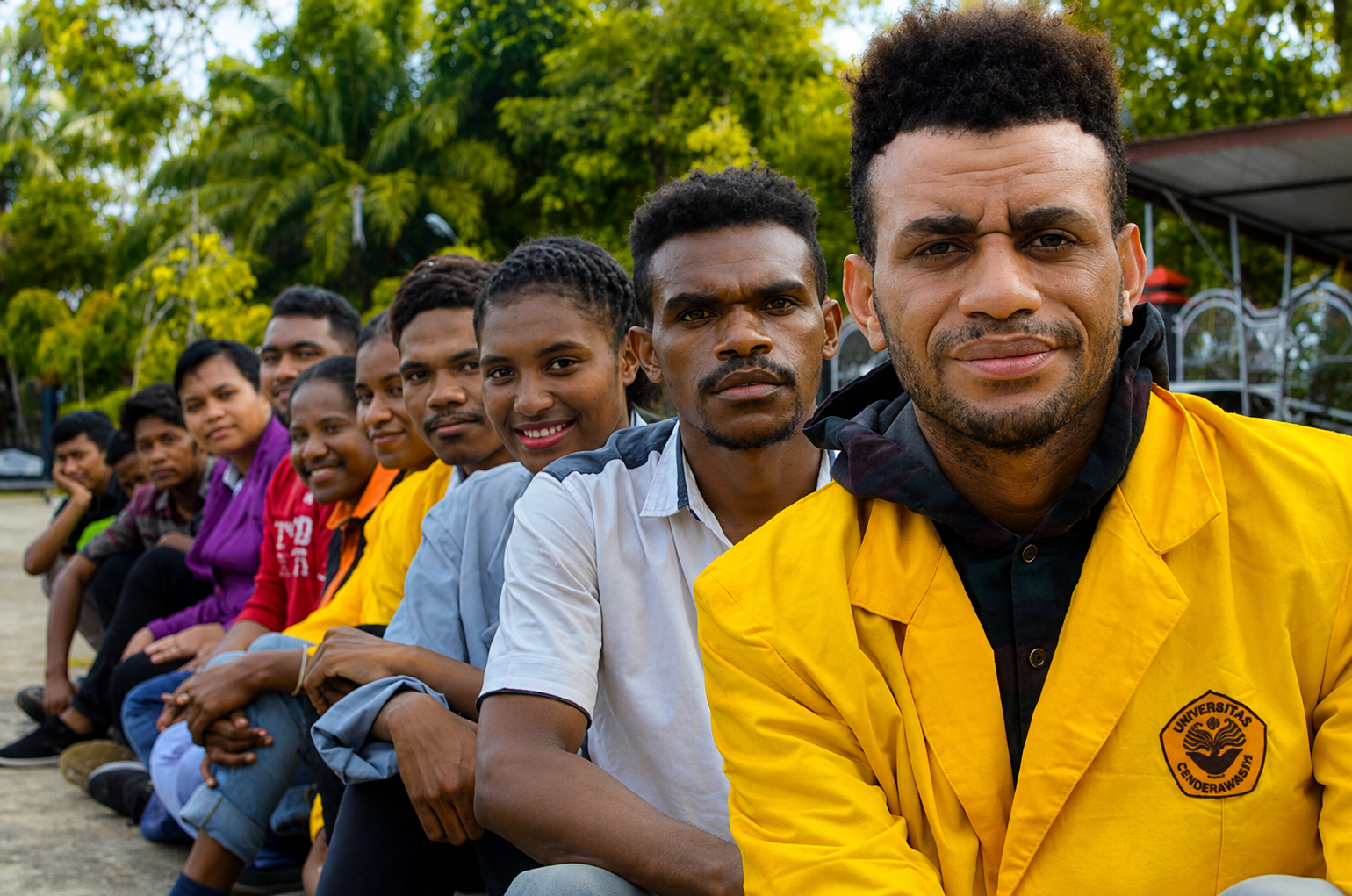
In a region where distance, household income, and access to quality schools can shape a child’s future, a free education program is becoming one of the Papua Tengah (Central Papua) provincial government’s most significant investments in human capital.
By 2026, the Government of Papua Tengah says its free education program has reached more than 64,000 students and university students. The figure includes more than 58,000 students at junior and senior secondary schools, vocational schools, special schools, and boarding schools, as well as approximately 6,000 university students studying in different locations. Some students from Papua Tengah are also receiving support while pursuing higher education overseas.
The scale of the program places education at the center of the province’s strategy to improve the quality of human resources, particularly among Orang Asli Papua (OAP), or Indigenous Papuans. Rather than treating education assistance simply as a social subsidy, the provincial government presents it as a long-term investment in a generation expected to contribute to Papua’s economic and social development.
Education as a Long-Term Investment in Papua
For Papua Tengah, the challenge is not simply getting children into classrooms. The wider question is whether young Papuans can acquire the skills, qualifications, and experience needed to participate in an increasingly competitive economy.
The provincial government has therefore sought to reduce one of the most immediate barriers to education: cost.
Governor Meki Nawipa said the program is intended to ensure that financial limitations do not prevent people from accessing education. According to the provincial government, more than 58,000 students in junior high schools, senior high schools, vocational schools, special schools, and school dormitories are being supported in 2026. Around 6,000 university students are also included.
The approach is particularly important in a province where communities are spread across large and geographically challenging areas.
Education costs do not always stop at tuition fees. Families can also face expenses for accommodation, transportation, books, school supplies, and daily living. For students who leave their home communities to study elsewhere, those costs can become even more significant.
By providing broader financial support, the provincial program seeks to make continued education more realistic for families that might otherwise struggle to finance it.
Keeping Students in School
One of the clearest objectives is preventing children from leaving school because of financial difficulties.
That issue has implications far beyond individual households. When students leave school prematurely, their future employment opportunities can become narrower. For a region seeking to improve productivity and diversify its economy, retaining young people in education is therefore also an economic policy.
The provincial government has described the program as part of its effort to reduce the risk of students dropping out because of financial constraints.
That objective gives the program a particularly important role in rural and remote communities, where household incomes and access to educational facilities can vary considerably.
More Than 64,000 Beneficiaries
The headline figure of more than 64,000 beneficiaries reflects the breadth of the initiative.
The program covers several levels of education rather than concentrating exclusively on university scholarships. Students in junior high school, senior high school, vocational schools, and special schools are included, alongside students living in school dormitories. Approximately 6,000 university students are receiving support at the higher education level.
This creates a continuum.
A child entering the education system can potentially receive support through several stages of their academic journey. At the other end, university students can receive assistance to complete higher education and acquire professional qualifications.
For Indigenous Papuan communities, such continuity matters because human capital development is rarely achieved through a single scholarship or short-term intervention.
It requires sustained access to education from childhood through adulthood.
Supporting Students Beyond Papua
Another notable element is the government’s support for students studying outside the province and overseas.
According to Governor Meki Nawipa, the program also covers students from Papua Tengah pursuing education abroad. The provincial government allocates approximately Rp30 billion annually through a grant mechanism for students overseas.
Studying outside Papua can expose young people to different academic environments, professional networks, and technologies.
For students who eventually return home, that experience can potentially become an important source of knowledge for Papua’s development.
A university graduate trained in engineering, medicine, economics, agriculture, or another professional field can contribute skills that are difficult to develop solely through local educational resources.
The broader objective is therefore not simply to send students away. It is to expand their opportunities while building a pool of educated people who can eventually strengthen their communities.
Why Human Capital Matters for Papua
Papua’s development agenda increasingly depends on the availability of qualified local workers.
Infrastructure requires engineers and technicians. Hospitals need doctors, nurses, and health professionals. Schools need qualified teachers. Public institutions require administrators, economists, legal professionals, and information technology specialists. Businesses need entrepreneurs and managers.
A workforce that is not sufficiently educated cannot fully realize the potential of infrastructure and investment.
This situation makes education one of the most important foundations of Papua’s development strategy.
The Papua Tengah program is particularly relevant because it combines broad access with higher education support. In principle, that creates a pathway from basic education to professional qualifications.
For Indigenous Papuans, expanding that pathway can also strengthen participation in the region’s own economic transformation.
The teacher Is Just as Important as the Student.
Providing free education does not automatically guarantee educational quality.
The provincial government appears to recognize this distinction.
Governor Meki Nawipa said that expanding access must be accompanied by improvements in the quality of teachers. Over the past two years, the provincial government has supported 1,800 teachers in obtaining professional certification. The program also provides additional incentives intended to improve teacher welfare.
That component is important because teachers remain the most direct link between education policy and what happens inside a classroom.
A government can provide buildings, textbooks, scholarships, and technology, but the quality of instruction ultimately depends heavily on teachers.
Professional certification can strengthen teachers’ qualifications, while additional incentives may help improve their economic conditions and motivation.
For remote areas, teacher retention is particularly important. Schools can struggle when qualified teachers are difficult to recruit or when educators are unable to remain in isolated communities for long periods.
The investment in teacher certification therefore complements the financial assistance provided to students.
Building an Education System That Includes Everyone
The broader direction of education policy in Papua Tengah also includes the concept of inclusion.
Earlier in 2026, Governor Meki Nawipa described inclusive education as an important symbol of educational progress in the province and stressed that children with disabilities should not be excluded from access to quality education. The provincial government has identified improvements to general schools and special schools, as well as efforts to make regular schools more disability-friendly, among its priorities.
This is relevant to the free education program because access and inclusion are closely connected.
A school may be financially accessible but still difficult for a child with disabilities to attend if the facilities, teaching methods, or learning environment are inadequate.
An effective education policy therefore has to address several barriers at the same time.
For Papua Tengah, the challenge is to ensure that the expansion of enrollment is matched by improvements in facilities, teachers, and learning quality.
Free Education and the Local Economy
The economic implications of the program extend beyond the education sector.
A more educated workforce can help local businesses move toward activities requiring greater technical skills and productivity. Agriculture, mining services, tourism, fisheries, construction, logistics, and digital services all require workers with increasingly specialized knowledge.
Vocational education can be especially important in this context.
Students who graduate from vocational schools can acquire practical skills that may allow them to enter the workforce more quickly, start businesses, or continue to higher education.
Meanwhile, university graduates can contribute to professional sectors that require advanced qualifications.
The long-term economic return from education is therefore likely to be measured not only by graduation numbers but also by employment, entrepreneurship, productivity, and the ability of local institutions to retain skilled workers.
Overseas Study and the Question of Return
Sending students overseas creates opportunities, but it also raises an important policy question: how can Papua benefit from the knowledge gained abroad?
The provincial government’s decision to finance students studying overseas suggests an expectation that international education will contribute to the province’s human resource development.
For that investment to produce its strongest long-term impact, graduates will need opportunities to apply their skills.
This could involve careers in provincial government, local businesses, schools, hospitals, universities, or development organizations.
It could also mean creating an environment in which graduates can establish businesses of their own.
A student who studies technology abroad, for example, may eventually bring digital skills into Papua. A graduate trained in agriculture could introduce new approaches to production and processing. Someone studying public policy could contribute to more effective government administration.
The value of overseas education is therefore potentially much greater than the degree itself.
A Development Strategy Built Around People
Papua has received significant attention for infrastructure development, connectivity, and public services. Roads, airports, electricity, and telecommunications remain essential.
Yet infrastructure requires people capable of using, managing, and maintaining it.
This is where education becomes strategically important.
A new hospital requires trained medical personnel. A new airport needs aviation and logistics professionals. Digital infrastructure needs technicians and software specialists. Government programs require administrators capable of planning and evaluating policies.
Investment in human resources can therefore determine whether physical infrastructure delivers sustainable results.
The Papua Tengah free education program represents an attempt to address that human dimension of development.
Its reach of more than 64,000 students gives it considerable potential, but the quality and long-term outcomes of the program will ultimately matter more than the headline figure.
From Access to Quality
The next phase of the program will likely shift from access to quality.
Financial support is a crucial initial step. The more difficult task is ensuring that students receive education that prepares them for further study, employment, and civic life.
Governor Meki Nawipa has said the government wants students not only to become academically capable but also to develop honesty, integrity, and a determination to progress.
That emphasis reflects a broader understanding of education.
Schools and universities do not only produce graduates. They shape the skills, values, and confidence of future citizens.
The distinction is significant for Papua Tengah, where the younger generation will play a major role in the province’s future.
A Model for Inclusive Development
The scale of the program also illustrates how regional governments can use education policy as a tool for inclusive development.
Instead of concentrating assistance solely on a small number of high-performing students, the Papua Tengah program reaches tens of thousands of learners across multiple educational levels.
At the same time, support for higher education creates opportunities for students to pursue specialized qualifications.
The combination could help widen access while maintaining a pathway toward professional development.
The challenge will be ensuring transparency, accurate beneficiary data, effective monitoring, and measurable outcomes as the program expands.
Those elements are essential for maintaining public confidence and ensuring that education funding reaches the students who need it.
Looking Ahead
The next several years will determine whether the current investment can translate into measurable improvements in Papua Tengah’s human capital.
The provincial government’s education strategy has already moved beyond the question of whether young people should receive assistance. With more than 64,000 beneficiaries, the central question is increasingly about what those students will achieve.
Will more children remain in school?
Will more students graduate from university?
Will vocational graduates secure productive employment?
Will overseas graduates return and contribute their expertise?
And perhaps most importantly, will education help create a generation of Indigenous Papuans capable of taking a stronger role in the region’s economic, social, and institutional development?
Those outcomes will require more than government funding. Parents, teachers, schools, universities, communities, and employers will all have a role.
The government’s investment can provide the foundation, but the long-term success of the program will ultimately be visible in the lives and careers of the students it supports.
Conclusion
The Papua Tengah government’s free education program has reached more than 64,000 students in 2026, including more than 58,000 school students and around 6,000 university students. The program also supports Papua Tengah students studying outside the province and overseas, with approximately Rp30 billion allocated annually through a grant scheme for overseas students.
For Papua Tengah, the initiative represents more than assistance with school fees. It is an investment in people and an effort to reduce the economic barriers that can prevent young Papuans from completing their education.
Its decision to support teacher certification for 1,800 educators also recognizes that access alone is not enough. Better trained and better supported teachers are essential if increased enrollment is to translate into improved educational outcomes.
The broader significance lies in the potential connection between education and Papua’s future economy. A generation with stronger academic, technical, and professional skills can help manage infrastructure, strengthen public services, develop local businesses, and participate more competitively in regional and national markets.
For Indigenous Papuans, that opportunity carries an additional significance. Building human capital can strengthen their participation in the development of their communities while creating a wider pool of local expertise.
The real measure of the program will not ultimately be the number of students receiving assistance. It will be whether those students graduate with the knowledge, skills, integrity, and confidence to build productive futures.
If the investment in free education is sustained and accompanied by improvements in teaching quality, infrastructure, and employment opportunities, Papua Tengah could turn today’s education spending into one of its most valuable long-term development assets.

