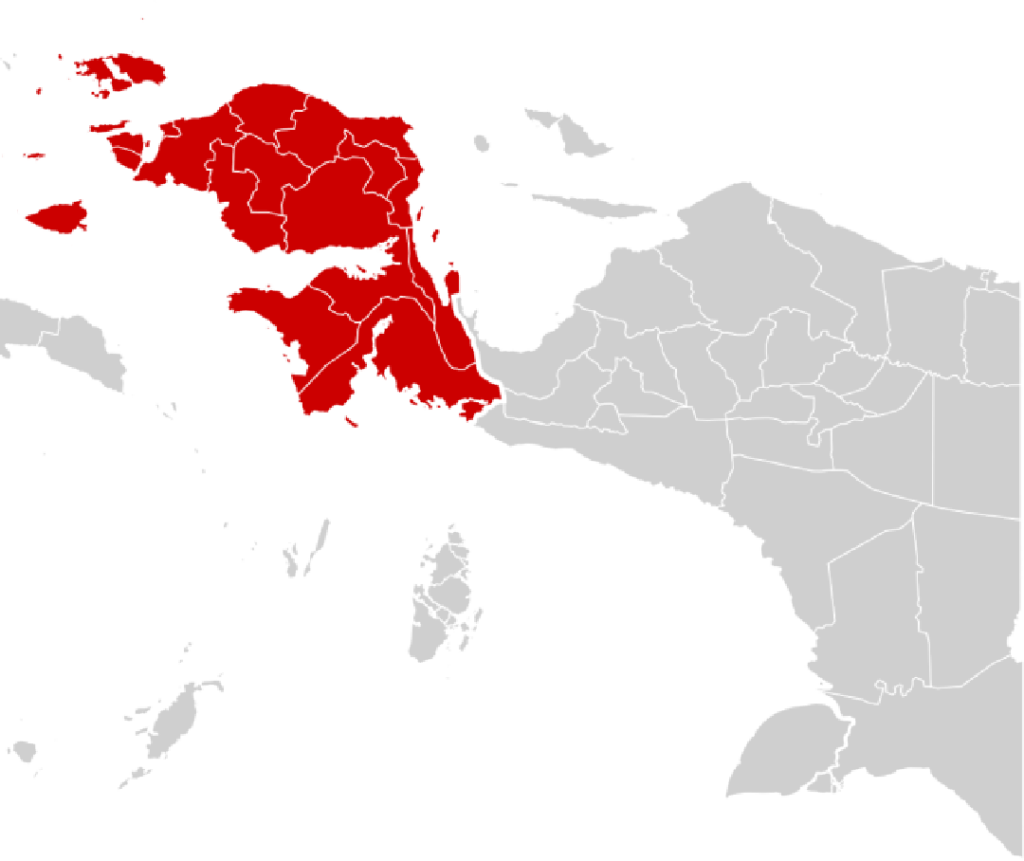
The RI-PNG border in Papua is more than a line separating two countries. For generations, communities on both sides have maintained family, cultural, customary, and social relationships that often existed long before modern border administration took shape. Now, the Papua provincial government is seeking to bring those traditional movements into a clearer and more accountable system.
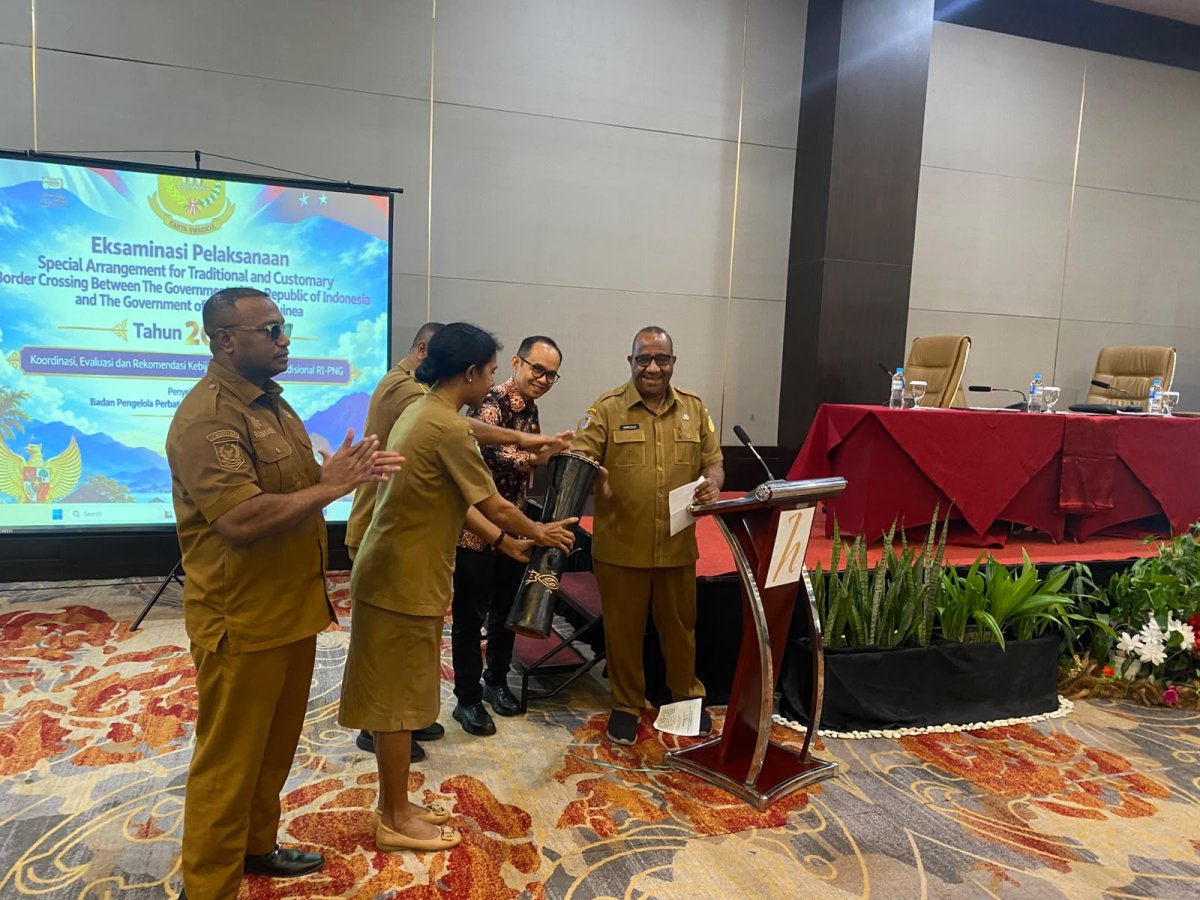
On September 22, 2026, the Papua Provincial Border Management Agency, or BPP Papua, evaluated the implementation of the Special Arrangement RI-PNG, focusing on how traditional and customary border crossings can be regulated while taking into account the changing realities of the border region. The review was held in Jayapura and involved discussion of infrastructure, information technology, public services, governance, security, and community needs.
The government says the objective is not to cut historical ties between border communities. Instead, it wants traditional movements that still take place through informal routes to operate through mechanisms that are official, legal, orderly, verifiable, and subject to supervision.
Papua is developing a policy that centers on that distinction.
Why Papua Is Reviewing the Special Arrangement
The review comes as conditions along the Indonesia-Papua New Guinea border continue to change.
Triwarno Purnomo, head of the Papua Provincial Border Management Agency, said the existing rules need to be examined objectively because the border environment is no longer the same as when earlier arrangements were developed.
Infrastructure has changed. Information technology has expanded. Government administration and public services have evolved. At the same time, communities living around the border continue to face practical challenges in accessing formal travel documentation and reaching official crossing points.
For the Papua provincial government, these changes create a need to assess whether the current arrangements remain appropriate for conditions on the ground.
Governor Matius Fakhiri conveyed a similar message through First Assistant to the Papua Regional Secretary Yohanes Walilo during the Special Arrangement examination forum in Jayapura on September 22.
Fakhiri said the review was not simply an exercise to identify weaknesses in existing regulations. Rather, the government wanted to ensure that border-crossing policies remained capable of responding to developments in the region.
“This examination is not merely about finding weaknesses in regulations. We want to ensure that border-crossing policies can respond to developments in the times,” Fakhiri said, according to the Papua provincial government.
His statement reflects the broader direction of the evaluation: adapting regulation without abandoning the legal framework governing the national border.
Traditional Communities Remain at the Center
One of the most sensitive aspects of border management in Papua is the relationship between formal state administration and traditional community life.
Triwarno emphasized that the Indonesia-PNG border should not be viewed solely as a jurisdictional line dividing two sovereign states. It is also a space where communities interact socially, culturally, and economically while maintaining customary and family relationships that have developed over generations.
This reality holds particular significance for communities whose social networks predate the establishment of modern border controls.
The provincial government therefore says border residents should not simply be treated as objects of regulation. They should also be considered subjects of development and important partners in maintaining the border area as the eastern front porch of the Republic of Indonesia.
Triwarno emphasized that the planned restructuring aims to preserve family, historical, and customary relationships rather than sever them.
Instead, the objective is to ensure that those relationships can continue through a system that is formally recognized and supervised.
“The restructuring is not intended to sever family, kinship, historical, and customary ties, but to ensure that these relationships can take place through official, legal, orderly, verified, and supervised mechanisms,” Triwarno said.
The approach gives the border issue a distinctly local dimension. Rather than treating traditional movement as inherently incompatible with state regulation, Papua’s provincial government is examining how existing social realities can be incorporated into a clearer administrative framework.
Informal Routes and the Need for Better Information
A major issue identified during the evaluation is the continued use of informal routes.
Triwarno acknowledged that some residents still cross the border through routes outside formal crossing points. He attributed this partly to Papua’s vast geographical conditions and difficult terrain.
The province’s border areas cover landscapes where transportation and access can be challenging. For some communities, reaching formal crossing points may not always be straightforward.
Another concern is access to official travel documents.
According to Triwarno, limited access to travel documentation is one of the factors that needs attention when authorities consider how the existing border system should work in practice.
This creates a policy challenge.
A border system must protect national sovereignty, security, and public order. At the same time, it must remain practical enough for people who live in remote communities and have maintained cross-border relationships for generations.
The provincial government’s response is to improve the system rather than simply impose restrictions.
The goal is to transform an informal system, which can be vulnerable to violations, into one that is official, legal, orderly, verifiable, and professionally supervised.
The Papua government is exploring a process to gradually integrate informal traditional crossing practices into a formal mechanism.
Triwarno described the goal as transforming an informal system that can be vulnerable to violations into one that is official, legal, orderly, verifiable, and professionally supervised.
The proposed approach does not mean creating unrestricted movement.
The provincial government has made clear that any special arrangement would remain within Indonesia’s national legal system.
“A special arrangement does not mean eliminating the rules or allowing freedom without rules. We remain within the framework of the national legal system,” Triwarno said.
This point is important because the reform is being positioned as regulatory adaptation rather than deregulation.
The intention is to make the rules more responsive to border communities while preserving accountability, security, and public order.
Coordination Across Government Agencies
The Papua Provincial Border Management Agency is also coordinating with agencies that have direct responsibilities at the border.
These include customs, immigration, quarantine authorities, vertical government agencies operating at the State Border Crossing Posts, or PLBN, and the Border Security Task Force.
The coordination is intended to prevent border management from becoming fragmented between institutions.
Triwarno said each institution continues to carry out its respective duties while working together to make the management of traditional movement more effective and balanced between community interests and security considerations.
This institutional coordination also matters because border movement involves more than immigration checks.
People, goods, agricultural products, livestock, and other activities can potentially involve customs, quarantine, public health, immigration, and security considerations. A coordinated system can therefore provide a clearer chain of responsibility.
For Papua, improving coordination is part of a broader effort to strengthen governance in a strategically important region.
Testing Solutions Before Changing the Rules
The government is not presenting the evaluation as an immediate replacement of the existing system.
Instead, Triwarno said authorities would first identify problems and shortcomings in the current arrangement. The government could then conduct limited trials of possible solutions before using the results to develop a more specific regulatory framework.
“The step is to identify obstacles, then conduct small-scale trials to see which solutions are appropriate before formulating a special arrangement,” he said.
This staged approach could allow authorities to assess whether proposed procedures actually work for communities in remote border areas.
It also allows government agencies to pinpoint practical issues before implementing a new mechanism on a larger scale.
For residents, the success of such a system will ultimately depend on whether formal procedures are accessible, understandable, and compatible with the realities of border life.
For the state, the challenge will be ensuring that greater accessibility does not weaken oversight.
Security and Community Welfare Must Move Together
The Papua government’s approach places security and community welfare within the same policy framework.
Official crossing points with inspection procedures and standard operating procedures, or SOPs, need to be accompanied by joint monitoring and balanced enforcement by both countries, Triwarno said.
That means strengthening border governance does not simply involve building checkpoints or issuing regulations.
It also requires communication between agencies, reliable information, documentation, supervision, and an understanding of the communities that use the border.
In this context, technology and improved information management become increasingly relevant. The provincial government specifically identified changes in information technology as one reason the Special Arrangement needs to be reviewed.
The effort is therefore also about making information on border movements clearer and more manageable.
For Indonesia, a more structured system could help government agencies distinguish legitimate traditional movement from activities that require further scrutiny while giving border communities a clearer pathway to comply with formal procedures.
A Border Policy That Reflects Papua’s Changing Reality
The evaluation of the Special Arrangement also comes at a time when infrastructure and public services in Papua’s border areas are receiving greater attention.
The provincial government’s own statement links the review to changes in infrastructure, governance, services, trade, technology, and security.
That broader context matters.
Border management cannot operate separately from development. Better roads and transportation can influence how communities reach border facilities. Improved communications can make government services easier to access. More effective public administration can reduce uncertainty for residents who need documents or government assistance.
These developments are part of the wider transformation of Papua’s connectivity and public services, including the provincial government’s efforts to improve transportation and infrastructure.
For readers following these developments, the West Papua Voice report “Nabire Airport Expansion Strengthens Papua Connectivity” provides another example of how transportation infrastructure is being positioned as part of Papua’s broader regional development.
Similarly, “AHY Pushes Stronger Infrastructure Connectivity in Papua” examines the government’s wider effort to connect communities, markets, and public services across Papua.
Together, these developments point to an increasingly integrated approach in which connectivity, governance, and border management are closely connected.
What Comes Next for the RI-PNG Border?
The September evaluation does not yet represent the final form of a new border-crossing system.
The sources indicate that the government is still identifying obstacles, assessing existing procedures, and considering limited trials before formulating a more specific arrangement.
That makes the next stage particularly important.
The practical test will be whether a formal mechanism can accommodate the social and customary realities of border communities while maintaining the authority of Indonesian law.
The Papua provincial government has made its position clear: traditional relationships should continue, but they should take place through mechanisms that are legal, orderly, verifiable, and supervised.
For Indonesia, that approach places border governance within a wider state-building effort in Papua. It seeks to strengthen the administration of the country’s frontier without treating local communities and their long-standing relationships as obstacles.
Conclusion
The Papua government’s review of the RI-PNG border is ultimately an attempt to reconcile two realities that have existed side by side for generations.
One is the formal reality of an international boundary, with national laws, security responsibilities, immigration procedures, and government oversight.
The other is the everyday reality of border communities whose families, customs, and social relationships do not necessarily stop at an international line.
The provincial government is now seeking a mechanism that recognizes both.
By evaluating the Special Arrangement, coordinating Customs, Immigration, Quarantine, PLBN authorities, and border security personnel, and considering small-scale trials before developing new procedures, Papua is pursuing a more structured approach to border management.
The ability to make legal border movement more accessible while maintaining security and public order will ultimately determine the policy’s success.
For Papua, the frontier is not simply where Indonesia ends. It is also where communities meet, trade, maintain family relationships, and interact with a neighboring country.
The challenge ahead is to ensure that those relationships remain possible within a stronger, clearer, and more accountable border system.
If that balance can be achieved, the reform of traditional cross-border movement could become not a barrier to community ties but a framework that gives those ties a safer and more orderly place within Indonesia’s national border governance.
Read Also
PNG Police Rescue 39 Indonesians from Human Trafficking Ring
RRI Expands Information Access Across Papua Border
Paitenda Border Post Signals a New Chapter in Indonesia and Papua New Guinea