
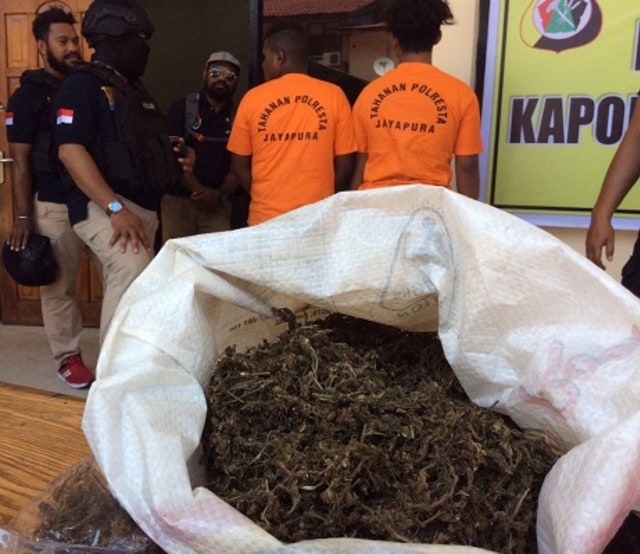
A major crackdown on Papua motorcycle theft has taken a new turn after Indonesian police revealed that two suspects admitted to exchanging stolen motorcycles for cannabis originating from neighbouring Papua New Guinea (PNG). The disclosure has raised questions about whether some vehicle theft cases in Papua may be connected to cross border drug trafficking.
Papua Regional Police are now investigating the alleged barter arrangement, which emerged following an intensified law enforcement operation between October 26 and November 7, 2026. The operation resulted in 56 arrests and the recovery of 104 motorcycles across eight police jurisdictions.
The findings suggest that investigators may be dealing with more than conventional vehicle theft. While most cases remain under investigation as property crimes, the admissions by two suspects have introduced a possible connection between stolen vehicles and illegal narcotics.
Police have stressed, however, that the suspected exchanges remain under investigation. The available evidence does not establish that all motorcycle theft cases in Papua are connected to drug trafficking or that a wider cross-border criminal network has been identified.
Papua Police Investigate Alleged Motorcycle for Cannabis Exchanges
The latest development was disclosed on November 10, when Papua Regional Police Director of General Criminal Investigation Senior Commissioner Herman Gultom addressed journalists in Jayapura.
According to ANTARA, Gultom confirmed that two individuals among the 56 people arrested during the recent operation had admitted previously exchanging stolen motorcycles for cannabis from Papua New Guinea.
“At present, only two of the 56 motorcycle theft suspects have admitted exchanging stolen motorcycles for cannabis from PNG,” Gultom said, as translated from his statement to ANTARA.
His remarks represent an important development in an investigation initially focused on recovering stolen vehicles and identifying those responsible for thefts in several Papuan cities.
The alleged exchanges could indicate that stolen motorcycles were used as a form of payment rather than simply being sold for cash. If corroborated, such arrangements would raise further questions about the movement of stolen property and narcotics across the Indonesia-Papua New Guinea border.
Yet several important details remain unresolved.
Police have not publicly identified the locations where the alleged exchanges occurred, the quantities of cannabis involved, the identities of the alleged trading partners, or whether the motorcycles physically crossed the international border.
Investigators have also not publicly established whether the two suspects acted independently or were connected to a larger criminal organisation.
These distinctions matter. The suspects’ admissions provide grounds for further investigation, but they do not by themselves prove the existence of an organised cross-border trafficking network.
How the Motorcycle Theft Investigation Developed
From October 26 to November 7, the Papua Regional Police intensified their efforts to investigate motorcycle theft, which is known locally as pencurian kendaraan bermotor or curanmor.
The investigation began as part of Kegiatan Rutin yang Ditingkatkan (KRYD), Indonesia’s Enhanced Routine Police Activities, designed to strengthen enforcement against recurring criminal offences.
The operation involved the Directorate of General Criminal Investigation and criminal investigation units from eight police jurisdictions: Jayapura City, Jayapura Regency, Biak Numfor, Merauke, Mappi, Jayawijaya, Boven Digoel and Supiori.
The participating jurisdictions are spread across the three provinces covered by Papua Regional Police: Papua, Papua Pegunungan and Papua Selatan.
According to Gultom, the operation was deliberately concentrated in areas where motorcycle theft had become a significant concern.
“The enhanced routine activities specifically targeted motorcycle theft cases that have been occurring frequently in several cities under Papua Police jurisdiction,” he said, according to ANTARA.
The coordinated enforcement effort was intended to identify suspected offenders, recover missing vehicles and respond to complaints from residents whose motorcycles had disappeared.
November 9: Police Announce 51 Theft Cases and 56 Arrests
On November 9, Papua Regional Police presented the results of the two-week operation at a press conference in Jayapura.
As previously reported by West Papua Voice, investigators had identified 51 motorcycle theft cases or complaints, arrested 56 suspects and secured 104 motorcycles of various types.
Papua Police Public Relations Chief Commissioner Cahyo Sukarnito described the results as the outcome of cooperation between the provincial criminal investigation directorate and police units in the participating jurisdictions.
The announcement demonstrated the scale of the enforcement operation, but it did not establish that the suspects belonged to a single criminal organisation.
The cases involved separate reports and investigations, and the precise relationships between individual suspects and stolen vehicles remain matters for police examination.
At the same briefing, police also described the techniques allegedly used in the thefts, including specialised T-shaped keys, damaged ignition systems and broken steering locks.
The methods indicated that offenders had exploited weaknesses in motorcycle security, sometimes taking vehicles without access to their original keys.
November 10: Investigation Expands to Suspected Drug Barter
A day after the broader operation was publicised, Gultom disclosed the two suspects’ admissions concerning cannabis from Papua New Guinea.
The announcement shifted attention toward the possible destinations of stolen motorcycles and how offenders might benefit financially or materially from the theft.
For investigators, the distinction is significant.
A motorcycle stolen for personal use or resale may involve a relatively straightforward property crime. A motorcycle exchanged for illegal drugs could potentially involve additional offences and participants beyond the original theft.
However, the available police statements do not establish whether the alleged exchanges occurred during the October 26 to November 7 operation or at an earlier time.
The investigation must therefore determine the chronology of the alleged barter transactions separately from the dates of the enforcement operation.
Why the Alleged PNG Connection Matters
A Border Shared by Two Neighbouring Countries
Indonesia and Papua New Guinea share a land border across the island of New Guinea, making cross-border security an important issue for both countries.
The frontier connects communities with longstanding geographical, cultural and family relationships. Legitimate cross-border movement, trade and community interaction are important parts of life in the region.
At the same time, the possibility that stolen motorcycles may have been exchanged for cannabis emphasises the necessity to distinguish lawful border activities from suspected criminal transactions.
If the suspects’ accounts are verified, investigators would need to determine how the alleged exchanges were arranged, who received the motorcycles and whether the cannabis entered Indonesian territory through illegal channels.
Such findings could help establish whether the alleged barter was an isolated arrangement or part of a more extensive pattern.
The distinction is particularly important because no evidence released in the cited reports establishes that ordinary border communities, legitimate traders or Papua New Guinea authorities were involved.
The investigation concerns the conduct of specific suspected offenders, not the broader relationship between the populations of the two countries.
Possible Links Between Property Crime and Drug Distribution
The alleged exchange also introduces an economic dimension to the investigation.
Stolen property can potentially be used as payment for illicit goods when offenders are unable or unwilling to conduct ordinary cash transactions.
In this case, the suspects’ reported admissions suggest that at least two individuals may have treated stolen motorcycles as items of exchange for cannabis.
If confirmed through independent evidence, the transactions could help investigators understand how the value of stolen vehicles was converted into narcotics.
Such an arrangement could also complicate the recovery of stolen motorcycles because vehicles transferred to other individuals may be more difficult to locate.
Nevertheless, the police have not disclosed evidence showing that the recovered motorcycles were involved in the alleged cannabis transactions.
The 104 vehicles secured during the operation should therefore not be described collectively as motorcycles used in drug trafficking.
Police Examine Theft Methods and Possible Receivers
The alleged drug connection emerged alongside a wider investigation into how motorcycles were stolen and where they went afterwards.
According to the earlier West Papua Voice report, investigators identified several methods used by suspects, including manipulating vehicle locks with T-shaped tools, damaging ignition mechanisms and breaking steering locks.
The reported thefts occurred at different times, including during the afternoon, evening and early morning.
Police also identified one person suspected of receiving stolen goods in the Jayapura Police jurisdiction.
That finding is relevant because receivers can provide an important investigative link between the original theft and the subsequent movement of stolen property.
However, there is no publicly established connection between the suspected receiver and the two individuals who admitted exchanging motorcycles for cannabis.
Investigators must determine whether any relationship exists rather than assume that the cases form part of the same criminal arrangement.
The earlier police disclosure also indicated that some suspects had previously been involved in criminal offences, although the exact number of repeat offenders had not been finalised.
Taken together, the findings demonstrate why investigating motorcycle theft requires attention not only to the act of stealing but also to the subsequent handling of the vehicles.
Motorcycle Theft Creates Financial Pressure on Papuan Families
Behind the investigation are residents who have lost vehicles used for work, education and daily travel.
In Papua, motorcycles are important for mobility, particularly where public transport services are limited or travel between residential and commercial areas can be difficult.
A stolen motorcycle can disrupt a family’s income, prevent workers from reaching their jobs and impose unexpected replacement costs.
For small business owners, losing a motorcycle may also affect deliveries, customer visits and other everyday activities.
The financial impact helps explain why the recovery of stolen vehicles has become an important part of the police operation.
According to the November 9 West Papua Voice report, three motorcycles had already been returned to their verified owners, while seven others were being prepared for handover following ownership checks.
On November 10, ANTARA documented Gultom handing a recovered motorcycle to a resident who had previously reported it missing.
The return of recovered property provides a practical outcome for affected residents, even as investigations and legal proceedings continue.
Police have encouraged anyone who has lost a motorcycle to check whether it is among the 104 vehicles secured during the operation.
Claimants must provide appropriate documentation demonstrating lawful ownership before a motorcycle can be released.
This verification is necessary to ensure that recovered vehicles are returned to the correct people and that evidence is properly managed during the investigation.
Strengthening Public Security Through Continued Enforcement
The investigation illustrates the importance of sustained law enforcement across several jurisdictions rather than isolated action against individual theft cases.
Papua Regional Police cover 21 police resort and city commands across Papua, Papua Pegunungan and Papua Selatan. The recent KRYD operation involved eight of those jurisdictions.
By combining investigative work across different locations, police were able to consolidate reports, identify suspects and recover motorcycles within a relatively short period.
The alleged cannabis connection also demonstrates why information obtained during ordinary criminal investigations can generate new investigative leads.
What began as an effort to address motorcycle theft has now produced allegations that require examination beyond the original property offences.
For Indonesian authorities, a thorough investigation could provide a clearer understanding of whether additional measures are necessary to address the movement of stolen vehicles and illegal drugs.
Any future cooperation involving border security or narcotics investigations would need to be based on verified findings and appropriate legal procedures.
The cited reports have not announced a new bilateral operation with Papua New Guinea, and no such initiative should be assumed to be underway.
Public Cooperation Remains Essential
Gultom has urged motorcycle owners to remain vigilant and ensure that their vehicles are properly secured when parked.
Police have also encouraged residents to report thefts promptly and provide accurate vehicle ownership information when seeking the return of recovered motorcycles.
Additional precautions, including secure parking, supplementary locks and surveillance equipment where available, may help reduce opportunities for theft.
Public cooperation can also assist investigators in identifying stolen vehicles and establishing the circumstances surrounding individual cases.
At the same time, effective law enforcement depends on ensuring that suspects are investigated fairly and that allegations are supported by evidence.
The two individuals who admitted participating in the alleged barter transactions remain subjects of an ongoing investigation. Their statements must be examined alongside other evidence before any broader conclusions can be drawn.
Conclusion
The discovery of a possible connection between Papua motorcycle theft and cannabis originating from Papua New Guinea has introduced a new dimension to an already significant criminal investigation.
The two-week KRYD operation produced 51 reported theft cases, 56 arrests and the recovery of 104 motorcycles, demonstrating the capacity of coordinated police enforcement to respond to crimes affecting residents across several Papuan jurisdictions.
The subsequent admissions by two suspects have raised a further question: whether some stolen motorcycles are being used as payment in illegal drug transactions.
For now, that possibility remains under investigation.
The next stage will require police to verify the suspects’ accounts, establish the circumstances of any exchanges and determine whether additional individuals or offences are involved.
The outcome could help Indonesian authorities better understand the relationship between vehicle theft and narcotics offences in the border region.
More immediately, the recovery and return of stolen motorcycles offers tangible assistance to families and workers whose daily lives have been disrupted by crime.
For Papua, continued law enforcement, transparent investigations and cooperation between residents and police will remain central to protecting public safety.
The suspected connection with cannabis from Papua New Guinea is an important investigative lead, but its wider significance will depend on what the evidence ultimately establishes.
Read Also
Papua Police Uncover 51 Motorcycle Theft Cases
Papua Traffic Accidents Fall 60% After Patuh Cartenz Operation

