
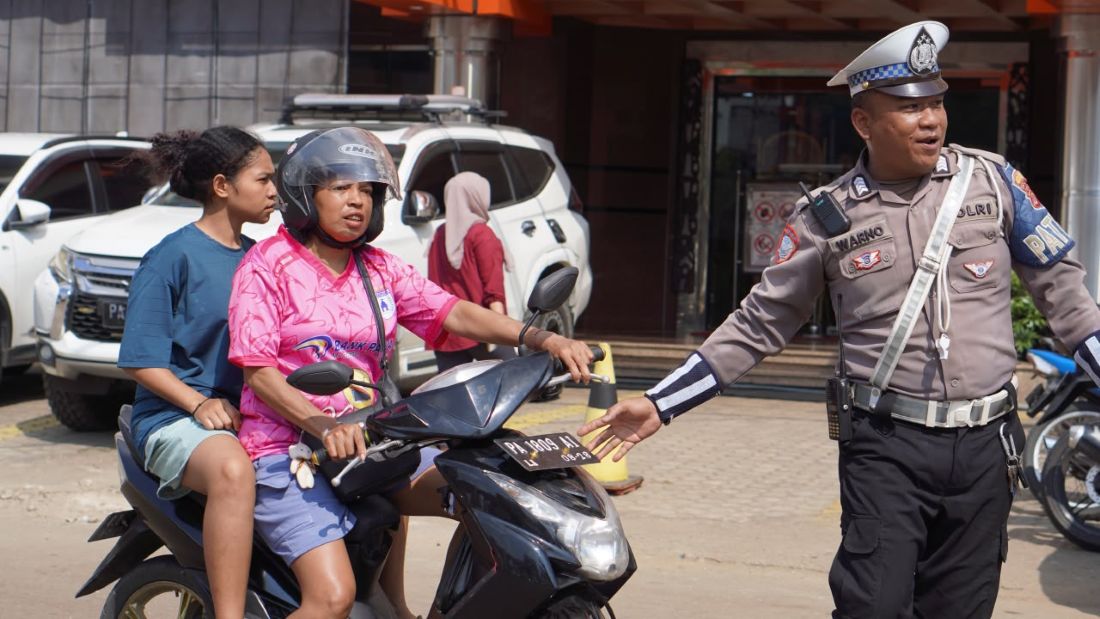
Traffic accidents in the jurisdiction of Papua Regional Police fell by 60 percent during the 2026 Patuh Cartenz Operation, according to an evaluation released on November 9. The Patuh Cartenz Operation in Papua ran for 14 days, from October 26 to November 8, bringing together police personnel to improve road discipline, prevent dangerous driving, and reduce the number of people killed or injured on the region’s roads.
The Directorate of Traffic of Papua Police recorded 44 traffic accidents during the operation, compared with 109 in the two weeks immediately before it. The reduction was accompanied by a significant fall in fatalities, serious injuries, and material losses, suggesting that the campaign’s emphasis on prevention and public education was producing measurable results.
Traffic Directorate Chief Commissioner Rahman Wijaya said the findings came from an analysis and evaluation of the operation. He attributed the improvement to increased preemptive and preventive activities carried out by police units, which sought to encourage safer behavior before violations resulted in accidents.
The campaign was not limited to roadside enforcement. Officers also conducted public education, issued warnings to motorists, monitored accident-prone locations, and reminded road users that compliance with traffic regulations is essential to protecting their lives and those of others.
For Papua, where road transport remains an important part of everyday mobility, the results offer an encouraging indication of what coordinated traffic management and sustained public engagement can achieve.
A 14-Day Campaign Focused on Road Safety
The 2026 Patuh Cartenz Operation officially began on October 26 and continued until November 8. Papua Police deployed approximately 347 personnel for the campaign, according to ANTARA’s report on the launch.
The operation carried the theme “Police Together with the Community to Create Orderly, Safe, and Road-Safety-Oriented Traffic.” Its central objective was to strengthen public discipline and reduce traffic violations that could lead to crashes and serious injuries.
The opening phase was marked by the mobilization of personnel and the start of enforcement and education activities across the police jurisdiction. The campaign focused on conduct that directly affects road safety, including distracted driving, riding without protective equipment, speeding, and driving under the influence of alcohol.
Police identified eight categories of violations as priorities.
These included using a mobile phone while driving, allowing underage individuals who do not meet legal requirements to operate vehicles, and carrying more than one passenger on a motorcycle. Officers also targeted motorcyclists without Indonesian National Standard (SNI) helmets and car occupants who failed to wear seat belts.
Other priorities included driving under the influence of alcohol, travelling against the direction of traffic, exceeding speed limits, operating vehicles that violate over-dimension and over-loading (ODOL) requirements, and using exhaust systems that do not comply with technical specifications.
The selection of these targets reflected a preventive approach. Rather than focusing solely on administrative violations, the campaign sought to address behavior that can place motorists, passengers, and other road users at immediate risk.
Jayapura Enforcement Begins with Warnings
In Jayapura City, one of the early enforcement activities took place on the afternoon of October 26 in front of the Yasmin Hotel, near the Yasmin security post on Jalan Percetakan.
The operation was led by Jayapura City Police Traffic Unit Chief AKP Muhammad Akbar. On its first day, officers issued written warnings to 49 motorcycle riders.
Of that total, 45 riders were warned for not wearing standard helmets, while four received warnings for using noisy exhaust systems that did not meet vehicle technical specifications.
The figures offered an early indication of the everyday violations that police were encountering on the city’s roads. Although the operation was designed to improve compliance, the initial findings also showed that basic protective measures remained a concern among some motorcyclists.
Akbar urged residents to wear SNI-certified helmets, ensure that their vehicles complied with technical requirements, and carry the necessary vehicle documents. He also reminded motorists not to travel against traffic or carry passengers beyond the permitted limit.
The police approach, he explained, was not simply about issuing penalties. Education and direct engagement were intended to help motorists understand why the rules mattered.
Second-Day Operation Delivers 287 Verbal Warnings
The campaign intensified on October 27, when the Papua Police Traffic Directorate conducted a roadside operation at the Papua Trade Centre (PTC) field in Entrop, Jayapura City.
The activity began with a personnel briefing led by AKBP Martin W. Asmuruf, an official of the Directorate of Traffic. Officers from the traffic directorate worked alongside representatives of Jasa Raharja and the Papua Provincial Revenue Agency.
During the briefing, Martin emphasized that personnel should prioritize an educational approach when dealing with motorists who violated traffic regulations. Warnings, he said, were intended to encourage greater understanding of road safety and strengthen compliance.
The operation resulted in 287 verbal warnings. Motorcycle riders accounted for 177 of them, while 110 were issued to car drivers.
Officers also recorded 51 warning forms, consisting of 38 for motorcycles and 13 for four-wheeled vehicles.
The figures demonstrated the scale of direct engagement during the second day. Instead of relying exclusively on punitive measures, officers used roadside interactions to explain the risks associated with unsafe driving and remind motorists of their responsibilities.
The involvement of Jasa Raharja and the provincial revenue agency also illustrated cooperation between police and other institutions in supporting road safety and vehicle compliance.
Sixty Motorcycle Riders Warned in November Enforcement
Enforcement continued into the following week. On November 4, Jayapura City Police conducted another operation on Jalan Percetakan, again in front of the Yasmin post.
Led by AKP Muhammad Akbar, officers focused on visible violations involving motorcycle riders, particularly the use of non-standard helmets and exhaust systems that did not comply with technical specifications.
A total of 60 riders received warnings. Fifty were warned for failing to wear standard helmets, while another 10 were cited for using non-compliant noisy exhaust systems.
The results reinforced a pattern observed during the first days of the campaign: helmet compliance remained a prominent issue in roadside checks, while the use of unsuitable exhaust systems was another recurring violation.
Akbar again called on the public to wear SNI-standard helmets and ensure that vehicle equipment met the applicable requirements. He said the operation was intended to build awareness and encourage discipline, rather than merely punish motorists.
The police also stressed that responsible road use protects not only the individual rider but also passengers, pedestrians, and other motorists sharing the same roads.
Police Education Extends Beyond Roadside Checks
Alongside enforcement, Jayapura City Police expanded direct public education during the campaign.
On November 2, officers conducted educational activities in the PTC Entrop area of South Jayapura District. The following day, ANTARA reported that the local police traffic unit was intensifying its efforts to explain safe driving practices to residents.
AKP Muhammad Akbar said the officers were reminding motorists to remain alert, obey traffic regulations, and avoid behavior that could endanger themselves or others.
He also used a message with a personal dimension, reminding drivers and riders that family members were waiting for them at home.
“We also continue to remind motorists that there are families waiting for them at home,” Akbar said, as quoted by ANTARA.
The message sought to make road safety more relatable. Compliance is not simply a matter of avoiding a police warning or fine. It can determine whether a person reaches home safely after travelling to work, school, a market, or another destination.
Akbar also urged motorists to check their vehicles before travelling and ensure that essential equipment was in proper condition.
His comments came against a concerning local traffic background. He reported that Jayapura City had recorded 137 single-vehicle accidents in October 2026, with six deaths, 52 serious injuries, and 106 minor injuries in the figures he cited.
The figures highlighted why road safety education remained necessary even as police intensified enforcement. Preventing accidents requires attention to vehicle condition, driver behavior, and the everyday decisions made by road users.
Accident Figures Show a Significant Improvement
The most important findings emerged from the final evaluation announced by Commissioner Rahman Wijaya on November 9.
According to the evaluation reported by Papua Terdepan, traffic accidents fell from 109 in the two weeks before the operation to 44 during the 14-day campaign, a reduction of approximately 60 percent.
The number of people killed in traffic accidents also declined, from 18 before the operation to four during the campaign, representing a 78 percent decrease.
Serious injuries fell from 57 to 32, while minor injuries dropped from 121 to 27. Material losses resulting from traffic accidents declined by 81 percent, from Rp935.9 million to Rp178 million.
The evaluation also compared the 2026 operation with the previous year’s Patuh campaign. Traffic accidents decreased from 73 in 2025 to 44 in 2026, a reduction of 40 percent.
Fatalities fell from five to four, while serious injuries declined from 53 to 32. Minor injuries dropped from 72 to 27. Material losses also decreased from Rp229.35 million to Rp178 million.
These figures provide two useful comparisons: the change from the two weeks immediately before the 2026 operation and the results recorded during the 2025 campaign. Both comparisons point to an improvement in the reported indicators.
However, the figures should be understood as the results of the police evaluation, rather than proof that enforcement alone caused every reduction. Road safety outcomes can also be influenced by traffic volume, weather, road conditions, and other factors. Even so, the scale of the improvement provides a strong basis for continuing preventive measures.
More Education and Patrols Behind the Results
Rahman said the reduction in accidents was accompanied by a substantial increase in pre-emptive and preventive police activities.
Pre-emptive activities reached 6,715 during the 2026 operation, a 34 percent increase compared with 5,011 recorded in 2025. These activities included public guidance and counseling, campaigns promoting SNI-standard helmets and seat belts, and education about the dangers of using mobile phones while driving or riding against traffic.
Preventive activities rose by 40 percent, from 5,366 in 2025 to 7,493 in 2026.
These measures included traffic management, monitoring, escort duties, and patrols during periods and at locations considered vulnerable to accidents. Police recorded 1,679 activities involving such traffic management and patrol work.
Officers were also deployed to accident-prone areas, commonly referred to as black spots, and locations where traffic violations frequently occur, known as trouble spots. A total of 1,284 activities involved personnel placement in these areas.
Personnel attendance during the operation reached 97 percent. Of the 3,070 personnel targeted, 2,988 were recorded as present.
The figures indicate that the operation relied on a combination of public engagement and visible police presence. Education sought to influence behavior, while patrols and targeted deployment allowed officers to monitor locations where the risk of violations and accidents was considered higher.
Jayapura City Records the Highest Number of Accidents
Despite the overall reduction, the evaluation showed that accident risks remained uneven across the police jurisdiction.
Jayapura City Police recorded the highest number of accidents during the operation, with 13 incidents. Merauke Police recorded 12, followed by Jayapura Sentani Police with nine.
The figures suggest that continued attention is needed in areas where traffic activity and accident risks remain significant. A reduction in the overall number of crashes does not mean that all localities have reached a safe level of road use.
Rahman said traffic monitoring would continue after the operation ended, particularly in locations with high accident and violation rates.
The police also plan to maintain public education on the use of SNI-standard helmets, conduct vehicle inspections or ramp checks, and make greater use of social media to communicate road safety information.
Such follow-up measures are important because a 14-day campaign can raise awareness, but lasting improvements depend on whether motorists continue to apply safe practices after the formal operation has concluded.
Conclusion
The 2026 Patuh Cartenz Operation has delivered encouraging results for road safety in Papua. The reported 60 percent decline in traffic accidents, alongside fewer fatalities, injuries, and material losses, demonstrates the value of combining enforcement with public education and preventive patrols.
The work of Papua Police, supported by cooperation with other institutions and direct engagement with motorists, has helped bring road safety into sharper public focus. The warnings issued in Jayapura, the monitoring of accident-prone locations, and the campaign against dangerous driving all form part of a broader effort to protect lives.
Yet the real measure of success will be what happens after the operation ends. Motorists must continue wearing helmets and seat belts, avoid alcohol and mobile phone use while driving, respect speed limits, and ensure their vehicles meet safety requirements. Police, meanwhile, need to sustain monitoring and education, particularly in areas where accident figures remain high.
As Rahman Wijaya emphasized, the operation may have ended, but the culture of orderly and safe traffic must continue. For Papua, that is the next step: turning a successful enforcement campaign into a lasting commitment shared by police and the wider community.
Read Also
Mimika Police Detain 13 Youths in Alcohol Crackdown
Papua Tengah Police Secure 11 Motorbikes in Noken Operation in Nabire

