
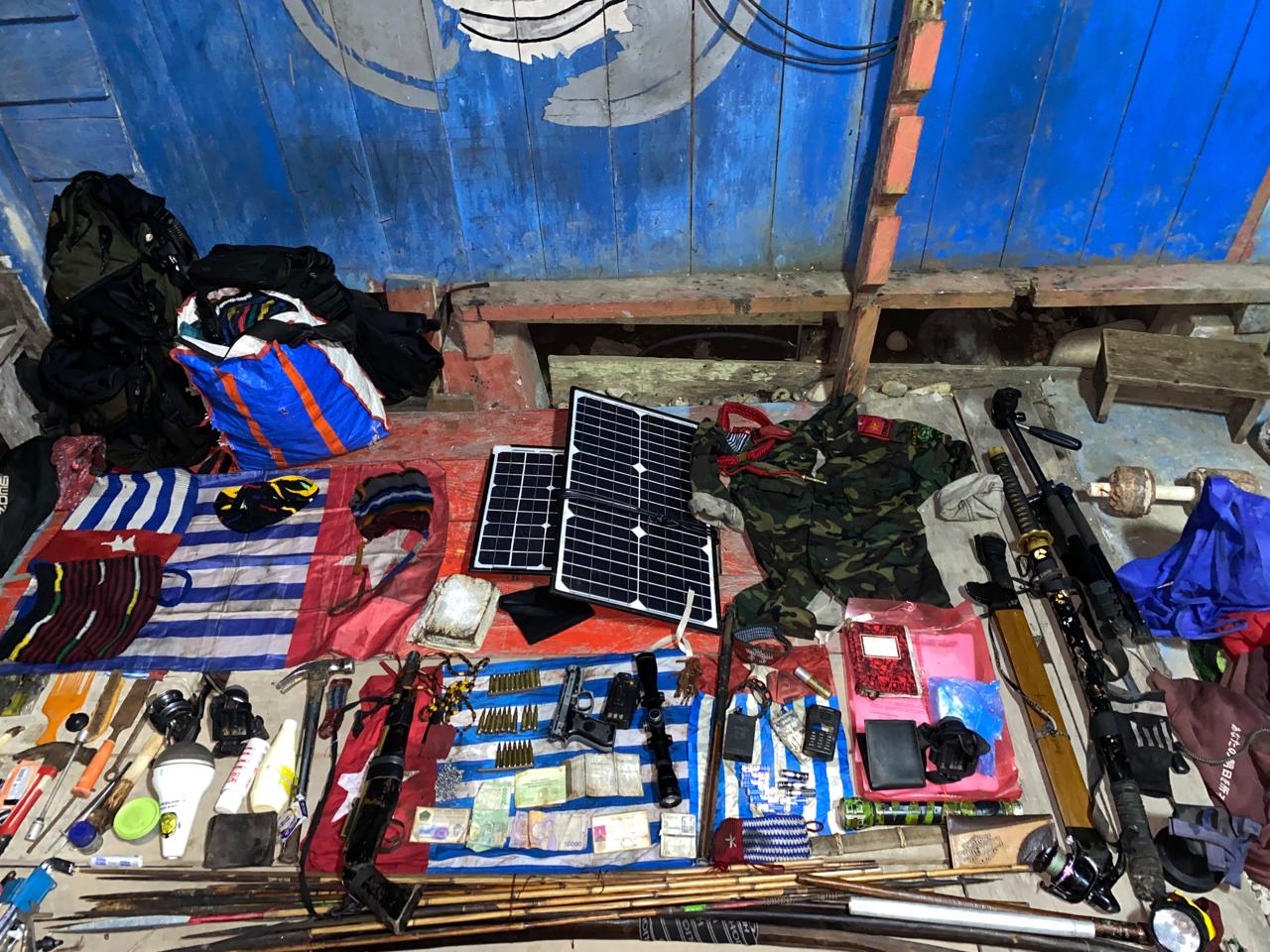
An exchange of fire between Indonesian troops and suspected members of the armed group identified by authorities as the Free Papua Movement (OPM) took place near Kali Braza in Yahukimo District on November 3, 2026. The brief clash was followed by the recovery of a homemade firearm, ammunition, and other equipment from a wooden building believed to have been used as a temporary stopover by the group.
The operation was conducted by personnel from the Indonesia-Papua New Guinea Mobile Border Security Task Force of Marine Infantry Battalion 3, operating under the TNI Habema Joint Operations Command. According to the military, the patrol was launched after information emerged about the presence of the OPM Kodap XVI/Yahukimo group, led by Elkius Kobak, in the area.
No fatalities or injuries were reported on either side. Following the exchange, troops secured the location and searched the building and its surroundings, recovering several items that military officials said had been left behind.
The incident highlights the continuing security challenges in parts of Papua Pegunungan, where military patrols remain part of efforts to monitor armed-group activity and protect local communities. It also puts renewed attention on the importance of conducting security operations in a way that prioritizes civilian safety and leaves room for peaceful solutions.
Patrol in Kali Braza Leads to Armed Encounter
The incident occurred around Kali Braza, near Kampung Kimbule, Kurima District, Yahukimo Regency, on Tuesday, November 3.
According to the account provided by TNI Habema, the patrol was conducted in response to information concerning the alleged presence of the OPM Kodap XVI/Yahukimo group under Elkius Kobak. The group was suspected of using the surrounding area as a temporary resting or transit location.
The military deployed personnel from the Mobile RI-PNG Border Security Task Force of Marine Infantry Battalion 3 to examine the area and follow up on the information. During the patrol, soldiers came across a wooden structure believed to have been used by members of the armed group.
The building became the focus of the operation as personnel moved closer to inspect it. During the examination, soldiers reportedly noticed two individuals moving away from the location.
According to the military’s account, personnel issued a warning. The situation then escalated into a brief exchange of gunfire after shots were fired from the direction of the suspected armed group.
The encounter did not develop into a prolonged firefight. Military officials said it ended without casualties or injuries among the personnel or the opposing group.
The troops subsequently secured the immediate area and examined the wooden structure and its surroundings. Their search led to the discovery of weapons, ammunition, and several other items believed to have been abandoned at the site.
What TNI Recovered from the Location
The most significant discovery was a homemade firearm chambered in 5.56 mm caliber. Troops also recovered an airsoft pistol, a telescopic sight, and ammunition.
Other items included bladed weapons, a bow and arrows, communication devices, documents, and additional equipment. Military officials said all recovered materials had been secured for further examination in accordance with applicable procedures.
The discovery of a homemade firearm is particularly relevant to the security assessment of the area. However, the available reports do not provide technical details about the weapon’s condition, its origin, whether it was operational, or the exact quantity of ammunition recovered.
The military has also not published a complete inventory of every item or explained the contents of the documents and communication devices. Those details may become clearer following the examination process.
Authorities have linked the location to the OPM Kodap XVI/Yahukimo group led by Elkius Kobak. The wooden building was suspected of serving as a temporary stopover, although the reports do not establish how frequently it was used or how long the group had occupied it.
For that reason, the recovered items should be understood as evidence secured during a military operation and subject to further examination. Their precise ownership and connection to particular individuals remain matters for verification.
Riyanto: Civilian Safety Remains the Priority
TNI Habema Joint Operations Commander Brigadier General Riyanto said that every action by troops in the field must be selective, measured, and professional and must comply with the applicable rules of engagement.
He praised the personnel involved in the patrol for securing the weapons and equipment without causing fatalities.
“I appreciate the professionalism of the soldiers who carried out their duties and secured the weapons without causing any casualties. We must remain firm against every armed threat, but the success of an operation should not always be measured by the number of casualties,” Riyanto said, as quoted in reports published on November 6.
He added that reducing threats and safeguarding the population were more important measures of the operation’s outcome.
“The more important thing is reducing threats and ensuring the safety of the community,” he said.
His remarks placed the emphasis on the operational objective beyond the exchange of fire itself. In a region where security incidents can disrupt daily activities, the absence of casualties is an important detail, particularly for residents living near areas where armed encounters occur.
The commander’s statement also underlined the military’s responsibility to carry out security duties within established operational rules. The use of force, according to his remarks, should remain measured and consistent with the priority of protecting civilians.
A Call for Armed Groups to Return to Peace
Alongside his comments on the operation, Riyanto issued an appeal to members of armed groups who remain in forested and mountainous areas to abandon violence and return to their families and communities.
He said peaceful options remained open and encouraged those involved in armed activity to take part in rebuilding their villages and creating better prospects for their children.
“The path to peace is always open. Let us return to building our villages, protecting family life, and providing a better future for Papua’s children. Security must create space for people’s lives to become increasingly normal and peaceful,” he said.
The appeal reflects the importance of combining security measures with opportunities for reconciliation and social reintegration. While patrols and law enforcement are intended to address immediate threats, lasting stability also depends on conditions that allow residents to work, attend school, access public services, and maintain their livelihoods without fear.
The military’s statement therefore presented the Kali Braza operation as part of a wider security effort that, according to the command, should be accompanied by territorial engagement and humanitarian approaches.
Such an approach is relevant in remote parts of Yahukimo, where geography and limited access can make security and public-service delivery more complicated. A peaceful environment is essential for communities to maintain their everyday activities and for development programs to reach the people they are intended to serve.
Security Challenges in Yahukimo
Yahukimo is part of Papua Pegunungan, a province characterized by mountainous terrain and communities spread across difficult-to-reach areas. In locations such as these, monitoring remote settlements and maintaining access can require sustained coordination among security personnel and local authorities.
The Kali Braza incident illustrates how information about suspected armed-group activity can lead to a patrol and, in this case, an armed encounter. It also demonstrates the importance of securing locations and preserving recovered materials for further examination.
The military’s account identifies the suspected group as the OPM Kodap XVI/Yahukimo organization led by Elkius Kobak. That identification is an official attribution by the authorities. The available reports do not include an independent statement from the group or a separate account from residents who may have witnessed the incident.
Similarly, the reports do not describe any disruption to nearby civilian activities, damage to homes or infrastructure, or displacement resulting from the encounter. There is also no reported information about arrests during the operation.
These gaps matter when assessing the wider consequences of a security incident. A complete picture requires not only information about the exchange of fire and recovered equipment but also reliable updates on the safety and daily conditions of people living in the surrounding communities.
For now, the confirmed details provided by the military and reported by Indonesian media are that the patrol took place on November 3, a brief exchange of fire occurred, no casualties were reported, and several weapons and other items were secured for further examination.
From Tactical Results to Long-Term Stability
The recovery of a homemade firearm, ammunition, and supporting equipment represents a tangible result of the patrol. Removing weapons from circulation may help reduce the potential for further armed activity, although the broader security impact cannot be measured from this single incident alone.
The next stage involves examining the recovered materials, establishing their origin where possible, and assessing whether they provide further information about armed-group activity in the area. Any conclusions about ownership, use, or links to specific incidents should be based on the results of that process.
At the same time, maintaining security requires more than patrols. Effective communication with local communities, attention to civilian protection, and coordination with regional authorities are important elements in preventing further violence.
For residents of Yahukimo, the practical measure of improved security is whether they can travel, work, study, and access public services without being caught in armed confrontations. The absence of casualties in the Kali Braza incident is therefore welcome, but it should be followed by continued efforts to prevent similar encounters.
The military’s appeal for armed members to return to peaceful community life also points to a path beyond confrontation. Dialogue, reintegration, and opportunities to rebuild family and village life can complement security measures and help create conditions for lasting stability.
Conclusion
The exchange of fire near Kali Braza ended without reported casualties, while troops from the TNI Habema operation recovered a homemade 5.56 mm firearm, ammunition, and other equipment from a wooden structure suspected of being used as a temporary stopover by the OPM Kodap XVI/Yahukimo group.
The operation demonstrates the continuing role of patrols in responding to security information in remote parts of Papua Pegunungan. It also reinforces a point made by Brigadier General Riyanto: operational success should not be measured solely by casualties but by the reduction of threats and the protection of civilians.
The longer-term challenge is to turn tactical security gains into safer conditions for local communities. Continued professional conduct, careful examination of recovered evidence, cooperation with residents, and opportunities for peaceful reintegration will all be important.
Ultimately, stability in Yahukimo should be reflected in the everyday lives of its people: children able to attend school, families able to sustain their livelihoods, and communities able to develop without the disruption of armed violence. Security measures will have their greatest value when they help make that normal, peaceful future possible.
Read Also
Ilaga Stabbing: TPNPB-OPM Claims Responsibility
TNI Captures Three TPNPB-OPM Figures in Maybrat

