
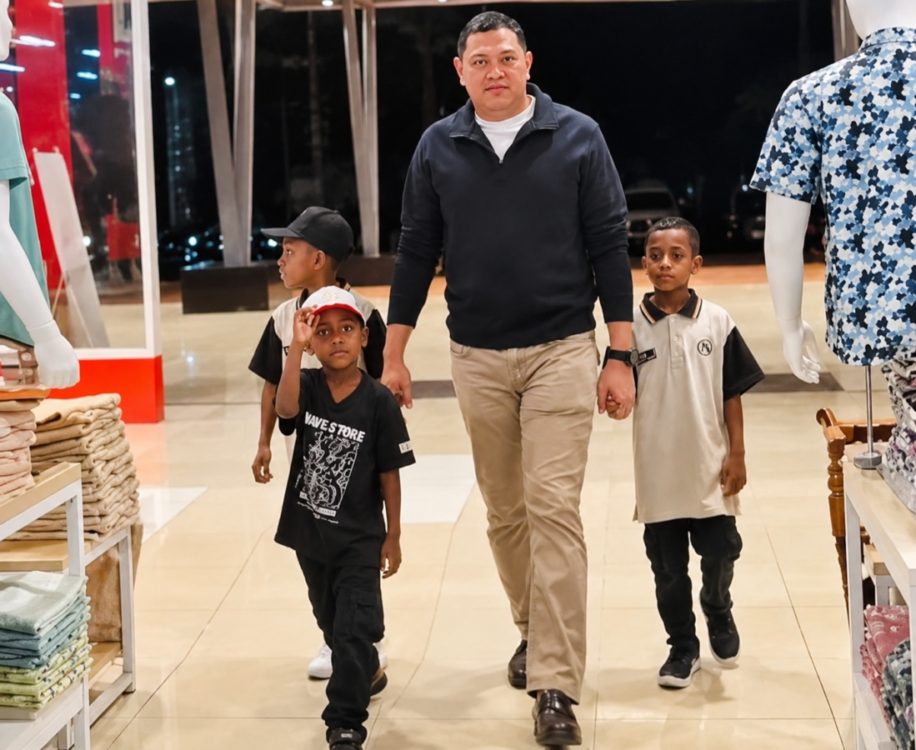
For children who have spent years in isolated forest areas, an ordinary visit to a shopping centre can become an unfamiliar experience. Escalators, brightly lit shops, colourful displays and the freedom to choose a toy may seem like everyday things to many young people. In Papua, however, such experiences can carry a more profound meaning for children whose lives have been affected by armed conflict.
That was the context behind an initiative by Papua Barat (West Papua) Police Chief Brigadier General Dr Hengki Haryadi, who invited children, wives and extended family members of former members of the Armed Criminal Group (KKB), also referred to as TPNPB-OPM, to visit a shopping mall in Papua. The activity, reported by Sinar Lampung on November 2, 2026, was intended to introduce the families to an environment beyond the forests and conflict-affected areas where they had previously lived.
Rather than focusing on security operations, the initiative placed the welfare of children and families at the centre of attention. It reflected an approach that recognises an important distinction: children should not be judged by the actions or affiliations of the adults in their families. They deserve access to education, social interaction, protection and opportunities to experience an ordinary childhood.
The visit also illustrated a broader dimension of Indonesia’s efforts to address the situation in Papua. Security measures remain part of the government’s responsibilities, but engagement with families, community support and opportunities for social reintegration are also important elements in building a more peaceful future.
A Different Experience for Children from Maybrat
According to the report, some of the children had spent approximately six years in the forested areas of Maybrat, far from regular schooling and the daily social activities normally experienced by children their age.
Their lives had been shaped by circumstances in which access to education, recreation and interaction with wider communities was limited. The report described how, for some of them, the shopping centre was an unfamiliar environment.
When they entered the mall, the children encountered bright lighting, moving escalators and rows of shops. The experience offered a contrast to the conditions in which they had reportedly spent much of their childhood.
The visit was not presented simply as a recreational outing. It was an opportunity to introduce the children to a different social environment and allow them to experience activities that many young people in other parts of Indonesia take for granted.
For children affected by conflict, these ordinary experiences can be meaningful. A safe opportunity to play, choose an item they like or spend time with peers can help restore a sense of normality. It can also provide a starting point for rebuilding confidence and encouraging them to participate in wider community life.
The report did not identify the name or exact location of the shopping centre, nor did it provide the number or ages of the children who took part. Nevertheless, its account highlighted the personal dimension of an initiative that sought to reach beyond the immediate concerns of security.
Hengki Haryadi: Families Must Be Treated Humanely
Brigadier General Hengki Haryadi said the families accompanying former KKB/OPM members should receive humane treatment, particularly because children and other relatives were not responsible for the decisions made by adult family members.
“They are families. There are children, wives and extended family members of KKB/OPM. They do not know anything about it but have spent a long time in the Maybrat forest. We serve them like our own family, humanely,” Hengki was quoted as saying by Sinar Lampung.
His statement conveyed the central message behind the activity: family members should not be excluded from society because of their relatives’ past involvement in armed groups.
This principle is particularly important for children. Growing up in a conflict-affected environment can create barriers to education, social development and access to public services. If children are also subjected to social stigma because of their family background, those barriers may become even harder to overcome.
The police chief’s approach sought to create a more welcoming environment for these families. By including wives, children and extended relatives in the activity, the initiative recognised that the consequences of conflict extend beyond the individuals directly involved in armed groups.
It also demonstrated how public institutions can engage with vulnerable families through activities that are personal, accessible and focused on human dignity.
Dialogue and Compassion as Part of Conflict Resolution
The initiative is set against the backdrop of ongoing security and humanitarian challenges in various regions of Papua. Armed violence has affected communities in several areas, disrupting daily life and creating risks for civilians, including women and children.
In such circumstances, a response based solely on security measures cannot address every consequence of conflict. Families may need assistance to reconnect with schools, access public services and rebuild relationships with communities outside areas affected by violence.
The Sinar Lampung report described Hengki’s approach as a form of soft engagement, complementing security measures with dialogue and personal interaction. It also stated that, during his leadership over the preceding six years, dialogue-based engagement had helped persuade a number of armed-group members to leave their former environment and return to civilian life.
The report did not provide a specific number of individuals involved or independent documentation of the outcomes. Its account nevertheless highlights the role that communication and personal relationships can play in encouraging people to consider alternatives to continued involvement in armed conflict.
Hengki was also quoted as saying, “Soon it will be over. Not everything has to be done through force, but through love and compassion.”
The statement reflects an approach that places persuasion and human relationships alongside the state’s responsibility to maintain security and uphold the law. It should not be interpreted as suggesting that dialogue alone can resolve every security problem. Rather, it illustrates why engagement with individuals and their families can be an important part of a wider effort to reduce conflict.
For communities affected by violence, the prospect of returning to civilian life requires more than a declaration of intent. It also depends on practical support, safety, access to education and opportunities to rebuild livelihoods.
Children Should Not Inherit the Burden of Conflict
One of the most significant aspects of the mall visit is its recognition of children as individuals with rights and aspirations independent of their parents.
The Sinar Lampung report included accounts of children who had been affected by armed violence in other parts of Papua. It referred to incidents in Sugapa, Intan Jaya, involving a 12-year-old child, Ronaldo Duwitau, who was reported killed, and a six-year-old, Nepina Duwitau, who reportedly suffered serious injuries during a shooting incident.
It also mentioned the death of a 17-year-old student, Ali Mom, in Ilaga, who was reportedly shot after being accused of acting as an informant for security personnel.
These cases were presented by the publication as examples of the risks faced by children in conflict-affected areas. They underline why the protection of young people must remain a priority for all parties and institutions operating in Papua.
The report further referred to incidents in which women and children were reportedly taken hostage in Mimika, requiring emergency responses involving security personnel and local authorities.
Such accounts illustrate the wider humanitarian consequences of armed violence. Children may lose access to education, experience the death or separation of family members, or develop lasting psychological distress. Their needs cannot be addressed simply by restoring physical security.
The mall visit therefore carried a message beyond the immediate activity. Children from families associated with former armed groups should have the opportunity to build relationships, pursue education and participate in society without being held responsible for the past.
Their future should be determined by their own choices and opportunities, not by the history of the adults around them.
Supporting Recovery Through Education and Social Reintegration
The report also referred to the Si Ipar programme, an initiative described as providing educational assistance and support for children affected by conflict.
According to the publication, the programme has sought to help children recover from traumatic experiences and return to basic learning activities, including reading and writing.
Such support is relevant because the effects of conflict can continue long after children leave dangerous areas. Interrupted schooling may create learning gaps, while prolonged exposure to violence can affect confidence, concentration and relationships with others.
Educational assistance can help address some of these challenges. However, children who have experienced distress may also require appropriate psychosocial support, a safe learning environment and continued involvement from parents, teachers and community members.
The shopping trip and educational assistance serve different purposes, but they share a common objective: helping children reconnect with ordinary social and learning experiences.
The first offers direct exposure to a public environment beyond the places where they previously lived. The second can help restore educational routines and provide opportunities to develop skills.
For these initiatives to produce lasting benefits, they need to be part of a sustained process. A single outing may create a memorable experience, but continued access to education, healthcare, recreational activities and family support is essential for children’s longer-term wellbeing.
A Humanitarian Dimension to Indonesia’s Approach in Papua
Indonesia’s efforts to address challenges in Papua involve a range of responsibilities, from maintaining public security to expanding development opportunities and protecting civilians.
The initiative led by Hengki Haryadi illustrates how police engagement can include humanitarian activities directed at people who are not involved in violence. By inviting the families of former armed-group members to participate in a public outing, the police chief demonstrated an effort to distinguish between security concerns and the needs of vulnerable family members.
This distinction is important for building trust. Children should be able to access public spaces and educational opportunities without being treated as extensions of their parents’ past affiliations. Families seeking to resume civilian life also need an environment in which they can interact with public institutions and local communities.
At the same time, humanitarian engagement must be accompanied by consistent protection and respect for individual rights. The welfare of children should remain the priority, including their privacy, safety and freedom from discrimination.
The experience also points to the importance of cooperation between security institutions, local governments, schools and community organisations. Police initiatives can help establish initial contact, but education and social services are needed to support families over time.
A sustainable approach should therefore connect humanitarian outreach with practical assistance. This could include helping children return to school, facilitating access to public services and supporting families as they rebuild their daily lives.
Conclusion
The initiative by Papua Barat Police Chief Brigadier General Hengki Haryadi to take children and families of former KKB/OPM members to a shopping mall represents a meaningful example of humanitarian engagement in Papua. By introducing children who had reportedly spent years in the forests of Maybrat to a different social environment, the activity offered them an opportunity to experience ordinary childhood activities beyond the circumstances of conflict.
More importantly, the initiative conveyed a principle that should guide all efforts to build peace: children must never be held responsible for the actions of adults. Their rights to education, protection, social participation and a hopeful future deserve equal attention, regardless of their family background.
However, lasting progress will require more than a single outing. Continued educational assistance, psychosocial support, community acceptance and access to public services will be essential to help these families rebuild their lives. Through a combination of firm law enforcement, dialogue and sustained humanitarian support, Indonesia can strengthen the foundations for peace and social recovery in Papua.
Ultimately, the most meaningful measure of success will not be the number of families who take part in a public activity, but whether children can return to school, grow up safely and pursue their aspirations without the burden of conflict defining their future.
Read Also
Anton and Yesias Fatem Surrender as TNI Recovers Caracal Rifle
Five Former TPNPB OPM Members Return from PNG

