
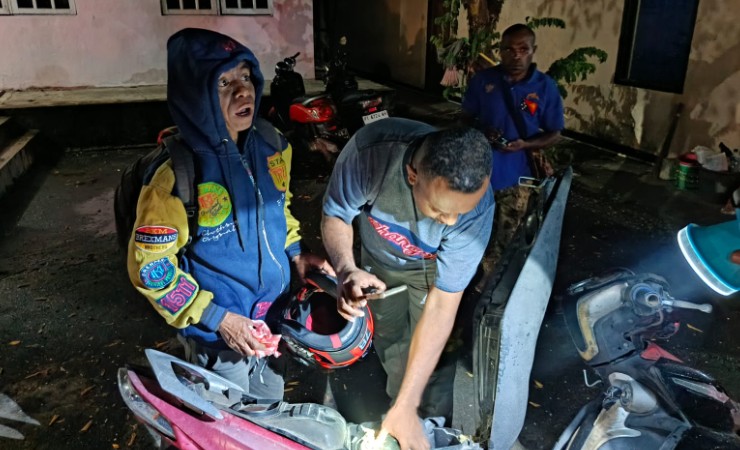
Operation Sikat Noken II 2026 has resulted in the seizure of 11 motorbikes, two sharp weapons, and an illegal liquor bottle of locally produced alcoholic drink during a nighttime security operation in Nabire as police step up efforts to prevent crime and maintain public order in Indonesia’s Papua Tengah province.
The operation took place on Saturday night, October 31, in Oyehe Village, Nabire Regency. Officers established an inspection point in front of Pos Kota, checking passing motorcyclists, vehicle documents, and personal belongings. The items secured during the first day of the operation were subsequently taken to Papua Tengah Regional Police headquarters for further examination.
The operation reflects the police’s focus on everyday security concerns, including motorcycle theft, the possession of sharp weapons without lawful justification, drug-related offenses, and the circulation of illegal alcoholic beverages. While the 11 motorbikes were taken into police custody because their documentation required further verification, authorities said their ownership status would be established through checks of chassis and engine numbers.
For residents, reliable public security is closely connected to daily life. Motorcycles are an important means of transport in Nabire, serving workers, students, traders, and families. Preventing vehicle theft and reducing the circulation of dangerous items are therefore part of a broader effort to create safer conditions for economic and social activity.
Night Operation Begins with Police Briefing
The first stage of Operation Sikat Noken II began at 9.30 p.m. local time with a preparatory assembly at the Papua Tengah Regional Police headquarters. The briefing was led by the police’s Head of Operations Bureau, Senior Commissioner Adnan Ratmoro.
According to reports published by local media, Adnan instructed personnel to carry out the operation thoroughly and professionally. He emphasized the need to prevent and take action against criminal offenses that could disrupt public safety and order, commonly referred to in Indonesia as keamanan dan ketertiban masyarakat, or kamtibmas.
The briefing established the operational priorities before officers moved to the inspection area. Rather than focusing exclusively on traffic violations, the operation combined vehicle checks with the examination of belongings carried by members of the public.
The deployment brought together personnel from several operational units within the Papua Tengah Regional Police. These included the Mobile Brigade (Satbrimobda), Directorate of Samapta, Community Guidance Directorate (Ditbinmas), Criminal Investigation Directorate (Ditreskrimum), Narcotics Investigation Directorate (Ditresnarkoba), Intelligence and Security Directorate (Ditintelkam), and Traffic Directorate (Ditlantas).
The participation of these different units enabled the operation to address several potential security concerns at the same location. Traffic personnel could examine vehicle documentation, while criminal investigation and intelligence personnel were positioned to support the identification of suspicious circumstances and possible criminal links.
At approximately 10 p.m., after the briefing had concluded, the joint team departed for the area around the Oyehe Village office. Officers then established checks in front of Pos Kota, where they began inspecting motorcycles travelling through the area.
Vehicle Documents and Personal Belongings Checked
The inspection process covered several aspects of vehicle and road-user compliance. Officers examined vehicle equipment and driving documents while also checking the motorcycles’ seats, bags, and other belongings carried by riders.
These checks were intended to identify vehicles with incomplete documentation and detect items that could be associated with criminal activity. The examination of motorcycle seats and personal bags was also directed at preventing the unlawful carrying of sharp weapons, alcoholic beverages, and other prohibited goods.
The approach reflects the multiple challenges that can confront local police in maintaining public order. Motorcycle theft, for example, is not simply a property offense. It can affect household finances, disrupt employment and education, and undermine public confidence in the security of neighborhoods.
Likewise, the possession of sharp weapons without a lawful reason can create risks during disputes or other public encounters. The circulation of illegal alcoholic beverages can also complicate efforts to prevent disturbances and maintain safe public spaces.
Police inspections are therefore intended to identify potential risks before they develop into more serious incidents. However, enforcement must be accompanied by clear procedures, professional conduct, and respect for the rights of people being checked.
Eleven Motorbikes, Two Sharp Weapons, and Cap Tikus Secured
The first day’s inspection resulted in the securing of 11 motorcycles, two sharp weapons, and an illegal liquor bottle of locally produced alcoholic drink known as Cap Tikus.
The motorcycles were taken to Papua Tengah Regional Police headquarters, along with the other items, for safekeeping and further examination. Police said the vehicles would undergo checks to establish their legal ownership and determine whether any were connected to reported cases of motorcycle theft.
A central part of that process will involve examining the chassis and engine numbers. These identifying details can be compared with available vehicle records and reports of missing motorcycles. Such verification is important because a vehicle’s incomplete documentation does not, by itself, prove that it has been stolen or that its owner has committed an offense.
The distinction matters. A vehicle may require additional administrative checks for a range of reasons, and the outcome of the verification process will determine whether further legal action is warranted.
The two sharp weapons and an illegal liquor bottle of Cap Tikus were also secured for examination. The reports did not identify the owners of the items or provide details of any arrests or charges arising from the first night’s operation. It would therefore be premature to draw conclusions about the legal responsibility of any individual.
The police action at this stage was to secure the items and conduct further checks. Any subsequent decision will depend on the findings of the investigation and the applicable legal provisions.
Adnan Ratmoro Emphasizes Prevention and Public Order
In his operational instructions, Senior Commissioner Adnan Ratmoro called on personnel to carry out their duties professionally and focus on preventing as well as addressing potential criminal offenses.
His message reflected the stated purpose of Operation Sikat Noken II: to reduce opportunities for crime and maintain stability across the jurisdiction of the Papua Tengah Regional Police.
Following the operation, police reiterated their appeal for residents to ensure that their motorcycles were accompanied by valid documents when travelling. Members of the public were also reminded not to carry sharp weapons without a legitimate reason and to avoid involvement in drug abuse or illegal alcoholic beverages.
The appeal is significant because public security cannot be maintained through enforcement alone. Police action can identify violations and investigate suspected offenses, but long-term improvements also depend on public awareness and cooperation.
For motorcycle owners, keeping registration and ownership documents in order can help prevent unnecessary complications during inspections. It can also make it easier for police to identify stolen vehicles and return them to their rightful owners when theft is established.
For the wider community, responsible behavior and timely reporting of suspicious activity can help authorities respond more effectively to emerging security concerns.
A Coordinated Approach to Nabire’s Security Challenges
Nabire is an important administrative and economic center in Papua Tengah. Its roads and public spaces support the movement of residents, traders, government employees, and visitors. Maintaining a safe environment is consequently important for the continuity of ordinary activities.
The operation’s multi-unit structure demonstrates an effort to coordinate different police functions around shared security priorities. Traffic enforcement, criminal investigation, intelligence gathering, and community engagement each play a distinct role in maintaining public order.
The presence of personnel from the narcotics investigation directorate also reflects the operation’s stated concern about drug-related offenses. Although the first-day report confirmed the seizure of an illegal liquor bottle of Cap Tikus, it did not report any narcotics seizure. The distinction is important: drug abuse and illegal liquor circulation were among the risks the operation aimed to address, but not every targeted offense was necessarily detected during the inspection.
Similarly, the seizure of two sharp weapons should be understood within the context of preventive checks. The reports did not establish that the weapons had been used in a crime. Further examination is needed to determine the circumstances of possession and whether any legal provisions were violated.
A measured approach to reporting these findings helps preserve public confidence. Security operations are most effective when enforcement is transparent, evidence-based, and accompanied by appropriate legal procedures.
Operation Ends Safely, Further Inspections Planned
The first day’s activities concluded at approximately midnight, or 12 a.m. local time on November 1. According to the police reports, the operation ended in a safe and orderly situation.
Papua Tengah Regional Police said Operation Sikat Noken II 2026 would continue as part of its sustained efforts to maintain public security and reduce potential criminal activity in the province.
The continuation of the operation means that the initial inspection should be viewed as one stage in a wider policing effort, rather than an isolated activity. Follow-up work will include examining the 11 motorcycles and comparing their identifying numbers with available vehicle records and theft reports.
The outcome of those checks will be important. If a vehicle is confirmed to have been stolen, investigators can pursue the case through the appropriate legal process. If ownership is established and no offense is identified, the relevant procedures for its release can be considered in accordance with the law.
The same principle applies to the other items secured during the operation. Their legal status and any possible connection to an offense must be determined through proper examination.
Public Cooperation Remains Essential
The Nabire operation illustrates how routine policing can contribute to a wider sense of security. The protection of property, prevention of violence, and control of illegal goods are issues that directly affect the daily experiences of residents.
Nevertheless, lasting improvements require a partnership between law enforcement and the public. Residents can support the effort by keeping vehicle documents available, reporting suspected theft, avoiding the unlawful possession of weapons, and cooperating with officers during lawful inspections.
Police, in turn, must ensure that checks are conducted proportionately and professionally, with due regard for individual rights and legal safeguards. Public trust is strengthened when enforcement is consistent, transparent, and supported by clear explanations of its purpose.
For Papua Tengah, maintaining a stable environment is an important condition for development. A safer community can help residents travel, work, attend school, and conduct business with greater confidence. Security is essential for economic and social progress, but not the only requirement.
Conclusion
The first day of Operation Sikat Noken II 2026 in Nabire resulted in the securing of 11 motorcycles, two sharp weapons, and one liquor bottle of Cap Tikus. Led operationally by Senior Commissioner Adnan Ratmoro, the joint police deployment brought together several units to conduct vehicle inspections and checks of personal belongings in Oyehe Village.
The next stage will be the verification of the motorcycles’ chassis and engine numbers, alongside further examination of the other seized items. These procedures will establish whether the vehicles are linked to theft reports and whether any legal action is required.
The operation sends a clear message that public order remains a priority for the Papua Tengah Regional Police. Its long-term value, however, will depend not only on the number of items secured but also on the quality of follow-up investigations, lawful enforcement, and continued cooperation with residents.
By combining professional policing with public awareness, Papua Tengah can strengthen the conditions needed for safer communities and more stable economic activity. In Nabire, the continuation of Operation Sikat Noken II offers an opportunity to reinforce that commitment through consistent, accountable, and community-oriented law enforcement.
Read Also
Papua Police Seize 25 Motorcycles in Jayapura
TNI Operation in Nduga: Drone Footage and Two OPM Deaths

