
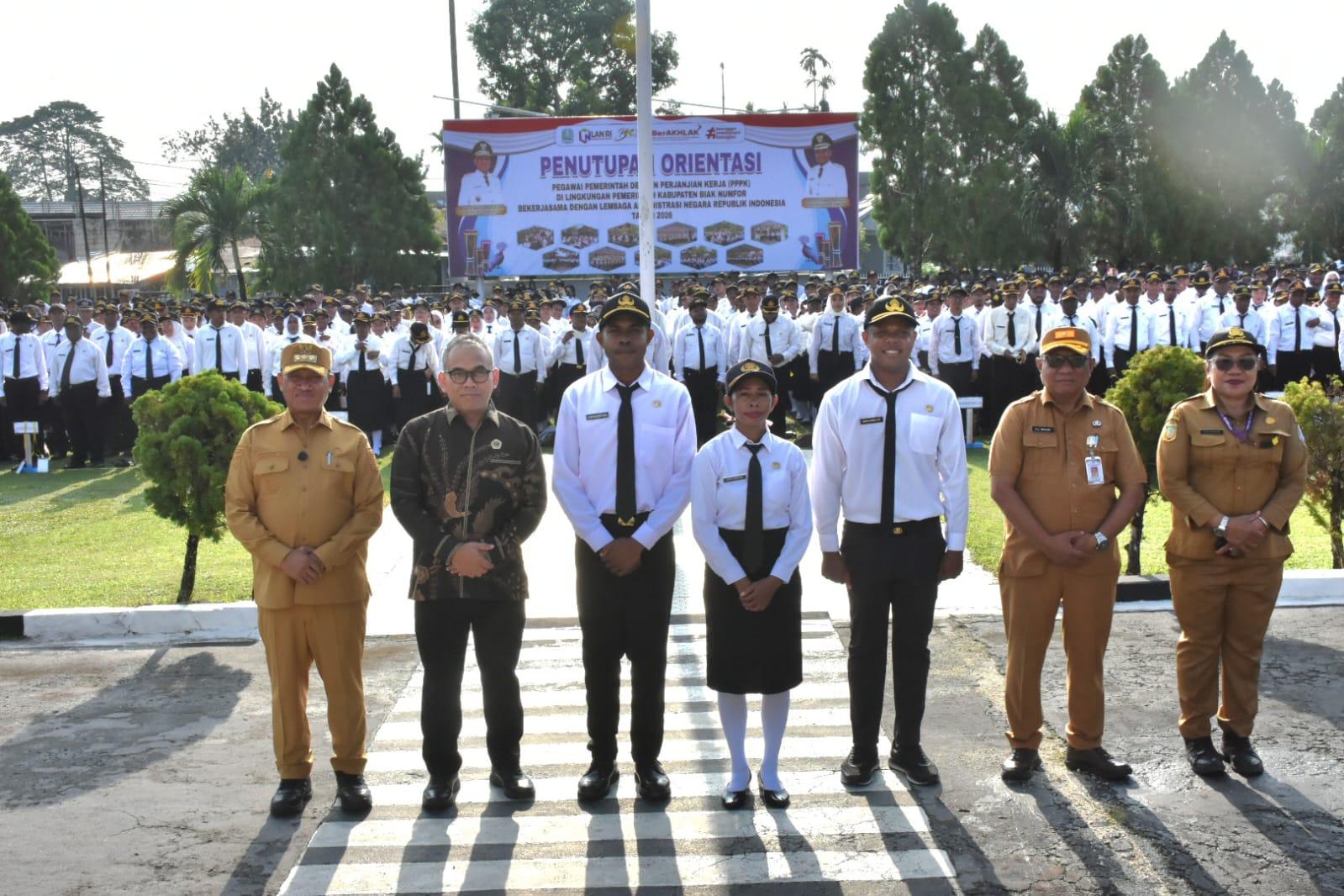
The Biak Numfor regency government has added 1,828 government employees under Indonesia’s contract-based civil service scheme, known as Pegawai Pemerintah dengan Perjanjian Kerja (PPPK), to strengthen public services and improve the delivery of government programmes across the island district. The milestone reached a new stage on October 27, 2026, when the administration concluded a month-long orientation programme designed to prepare the employees for their duties.
The closing ceremony took place at the office of the Biak Numfor regent, attended by Regent Markus Octovianus Mansnembra, National Institute of Public Administration (LAN RI) Director of Character and Socio-Cultural Learning Deny Junanto, and acting regional secretary Zacharias L. Mailoa. The ceremony concluded with the officials striking a traditional tifa, a drum used in cultural ceremonies across Papua.
For the local administration, the addition of 1,828 employees is intended to strengthen the workforce responsible for carrying out government programmes, from the regency level down to districts and villages. But the message from officials was clear: recruitment and orientation are only the beginning. The employees are expected to demonstrate professionalism, responsibility and innovation in their daily work.
The announcement comes as regional governments across Indonesia face the challenge of translating administrative resources into more responsive public services. In Biak Numfor, the priority is to ensure that the expanded workforce helps residents access government services more efficiently and supports development programmes where people live.
From Recruitment to Readiness for Public Service
A Month of Orientation Reaches Completion
The latest milestone followed an orientation programme lasting approximately one month for all 1,828 PPPK employees. The programme was organised in cooperation with the Biak Numfor administration and LAN RI, the national institution responsible for developing public administration capacities.
According to the regency’s personnel and human resources development agency, all 1,828 participants completed the orientation and were declared to have passed. The completion was announced as part of the ceremony on October 27.
The orientation was intended to help employees understand their position, responsibilities and obligations as members of Indonesia’s state civil apparatus, or ASN. While PPPK employees work under employment agreements rather than the career-based status held by permanent civil servants, they are part of the public administration system and are expected to perform their duties in accordance with applicable regulations.
The distinction matters because a government workforce is effective only when employees understand both the authority entrusted to them and the obligations that accompany it. Orientation helps establish a common understanding of public service, professional conduct and the role of government employees in carrying out policy.
For Biak Numfor, the completion of the programme marks a transition from initial preparation to the practical demands of the workplace. The next challenge is to ensure that what participants learned becomes visible in their performance and in the experience of residents who rely on public institutions.
Officials Use the Ceremony to Set Expectations
At the close of the programme, Regent Markus Octovianus Mansnembra welcomed the employees into the regency administration and urged them to remain committed to their responsibilities. He described the additional workforce as a new source of strength for the government, enabling it to carry out development programmes and improve services for the public.
“Although they have PPPK status, in carrying out their duties as ASN, they have the same rights in accordance with their obligations and responsibilities under the applicable laws and regulations,” Markus said, as reported by ANTARA.
The regent also called on the employees to attend work consistently and commit themselves to their respective regional government organisations, known as OPDs. Their placement across government units at the regency and district levels is intended to expand the reach of public services and help implement programmes throughout the area.
His message focused on the responsibilities that accompany public employment. A position in government is not simply an appointment or a source of income. It carries an obligation to serve the public, follow established procedures and contribute to the work of the institution in which an employee is assigned.
That expectation is especially important for employees who deal directly with residents. The quality of public services is often experienced through everyday interactions, including the clarity of information provided, the speed with which requests are handled and the willingness of officials to respond to people’s needs.
Why 1,828 Employees Matter to Local Administration
The addition of 1,828 PPPK employees is intended to strengthen the capacity of the Biak Numfor administration to implement government programmes at different levels. Their deployment across regency and district government organisations is expected to help extend the reach of public services beyond central administrative offices.
The potential benefits depend on the responsibilities assigned to individual employees and the needs of their respective workplaces. Additional personnel can help government offices manage workloads, maintain continuity in service delivery and support the implementation of public programmes. However, the number of employees alone cannot demonstrate whether services have improved.
To translate recruitment into tangible results, each government unit needs to ensure that staff members understand their duties, have the necessary resources and are evaluated against clear performance expectations. Supervisors must also ensure that employees’ skills match the responsibilities assigned to them.
The regency’s approach, as described by officials, is to use the expanded workforce to strengthen public administration and support development programmes from the district level down to villages. This is important for residents who may otherwise need to travel to administrative centres to obtain information or access government services.
Yet the practical impact will vary depending on the functions of each office and the needs of the community it serves. Some units may need to improve administrative processing, while others may focus on supporting programmes, coordinating local implementation or providing information to residents.
The central question for the administration is therefore how to translate the larger workforce into improvements that citizens can recognise in their daily lives.
The Government Faces Fiscal Constraints
The recruitment and integration of the PPPK workforce have taken place against a backdrop of pressure on regional budgets. Markus said the regency administration had to assess its financial capacity while accommodating the employees, particularly following the implementation of budget-efficiency measures under Presidential Instruction No. 1 of 2025.
According to RRI, after taking office in February 2025, Markus and the regional budget team evaluated the regency’s fiscal capacity and undertook budget rationalisation to accommodate the PPPK appointments. The administration said it continued working to provide legal certainty for employees who had been accepted into the system despite the financial constraints.
The issue illustrates the balance regional governments must maintain between staffing needs and financial sustainability. Public services require adequate personnel, but government budgets must also cover salaries, operational expenses, infrastructure and development programmes.
The recruitment of a large number of employees can strengthen administrative capacity, but it also creates continuing obligations. The government must ensure that personnel costs remain manageable while preserving the resources required for the work those employees are expected to perform.
This makes workforce planning and performance evaluation particularly important. The administration needs to understand not only how many employees it has but also where they are needed most and whether their deployment is producing meaningful improvements.
Budget efficiency should not be measured solely by reductions in expenditure. It should also be assessed in terms of whether public money supports effective services and whether government employees are able to carry out their responsibilities without unnecessary delays or administrative obstacles.
LAN RI Calls for Innovation and Digital Adaptation
Small Improvements Can Make a Difference
Deny Junanto, LAN RI’s Director of Character and Socio-Cultural Learning, said the orientation should provide a foundation for the PPPK employees to improve public services and introduce useful changes in their workplaces.
He encouraged the employees to apply what they had learned, develop their capabilities and adapt to advances in digital technology. He also emphasised that limited resources should not become a reason to stop improving the way government services are delivered.
“Apply the results of the PPPK orientation to bring about changes in service, however small, in your workplace for the needs of the community,” Deny said, according to ANTARA.
The emphasis on incremental improvement is relevant to public administration. Innovation does not always require expensive technology or major institutional restructuring. It can begin with clearer procedures, better communication, more accurate records or a more accessible way for residents to obtain information.
Digital tools can also help government offices improve the management of documents and reduce repetitive administrative tasks, provided staff receive adequate training and the systems are suitable for local conditions. In areas where connectivity or technical resources may be limited, practical solutions need to reflect the capacity of the institution and the needs of the people it serves.
Deny also reminded the employees that ASN have three central functions: serving the public, implementing public policy, and acting as a unifying force within the nation. Those responsibilities, he said, must be reflected in the way they carry out their daily duties.
His message places public service at the centre of the orientation programme. Employees are expected not only to understand administrative rules but also to apply them in ways that benefit the people who depend on government institutions.
From Orientation to Measurable Performance
The conclusion of the programme gives the Biak Numfor administration an opportunity to move from training to performance management. The next stage will involve ensuring that employees apply their knowledge in their assigned offices and that supervisors can identify where further support is required.
Clear performance expectations can help employees understand what is required of them. Depending on the service, this could include timely processing of requests, accurate record-keeping, responsive communication or consistent implementation of government programmes.
Regular evaluation can also help managers identify obstacles. If a service remains slow despite additional staff, the cause may involve procedures, technology, coordination or the allocation of responsibilities rather than staffing numbers alone.
The administration will therefore need to assess the practical effects of the new workforce over time. Indicators such as processing times, service availability, public complaints and the completion of assigned tasks can help establish whether the recruitment is delivering the intended results.
The aim should be continuous improvement rather than a one-time assessment following orientation. Employees will encounter different situations in their workplaces, and ongoing professional development can help them respond to changing needs and expectations.
For the PPPK employees themselves, the regent’s call for real performance is a reminder that their contribution will be judged through their work. Their responsibilities extend beyond the completion of training to the everyday task of making government services more accessible, reliable and useful to residents.
Conclusion
The completion of orientation for 1,828 PPPK employees marks an important step in Biak Numfor’s efforts to strengthen its public administration. The regency government, working with LAN RI, has prepared the employees to take on their responsibilities, while Regent Markus Octovianus Mansnembra and Deny Junanto have emphasised professionalism, accountability and innovation.
The next test is implementation. The expanded workforce must translate its training into better service delivery, support government programmes across districts and villages, and respond to residents with competence and responsibility. At the same time, the administration must manage its financial obligations carefully so that staffing needs remain consistent with the regency’s fiscal capacity.
If the new employees are supported by clear assignments, appropriate resources and regular performance evaluation, their presence could help strengthen the connection between government institutions and the communities they serve. That outcome cannot be guaranteed by recruitment figures alone, but it is the standard against which the programme should be measured.
For Biak Numfor, the real achievement will be visible when residents experience more responsive services and greater confidence in their local government. The orientation has concluded, but the work of public service is only beginning.
Read Also
Papua Pegunungan Hospitals to Expand 11 Priority Services
Papua Wins Recognition for Public Service Progress

