
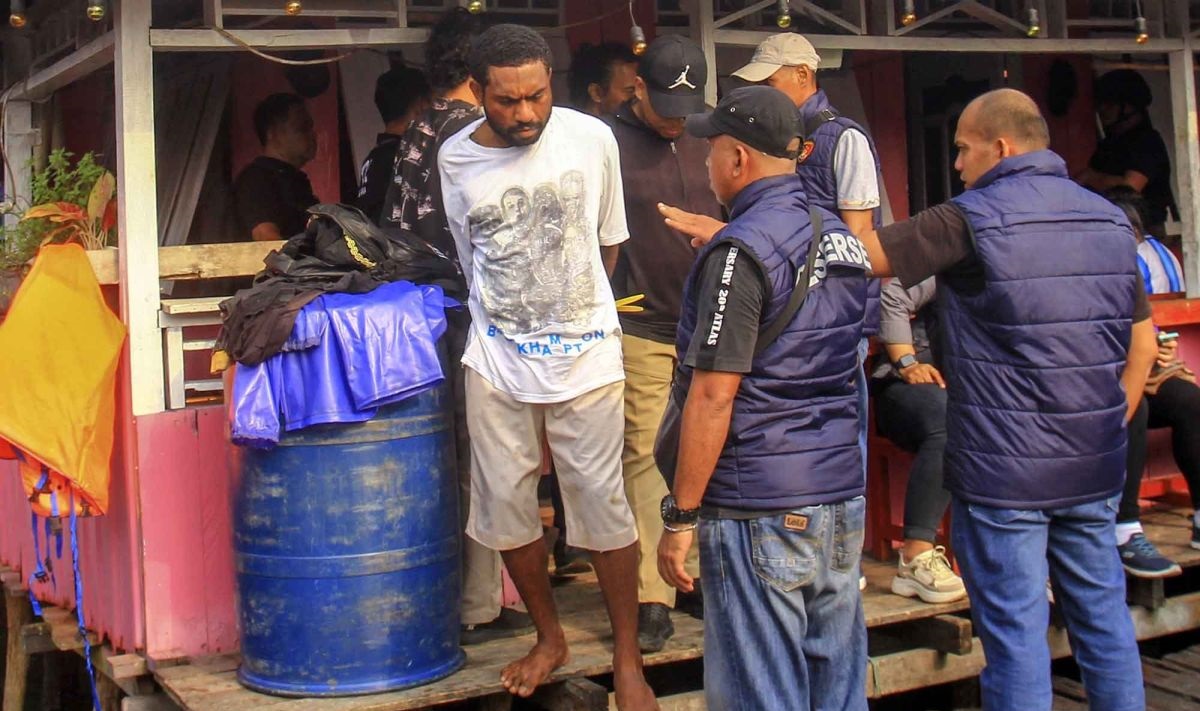
A coordinated crackdown on suspected drug trafficking in Jayapura has resulted in the detention of 10 people, including six Papua New Guinea nationals, and the seizure of 10 kilograms of dried marijuana, according to Indonesian authorities. The operation in Kampung Vietnam, Argapura, also uncovered air rifles, an airsoft gun and bladed weapons, adding to concerns about the combination of illegal drugs and potentially dangerous items in the area.
The raid was conducted by the Papua Regional Police’s Directorate of Narcotics Investigation, working with the National Narcotics Agency’s Papua office, known as BNN Papua. The operation forms part of a wider enforcement effort aimed at curbing the distribution and misuse of narcotics in Jayapura.
Police have described the 10 people as suspected offenders, meaning their alleged involvement must still be examined through the legal process. Their detention does not amount to a conviction. Authorities said the individuals and seized items had been taken to Papua Regional Police headquarters for further investigation.
The case also highlights the cross-border dimension of narcotics enforcement in eastern Indonesia. Jayapura is close to the land border with Papua New Guinea, and Indonesian authorities have previously reported suspected marijuana smuggling through unofficial routes along the frontier. The nationality of those detained in this operation is relevant to the investigation, but it does not establish that all six were involved in cross-border trafficking or that the group operated as a single organised network.
For the authorities, the immediate task is to establish the source of the seized drugs, determine the role of each suspect and identify any wider distribution network supported by evidence.
A Joint Operation Begins Before Dawn
Police and BNN Enter Kampung Vietnam
The operation, identified by authorities as part of the 2026 Operasi Sarang Narkoba, began at approximately 5 a.m. local time on October 24. The target was Kampung Vietnam, in Argapura, South Jayapura District, within Jayapura City.
The operation brought together personnel from several agencies. In addition to the Papua Regional Police narcotics investigation directorate and BNN Papua, the joint team received support from the Mobile Brigade Corps, commonly known as Brimob, the Sabhara public-order unit, the police water and air unit, and Jayapura City Police.
The presence of multiple units enabled officers to conduct searches and inspect people suspected of involvement in drug-related activity. The operation was also attended by BNN Papua chief Brigadier General Anang Triwidiandoko, according to ANTARA’s report.
Authorities have not published a complete operational timeline detailing how intelligence was gathered, how many individual premises were searched or the specific grounds for detaining each person. The available account nevertheless establishes that the operation was coordinated across police and narcotics enforcement agencies rather than conducted by a single unit acting alone.
That coordination is important in investigations involving suspected drug distribution. Police may need to examine the substances recovered, interview suspects and witnesses, establish ownership of seized property and determine whether evidence points to suppliers or other people involved in distribution.
One Suspect Reportedly Attempts to Escape
During the operation, one suspected offender reportedly attempted to escape by running towards the sea. Officers subsequently apprehended the individual, Alfian told ANTARA.
The report did not identify the person or provide further details about the attempted escape. It also did not specify whether the individual was carrying drugs or other evidence at the time.
The episode formed part of the account of the operation’s progress, but the legal significance of the incident will depend on the evidence gathered during the investigation. Police will need to establish the circumstances of the arrest and assess any connection between the individual and the suspected drug activity.
After completing the operation, officers transferred the 10 people and the seized items to Papua Regional Police headquarters. Alfian said the case would proceed through further investigation.
What Police Seized During the Raid
Ten Kilograms of Dried Marijuana
The principal narcotics seizure reported from Kampung Vietnam was approximately 10 kilograms of dried marijuana. Police also secured several weapons and other items during the operation.
The reported inventory included two air rifles, one airsoft gun, two bayonets, two machetes and alcoholic beverages bearing the Singaraja brand. Authorities said other items were also collected, but the reports did not provide a complete list.
The distinction between the types of weapons is important. Air rifles and airsoft guns are not necessarily equivalent to conventional firearms, and their legal classification depends on the specific equipment and applicable regulations. The published reports do not provide enough technical detail to determine the exact specifications of the seized items.
Similarly, the discovery of alcohol alongside suspected narcotics does not by itself establish that every item was connected to drug distribution. Investigators will need to establish the circumstances in which the items were found and whether they are relevant to any alleged offence.
The marijuana seizure remains a central part of the case. Investigators will need to document and examine the substance, maintain proper records of the evidence and determine whether it can be linked to particular suspects or a wider distribution operation.
The available reporting does not specify the estimated street value of the 10 kilograms, the intended destination of the marijuana or the number of individual transactions the seized amount might have supplied. Those questions remain matters for investigation.
Earlier Seizures Add Context to the Crackdown
Alfian also told ANTARA that authorities had previously seized another 20 kilograms of marijuana during raids at two locations. He said the drugs were being held at Papua Regional Police headquarters in Jayapura.
That earlier seizure provides context for the latest operation, but it should be distinguished from the 10 kilograms reported at Kampung Vietnam. The available report does not establish that all the drugs came from the same source or belonged to the same distribution network.
Nor does the combined reported quantity prove that the suspects detained on October 24 were responsible for the earlier seizures. Investigators would need to establish any connection through evidence such as communications, witness statements, transaction records or other material obtained lawfully.
The wider enforcement campaign suggests that authorities are examining suspected drug activity at multiple locations in Jayapura. The next step will be to determine whether these separate cases reveal links between suppliers, transporters and local distributors.
Ten People Detained, Including Six Papua New Guinea Nationals
Of the 10 people detained during the operation, six were identified by police as Papua New Guinea nationals and four as Indonesian citizens. The figures were confirmed by Alfian in his statement to ANTARA.
The involvement of foreign nationals makes the case relevant to cooperation between Indonesia and Papua New Guinea, which share a land border and extensive social and geographical connections. However, nationality alone is not evidence of criminal involvement. The responsibility of each person must be determined individually through the investigation and, where charges are brought, the judicial process.
The reports did not publish the names, ages or specific alleged roles of the 10 people. They also did not clarify whether all were suspected of selling drugs, whether some were suspected of possession or whether any were being questioned in connection with other alleged offences.
For that reason, the most accurate description at this stage is that 10 people were detained on suspicion of drug-related activity. The authorities’ use of the term “suspected drug dealers” in initial reporting should not be read as a final legal determination.
The investigation may establish different levels of involvement among those detained. Some individuals could be connected to possession, others to distribution, while evidence might show that some had no involvement in a particular offence. Any formal charges and subsequent findings will be important in clarifying the case.
The Importance of Cross Border cooperation
Indonesia and Papua New Guinea have a shared interest in preventing illicit trafficking across their border. Yet the participation of six PNG nationals in this particular case does not, on its own, demonstrate that the seized marijuana crossed the border or that all the suspects were part of an international trafficking network.
Indonesian authorities have previously described marijuana as entering parts of Papua through unofficial routes along the Indonesia-Papua New Guinea frontier. In a separate report earlier in October, Papua police said they had found 10 kilograms of marijuana near Holtekamp and suspected it had originated in PNG. The individuals believed to own that shipment reportedly fled when officers approached.
That earlier incident illustrates why border-related intelligence can be relevant to narcotics investigations in the region. It remains a separate case, however, and should not be treated as proof of the origin of the marijuana recovered in Kampung Vietnam.
Establishing a cross-border link in the current case would require evidence tracing the substance’s origin, movement and intended destination. If such a link is confirmed, cooperation between the relevant Indonesian and Papua New Guinea authorities could help investigators pursue suppliers and transport networks beyond the immediate location of the raid.
Part of a Wider Campaign Against Drug Distribution
Operasi Sarang Narkoba Targets Several Forms of Illicit Activity
The October 24 raid took place against the backdrop of a wider campaign by the Papua Regional Police to tackle suspected narcotics distribution and misuse in Jayapura.
A report published by Cenderawasih Pos on October 23 said the Papua narcotics directorate had begun the campaign on October 8 as part of a 100-day programme directed by the National Police chief and the head of the Criminal Investigation Agency. The campaign targets marijuana, methamphetamine, alcoholic beverages and other substances or products associated with misuse.
Earlier operations had already produced seizures and arrests. On October 9, police reported finding approximately 10 kilograms of dried marijuana and detaining four children for further handling in a separate operation that targeted locations around the former Ampera Market and Jalan Terminal 12. Authorities said those children were suspected of substance misuse, including marijuana, inhalants and alcohol, and indicated that rehabilitation would be considered.
The earlier operation is distinct from the October 24 raid at Kampung Vietnam. The people detained, the locations and the reported circumstances should not be conflated.
Taken together, the reports show that police activity has included both investigations into suspected distribution and interventions involving people suspected of substance misuse. Those approaches serve different purposes. Criminal investigations seek to establish responsibility for offences, while cases involving children or people experiencing substance-use problems may require assessment, health services and appropriate rehabilitation.
An effective public response therefore needs to distinguish between organised distribution, possession, personal use and cases involving minors. The appropriate legal and social measures may differ substantially according to the facts of each case.
Enforcement Needs Evidence and Prevention
Police operations can disrupt suspected drug distribution and provide investigators with evidence to pursue further cases. But a sustained response to narcotics also requires prevention, education, access to treatment and cooperation with local communities.
Where young people are involved in substance misuse, early intervention can be important in preventing further harm. Families, schools, health workers and community organisations can help identify risks and connect affected people with appropriate services.
At the same time, suspected suppliers and distributors must be investigated according to the law. Careful evidence handling and fair legal procedures are essential to ensure that enforcement actions lead to reliable outcomes rather than premature conclusions.
The Kampung Vietnam operation presents an opportunity for authorities to examine the relationship between local drug distribution and any wider supply networks. Whether the case reveals a broader network will depend on what investigators establish, not simply on the number of people detained or the quantity of drugs seized.
What Happens Next?
The immediate priority is the formal investigation of the 10 people and the items recovered during the raid. Police will need to establish the ownership and relevance of the seized property, determine the role of each individual and identify whether further suspects or locations are connected to the case.
The authorities have not yet publicly detailed the specific charges, if any, brought against each person. The reports also do not provide information about court proceedings or a final determination of guilt. Those details will be necessary to understand the legal outcome.
If investigators establish links to suppliers or transporters, the case could lead to further enforcement activity. If evidence points to cross-border trafficking, cooperation with Papua New Guinea’s relevant authorities may become important. These remain possible next steps rather than confirmed outcomes.
The investigation will also need to maintain a clear record of the seized marijuana and other evidence. Proper documentation, testing and chain-of-custody procedures can help establish whether evidence is admissible and how it relates to any alleged offence.
For the public, transparent updates about formal charges, investigative findings and court decisions would provide a clearer picture of what the operation has achieved. Reporting the number of people detained and the items seized is an important first step, but the final measure of success will be whether the investigation establishes responsibility and disrupts criminal activity in accordance with the law.
Conclusion
The Kampung Vietnam raid marks a significant enforcement action by Papua police and BNN Papua, with 10 people detained, including six Papua New Guinea nationals, and 10 kilograms of dried marijuana seized alongside air rifles, an airsoft gun and bladed weapons. The operation, which began before dawn on October 24, involved several police units and resulted in the detention of a suspect who reportedly attempted to escape towards the sea.
The seizure adds to earlier reported marijuana recoveries in Jayapura, but it remains important to distinguish the separate incidents and avoid assuming that all suspects were connected to a single network. Investigators must establish the origin of the drugs, the role of each detained person and whether evidence supports further action against other suspected participants.
The broader challenge extends beyond a single raid. Sustained enforcement, careful cross-border cooperation where evidence warrants it, prevention programmes and access to treatment can all contribute to reducing the harm caused by illicit drugs.
For Jayapura, the next test will be whether the operation leads to a well-supported case and actionable intelligence that helps prevent further distribution. The strength of the response will ultimately be measured not just by seizures, but by lawful prosecutions where evidence supports them, reduced harm to communities and a more effective system for addressing drug-related problems.
Read Also
Papua Police Seize 20 kg of Drugs in Jayapura Raid
The Indonesia’s Customs Unveils 45 Drug Cases Worth Rp2.24 Billion in Papua

