
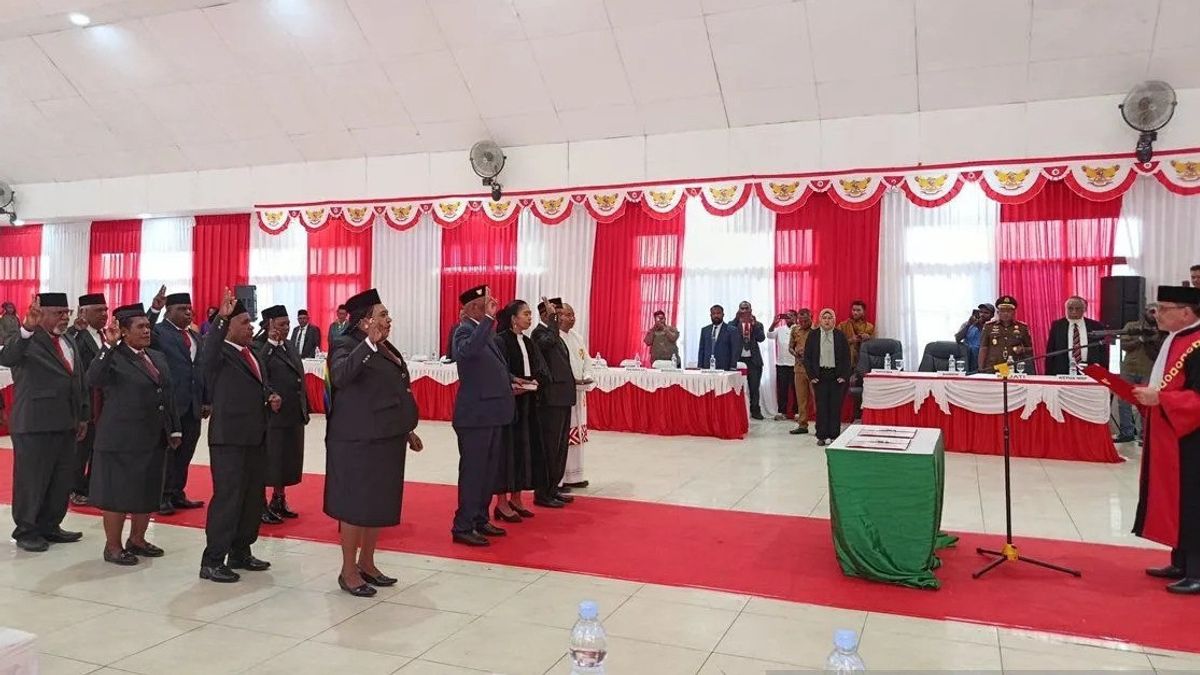
The inauguration of 11 members of the Papua Pegunungan (Highland Papua) Provincial Legislative Council through Indonesia’s Special Autonomy mechanism marks an important step in strengthening Indigenous representation and completing the province’s legislative membership. The ceremony, held in Wamena on October 19, 2026, concluded a selection and appointment process that had taken nearly two years, allowing the new legislators to begin serving for the remainder of the 2024-2029 term.
The appointment mechanism is a distinctive feature of Indonesia’s special autonomy policy for Papua. Alongside legislators elected through political parties, it provides a formal route for Indigenous Papuans, known locally as Orang Asli Papua (OAP), to participate in provincial legislative institutions.
The inauguration brings the Papua Pegunungan assembly to 56 members: 45 elected through political parties and 11 appointed through the Special Autonomy pathway. For the provincial government, the immediate challenge is to ensure that the newly sworn-in members can quickly assume their responsibilities, contribute to policymaking and represent community interests across the mountainous region.
The event also illustrates both the significance and the administrative complexity of implementing Indonesia’s Special Autonomy framework. The appointment process took considerably longer than expected, but the final ceremony brought the selection process to a formal conclusion and opened the way for the 11 legislators to join the assembly’s work.
A Long Process Reaches Its Conclusion
From Selection to Final Appointment
The appointment process developed through several administrative and selection stages following the establishment of Papua Pegunungan as a new province. Unlike the 45 legislators elected through political parties, the 11 Special Autonomy members had to pass through a separate appointment mechanism intended to ensure Indigenous representation.
In January 2025, the provincial government’s National Unity and Political Affairs Agency, known as Bakesbangpol, stated that the selection process for the 11 positions was being conducted under the applicable rules. Officials explained that the selection committee involved five members appointed by the Ministry of Home Affairs, with representation from central government institutions.
The process continued into February 2025, when the provincial selection committee completed the verification and validation of candidates’ administrative requirements from eight regencies. Candidates who met the requirements were expected to proceed to further stages, including written tests, the preparation of papers and interviews.
The selection process was designed to establish eligibility through defined procedures rather than simply fill vacant seats. The positions were distributed across Papua Pegunungan’s eight regencies, reflecting the province’s administrative structure and the intended representation of Indigenous communities.
In March 2025, Bakesbangpol explained that the 11 appointed positions represented a quarter of the 45 seats filled through political parties. Officials also highlighted the requirement that women account for at least 30 per cent of the appointed representation, translating into a minimum of three women among the 11 members.
These stages were important to establishing the basis for the appointments, but they did not immediately result in the legislators taking office. The process continued through subsequent administrative steps before the appointment decision was issued and the inauguration could be scheduled.
The Central Government Calls for the Inauguration
By October 2026, the appointment had become a pressing administrative matter. The Ministry of Home Affairs confirmed that the ministerial decree authorising the appointments had been issued and called on the provincial government and legislature to proceed with the inauguration.
On October 9, Deputy Minister of Home Affairs Ribka Haluk announced that the regional government had already received the appointment decision. She urged provincial authorities and the assembly to complete the administrative and technical steps needed to bring the 11 members into office.
Ribka emphasised that the appointments were intended to allow Indigenous Papuans to exercise their roles in the provincial legislature in accordance with the Special Autonomy framework. She also expressed the hope that Papua Pegunungan would not experience further delays compared with other new autonomous provinces in Papua.
The ministerial intervention was an important step in the final phase of the process. It clarified that the central government had completed the appointment stage under its authority and that the remaining arrangements needed to be carried out locally.
On October 19, the long-awaited inauguration finally took place in Wamena. The ceremony formally completed the appointment process for the 11 legislators and allowed them to begin their remaining term in the provincial assembly.
The Inauguration in Wamena
Judicial Official Leads the Oath-Taking Ceremony
The swearing-in ceremony was held during a plenary session at the Tongkonan Building in Wamena on Monday, October 19, 2026. Hongkun Otoh, Deputy Chief Justice of the Jayapura High Court, led the oath-taking on behalf of the court’s leadership.
The ceremony was attended by Papua Pegunungan Governor John Tabo, members of the regional leadership coordination forum, legislators, government officials and representatives of community, customary, religious, youth and women’s groups.
The appointments were based on Minister of Home Affairs Decree No. 100.2.1.4-2250 of 2026, dated September 29, concerning the formal appointment of members of the Papua Pegunungan legislature through the Special Autonomy mechanism for the remainder of the 2024-2029 term.
The oath-taking marked more than just the completion of an administrative process. It formally established the authority and responsibilities of the newly appointed legislators within the provincial institution.
For the members themselves, the immediate task is to become familiar with the assembly’s procedures, participate in its legislative and oversight work, and contribute to the policy decisions that affect residents across Papua Pegunungan.
The 11 Appointed Legislators
The newly inaugurated members represent eight regencies in the province. According to the published list, they are:
• Jayawijaya: Paskalis Kossi and Saul Esarue Elokpere
• Pegunungan Bintang: Yulita Gebze
• Yahukimo: Kalu Keroman and Yonet Silak
• Tolikara: Watimartha Kogoya
• Mamberamo Tengah: Uria Yikwa
• Yalimo: Arauna Nekwek
• Lanny Jaya: Briyur Wenda and Abisay Kogoya
• Nduga: Yakoba Y. Lokbere
The distribution reflects the participation of representatives from all eight regencies in the province’s Special Autonomy appointment process.
With their inauguration, the 11 members join the 45 legislators elected through political parties. The resulting 56-member assembly now has its full complement of members under the current composition reported by provincial media.
The new legislators will initially form a special group before being distributed among the assembly’s internal bodies in accordance with the applicable rules and quotas. This arrangement aims to integrate appointed members into the institution’s regular work, ensuring they operate within its established structures.
Special Autonomy and Indigenous Representation
A Formal Mechanism for Participation
The appointment pathway is part of Indonesia’s broader Special Autonomy policy for Papua. Its purpose is to create a formal channel through which Indigenous Papuans can participate in regional governance alongside representatives elected through political parties.
Yos Elopere, chair of the Papua Pegunungan Provincial Legislative Council, described the appointment of Indigenous representatives as part of implementing the Special Autonomy framework. He cited Government Regulation No. 106 of 2021, concerning authority and institutional arrangements for Special Autonomy in Papua, and Law No. 16 of 2022 on the establishment of Papua Pegunungan Province as legal foundations for the process.
The mechanism recognises that representation in Papua requires attention to the province’s distinctive social and customary contexts. It supplements the electoral process with an additional route for participation while placing appointed members within the same legislative institution.
This arrangement is significant for the relationship between regional governance and Indigenous communities. Legislative representation channels local concerns into debates on public policy, budgets, development priorities, and government oversight.
However, representation alone does not guarantee that every community’s concerns will be addressed. The effectiveness of the mechanism will depend on whether legislators engage with constituents, participate actively in legislative work and scrutinise the implementation of public programmes.
The appointments should therefore be understood as an institutional opportunity rather than a complete measure of the success of special autonomy. We will ultimately assess their contribution based on their performance and the extent to which policy decisions reflect community interests.
Recognition Through Institutions and Legal Procedures
The inauguration also demonstrates how the Indonesian state’s Special Autonomy framework operates through formal institutions and legal procedures. The central government issued the appointment decree, the regional government and legislature completed the arrangements, and a judicial official administered the oath.
This sequence matters because the appointment process required coordination between national and provincial authorities. The final ceremony established the members’ formal status and allowed them to enter the legislative institution under the applicable legal framework.
The nearly two-year delay nevertheless highlights the importance of timely administration. Special representation mechanisms can fulfil their intended purpose only when selection, appointment and inauguration procedures are completed efficiently enough for the appointed members to contribute meaningfully during their terms.
The experience may also provide lessons for future implementation in Papua’s new autonomous provinces. Clearer administrative timelines, coordination among institutions and early resolution of procedural obstacles could help reduce delays in similar processes.
Governor John Tabo Calls for Unity and Responsibility
Working Together Across Political Pathways
Governor John Tabo welcomed the newly appointed members and called for cooperation between them and legislators elected through political parties.
“Congratulations on joining your colleagues in the DPRD. We have the same rights and obligations. Togetherness must be the foundation for laying the groundwork for positive development in Papua Pegunungan,” Tabo said, according to the Papua Times’ report of the inauguration.
The governor’s message placed the emphasis on institutional cooperation rather than differences in how legislators obtained their seats. Both elected and appointed members are expected to contribute to the assembly’s responsibilities and work within its established rules.
Tabo also acknowledged that the appointment process had taken a long time and experienced considerable administrative and political dynamics. He urged the legislators to protect the dignity of the institution, resolve disagreements through established procedures and demonstrate the conduct expected of public representatives.
His remarks reflect the practical demands facing the assembly. With the 11 appointed members now joining the institution, cooperation will be necessary to develop policies, review spending priorities and oversee the implementation of government programmes.
The governor also pointed to the province’s fiscal circumstances, noting its continued reliance on transfers from the central government. That dependence makes coordination and careful prioritisation important as provincial authorities seek to address development needs across a geographically challenging region.
Completing the Assembly Is Only the Beginning
Legislative Duties and Public Accountability
Yos Elopere said the long selection process should not diminish the new members’ commitment to carrying out their duties under the law. He also stressed the importance of ensuring that appointed members are integrated into the assembly’s internal structures and receive their allocated roles according to its rules.
The assembly’s responsibilities include legislation, budgeting and oversight. These functions are especially relevant to a province managing substantial development demands, including infrastructure, education, healthcare, public services and economic opportunities across its regencies.
The newly appointed members will need to familiarise themselves with ongoing programmes and budget discussions, build working relationships with fellow legislators and understand the concerns of the communities they represent. Their effectiveness will depend on active participation, scrutiny of government proposals and consistent communication with constituents.
The inauguration also creates an opportunity to strengthen public confidence in regional institutions. A legislature is more likely to earn that confidence when its members explain their decisions, scrutinise public expenditure and help ensure that development programmes respond to local needs.
For the Special Autonomy mechanism to have a lasting impact, Indigenous representation must translate into substantive participation. That means contributing to policy debates, identifying gaps in public services and helping hold the regional administration accountable for implementation.
Conclusion
The inauguration of 11 Papua Pegunungan legislators through the Special Autonomy pathway on October 19, 2026, marks the end of a selection and appointment process that took nearly two years. The ceremony completed the province’s 56-member legislative composition and formally brought Indigenous representatives from eight regencies into the assembly.
The process demonstrates the role of Indonesia’s Special Autonomy framework in providing a formal mechanism for Indigenous Papuans to participate in provincial governance. It also highlights the importance of administrative coordination: timely implementation of legal provisions and appointment decisions is essential for effective representation.
The delay should not be overlooked. The experience points to the need for clearer procedures and better coordination in future appointment processes. At the same time, the successful inauguration provides an opportunity to move beyond procedural questions and focus on the work ahead.
Governor John Tabo’s call for cooperation offers a relevant starting point. The elected and appointed legislators share responsibility for strengthening the assembly, overseeing public spending and helping ensure that provincial policies serve communities across Papua Pegunungan.
Ultimately, the ceremony alone will not measure the value of the 11 appointments. It will be measured by the quality of legislative work, the seriousness of oversight and the extent to which Indigenous representation contributes to inclusive development. The inauguration has opened that opportunity. The next task is to turn it into accountable governance and tangible public benefits.
Read Also
Papua Special Autonomy Funds Must Benefit Communities
Papua Special Autonomy Funds Face Push for Faster Distribution

