
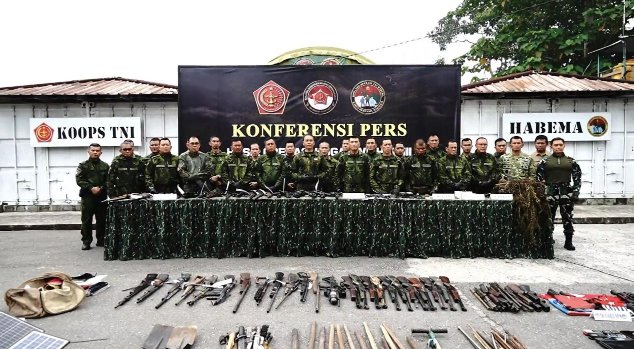
Indonesia’s Joint Regional Defence Command III (Kogabwilhan III) has reported the seizure of 79 weapons and 394 rounds of ammunition during security operations across Papua and surrounding areas in the third quarter of 2026. The command also reported taking action against 22 people identified as figures or members of the armed organisation known as the Free Papua Movement (OPM), describing the results as part of efforts to disrupt armed activity, illegal supply chains and logistical networks.
The results, covering operations from July through September, were presented by Kogabwilhan III Commander Lieutenant General Lucky Avianto during a press briefing in Mimika, Papua Tengah (Central Papua), on October 14, with details published by regional media on October 14 and 15. The weapons inventory included 24 standard-issue firearms, 25 mixed-category firearms and 30 air rifles. Security personnel also recovered ammunition, communication equipment, optical devices, documents and other items that the military said were associated with the activities of armed groups.
The figures provide a snapshot of Indonesia’s security campaign in a region where armed violence, illegal weapons circulation and the safety of local communities remain important public concerns. They also underline the challenge facing authorities: preventing firearms and ammunition from reaching armed groups while ensuring that security operations comply with the law and protect civilians.
For Papua’s residents, the significance of the operation extends beyond the quantity of equipment seized. Its longer-term value will depend on whether efforts to reduce armed capabilities contribute to safer communities, more reliable public services and greater opportunities for economic activity.
What the Third-Quarter Operation Revealed
A Three-Month Security Campaign
The latest figures cover the third quarter of the 2026 fiscal year, from July to September. Rather than describing a single raid, Kogabwilhan III presented the results as the cumulative outcome of security operations conducted across several areas of Papua and its surrounding operational territory.
According to Lucky, the operations were part of an ongoing effort to address security threats, including armed-group activity, weapons trafficking and other illegal activities. The command also highlighted the importance of coordination between military units and the use of intelligence information to identify individuals, weapons and networks linked to armed activity.
A briefing in Mimika on October 14 made the results public. The following day, reports from Papua60Detik, Fajar Papua and ANTARA Papua detailed the number and types of weapons seized, as well as other equipment and materials collected during the operation.
The timing of the announcement is significant because it offers a consolidated account of activity over several months. It also provides a basis for assessing the range of security challenges addressed by the command, from the presence of weapons to communication systems and suspected logistical support.
However, the military reported these figures as operational results. They don’t, by themselves, show the circumstances of every seizure, the legal status of every person named, or whether all recovered items were used in violent incidents.
Breaking Down the 79 Weapons
The headline figure of 79 weapons requires a closer look. Kogabwilhan III reported three broad categories: 24 standard-issue firearms, 25 mixed-category firearms and 30 air rifles. The total, therefore, includes air rifles as well as conventional firearms.
The 24 standard-issue firearms consisted of 11 pistols and 13 long-barrel firearms. A further 25 weapons were classified as mixed-category firearms: three short-barrel firearms chambered for 9 mm ammunition and 22 long-barrel firearms chambered for 5.56 mm ammunition.
The remaining 30 weapons were air rifles. Although these are different from conventional firearms, their inclusion in the overall total reflects the range of weapons and weapon-like equipment recorded during the operation.
This distinction is important for international readers. Recovering 79 weapons does not mean recovering 79 conventional military firearms. The published breakdown gives a more precise account of the inventory and helps prevent the headline figure from being misinterpreted.
The report also listed 394 rounds of ammunition. Of these, 304 were 5.56 mm rounds, 30 were 7.62 mm rounds and 60 were 9 mm rounds. In addition, troops recovered 55 spent cartridge cases, comprising 50 of 5.56 mm calibre and five of 7.62 mm calibre.
Ammunition seizures are operationally relevant because access to compatible ammunition can affect whether a firearm can be used. Yet the published figures do not establish that all the recovered rounds were intended for a single group or a particular planned attack. Those questions would require evidence specific to each seizure.
Communication Equipment and Other Materials Recovered
Devices that May Help Investigators Trace Networks
Beyond weapons and ammunition, the operation yielded 28 handheld radios, 50 mobile phones, one drone, 10 optical devices and 10 bundles of documents described in the reporting as related to OPM.
These items may have investigative value beyond their immediate physical characteristics. For example, mobile phones and documents can provide investigators with legal information about people’s identities, locations, and connections. Depending on their usage and location, handheld radios and drones can serve beneficial or harmful purposes.
The public reports do not detail the contents of the documents or digital devices, nor do they establish the precise role of every item in the activities under investigation. Their significance will depend on subsequent examination and verification.
The distinction between collecting an item and proving its connection to a crime is essential. An object can become evidence in an investigation, but its presence alone does not necessarily prove that its holder committed an offence.
Cannabis, edged weapons and financial evidence
The reported inventory also included 1,347 cannabis plants or stalks, 10 solar panels, 20 sets of Morning Star (Bintang Kejora) themed accessories, 20 sets of bows and arrows, 20 machetes and 10 axes. Authorities also listed 10 additional OPM-related accessories, cash totalling Rp26,773,000 and 45 pieces of old or antique currency.
The range of materials illustrates the breadth of the operation as described by the military. Some items were weapons or potential weapons; others were communication equipment, financial materials or objects that authorities associated with the armed organisation.
The reported cannabis seizure is a separate element of the operation and should not automatically be treated as proof that every individual targeted was involved in drug production or trafficking. Likewise, the presence of currency or political-themed accessories does not by itself establish criminal conduct. The legal significance of each item depends on the evidence and the applicable law.
For investigators, the task after a seizure is to establish the origin, ownership and intended use of recovered materials, where relevant. That process is important both for effective law enforcement and for ensuring that individuals are not treated as guilty solely because their names or belongings appear in an operational report.
Twenty-Two People Identified in the Operation
Individuals from Several Operational Areas
Kogabwilhan III also reported taking action against 22 people whom it identified as figures or members of OPM across several operational areas. The names were presented by Lucky during the October briefing and subsequently published by regional media
The list covered individuals associated in the military’s account with Kodap (Regional War Command) IV/Soraya, Kodap III/Ndugama, Kodap XVI/Yahukimo, Kodap XVIII/Ilaga, Kodap XIII/Kegepa Nipouda, Kodap XXXV/Bintang Timur, Kodam III/D Dulla and the Domberai area.
For Kodap IV/Soraya, the published list included Yesias Mate, Manuel Yohanes Aimau, Alfon Sorry, Arso Aisnak, Manfred Fateem, Anton Fatem, Yesias Fatem, Riki Asiasior, Yopi Frasov, Yohannes Ky and Zakarias Fatem.
The names reported in connection with Kodap III/Ndugama were Lau Gwijangge, Ket Gwijangge, Peltu Usmabul and Lut Wumangge, also known as Medak-Medak. Other names included Bilip Kobak of Kodap XVI/Yahukimo; Jeki Murib of Kodap XVIII/Ilaga; Oktonil Degei of Kodap XIII/Kegepa Nipouda; Abdon Kisamlu of Kodap XXXV/Bintang Timur; Dinus Tigau and Hurbianus Mirip of Kodam III/DDulla; and Colonel Jacob of the Domberai area.
These names and affiliations reflect the military’s published account. The reports do not provide a complete, individualised explanation of the action taken against each person, nor do they establish that all 22 were arrested as weapons smugglers. It would therefore be inaccurate to describe every individual as a convicted offender or to claim that each was directly involved in trafficking firearms and ammunition.
That distinction matters in a security operation involving multiple people and different operational areas. Arrest, detention, investigation, surrender and other forms of action are not interchangeable legal categories. Any criminal responsibility must be determined through the relevant legal process and supported by evidence.
Intelligence and Coordination
Lucky attributed the results to coordination and cohesion among TNI units operating in Papua, with information support from Indonesia’s State Intelligence Agency, known as BIN. He said intelligence information helped authorities identify the whereabouts of figures and members of armed groups and trace weapons in their possession.
The commander also described the objective as broader than collecting weapons. According to the published statement, the operation sought to disrupt illegal activity by examining how weapons were obtained, the routes used to distribute them, the networks supporting the groups and the logistics that enabled their activities.
This approach reflects a wider law-enforcement challenge. A chain of suppliers, intermediaries, transport routes, and other forms of support can sustain the availability of firearms. Seizing weapons may reduce immediate access to equipment, while investigations into their origin and distribution may help authorities identify how the supply chain operates.
However, seizure figures alone cannot determine the extent of disruption within a particular network. That assessment would require further information about the origins of the weapons, the people involved, the status of investigations and whether supply routes remain active.
Lucky Avianto: Protecting the Public Is Central
In his statement, Lucky framed the operation as part of the military’s responsibility to protect people in Papua from threats posed by armed violence and illegal activities.
“I and, of course, all of us cannot imagine how dark and terrifying the fate of our brothers and sisters in Papua would be if these life-taking weapons had not been secured,” he said, according to Papua60Detik’s report of the October 15 statement.
His remarks emphasised the potential danger associated with firearms circulating outside of lawful control. The commander stated that the recovery of weapons and ammunition aimed to prevent their use in violent acts that could endanger civilians and security personnel.
Lucky also stated that the operation adhered to the applicable rules of engagement, legal requirements, and humanitarian values. He highlighted coordination with law-enforcement agencies, government institutions, regional administrations and communities as part of efforts to maintain stability in Papua.
The emphasis on legal and humanitarian standards is important. Security operations in populated areas can have consequences for people who are not involved in armed activity. A sustainable security policy must therefore combine the protection of civilians with professional conduct, accountability and compliance with applicable law.
The commander also called on residents to report suspected illegal activity or threats to public order to the relevant authorities. Such cooperation can provide useful information, but it should be pursued safely and without encouraging vigilantism or the targeting of people based on unverified allegations.
What the Results Mean for Papua’s Wider Security Environment
Reducing Access to Weapons is Only One Measure
The seizure of 79 weapons and 394 rounds of ammunition represents a substantial inventory of recovered material, according to the command’s report. But the broader security picture cannot be assessed by counting weapons alone.
The impact will depend on whether the operation reduces the capacity to carry out attacks, helps investigators identify illegal supply networks and improves safety for communities. It will also depend on whether the recovered evidence can be processed effectively and whether subsequent law-enforcement action follows the requirements of the law.
Papua’s geography presents additional challenges. Forests, mountainous terrain and distances between settlements can complicate access for security personnel and public-service providers alike. When insecurity disrupts movement, the effects can extend to schools, health facilities, markets and transport services.
Reducing armed threats can contribute to a more stable environment, but it is not a substitute for sustained investment in education, healthcare, infrastructure and livelihoods. These priorities work together: communities are better positioned to benefit from development when people can move safely and public services can operate reliably.
Security, Development and Public Confidence
The operation also highlights the importance of public confidence. Military announcements provide an account of operational achievements, while residents need to see that security measures translate into tangible improvements in their daily lives.
That means evaluating results not only through the number of firearms seized or individuals targeted, but also through indicators such as reduced violence, safer transport routes, uninterrupted schooling and better access to essential services.
Coordination between the military, police, local governments and community representatives can help connect security measures with broader development priorities. Transparent communication about operations and investigations can also help the public distinguish verified information from allegations or speculation.
At the same time, the handling of individuals named in military statements must remain consistent with the law. Evidence must be examined, allegations must be distinguished from proven offences, and any legal proceedings must follow the relevant safeguards. These standards enhance law enforcement’s credibility and ensure responsible pursuit of security objectives.
Conclusion
Kogabwilhan III’s third-quarter report records the seizure of 79 weapons, including 49 conventional firearms across two reported categories and 30 air rifles, along with 394 rounds of ammunition. The command also reported recovering communication equipment, optical devices, documents, cannabis plants or stalks, edged weapons, cash and other materials. It identified 22 people as figures or members of OPM against whom action had been taken.
The figures underline the scale and breadth of the military’s reported security activities between July and September 2026. Lucky Avianto said the results depended on coordination among TNI units and intelligence support, while emphasising the need to disrupt illegal supply chains and protect the public.
The next challenge is to convert those operational results into durable improvements in safety. That will require continued investigation into the origins and distribution of weapons, lawful handling of evidence, cooperation with local communities and close attention to civilian protection.
For Papua, lasting stability cannot be measured solely by the amount of equipment removed from circulation. It must also be reflected in the everyday experiences of residents: whether children can attend school, families can reach health services, traders can move goods and communities can pursue their livelihoods without fear.
The reported seizures are one part of that effort. Their lasting value will depend on whether they help prevent violence, strengthen public confidence and create more secure conditions for peaceful development across Papua.
Read Also
Anton and Yesias Fatem Surrender as TNI Recovers Caracal Rifle
Papua Illegal Arms Network: 17 Suspects Detained Since March 2026
Police Trace Suspected Illegal Arms Network in Jayapura
Indonesia Seizes 200 Ammunition Rounds in Jayapura

