
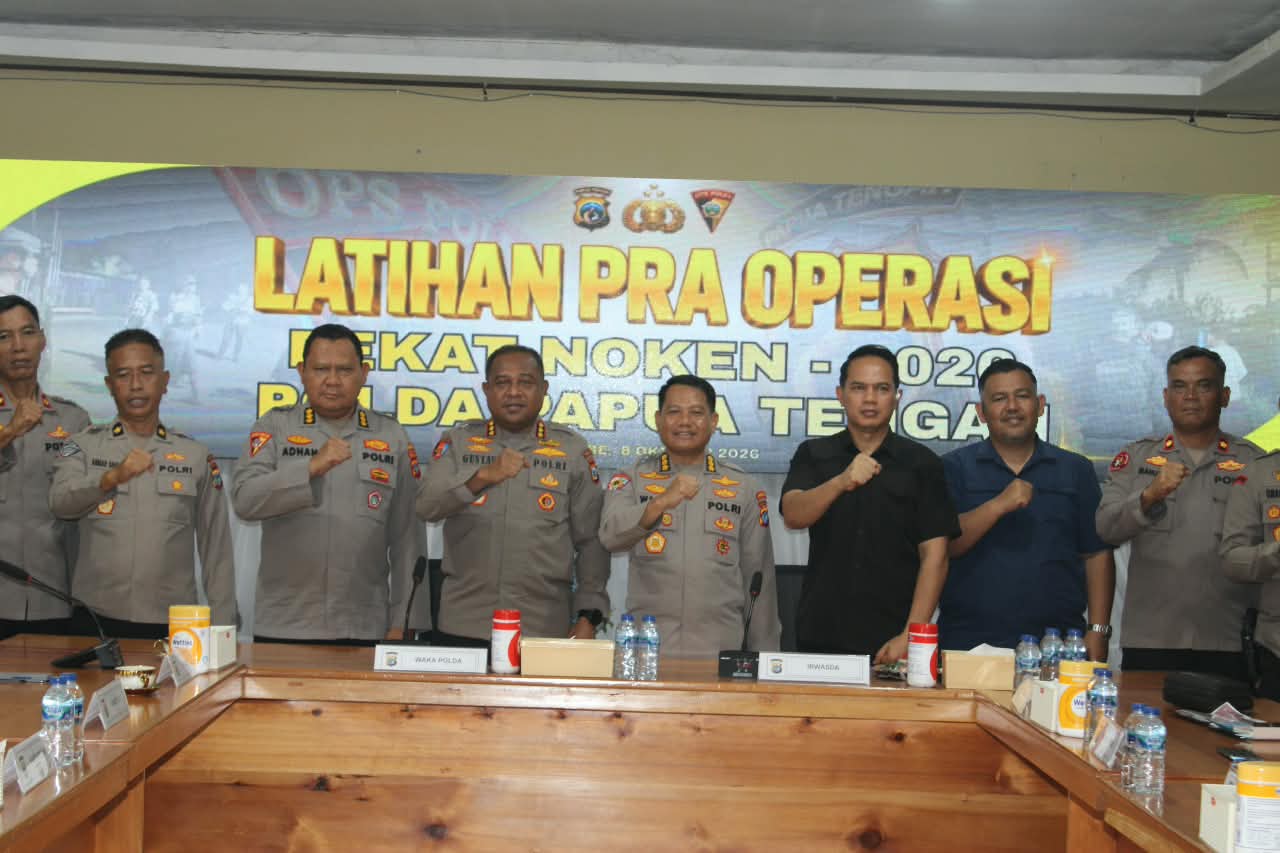
Papua Tengah (Central Papua) Regional Police have intensified efforts to tackle crime and public order disturbances through the 2026 Pekat Noken Operation, a 12-day campaign running from October 9 to 20. The operation follows police records showing 459 conventional crime cases and other public security disturbances between January 1 and October 6, 2026. The figures highlight the challenges facing law enforcement in the province and the importance of measures that protect residents, businesses and public services.
The operation is designed to address crimes ranging from motorcycle theft and violent robbery to assault, narcotics distribution, illegal gambling, alcohol-related problems and street intimidation. Police are combining early intervention, preventive measures and law enforcement, with an emphasis on identifying locations and circumstances where crime is more likely to occur. The initiative is also intended to strengthen cooperation with local government, the military, traditional leaders, religious organisations and community representatives.
The campaign comes at a time when public safety remains important to the province’s social and economic development. Residents need to travel, work, attend school, operate businesses and access public services without undue fear of crime. The effectiveness of the operation will therefore depend not only on arrests and case investigations but also on whether it can help reduce risks and improve public confidence in law enforcement.
459 Cases Recorded in Nine Months
Theft and Violence Account for Prominent Categories
Police data cited by Koran Papua and Odiyaiwuu show that 459 conventional crime cases and other public order disturbances were recorded from January 1 through October 6, 2026. The information came from the police DORS application, which was used to compile the reported figures.
By the October 6 reporting date, the police had resolved 47 of the 459 cases. The data also identified four prominent categories: 150 cases of motor vehicle theft, 121 cases of assault, 105 cases of robbery involving force or violence, 35 cases of group assault or mob violence, and 9 cases related narcotics.
Motorcycle theft represented the largest of the four categories. In communities where motorcycles are important for commuting, transporting goods and earning a living, vehicle theft can have consequences beyond the immediate financial loss. Victims may lose access to a key means of transport, while small businesses and workers can face additional costs or interruptions to their daily activities.
Assault and robbery also pose direct risks to personal safety. Robbery involving violence can leave victims physically injured and financially vulnerable, while incidents of assault may affect families and create wider concern about safety in public spaces.
The figures provide a snapshot of recorded cases, not a complete measure of every crime committed in the province. They also do not establish that crime has increased or decreased compared with the same period in previous years. Such conclusions would require comparable historical data and a clearer account of reporting practices.
Nevertheless, the number of recorded incidents provides police a basis for identifying priorities and allocating operational resources. The concentration of cases in theft, assault and violent robbery suggests that measures addressing property crime and violence are important components of the current response.
A Case Backlog Remains an Important Challenge
The 47 cases recorded as resolved represent a portion of the 459 cases listed in the police data. The figures indicate that case resolution remains an important issue requiring attention, although they do not explain the status of every unresolved case or the reasons for the difference.
Criminal investigations can vary considerably in complexity. Some cases may require witness interviews, forensic examinations, identification of suspects or coordination between police units. A case recorded as unresolved by a particular date may still be under investigation.
The public’s crucial question is whether investigators consistently follow up on reports and provide appropriate updates to victims. Improving the quality of investigations and case management can help strengthen trust in law enforcement alongside preventive operations.
Operation Pekat Noken is intended to address immediate security concerns, but its longer-term value will also depend on the ability of police units to follow investigations through to lawful outcomes.
Inside the 2026 Pekat Noken Operation
A 12-Day Campaign Focused on Prevention and Enforcement
The operation began on October 9, and is scheduled to run through October 20. Its scope covers a range of activities that police classify as penyakit masyarakat, a term commonly used in Indonesia for social problems and unlawful conduct that can disturb public order.
The targeted offences include motor vehicle theft, violent robbery, aggravated theft, narcotics distribution and misuse, illegal alcohol distribution, gambling, prostitution, intimidation and other conventional crimes. The operation is intended to combine action against offenders with measures that can prevent disturbances from developing in the first place.
The three principal approaches are pre-emptive action, preventive measures and law enforcement.
Pre-emptive activities seek to address conditions that may contribute to crime. These can include public education, communication with residents and efforts to discourage unlawful behaviour before an offence occurs.
Preventive measures focus on reducing opportunities for crime. Depending on local conditions, this may involve patrols, monitoring of vulnerable areas and improved coordination among officers and communities.
Law enforcement provides the response when evidence indicates that an offence has occurred. Investigations and legal proceedings must follow applicable procedures, with suspects’ rights respected and decisions based on evidence.
The combination matters because enforcement alone cannot address every factor that influences crime. At the same time, prevention must not become a substitute for investigating serious offences or holding offenders accountable through the justice system.
Mapping Crime Hotspots
Papua Tengah Deputy Police Chief Commissioner Gustav R. Urbinas has asked personnel to map crime-prone locations and periods, identify recurring methods of operation and assess potential sources of public order disturbances.
The aim is to make the deployment more focused rather than applying the same approach everywhere. Detailed local information can help officers decide where patrols are most needed, when monitoring should be intensified and which types of offences require particular attention.
The police have identified Nabire City and the wider jurisdiction of Papua Tengah Regional Police as areas of operational concern. The province’s geographic scale means that effective deployment also requires attention to local conditions and the resources available to each police unit.
A well-designed operation should be responsive to evidence. If a particular area experiences repeated vehicle theft, for example, the response may need to focus on the circumstances that enable such crimes. If violent incidents are concentrated at certain times or locations, patrol planning and community engagement can be adjusted accordingly.
The quality of this process depends on accurate data and regular review. As the operation progresses, police should be able to assess whether their measures are reaching priority locations and whether reported incidents are changing.
Gustav Urbinas: Firm Action Must Remain Professional
Deputy Police Chief Gustav R. Urbinas has stressed that the campaign should not be measured solely by the number of people arrested or cases uncovered. In his view, preventing crime, improving public awareness and maintaining a secure environment are also important indicators of success.
“This data is a serious concern for the police because it does not only describe the number of cases but also shows disturbances that directly affect the public’s sense of security,” Gustav said after leading a meeting on Operation Pekat Noken 2026, according to Koran Papua.
He has also directed personnel to conduct the operation professionally, proportionately and humanely, in accordance with applicable law. Officers have been warned against arrogance, excessive force and actions that violate established procedures.
“Do not let our efforts to eradicate social ills result in violations committed by our own personnel,” Gustav said, as reported by Koran Papua and Odiyaiwuu.
The instruction is significant because the credibility of a public security campaign depends on the conduct of those implementing it. Residents are more likely to cooperate with law enforcement when officers act fairly, explain their actions where appropriate and respect legal safeguards.
Firm enforcement and respect for rights are not competing objectives. Both are necessary for effective policing. Investigations must be based on evidence, and enforcement must remain proportionate to the circumstances of each case.
Gustav’s emphasis on professional conduct also establishes an internal standard for the operation. Police performance should be judged not only by the number of offences addressed but also by whether officers comply with the law while carrying out their responsibilities.
Cooperation Beyond the Police
Local Government, TNI and Community Leaders
Papua Tengah Regional Police plan to strengthen cooperation with local government, the Indonesian National Armed Forces, traditional leaders, religious figures, community representatives and other local organisations.
This cooperation is intended to help identify potential disturbances early, improve communication and encourage residents to participate in maintaining public order. Local leaders can often provide information about community concerns and changes in neighbourhood conditions, while public institutions can coordinate responses within their respective responsibilities.
Traditional and religious leaders may also help communicate messages about peaceful dispute resolution, responsible behaviour and the importance of reporting serious incidents. Such engagement can be particularly useful when authorities need to build public understanding across communities with different local circumstances.
The effectiveness of cooperation will depend on clear responsibilities and reliable communication. Community participation should support lawful policing, not replace formal investigations or place residents at risk by asking them to confront suspected offenders themselves.
Residents can contribute by reporting crimes through appropriate channels, securing their property where possible and sharing credible information with authorities. They should avoid spreading unverified accusations or taking matters into their own hands.
For police, community engagement can provide a clearer understanding of local concerns while helping ensure that preventive measures respond to actual risks rather than assumptions.
Why Public Security Matters for Development
Public safety is closely connected to economic and social activity. When residents feel secure, they can travel to work, run small businesses, transport goods and participate in community life with greater confidence.
For traders and service providers, theft and robbery can lead to direct losses, interruptions and higher costs. For families, violence can cause injury, financial pressure and lasting anxiety. Public disorder can also affect access to schools, healthcare facilities and other essential services when people feel unsafe travelling to them.
These effects make crime prevention relevant to more than police statistics. Security is one of the conditions that allow local economic activity and public services to function.
However, a 12-day operation cannot by itself resolve every cause of crime. Sustainable improvements may require continued investigation, effective case management, community-based prevention, attention to substance misuse and coordination with relevant social services.
Authorities should also monitor whether interventions produce measurable results. Useful indicators include changes in reported offences, the number and quality of completed investigations, repeat incidents in priority locations and public feedback on safety. These measures would provide a stronger basis for evaluating the operation than arrest totals alone.
As Papua Tengah continues to develop its public institutions and economy, a consistent approach to security can help create conditions in which residents and businesses can operate more confidently.
Measuring the Operation’s Success
Operation Pekat Noken 2026 is scheduled to conclude on October 20. As of October 12, the published information describes the operation’s objectives, scope and preparation but does not provide a final operational outcome. It would therefore be premature to claim that the campaign has already reduced crime or resolved the 459 recorded cases.
A clear public report after the operation would help residents understand what was achieved. It could explain the number of cases investigated during the campaign, any arrests and seizures, the preventive activities conducted, and whether particular crime categories showed changes during the period. It should also distinguish offences recorded before the operation from cases discovered or handled during it.
Equally important is the status of the 47 cases already recorded as resolved in the DORS data. More detail about case outcomes would help clarify what resolution means in practice and how the remaining cases are being handled.
Transparent reporting can help the public assess whether the campaign has delivered practical improvements. It also gives police a basis for refining future operations and directing resources towards persistent problems.
Conclusion
Papua Tengah Regional Police launched Operation Pekat Noken 2026 in response to 459 recorded conventional crime cases and public order disturbances between January 1 and October 6. The figures, including 150 motorcycle theft cases, 121 assault cases and 105 violent robberies, underline the need for targeted action to protect residents and their livelihoods.
Deputy Police Chief Gustav R. Urbinas has emphasised a combination of prevention, focused enforcement and cooperation with local institutions and community leaders. He has also made clear that officers must act professionally, proportionately and in accordance with the law.
The operation’s success will ultimately depend on results that extend beyond the 12-day campaign. More effective investigations, fewer repeat offences, safer public spaces and greater confidence in lawful policing are important measures of progress. A transparent assessment after October 20 will be necessary to determine whether the operation has achieved those goals.
For Papua Tengah, the long-term objective is a public security environment in which residents can work, study, travel and conduct business with greater confidence. Consistent law enforcement, respect for legal procedures and sustained community cooperation will remain essential to that effort.
Read Also
Papua Tengah Antik Noken Operation Uncovers 9 Cases
Papua Illegal Arms Network: 17 Suspects Detained Since March 2026
Papua Drug Cases Rise as Police Step Up Enforcement

