
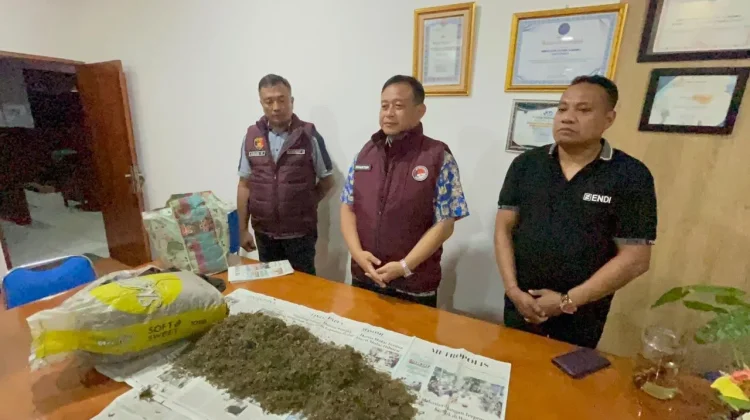
Papua Police have seized approximately 10 kilograms of dried marijuana during the opening day of Operation Sarang Narkoba in Jayapura while taking action against suspected substance abuse involving young people. The Papua Police drug operation in Jayapura on October 9, 2026, targeted locations in Holtekamp and the former Ampera Market area, as officers began a month-long effort to disrupt drug distribution and protect communities from the effects of narcotics.
The seizure was made near Jalan Terminal 12, in front of Mayo Beach Resort, in the Holtekamp area of Muara Tami District. Police found two sacks containing dried marijuana, each reportedly weighing around five kilograms. The packages had been left behind after people in the area fled as officers approached. Investigators are now trying to find out who owned the drugs, how they got there, and who may have been involved in the suspected distribution network.
The operation was led by Senior Commissioner Alfian, Director of Drug Crimes Investigation at the Papua Regional Police, and involved 75 personnel from several police units. Officers also inspected an area near the former Ampera Market, where they identified four minors suspected of substance abuse and took them for further examination.
The operation has drawn attention to two connected challenges for authorities in Papua: preventing illegal drugs from moving across the Indonesia-Papua New Guinea border and responding to substance abuse before it causes lasting harm to young people. Police have said the operation will continue for 30 days, combining enforcement with calls for stronger cooperation among families, schools and local communities.
How the Operation Unfolded in Jayapura
A Coordinated Deployment of 75 Personnel
The operation began on Friday, October 9, as the Papua Regional Police intensified efforts to address the distribution and misuse of narcotics in Jayapura. The deployment involved 75 personnel, including officers from the Directorate of Drug Crimes Investigation and other supporting units.
According to police reporting carried by Tribratanews, the operation covered two locations considered relevant to suspected drug activity: the area around Jalan Bekas Pasar Ampera and Jalan Terminal 12, near Mayo Beach Resort in Holtekamp.
The two locations presented different concerns. At the former Ampera Market area, officers encountered minors suspected of substance misuse. At Holtekamp, they found a larger quantity of suspected marijuana after several people fled when approached.
The sequence of events illustrates why drug enforcement often requires more than a single arrest. Officers must identify suspected users, locate substances, secure potential evidence and establish whether people encountered at different locations are connected to the same distribution network. In this case, police have not publicly established that the individuals encountered at the two locations were part of one organised group.
Four Minors Encountered Near the Former Ampera Market
During the first part of the operation, officers moved through the area around Jalan Bekas Pasar Ampera. Four minors were taken for further examination after police identified indications of substance misuse.
Police reporting listed several items found at the location: one bottle of alcoholic beverage, a can of glue, six dexamethasone tablets and three amoxicillin tablets. These items were reported as part of the findings associated with the inspection. Their discovery does not, by itself, establish that every substance was used illegally or that every item was connected to a single offence.
The minors were taken to the former Papua Police headquarters for further handling under applicable procedures. Police said their treatment would prioritise the protection and best interests of the children.
Some media reports described the four minors as having tested positive for marijuana, while the account published by Tribratanews focused on indications of substance misuse and the items found during the inspection. The available reports do not provide a sufficiently consistent account of the test results to state categorically that all four tested positive for cannabis.
That distinction matters. Children suspected of substance misuse require careful assessment, and their legal and welfare needs differ from those of adults suspected of trafficking. Reliable findings from medical or forensic examinations will be important in determining the appropriate response.
Officers Find Two Sacks of Dried Marijuana in Holtekamp
The operation then continued to Jalan Terminal 12, near Mayo Beach Resort. As officers inspected the area, they saw several people who fled when police approached. The individuals left the immediate area before officers could complete their examination.
Police subsequently found two sacks containing dried marijuana, with a combined weight of approximately 10 kilograms. Officers also secured a white bag and a rice sack left at the location.
The discovery was significant because the amount was much larger than the quantities typically associated with individual possession cases. However, the seizure alone does not establish the final destination of the drugs, their intended market or the identities of the people responsible.
Senior Commissioner Alfian informed ANTARA that officers had come across suspicious individuals close to the site where they later discovered marijuana concealed in rice sacks.
“We found suspicious individuals near the area where we later found marijuana in rice sacks. However, they escaped when our officers approached them,” Alfian said, according to ANTARA’s English-language report published on October 10.
Police have continued investigating the circumstances surrounding the abandoned packages. The task now is to move beyond the physical seizure and determine the origin of the marijuana, identify the people who transported or stored it, and establish whether other individuals were involved.
The reported flight of several people also means that the operation’s immediate result should not be confused with the case’s completion. The marijuana has been seized, but the investigation into its ownership and supply chain remains essential.
The Suspected Cross-Border Dimension
Why the Indonesia-Papua New Guinea Border Matters
The location of the seizure gives the case a broader significance. Jayapura lies in Indonesia’s easternmost region, close to Papua New Guinea, and the two countries share a land border that connects communities across a geographically challenging landscape.
ANTARA reported that smugglers likely transported the marijuana from Papua New Guinea through illegal routes along the Indonesia-Papua New Guinea border. Alfian said the location where the drugs were found was suspected to function as a transit point for smugglers.
An unfinished wooden hut stood at the site, approximately 500 metres from the nearest road, according to the same report. Its position and the surrounding vegetation could make it easier for people to leave the area when they hear someone approaching. Police cited those circumstances when explaining why the location attracted their attention.
The reported cross-border origin remains an investigative issue rather than a conclusion about the people responsible. Further evidence, including the circumstances of transportation and any information that may identify its handlers, will be necessary to establish the marijuana’s origin.
It is also important not to treat the case as evidence of widespread involvement by communities on either side of the border. The investigation concerns suspected criminal activity and the individuals who may have participated in it, not ordinary cross-border residents or lawful economic and social exchanges.
Enforcement Requires Cooperation Beyond the Immediate Crime Scene
The geography of the border presents practical challenges for law enforcement. Roads do not reach every location, while forests and unofficial pathways can complicate surveillance and investigation. A person suspected of transporting illegal goods may attempt to avoid detection by moving away from a road or through difficult terrain.
The reported location near Holtekamp illustrates why effective enforcement needs coordination, reliable information and follow-up investigations. Patrols can help identify suspicious activity, but investigators must also trace the movement of goods and establish links between the people involved.
Where evidence points to a cross-border supply chain, cooperation among relevant Indonesian agencies and, where appropriate, counterparts in Papua New Guinea may become important. Such cooperation can help clarify routes, identify repeat offenders and distinguish isolated incidents from more organised activity.
At the same time, border security must remain compatible with legitimate movement and economic activity. The aim is to prevent illegal trafficking while allowing lawful trade and community relations to continue.
For Indonesia, protecting the border is not only a matter of territorial control. It is also part of protecting public health and community safety, particularly in areas where the distribution of narcotics can affect young people and local livelihoods.
Alfian: Drug Prevention Cannot Rely on Police Alone
Senior Commissioner Alfian has emphasised that the campaign against narcotics requires participation beyond law enforcement. Police action can remove drugs from circulation and investigate suspected offenders, but it cannot by itself prevent every case of substance misuse.
Alfian stated in a Tribratanews article that community support, families, and educational institutions are essential for preventing drug abuse, especially among young people. He also urged residents to report suspicious activity that might be linked to illegal drug distribution.
The message reflects a broader principle of public safety: enforcement and prevention need to operate together. Police can investigate suspected criminal conduct, while parents, teachers and community leaders can help identify early signs of substance misuse and guide young people towards appropriate support.
The circumstances involving minors during the Holtekamp operation make that point particularly relevant. The response should extend beyond punishment when children are involved. Depending on the findings and the applicable legal framework, we may need to provide assessment, appropriate health services, family involvement, and education.
Police said the minors would be handled according to the procedures and rules in force, with an approach appropriate to their age. ANTARA’s English-language report quoted Alfian as saying that they would undergo drug rehabilitation.
The precise treatment pathway should depend on professional assessment and the legal requirements applicable to each child. A suspected case, an initial screening result and a confirmed diagnosis are not interchangeable. Clear communication about those distinctions can protect the children involved while maintaining public confidence in the investigation.
Prevention also requires consistent information about the dangers of narcotics and other addictive substances. Schools and families can help young people understand the health, educational and social consequences of substance misuse. Community organisations may also play a role in making it easier for young people to seek assistance without the fear of stigma.
A 30-Day Operation with Wider Objectives
From an Initial Seizure to Sustained Enforcement
The seizure of 10 kilograms of marijuana marks the first reported result of an operation planned to continue for 30 days. According to ANTARA, the campaign is scheduled to run until November 9, 2026.
The initial deployment of 75 personnel demonstrates the scale of the coordinated effort. Yet the operation’s effectiveness will ultimately be measured by more than the weight of the drugs seized on its opening day.
Investigators will need to determine who owned the marijuana, where it came from, whether the abandoned packages were intended for onward distribution and whether the people who fled can be identified. Any further arrests or legal action will need to be supported by evidence and handled under the applicable law.
Police have also indicated that the campaign will address drug abuse in addition to suspected trafficking. That distinction is important because users and suspected distributors may require different responses. Enforcement against trafficking can disrupt supply, while people experiencing substance-use problems may need assessment and rehabilitation.
A sustained operation can help authorities identify recurring locations and patterns, but its longer-term impact will depend on the quality of investigations and the cooperation of local communities. Residents often notice unusual activity, while law enforcement agencies are responsible for assessing information, verifying allegations, and acting lawfully.
The public can support that process by reporting credible concerns through official channels rather than confronting suspected offenders directly or circulating unverified accusations online.
Protecting Young Generation is Part of Community Security
The case also highlights the importance of protecting young generation from substance misuse. Children and adolescents who encounter addictive substances may face risks to their health, education and relationships. Early intervention can reduce the likelihood that experimentation develops into a more serious problem.
Parents, community leaders, and schools must strengthen supervision and education, as the police have urged. Their circumstances, the substances involved and the appropriate legal or health measures should be assessed individually.
The police have called on parents, community leaders and schools to strengthen supervision and education. These measures can complement enforcement by helping young people recognise risks and providing routes to assistance when problems arise.
For communities in Jayapura, the challenge is to build an environment where the illegal drug trade has fewer opportunities to operate and where those affected by substance misuse can receive appropriate help. That requires cooperation among public authorities, families, schools and health services.
Conclusion
Papua Police’s seizure of approximately 10 kilograms of dried marijuana in Holtekamp represents a significant early result in Operation Sarang Narkoba. The discovery, together with the examination of minors in the former Ampera Market area, has placed both suspected trafficking and substance misuse in the spotlight.
The reported possibility that the marijuana entered Indonesia through illegal routes from Papua New Guinea adds a border-security dimension. Investigators must now establish the origin of the drugs, identify those responsible and determine whether the location served as part of a wider distribution network. Those questions remain open until supported by evidence.
At the same time, the presence of minors suspected of substance misuse underscores the need to combine firm law enforcement with prevention, education and appropriate welfare measures. Police have made clear that families, schools and communities have a role in reducing the risks facing young people.
The 30-day operation provides an opportunity to build on the initial seizure through further investigations and sustained prevention efforts. Its lasting contribution will depend on whether authorities can disrupt supply networks, apply the law fairly and help prevent young people from becoming involved in substance misuse.
For Jayapura and the wider Papua region, public safety requires both decisive action against illegal drug distribution and a long-term commitment to healthier communities. The seizure marks a significant initial step. Turning it into lasting progress will require evidence-led investigations, cooperation across the border where necessary, and continued attention to the well-being of the next generation.
Read Also
Papua Drug Cases Rise as Police Step Up Enforcement
1 Kg Cannabis Seized in Biak as Papua Drug Risk Grows
Indonesian Police Arrest PNG Citizen in Jayapura Related Drug Smuggling

