
For thousands of students and university learners in Papua Barat (West Papua), the cost of staying in education can extend well beyond tuition fees. School uniforms, learning materials, accommodation and the expenses associated with specialised training can all place pressure on household budgets. Against this backdrop, the provincial government has allocated Rp57.06 billion through its Papua Barat Cerdas education assistance programme, targeting 10,872 recipients across secondary schools and higher education.
Governor Dominggus Mandacan announced the allocation in Manokwari on Monday, 12 October 2026, as Papua Barat marked the 27th anniversary of its establishment. The programme covers a range of educational needs, including school uniforms for senior high school and vocational students, academic achievement scholarships, undergraduate assistance, medical education, postgraduate study and specialised training.
The announcement places education at the centre of the province’s broader development agenda. While infrastructure and economic investment remain important to regional progress, young people’s capacity to complete their studies and develop professional skills will also influence Papua Barat’s long-term prospects.
The allocation is intended to reach learners at different stages of their educational journeys. Its effectiveness, however, will depend not only on the amount budgeted but also on whether eligible recipients receive the assistance on time, understand the requirements and can use the support to continue their education.
Papua Barat Cerdas Targets 10,872 Learners
Education Assistance Announced on Provincial Anniversary
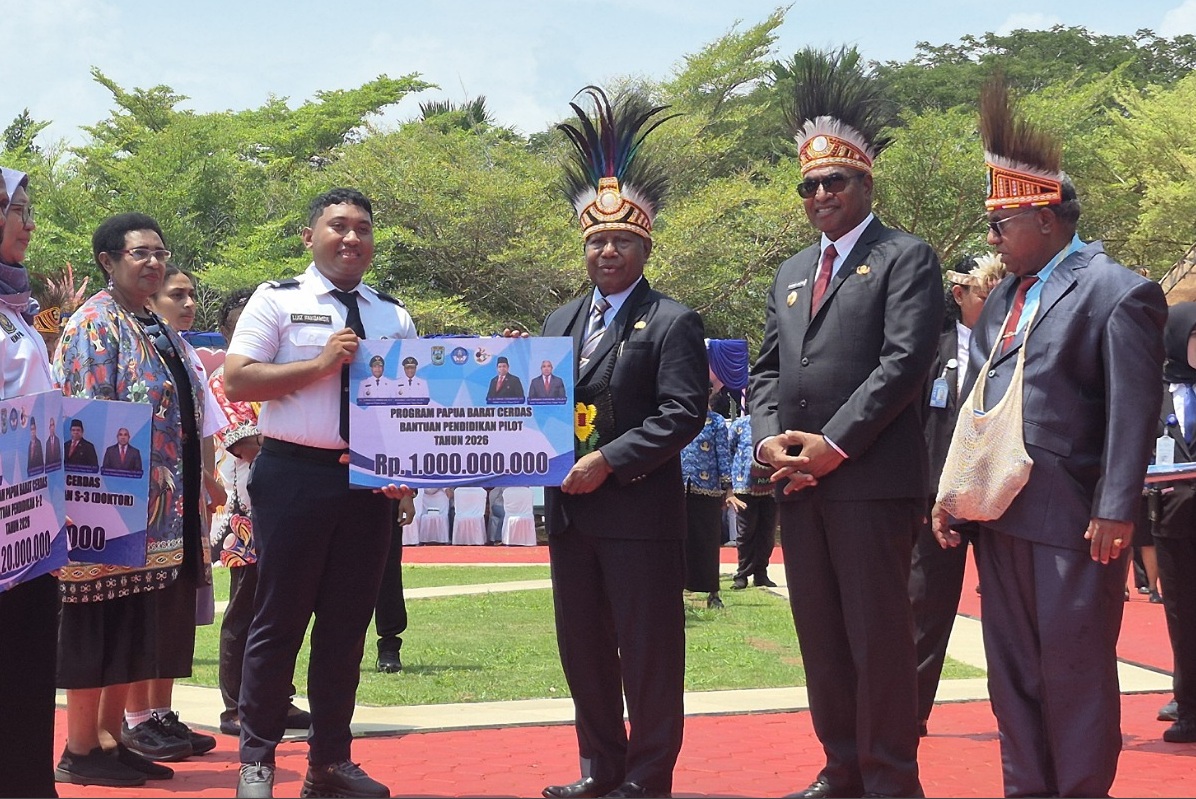
The announcement came during celebrations marking the 27th anniversary of Papua Barat Province. At the event in Manokwari, Dominggus symbolically handed over education assistance, including school uniform support for senior high school students.
The timing gave the programme a wider significance. Provincial anniversary celebrations are occasions to reflect on government achievements and future priorities, and the education allocation placed support for students among the initiatives highlighted by the provincial administration.
Dominggus said the programme would benefit 10,872 learners from senior high schools, vocational schools and universities. The assistance is structured around different educational levels and needs rather than a single uniform payment for every recipient.
Dominggus said, as quoted by ANTARA, that the Papua Barat Cerdas programme has a total of 10,872 students receiving assistance at the senior high school, vocational school, and university levels.
The figure represents a broad mix of beneficiaries. Most are secondary school students or undergraduates, but the programme also reaches medical students, trainee doctors, postgraduate researchers, pilot trainees and a student studying overseas.
This approach recognises that educational costs differ substantially between stages of study. A secondary school student may need assistance with uniforms and other basic requirements, while a university student faces tuition and living expenses. Professional training can carry additional costs, particularly in fields that require specialised instruction and practical experience.
By dividing the funding among several categories, the provincial government aims to address a range of these needs. The published allocation details identify 12 categories of educational assistance, with eligibility and payment amounts varying according to the recipient’s level and field of study.
How the Rp57.06 Billion Budget Is Distributed
The categories listed above total approximately Rp57.06 billion and 10,872 recipients when the reported figures are combined, with the breakdown based on various levels of study categories.
The Papua Barat Cerdas programme allocates Rp23.51 billion to support 2,351 general undergraduates (S1), with each eligible student receiving assistance of Rp10 million. A further Rp12.81 billion is earmarked for 4,691 senior high school and vocational school students to help cover uniform costs. The programme also provides Rp9.39 billion in academic achievement scholarships for 3,505 senior high school and vocational students.
In addition, Rp1.06 billion is allocated to 106 medical students, while 28 students undertaking medical professional training or clinical clerkships (koas) are set to receive a combined Rp2.80 billion. The programme also includes Rp133 million for 19 Diploma III students, Rp2.62 billion for 131 master’s degree students (S2), and Rp1.14 billion for 38 doctoral students (S3).
Specialised education is also included. Two participants undertaking pilot training are allocated a total of Rp2 billion, while one student studying overseas is set to receive Rp1.60 billion in assistance. Together, these allocations illustrate the range of educational pathways covered by Papua Barat Cerdas, from secondary school requirements to university degrees and specialised professional training.
Undergraduate Assistance: Rp10 Million Per Eligible Student
The largest single category provides Rp23.51 billion for 2,351 general undergraduates. Each eligible student can receive Rp10 million, subject to the programme’s requirements, including a minimum cumulative grade point average, or GPA, of 2.75.
Dominggus clarified that the provincial government handles assistance for general undergraduates who meet the minimum GPA requirement. Students whose GPA falls below 2.75 are, according to the governor’s explanation, the responsibility of their respective regency governments.
“The province only handles general undergraduate education assistance for students with a minimum GPA of 2.75. If the GPA is below that, it becomes the responsibility of the regency,” he said, according to ANTARA.
The distinction reflects the division of responsibilities described by the provincial administration. It also makes coordination between provincial and regency governments important, particularly to ensure that students understand where to apply and which requirements apply to their circumstances.
For recipients, the Rp10 million assistance could help meet education-related expenses and reduce the financial pressure associated with continuing university studies. Its actual effect will depend on each student’s circumstances and the costs faced during the academic year.
School Uniforms and Academic Achievement Scholarships
The second-largest allocation, Rp12.81 billion, is earmarked for uniforms for 4,691 senior high school and vocational school students. The group consists of 3,424 senior high school students and 1,267 vocational students.
The reported assistance is Rp3 million per senior high school student and Rp2 million per vocational school student. The funding is intended to help cover uniform requirements, which can be a significant expense for families preparing children for school.
A further Rp9.39 billion is allocated for academic achievement scholarships for 3,505 secondary school students. Of these, 2,450 attend senior high schools and receive a combined allocation of Rp6.56 billion, while 1,055 vocational school students share Rp2.83 billion.
Each scholarship recipient is reported to receive Rp2,678,500.
The two types of assistance serve different purposes. Uniform support helps students meet basic school requirements, while achievement scholarships reward academic performance. Together, they address both the practical costs of attending school and the importance of encouraging students to maintain their educational progress.
For families, the significance of such assistance lies in its potential to ease some education-related expenses. For the government, a key consideration will be whether the support reaches eligible students transparently and contributes to sustained school participation.
Investment in Medical and Specialist Education
Supporting Future Health Professionals
The Papua Barat Cerdas programme extends beyond general schooling and undergraduate education. It includes Rp1.06 billion for 106 medical students and Rp2.8 billion for 28 students undertaking professional medical training, commonly known in Indonesia as koas.
Medical education involves a long period of study and practical training before graduates can enter professional practice. Assistance at these stages can help students continue their training, although the published allocation does not by itself establish how many recipients will eventually work in Papua Barat.
The investment nevertheless points to the importance of building professional capacity in fields directly connected to public services. Health services in geographically challenging regions depend on trained personnel, adequate facilities and the ability to retain qualified workers.
Scholarship support is one component of that effort. It can help students progress through training, while broader workforce planning is needed to connect graduates with employment opportunities and communities that require their skills.
The programme also allocates Rp133 million to 19 students undertaking Diploma III education, with reported assistance of Rp7 million per student. This category broadens support to learners following diploma-level pathways rather than conventional undergraduate degrees.
Postgraduate Study and Specialised Training
At the postgraduate level, the provincial government has allocated Rp2.62 billion for 131 master’s students and Rp1.14 billion for 38 doctoral students.
Postgraduate qualifications can contribute to a region’s pool of researchers, educators, administrators and specialists. Their wider value, however, depends on the relevance of the training, the quality of institutions and whether graduates have opportunities to apply their expertise.
The programme also supports specialised education beyond conventional academic degrees. Two participants undertaking pilot training are set to receive a combined Rp2 billion, equivalent to Rp1 billion each. One student studying overseas is allocated Rp1.60 billion in assistance.
These are comparatively small groups of recipients but involve substantial per-person funding. Specialised training can carry costs that differ significantly from those of standard university programmes, which helps explain why assistance is not distributed equally across all categories.
The overseas scholarship may also provide access to educational opportunities not readily available through a student’s existing local pathway. However, the public information on the allocation does not specify the student’s field of study, the destination country or the expected employment outcome.
Those details would be relevant when evaluating the longer-term benefits of this category.
Education as Part of Papua Barat’s Development Strategy
Beyond Enrolment: Building Skills and Opportunity
Discussions about education assistance often focus on access, but the broader development value hinges on what occurs after students enter or stay in school. Learners need to complete their studies, acquire relevant skills and find pathways into employment or further professional development.
For Papua Barat, this question is especially important because the region’s development requires qualified people across public administration, health, education, technical services and the private sector. A scholarship programme can help ease financial barriers, but it works best when connected to improvements in teaching quality, school facilities, career guidance and labour-market opportunities.
The Papua Barat Cerdas allocation provides support at several points along that pathway, from secondary school to doctoral studies and specialised training. That breadth is one of its defining features.
At the same time, the number of recipients and the amount allocated should not be confused with proof of educational outcomes. The announcement establishes the programme’s funding and intended reach; it does not, on its own, demonstrate improved graduation rates, stronger learning results or long-term employment gains.
Those outcomes require follow-up data. Useful indicators would include the number of eligible applicants, the proportion who receive assistance on schedule, school attendance and completion rates, university retention, and the employment or professional placement of graduates.
Public reporting on these indicators would allow families and policymakers to assess whether the funding is achieving its intended purpose. It would also help the provincial government refine eligibility criteria and budget allocations in future years.
Coordination and Accountability Remain Important
The programme’s range of recipients means that administration will be a significant part of its success. Secondary school uniform assistance, university scholarships and specialised professional training involve different institutions and verification requirements.
Clear application procedures can reduce confusion for students and families. Transparent eligibility criteria can help ensure that assistance reaches the intended recipients, while timely payments can make the support more useful when school or university expenses fall due.
The division of responsibility between provincial and regency governments for some undergraduate assistance also highlights the need for effective coordination. Students should be able to determine which level of government is responsible for their cases without facing unnecessary administrative obstacles.
These are practical considerations rather than reasons to discount the programme. A substantial budget creates an opportunity to support thousands of learners, but reliable delivery and transparent monitoring are essential to turn the allocation into meaningful educational benefits.
For international readers, the programme illustrates one way a subnational government in Indonesia is attempting to respond to the costs of education through targeted assistance. The experience of students and families, along with published data on implementation and outcomes, will provide the best assessment of its results.
Conclusion
The Rp57.06 billion allocation through Papua Barat Cerdas represents a major commitment by the Papua Barat provincial government to educational assistance. With 10,872 intended recipients across secondary schools, universities and specialised training programmes, the initiative addresses a broad range of educational costs.
Governor Dominggus Mandacan announced on 12 October, coinciding with the province’s 27th anniversary, that students and human capital are among the priorities highlighted by the provincial administration. The funding covers practical school needs, academic achievement, undergraduate study, medical training, postgraduate qualifications and specialist education.
The next challenge is implementation. Transparent selection, timely assistance and coordination between government levels will determine whether eligible students can make full use of the programme. Public reporting on educational progress will also be important in measuring the impact beyond the initial allocation.
Ultimately, education funding is an investment whose returns emerge over time. If the programme helps more students remain in school, complete university and develop skills relevant to their communities, it can contribute to a stronger foundation for Papua Barat’s social and economic future. The allocation is an important starting point; sustained delivery and measurable results will determine its lasting value.
Read Also
Papua Civil Servants’ Families of TPNPB OPM Victim in Papua Receive Aid, Scholarships and Jobs
Papua Tengah Expands Medical Scholarships for Indigenous Papuans
Papua Tengah Funds Medical Scholarships for 35 OAP

