
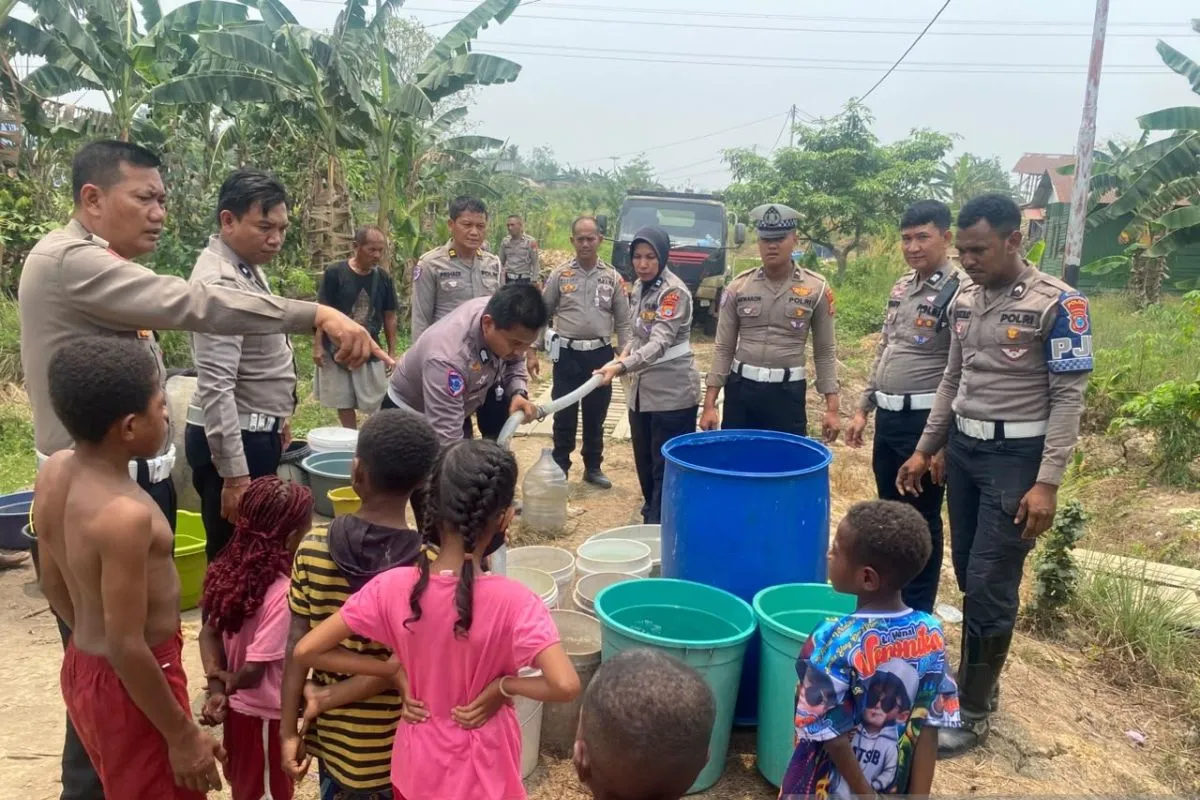
The Papua Barat Daya (Southwest Papua) Regional Police have distributed 10,000 litres of clean water to the Putra Putri Muhammadiyah Orphanage Foundation and residents of Makmini village in Sorong Regency, providing practical assistance to people facing difficulties securing water for everyday needs. The Papua Barat Daya clean water distribution was carried out through the police traffic directorate, Ditlantas, in coordination, and, where necessary, long with the orphanage management and local residents.
The assistance comes as prolonged dry conditions have raised concerns about water availability in parts of Sorong Regency, particularly for communities that depend on limited water sources. For an orphanage caring for children, access to sufficient clean water is essential for drinking, cooking, cleaning and maintaining basic hygiene. For households in Makmini, reliable water supplies are equally important to daily life.
Senior Commissioner Jenny S.A. Hengkelare, head of the Public Information Subdivision at the Papua Barat Daya Regional Police Public Relations Division, said the distribution was intended to help meet basic community needs and provide direct assistance where water availability had become a concern.
“The distribution was carried out in coordination with the orphanage management and the local community so that the assistance could be received properly,” Jenny said, as reported by ANTARA on October 11, 2026.
The police described the initiative as part of their community service activities, with the immediate aim of helping the orphanage’s residents and Makmini households manage their daily water requirements. The distribution also reflects a wider public-service role for police institutions, which can support communities during periods of hardship alongside their core responsibilities for law enforcement and public safety.
Although the 10,000 litres offer immediate relief, the wider issue extends beyond a single delivery. Maintaining access to safe water during prolonged dry conditions requires reliable supplies, effective local coordination and, where necessary, longer-term improvements to water infrastructure.
How the Water Assistance Was Organised
Coordination with the Orphanage and Local Residents
The Papua Barat Daya Regional Police, through the Directorate of Traffic, organised the water distribution. Officers coordinated with the management of the Putra Putri Muhammadiyah Orphanage Foundation to arrange the delivery and ensure that the assistance could be received and used by the institution.
A separate report published by Tribratanews Polri on October 10 provided a more detailed account of the orphanage component. It said Ditlantas personnel delivered 5,000 litres of usable clean water to the Putra Putri Papua Muslim Orphanage Foundation in Sorong Regency on Friday, October 9.
The report described the delivery as an effort to support the basic needs of the children and staff at the orphanage. It also said officers coordinated with the foundation’s management to ensure the distribution proceeded smoothly.
The two reports refer to the orphanage assistance using slightly different names: ANTARA identifies the recipient as the Putra Putri Muhammadiyah Orphanage Foundation, while the Tribratanews report uses Putra Putri Papua Muslim Orphanage Foundation. Both describe the provision of 5,000 litres to an orphanage in Sorong Regency on October 9. If a definitive formal name is required for publication, the relevant institution should clarify the naming difference.
The broader ANTARA report states that the total assistance for the orphanage and Makmini residents amounted to 10,000 litres. Taken together, the reporting indicates that the orphanage received 5,000 litres and that the wider distribution also included water for the village community.
This coordination was important because delivering water is only one part of an effective assistance programme. The receiving institution and community need to be able to accept, store and use the supply safely. Local coordination can also help organisers understand immediate requirements and distribute the available resources in an orderly manner.
Why Direct Delivery Matters
When water becomes scarce, families may have to spend more time and effort obtaining it. An institution caring for children takes on additional responsibilities due to the need for water in various daily activities, such as food preparation, cleaning, and personal hygiene.
A direct delivery can help ease those immediate pressures. Rather than requiring recipients to arrange their transport for a large quantity of water, the assistance brings the supply closer to the people who need it.
The available reports do not specify the number of households or children who benefited, how long the water supply was expected to last, or the precise method used to transport the full 10,000 litres. Those details should not be assumed. What the reports establish is that the police provided clean water and coordinated with the orphanage and local community to facilitate its distribution.
The immediate purpose was practical: help meet basic water needs while dry conditions continued to affect availability.
Jenny Hengkelare: Water Is an Essential Community Need
Police Support During Prolonged Dry Weather
Jenny Hengkelare explained that the police intended to demonstrate their presence in the community by engaging in an activity that directly addressed a basic need.
She said prolonged dry weather can affect water availability in some areas, particularly where residents depend on limited sources. Under those circumstances, distributing clean water can help relieve immediate pressure on families and institutions.
“Prolonged dry weather can affect the availability of water in several areas, particularly for communities that rely on limited water sources,” Jenny said, according to ANTARA.
Her statement highlights the connection between weather conditions and everyday access to essential services. Dry weather does not affect every community in the same way. The consequences depend on the availability of alternative sources, the reliability of local infrastructure, storage capacity and the distance residents must travel to obtain water.
Where these resources are limited, a temporary water delivery can provide meaningful relief. However, the amount required and the duration of support will vary according to the number of people served and their daily needs.
Jenny stated that the police aimed to use the water to meet the daily needs of the children at the orphanage and the residents of Makmini. She also mentioned that the initiative aimed to strengthen relationships between the police and the community while fostering a spirit of mutual assistance.
The comments place the distribution within a broader community-service approach. Police officers are most directly responsible for public safety and law enforcement, but cooperation with residents also involves responding to urgent local concerns when assistance can be provided.
The impact of such efforts should be assessed in practical terms: whether recipients obtain usable water, whether the supply reaches the intended beneficiaries and whether the activity helps local institutions respond to immediate needs.
Why Clean Water Matters for Children and Families
Supporting Health, Hygiene and Daily Routines
For children living in an orphanage, clean water is a daily necessity rather than an occasional convenience. Water is required for drinking, preparing food, washing hands, cleaning living spaces and maintaining sanitation. If supply becomes unreliable, all these activities can be disrupted.
Families in Makmini face similar everyday requirements. Water is used in cooking, cleaning and personal hygiene, while access to a dependable supply can reduce the time and effort spent seeking alternative sources.
Water shortages can create additional pressure on households that have already limited resources. Families may have to purchase water, travel farther to collect it or reduce consumption for activities such as washing and cleaning. The extent of these difficulties in Makmini has not been quantified in the available reports, but the distribution was intended to help residents experiencing concerns about water availability.
The assistance is therefore relevant to public health as well as immediate household needs. Access to safe water supports hygiene and helps communities maintain basic sanitation practices. It is one part of the wider conditions necessary for protecting health, particularly among children and other people who may depend on carers for their daily needs.
At the same time, a delivery of clean water should not be confused with a permanent solution to a water shortage. Its value depends on the immediate needs it meets and on whether alternative supplies are available when the delivered water runs out.
The Importance of Safe Storage and Use
Once water has been delivered, proper handling and storage remain important. Containers should be clean and suitable for storing water, and supplies intended for drinking and cooking should be protected from contamination.
The reports do not describe the storage facilities available at the orphanage or in Makmini, so no conclusions can be drawn about their current capacity. Nevertheless, the general principle is relevant to any emergency water distribution: delivery and safe use need to be considered together.
Local authorities, health workers and community leaders can help residents understand how to preserve water quality and where to seek assistance if shortages continue. Such guidance can complement emergency deliveries and help ensure that the water provided remains useful for its intended purposes.
A Wider Response to Water Difficulties in Sorong Regency
A Separate Delivery to Warmon Kokoda
The orphanage and Makmini distribution took place during a period when Papua Barat Daya police were also providing water assistance elsewhere in Sorong Regency.
On October 8, the Papua Barat Daya Regional Police distributed a separate 10,000 litres of clean water to residents of Warmon Kokoda SP 3 village in Sorong Regency, according to the Indonesian National Police’s English-language news service and a related Tribratanews report.
Jenny Hengkelare said that operation was intended to help meet residents’ basic needs amid prolonged drought conditions. Officers coordinated with village officials and community leaders to ensure that the assistance reached the intended households.
That October 8 delivery was a separate activity from the water provided to the orphanage and Makmini on October 9. The two distributions should therefore not be treated as a single 20,000 litres delivery or as one operation serving the same beneficiaries.
Considered separately, the activities show that the police were responding to water-related needs in more than one location within Sorong Regency. Each delivery had its own recipients and local coordination arrangements.
The repeated use of water distribution as a form of assistance also raises a broader question: how can immediate relief be linked to efforts that improve water access over time?
Emergency deliveries can help communities during a difficult period, but recurring shortages may require further assessment of water sources, storage facilities, distribution systems and maintenance arrangements. The available reports do not identify a specific infrastructure project for Makmini, so any longer-term intervention would need to be based on a local assessment.
Community Partnerships Can Strengthen the Response
The police worked with the orphanage management and local residents to coordinate the delivery. This kind of cooperation can help identify immediate needs and reduce the risk that assistance is delivered without adequate arrangements for receiving it.
Village administrations and community leaders can contribute by communicating local requirements, identifying vulnerable households and helping organise the use of shared resources. Institutions such as orphanages may also need assistance tailored to the number of people they accommodate and the demands of their daily routines.
For the longer term, cooperation between local government, public utilities, community organisations and other relevant institutions can help identify where water access remains unreliable. Such work may involve reviewing existing sources, checking the condition of local infrastructure and determining whether additional storage or distribution capacity is needed.
The purpose would be to complement immediate relief rather than replace it. Emergency deliveries address urgent requirements, while better planning can help reduce the likelihood that communities repeatedly face the same problem.
Public Service and the Role of the Police
The Papua Barat Daya Regional Police presented the water distribution as an example of community service. In this case, the immediate benefit was the delivery of a resource needed by children at an orphanage and residents of a village affected by concerns over water availability.
Public institutions are often judged by their ability to respond to the needs people encounter in everyday life. In an emergency or period of hardship, the timely delivery of essential supplies can help residents manage immediate difficulties. Cooperation with local communities can also give authorities a clearer understanding of the conditions people face.
However, water assistance is only one component of a broader response to water insecurity. Police can support relief activities, but sustained access to water generally requires coordination with the institutions responsible for water infrastructure, public health and local development.
This distinction is important when evaluating the significance of the initiative. The police delivery provided immediate assistance, but it does not by itself establish that the underlying water shortage has been resolved.
A clear assessment would consider how many people received water, how long the supply lasted, whether further assistance was required and what measures could improve access over the following weeks and months. Publishing such information would help the public understand both the immediate result and the remaining needs.
Conclusion
The Papua Barat Daya Regional Police’s distribution of 10,000 litres of clean water to the Putra Putri Muhammadiyah Orphanage Foundation and residents of Makmini was a practical response to water availability concerns during prolonged dry conditions in Sorong Regency.
The activity, implemented through the police traffic directorate and coordinated with the recipients, was intended to support everyday needs at the orphanage and among local households. The more detailed report of a 5,000 litres delivery to an orphanage on October 9 provides additional context for the assistance described in ANTARA’s broader account.
A separate 10,000 litres delivery to Warmon Kokoda on October 8 demonstrates that water distribution was also taking place elsewhere in Sorong Regency. Keeping the activities distinct is essential to understanding who received assistance and when.
For the orphanage and Makmini residents, the immediate priority is access to enough clean water for daily use. For public authorities, the next challenge is to determine whether further assistance is needed and how to make supplies more reliable if dry conditions persist.
The distribution demonstrates how direct community assistance can help address an urgent need. Its longer-term value will depend on continued coordination, safe handling of the water delivered and practical steps to strengthen access where shortages recur.
Clean water is a basic requirement for health, dignity and daily life. Emergency deliveries can ease pressure when supplies are limited, while lasting progress depends on ensuring that communities have dependable ways to obtain safe water beyond the period of immediate relief.
Read Also
Merauke Receives 40,000 Litres of Clean Water
PLN Wins Gold for Asmat Water Desalination

