
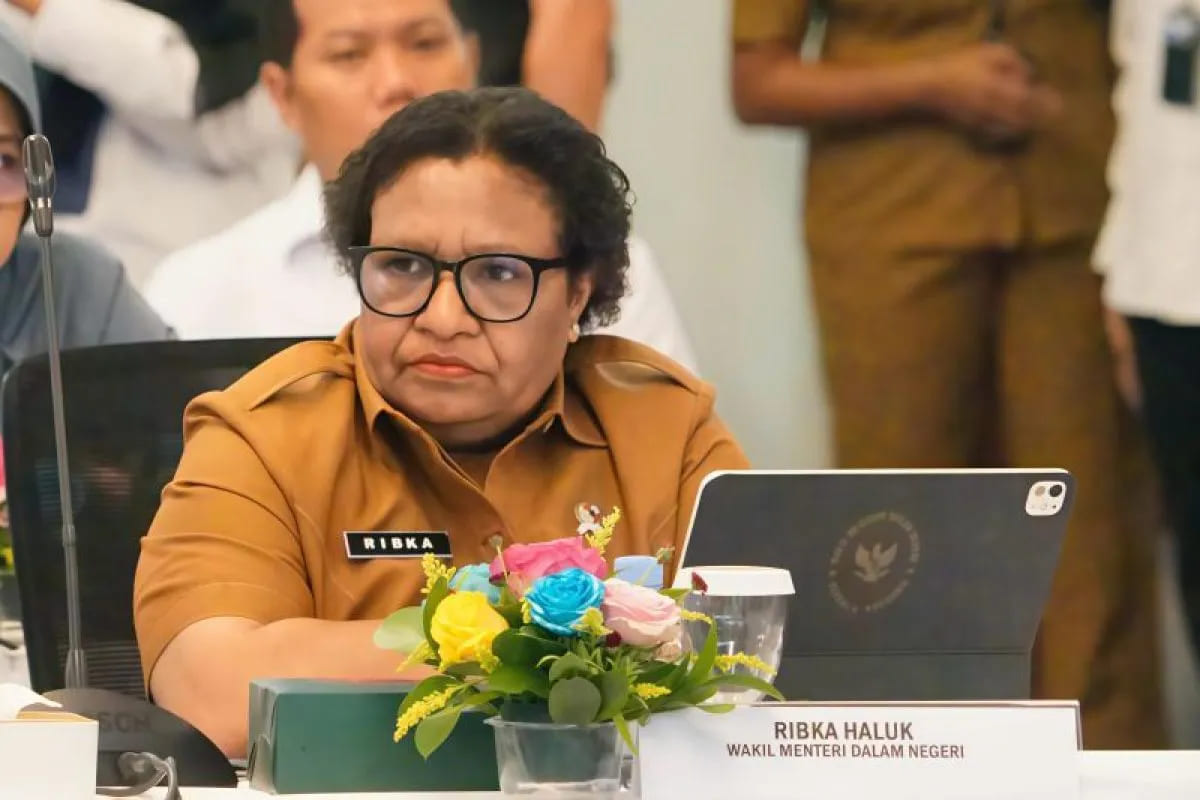
For communities across Papua, Papua Special Autonomy funds are not simply figures in a government budget. They are intended to finance services that people encounter in everyday life, from schools and hospitals to health programs and other basic public services. That is why a warning from Deputy Minister of Home Affairs Ribka Haluk over delays in distributing the second phase of the 2026 Special Autonomy allocation has attracted attention.
Haluk has urged local governments throughout the Papua region to accelerate the distribution of the second phase of Special Autonomy, or Otsus, funds. The second phase, equivalent to 45 percent of the annual allocation, was supposed to be distributed no later than June. Yet by August, several local governments had still not completed the process.
The issue is significant not only as a matter of financial administration. It also highlights a broader challenge facing Papua’s development agenda: ensuring that special fiscal arrangements translate into timely and measurable benefits for communities.
At an evaluation meeting on August 27, Haluk argued that delays could no longer routinely be attributed to regulatory complications or shortages of human resources. She called for stronger coordination, supervision, and administrative discipline among provincial and district governments.
Her message was direct. The longer funds remain undisbursed or incomplete, the greater the likelihood of delays in programs designed to support public services.
Why the Second Phase Matters
According to data from Indonesia’s Directorate General of Fiscal Balance as of August 24, 19 local governments in Papua had received the second phase of Special Autonomy funding. However, the distribution was not yet complete because some local governments had not received the full combination of special autonomy funds and additional infrastructure funds, known as DTI.
This distinction is important. Receiving an allocation does not necessarily mean that all funds have completed the necessary administrative and distribution stages.
For local governments operating in geographically challenging parts of Papua, the process can involve multiple layers of planning, verification, and coordination. Yet the central government argues that these challenges should not become a permanent explanation for delays.
Haluk’s position reflects that concern. She said the mechanisms and stages for managing Special Autonomy funding have already been established. What is now required, she said, is stronger commitment, consistency, and oversight at the local level.
The debate therefore goes beyond whether funds have been approved. The more important question is whether the money can move efficiently from the public budget into programs that people can actually see and use.
Education and Health at the Center
The urgency is particularly visible in sectors such as education and health.
Haluk pointed to the potential consequences for students studying outside Papua, as well as for schools, health services, and hospitals operating within the region. If budget realization is delayed, programs dependent on those allocations can face disruption.
“How about our brothers and sisters studying abroad?” she asked, while also highlighting education, health, hospitals, and basic public services as areas that could be affected.
That argument places the discussion in a practical context. For a student, a delayed budget is not an abstract accounting issue. It can mean uncertainty over educational support. For a patient, delays can affect the availability or continuity of public health services. For a district administration, delayed funding can complicate the implementation of programs already included in its development plans.
The effectiveness of special autonomy depends on both the allocation size and institutions’ ability to manage it efficiently.
Ribka Haluk Calls for Stronger Local Capacity
The warning also carries a message about institutional capacity.
Papua has operated under the Special Autonomy framework for 25 years. Haluk argued that such a long period should have been accompanied by stronger local government capacity to manage public administration and finances independently.
Her criticism is therefore not simply about a missed administrative deadline. It is also an evaluation of how local governments have developed their ability to plan, distribute, and supervise public funds.
That distinction matters for Papua’s long-term development.
Large fiscal transfers can provide resources for infrastructure, education, health, and economic development. But funding alone cannot guarantee results. Effective institutions are needed to identify priorities, prepare projects, execute budgets, and monitor outcomes.
The challenge becomes even more pronounced in Papua because local governments operate across a vast territory with difficult transportation links, dispersed communities, and varying administrative capacities.
A stronger financial management system can help ensure that the benefits of public spending are not concentrated only in major urban centers.
The 5T Principle
To address the problem, the Ministry of Home Affairs plans to intensify its evaluation of special autonomy fund distribution through what it calls the 5T principle.
The five principles are tepat waktu, tepat sasaran, tepat jumlah, tepat penerima, and tepat penggunaan. In English, these broadly mean timely distribution, appropriate targeting, correct amounts, correct recipients, and proper use.
The concept is straightforward, but its implementation will be crucial.
Timeliness ensures that programs do not wait unnecessarily for funding. Appropriate targeting means that allocations reach the priorities they were designed to address. Correct amounts reduce the risk of discrepancies, while identifying the right recipients strengthens accountability. Finally, proper use ensures that money is spent according to its intended purpose.
Taken together, the five principles provide a framework for shifting the discussion from simply “how much money was distributed” to “what happened after the money was distributed.”
That is an important distinction for Papua.
A Governance Issue, Not Just a Funding Issue
The delay in the second phase of Otsus distribution also illustrates a wider issue in regional development: the relationship between fiscal resources and governance capacity.
The Indonesian government has continued to place development in Papua within a framework of decentralization, infrastructure development, and targeted public services. Special autonomy is one of the principal fiscal mechanisms supporting that approach.
Yet the effectiveness of the policy ultimately depends on implementation at the provincial and district levels.
Haluk has asked governors, regional secretaries, and technical government agencies to strengthen coordination, control, and supervision. She also said that delays should be part of evaluating local government performance and its officials’ capacity.
This approach can be viewed as an attempt to strengthen accountability without reducing the role of regional governments in determining local priorities.
It also signals that Jakarta expects Papua’s local administrations to assume greater responsibility for managing development resources.
From Budget Absorption to Public Results
For international observers following Papua, the discussion is worth watching because it reflects a broader transition in Indonesia’s approach to regional development.
In many developing regions, the size of government spending often serves as a measure of public policy. A more meaningful measure is whether spending improves people’s access to services and opportunities.
For Papua, that means asking whether special autonomy funding contributes to better schools, functioning health facilities, stronger local economies, infrastructure, and improved human capital.
This is particularly relevant as Papua’s administrative landscape continues to evolve. The creation and consolidation of new provinces have increased the number of local institutions involved in planning and delivering government programs.
That expansion can bring decision-making closer to communities, but it also requires capable institutions and clear coordination between levels of government.
The current Otsus distribution issue provides an opportunity to strengthen that institutional foundation.
Why Timely Distribution Matters for Papua’s Development
Papua’s development challenges are not limited to budget availability. Geography, transportation, human resources, and the uneven distribution of public infrastructure all influence the speed of government program delivery.
For this reason, delays in funding can have a multiplier effect.
A delayed allocation may postpone procurement. Delayed procurement may push back construction or service delivery. A postponed program can then affect communities that were already waiting for government assistance.
Accelerating fund distribution does not automatically solve these problems. But it removes one potential bottleneck.
This is where the central government’s emphasis on the 5T principle becomes relevant. A faster transfer must still be accompanied by proper planning and supervision. Otherwise, acceleration could come at the expense of accountability.
The objective, therefore, should not be speed alone. It should be speed with control and measurable outcomes.
That balance will be essential if Special Autonomy funding is to maintain public confidence and demonstrate its tangible value.
A Test for the Next Stage of Special Autonomy
Haluk’s intervention comes at a significant point in Papua’s special autonomy experience.
After 25 years, the policy is increasingly being assessed not only by its political framework but also by its administrative performance. Can local governments manage larger responsibilities? Can they distribute funds on time? Can they demonstrate where the money goes? And can communities see improvements in the services they receive?
These questions are likely to become increasingly important.
The Indonesian government’s insistence on stronger monitoring suggests that the next stage of Special Autonomy will involve greater attention to governance quality and financial accountability.
This could strengthen the credibility of development programs if local governments can demonstrate that fiscal resources are translated into practical results.
At the same time, delays should be treated as an opportunity for institutional improvement rather than simply as an administrative failure. Training, better coordination, digital monitoring, and stronger internal controls could help local governments reduce recurring bottlenecks.
What Comes Next
The immediate priority is clear: local governments that have not completed the second phase distribution need to finish the required stages in accordance with applicable regulations.
But the longer-term challenge is more substantial.
Papua needs a system in which development funding moves predictably from planning to implementation while remaining transparent and accountable. That requires cooperation between the central government, provincial administrations, districts, and technical agencies.
The roles of governors, regional secretaries, and local officials will be particularly important. They are closest to the administrative processes that determine whether approved programs can actually begin.
At the same time, stronger oversight from the Ministry of Home Affairs can provide an additional layer of accountability and help identify problems before they affect subsequent funding stages.
The objective should ultimately be simple: every rupiah allocated through Special Autonomy should reach its intended purpose and produce a clear public benefit.
Conclusion
Ribka Haluk’s warning over delayed Papua Special Autonomy funds is more than a reminder about an administrative deadline. It is a broader call for Papua’s local governments to strengthen financial management and ensure that development resources are converted into services for citizens.
As of August 24, 19 local governments had received the second phase of Otsus funding, but some had yet to complete the distribution of Otsus and additional infrastructure funds. The second phase, representing 45 percent of the allocation, should have been distributed by June.
The central government’s response is to intensify monitoring through the 5T principle: timely, targeted, correct in amount, directed to the right recipients, and properly used.
That approach places responsibility on both sides. Jakarta must maintain effective oversight and support, while local governments must strengthen their administrative capacity and ensure that funds are translated into concrete programs.
For Papua, the real measure of Special Autonomy will ultimately not be the amount of money transferred from one government account to another. It will be whether those resources help a child remain in school, a patient receive treatment, a hospital function effectively, or a community gain access to better public services.
That is where the success of the next phase of Papua’s development will be judged.

