
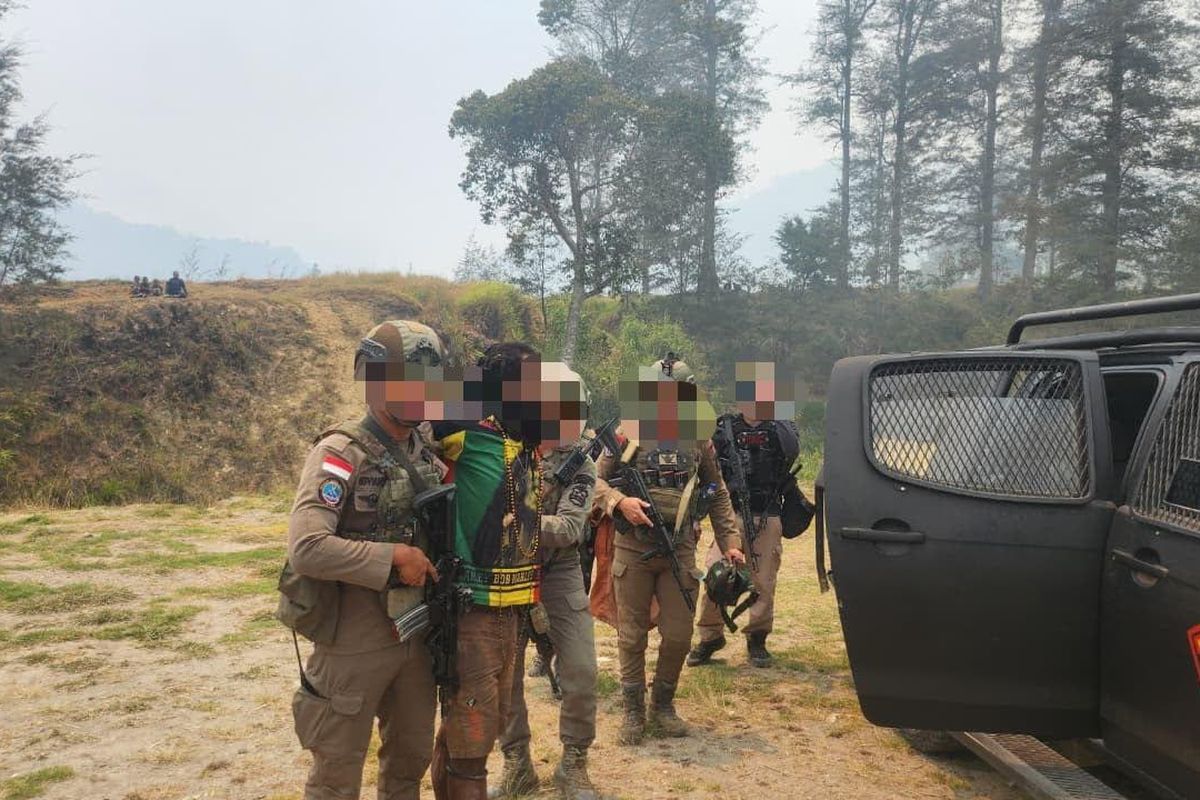
Two Indonesian security operations in Papua Tengah (Central Papua) province have resulted in the arrest of a long-wanted suspect and the discovery of a concealed structure believed to have been used by an armed group, known as the West Papua National Liberation Army—Free Papua Movement (TPNPB OPM). The operations, conducted by the Damai Cartenz Task Force and local police, targeted separate locations in Puncak and Intan Jaya, producing evidence that investigators are examining as part of wider efforts to address armed violence and related criminal activity in the region.
In Puncak, officers arrested a 32-year-old man identified by the initials PW on October 19, 2026. Authorities sought him in connection with the February 11, 2021, burning of facilities belonging to PT Unggul at Jenggerpaga village in Ilaga District. In a separate operation two days earlier, personnel searching forested terrain in Intan Jaya found a concealed honai, a traditional highland dwelling, containing 559 spent 5.56-millimeter cartridge casings, disassembled rifle components, documents, and other items. Authorities suspected the structure had been used as a transit point or hideout by an armed group identified by police as TPNPB OPM from War Region Command (Kodap) VIII Soanggama.
Although the operations took place in different regencies and addressed different immediate objectives, both are part of the security challenges facing Papua Tengah. The arrest advances an investigation into a past attack on company facilities, while the discovery in Intan Jaya has given investigators material to examine for possible links to weapons-related activity.
Five-Year Manhunt Ends in Puncak
The October 19 Arrest in Gome
The first operation concluded at approximately 10:45 a.m. local time on October 19, when the Damai Cartenz Task Force and Puncak Police arrested PW at his hiding place in Gome District, Puncak Regency. The arrest followed the development of an investigation into the burning of PT Unggul’s camp in Jenggerpaga village, Ilaga District, in February 2021.
According to Damai Cartenz Task Force Public Relations Chief Senior Commissioner Yusuf Sutejo, PW was suspected of being affiliated with an armed group identified by authorities as Kodap XVIII, led by Numbuk Telenggen and operating in Puncak Regency. The suspect was subsequently taken to Puncak Police headquarters for questioning. Police said investigators were examining his alleged role in the camp-burning case and whether he might have been connected to other offenses in the regency.
Officers also seized several items during the arrest, including bladed weapons described as an axe and a machete, along with a mobile phone. The items were secured as part of the investigation. Their relevance to the alleged offense, if any, will need to be established through examination and other evidence.
The arrest marked an important turning point in a case that had remained unresolved for years. However, PW remains a suspect, and his criminal responsibility must be determined through the legal process.
Reconstructing the 2021 Camp Burning
The case dates back to February 11, 2021, when facilities at PT Unggul’s camp in Jenggerpaga village, Ilaga District, were set on fire. According to the police account reported by ANTARA, the incident caused no fatalities but resulted in extensive damage to company assets and buildings.
The damaged equipment reportedly included two excavators, one wheel loader, one track loader, one Bomag machine, one tractor, three trucks, and two light vehicles. The employees’ dormitory, a diesel storage facility, and a generator warehouse were also reported to have been destroyed by fire.
The destruction of heavy equipment and support facilities can have consequences beyond the immediate cost of replacing property. Disruptions to company operations, loss of access to facilities for workers, and delays in planned activities may occur. The available reports do not quantify the total financial loss or the broader economic impact of the incident.
Investigators registered the case under police report number LP/05/II/2021/Papua/Res Puncak, dated February 13, 2021. As the inquiry progressed, officers identified three other suspects who were arrested on separate dates: AT, also known as K, on February 18, 2024; JW, also known as LW, on May 19, 2024; and YW, also known as SM, on June 10, 2025.
The investigation subsequently identified PW as a person allegedly involved in the case. A wanted-person notice was issued on May 27, 2024, according to the police account. His arrest on October 19, 2026, therefore followed a lengthy effort to locate him and develop the case.
Legal Proceedings Remain Essential
Yusuf said PW’s arrest was part of the continuing investigation into the 2021 incident. Authorities have said he is suspected of an offense under Article 308 paragraph (1) of Indonesia’s Law No. 1 of 2023 on the Criminal Code, which carries a maximum prison sentence of nine years, as reported by ANTARA. The precise legal outcome will depend on the evidence and the proceedings that follow.
The distinction between an arrest and a conviction is important. Investigators must establish the suspect’s individual role, assess the available evidence, and follow the applicable procedures before a court determines criminal responsibility.
Inspector General Faizal Ramadhani, head of the Damai Cartenz Operation in 2026, said the handling of the case must remain consistent with the law, transparent, and respectful of human rights. He also emphasized coordination between the task force and local police units to ensure that the case is handled according to their respective authority and procedures.
That emphasis on procedure is relevant to the credibility of security operations. The objective is not merely to locate suspects but to establish facts that can withstand legal scrutiny and support accountability for alleged criminal acts.
Suspected Armed-Group Hideout Found in Intan Jaya
A Concealed Structure in Forested Terrain
A separate operation took place on October 17, 2026, when personnel from the Damai Cartenz Task Force’s Intan Jaya sector searched forested terrain near the boundary between Kulindigi and Bulage villages in Sugapa District, Intan Jaya Regency.
During the search, officers discovered a hidden honai among trees, vegetation, and surrounding terrain. Police suspected that the structure had been used as a transit location or hideout by an armed group identified as Kodap VIII Soanggama. Its location and concealment made it difficult to distinguish from the surrounding forest.
The discovery did not occur during the arrest of PW in Gome. The two operations involved separate locations, different circumstances, and distinct investigations. No information in the cited reports establishes that the suspect arrested in Puncak was directly connected to the structure found in Intan Jaya.
The distinction matters when assessing the results. The Gome arrest relates to an alleged criminal offense dating back to 2021. The Intan Jaya search concerned a suspected hideout and the collection of material that authorities believe may be relevant to armed-group activity.

Investigators Secure 559 Cartridge Casings and Weapon Components
According to Yusuf Sutejo, the search of the structure uncovered 559 spent cartridge casings of 5.56-millimeter caliber. Officers also found two disassembled rifle sets, one rifle stock, one barrel, additional rifle components, and three hand-operated air pumps associated with air rifles.
Other items included a karambit knife, a Morning Star flag, identity papers, and personal documents. Officers also collected notebooks and other documents that were suspected of being related to the armed group’s activities, electronic devices, a traditional woven bag, and a black-and-red jacket. One notebook reportedly contained information concerning transactions involving ammunition.
The range of items provides investigators with several lines of inquiry. The cartridge casings may be examined to determine their characteristics and potential relevance to other evidence. Weapon components may help establish what equipment was present at the location, while the documents and electronic devices could contain information relevant to identifying individuals, movements, or alleged transactions.
However, the discovery of items inside a suspected hideout does not, by itself, establish who owned each item or whether every document relates to a criminal offense. Police have said the material is being examined to determine its origin and possible connection to suspected crimes.
This process is particularly important when dealing with spent cartridge casings. They are not the same as live ammunition. Their presence may provide investigative leads, but their meaning depends on the circumstances in which they were collected and the results of any forensic or documentary examination.
The Structure Was Destroyed After Examination
After officers examined the location and secured the items, the suspected hideout was destroyed to prevent it from being used again for similar activities, according to the task force’s account.
The decision followed the discovery of a structure believed to have served as a temporary base or place of concealment. Authorities described the location as difficult to identify because it blended into the surrounding forest.
Faizal Ramadhani said the items and documents recovered at the site had to be examined carefully before any conclusions were drawn about their connection to suspected criminal activity. He said law enforcement must be conducted professionally, according to procedure and on the basis of verified evidence.
The approach underscores the need to separate the operational assessment of a site from the evidentiary conclusions of an investigation. Destroying a suspected hideout may prevent its immediate reuse, but establishing the history of the location and the significance of its contents requires further examination.
Security Challenges in Papua Tengah
Why Local Coordination Matters
The operations in Puncak and Intan Jaya illustrate the different tasks involved in addressing security threats across Papua Tengah. One required a long-running investigation into an alleged attack on company property. The other involved a search in remote terrain and the collection of potential evidence linked to an armed group.
These tasks demand coordination between specialized task forces and local police, as well as the careful handling of evidence. Investigators must be able to connect information from separate sources, establish the identities and roles of individuals, and ensure that allegations are supported by verifiable facts.
The arrest in Gome also demonstrates that investigations into serious offenses can continue over several years. The earlier arrests in the PT Unggul case show that the inquiry proceeded in stages, with different suspects apprehended at different times. PW’s arrest adds another development, but it does not automatically establish the final outcome of the case or whether further suspects remain under investigation.
In Intan Jaya, the material recovered from the honai could provide leads for examining suspected weapons-related activity. The notebooks and electronic devices may be of particular interest to investigators, but their contents and evidentiary significance must be verified before conclusions are drawn.
Protecting Communities while Upholding the Law
Security operations in remote areas must also consider the safety of residents who live and work near locations under investigation. Clear communication, disciplined conduct, and respect for legal procedures are important to maintaining public confidence.
Adarma Sinaga, deputy head of the Damai Cartenz Task Force, urged residents to report information about activity that could threaten public security. He said information provided to the authorities would be handled through established procedures and that the identities of people providing information would be kept confidential.
Community information can help authorities identify potential risks, but it must be assessed carefully. Reports should be verified, and people should not be treated as suspects solely because of rumors, personal associations, or unsubstantiated allegations.
A credible security approach combines operational effectiveness with accountability. That means protecting residents from violence, investigating alleged offenses, and ensuring that evidence is handled in a manner consistent with the law.
Conclusion
The arrest of PW in Gome and the discovery of a suspected armed-group hideout in Intan Jaya represent two distinct developments in Papua Tengah’s security environment. The first advances an investigation into the 2021 burning of PT Unggul’s camp, an incident that reportedly destroyed vehicles, heavy machinery, and several company buildings. The second produced 559 spent 5.56-millimeter cartridge casings, rifle components, documents, and other items that investigators are examining.
The operations demonstrate the importance of continued investigation, coordination between security units and the careful collection of evidence. They also underline why authorities must distinguish allegations from established findings and allow legal proceedings to determine individual responsibility.
The immediate operational results are clear: a long-wanted suspect has been arrested, and a concealed structure believed to have been used by an armed group has been searched and destroyed. The wider impact will depend on what subsequent investigations establish, whether any links to other offenses can be proven, and whether law enforcement can help reduce the risk of further violence.
For communities in Papua Tengah, lasting security requires more than individual arrests or the recovery of suspicious items. It depends on credible investigations, lawful enforcement, public cooperation, and sustained attention to the safety of people living in affected areas. The next measure of success will be whether the evidence gathered leads to accountability and contributes to a more secure environment for residents, workers, and local communities.
Read Also
TNI Seizes 79 Weapons in Papua Security Operations
Anton and Yesias Fatem Surrender as TNI Recovers Caracal Rifle
Police Trace Suspected Illegal Arms Network in Jayapura

