
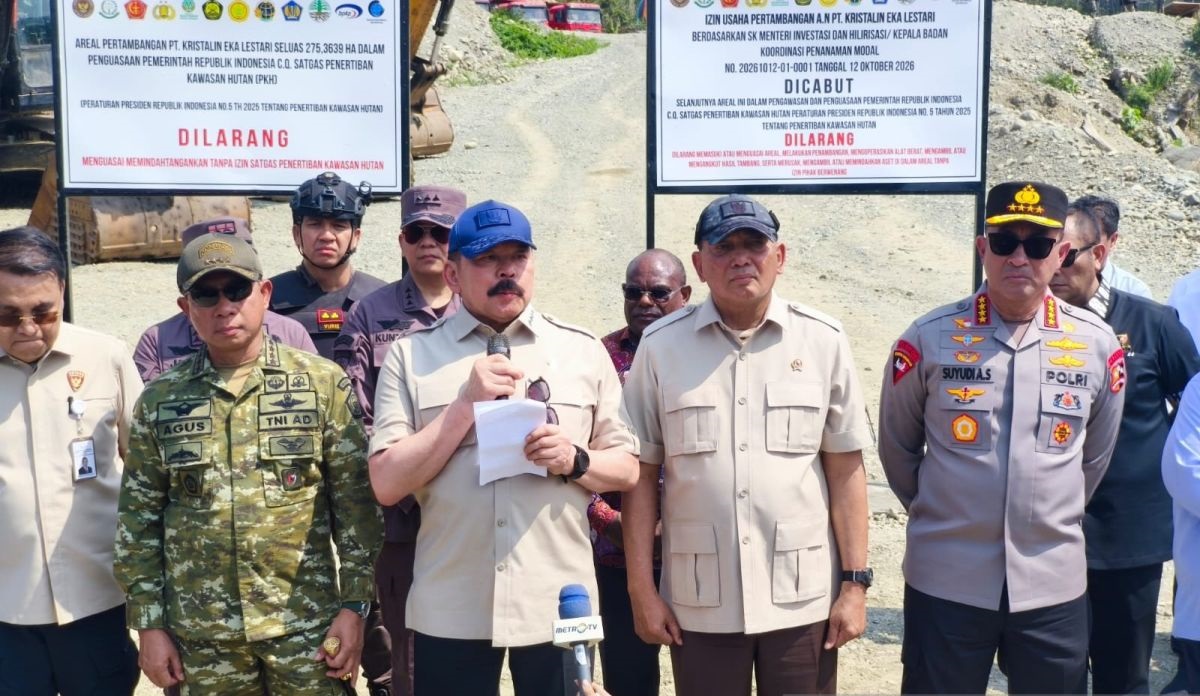
Indonesia has stepped up efforts to regulate gold mining in Papua Tengah (Central Papua), revoking the mining licence of PT Kristalin Eka Lestari after finding violations involving forest-use permissions and land-reclamation obligations, while preparing a regulatory framework intended to distinguish eligible community mining from operations that breach the law.
The announcement came during a visit to Nabire on October 22, 2026, by four senior national officials: Attorney General Sanitiar Burhanuddin, Defence Minister Sjafrie Sjamsoeddin, Indonesian Military Commander General Agus Subiyanto and National Police Chief General Suyudi Ario Seto. The action was part of the government’s broader programme to bring forest areas and natural-resource activities under stricter legal oversight.
The government said the permit held by PT Kristalin Eka Lestari, covering a concession of approximately 3,500 hectares, had been revoked through a decision dated October 12. The move followed field verification by the Forest Area Enforcement Task Force, known as Satgas PKH, which found that mining activities had taken place without the required forest-use approval and that the company had not fulfilled its reclamation-related obligations.
At the same time, the government said it was preparing rules to accommodate community mining that meets legal requirements. The proposed approach is intended to address the economic needs of people who depend on small-scale mining without allowing the term “community mining” to become a cover for operations using heavy machinery in violation of regulations.
The policy presents two connected challenges for Papua: enforcing the law against mining that fails to meet its obligations and creating a credible legal route for local people to participate in resource development while protecting forests and communities.
How the Nabire Enforcement Action Unfolded
A Field Review Led to the Permit Revocation
The latest action followed verification by a joint team from Satgas PKH, which was established to strengthen oversight of forest areas under Presidential Regulation No. 5 of 2025. During its examination of PT Kristalin Eka Lestari’s operations in Nabire, the team found mining activity in a forest area without the required approval for the use of forest land. The company also failed to fulfil its obligations relating to reclamation guarantees and the implementation of reclamation.
The permit revocation was formalised through a decision issued by the Minister of Investment and Downstreaming, acting as head of the Investment Coordinating Board, on October 12, 2026. The decision covered the company’s 3,500-hectare mining concession. During the October 22 visit, officials announced that control of the area would return to the state following the revocation.
The distinction between the size of the concession and the area associated with the alleged violations is important. The 3,500 hectares refers to the overall concession covered by the revoked permit. A separate report by ANTARA cited field findings concerning mining activities in forest areas without the required approval. Do not confuse those findings with a claim that every hectare of the concession had been mined illegally.
According to Attorney General Burhanuddin, the company’s failure to meet forest-use and reclamation requirements formed the basis for the decision. He said the revocation was carried out under Article 119(a) of Law No. 4 of 2009 on Mineral and Coal Mining, as amended, which provides for revocation when permit holders fail to fulfil their obligations.
Senior Officials Visit the Site
The October 22 visit brought together officials responsible for defence, national security, law enforcement and resource governance. Defence Minister Sjafrie Sjamsoeddin attended in his capacity as steering chair of Satgas PKH, alongside Burhanuddin, General Agus Subiyanto and General Suyudi Ario Seto. Central and regional officials were also involved in the wider enforcement effort.
The visit served as a public confirmation that the permit had been revoked and that the government intended to continue the enforcement programme. It also provided an opportunity for officials to explain the next steps, including the proposed role of a state-owned enterprise in the former mining area and the preparation of rules for community mining.
The government’s position is that resource development must obey the law, comply with environmental requirements and provide benefits to the public. In practical terms, that means companies cannot rely solely on a mining licence if they have failed to obtain other required approvals or meet environmental obligations.
Defence Minister Says Forest Enforcement Will Continue
Satgas PKH to Maintain Its Mandate
Sjafrie said the government would continue its forest-area enforcement work despite challenges and resistance encountered during implementation.
“We remain committed to continuing the PKH task, despite the difficult but noble challenges involved,” Sjafrie said, according to ANTARA. He added that the task force involved 12 ministries and government institutions, reflecting the cross-agency nature of the enforcement programme.
The minister said the operation was being carried out under Presidential Regulation No. 5 of 2025, which provides the basis for the government’s forest-area enforcement work. He maintained that the programme would continue to address activities that violate the rules governing the use of forest areas.
The involvement of multiple agencies reflects the complexity of regulating mining. The process can involve land status, mining permits, forest-use approvals, environmental responsibilities, tax and royalty obligations, labour rights and enforcement of criminal law. No single institution can address every aspect independently.
The effectiveness of the policy will therefore depend on coordination, evidence-based decisions and consistent application of the rules. Clear communication with provincial and district administrations will also matter, particularly where local governments are developing their own arrangements for community mining.
Government Plans to Prepare Rules for Community Mining
A Legal Route for Eligible Local Miners
Alongside the closure of the company’s operation, the government announced plans to prepare rules for community mining in Nabire. Attorney General Burhanuddin said the framework should take account of residents who rely on mining to support their livelihoods while ensuring that activities comply with legal and environmental requirements.
“We will establish regulations, and of course we will not leave out communities who identify themselves as community miners but use heavy equipment,” Burhanuddin said, referring to the need to distinguish genuine small-scale activity from operations that breach the rules.
His remarks point to a central issue in the regulation of artisanal mining. For some households, gold mining can provide an important source of income. But without clear legal boundaries and effective supervision, mining can also contribute to uncontrolled land clearing, environmental degradation and uncertainty over who is authorised to operate.
The proposed regulations are intended to provide greater certainty for eligible miners while making clear that the use of heavy machinery in violation of applicable rules will remain subject to enforcement. Burhanuddin said the government must balance the needs of people seeking a livelihood with the protection of the environment and compliance with the law.
As of the October 22 announcement, the government had not yet detailed the proposed regulation’s final form, licensing procedures, designated mining areas or eligibility requirements. Those elements will be essential to turning the announcement into a functioning policy.
Papua Tengah Has Already been Working on Community Mining
The proposed national framework comes amid earlier efforts by the Papua Tengah provincial government to formalise community mining. In May 2026, the province said it had proposed 20 blocks of Community Mining Areas, known as Wilayah Pertambangan Rakyat, or WPR, to the central government. The initiative was intended to bring community mining under a clearer legal framework and encourage the participation of Indigenous communities.
The provincial government has also adopted Special Regional Regulation No. 6 of 2026 on community mining and is preparing to implement rules, according to the May report. Provincial officials said the aim was to ensure that local people could participate legally in the sector and that mining activity could contribute to regional revenue.
These provincial efforts are relevant to the new national announcement because formalisation requires more than just a general commitment. Authorities must identify legally mineable areas, establish the licensing process, and define operational requirements, including environmental safeguards.
A workable system could help eligible community miners understand their obligations and reduce uncertainty over whether their activities are permitted. It could also provide authorities with a clearer basis for distinguishing lawful community operations from larger or mechanised activities that do not meet regulatory requirements.
However, the proposed national rules and the province’s existing initiatives should not be assumed to be fully integrated yet. Their legal relationship, final procedures and implementation timetable need to be clarified by the responsible authorities.
PT Antam Considered for the Former Mining Area
State-Owned Management after the Licence is Revoked
The government has also announced plans to involve PT Aneka Tambang, commonly known as Antam, in managing the former PT Kristalin Eka Lestari mining area.
Burhanuddin said the government intended to transfer management of the former operating area to the state-owned enterprise so that mining activities could be conducted under state management. He expressed the hope that Antam would serve not only as an investor but also as an operator.
Burhanuddin announced that a state-owned enterprise, specifically PT Antam, will take over the management of the former mining operation area.
The proposed arrangement reflects the government’s stated intention to strengthen oversight of natural resources and ensure that mining activity is conducted within the legal framework. Antam’s prospective role could also provide a basis for more structured operational management, although the specific implementation arrangements have not been fully detailed in the announcement.
The transition will require careful planning. Before any new operation begins, the status of the land, the environmental condition of the former site, the applicable permits and the responsibilities for rehabilitation must be established. The revocation of a previous licence does not remove the need to address damage or outstanding obligations associated with earlier activities.
Burhanuddin said the former company would remain responsible for obligations that continued after the revocation, including environmental recovery, taxes and royalties due under the law, and the rights of eligible workers, including severance payments.
These obligations matter because a change in management should not leave unresolved environmental or labour issues behind. The government’s stated objective is to improve resource governance while ensuring that the interests of communities and workers are not overlooked.
Environmental Protection and Accountability
Reclamation is a Central Issue
One of the principal reasons cited for revoking PT Kristalin Eka Lestari’s permit was the failure to meet requirements relating to reclamation guarantees and implementation. Reclamation is important because mining can disturb vegetation, soils and drainage patterns, leaving land vulnerable to erosion and other environmental problems if it is not properly managed.
A reclamation guarantee is intended to provide financial assurance for required rehabilitation. Authorities must decide what corrective action is needed and who is legally responsible if the relevant obligations are not met.
The government’s announcement that environmental recovery remains an obligation of the former permit holder is therefore significant. Revoking a licence is an enforcement measure, but it does not by itself restore land affected by mining.
The next stage should include a documented assessment of the site, identification of outstanding rehabilitation requirements and a clear allocation of responsibilities. Transparent information about these steps would help demonstrate whether enforcement is producing tangible environmental results.
Protecting Public Interests
Burhanuddin said the management of natural resources must prioritise the interests of the public and environmental sustainability rather than focusing solely on economic returns. He referred to Article 33(3) of Indonesia’s Constitution, which states that the land, waters and natural resources contained within them are controlled by the state for the greatest prosperity of the people.
That principle places public benefit at the centre of resource governance. In practice, its implementation requires more than state ownership or a change in the company operating a mine. It requires transparent licensing, compliance with environmental standards, protection of workers’ rights, fair treatment of local communities and accountability for public revenue.
For Papua Tengah, the challenge is to ensure that gold mining contributes to local development without imposing disproportionate costs on forests, water resources and communities living near mining areas.
The enforcement action in Nabire offers an opportunity to review how mining operations are authorised and supervised. It also creates a test for the planned community-mining framework: whether it can provide a realistic legal route for local participation while preventing the misuse of community status to conceal activities that violate the law.
What the Policy Could Mean for Papua Tengah
The combination of enforcement, proposed Antam management and planned rules for community mining points to a broader effort to restructure the sector rather than simply close one operation.
For the government, the immediate priorities are to enforce the permit revocation, ensure that outstanding obligations are addressed and clarify the future management of the site. For local authorities, the task includes coordinating with national agencies and ensuring that community mining proposals are consistent with the applicable legal framework.
Residents will benefit from the policies’ implementation. A properly regulated community-mining system could provide eligible local miners greater legal certainty, while better oversight could help ensure that economic activity contributes to regional revenue and does not leave communities bearing the cost of environmental damage.
Those outcomes are not automatic. The final regulations need to specify eligibility, licensing, permitted equipment, environmental standards, monitoring responsibilities and enforcement procedures. Authorities will also need to explain how proposed community mining areas relate to forest protection and existing land rights.
The proposed involvement of Antam likewise requires clear operational arrangements and public accountability. The state-owned enterprise’s role, the conditions for any future mining, and the approach to environmental rehabilitation should be made transparent before the former site resumes activity.
Conclusion
The October 22 action in Nabire is an important milestone in Indonesia’s effort to regulate gold mining in Papua Tengah. The government revoked PT Kristalin Eka Lestari’s mining permit after finding violations related to forest-use approval and reclamation obligations, while announcing plans for Antam to manage the former operating area and preparing rules for eligible community miners.
The long-term test will be whether these measures lead to more accountable mining, meaningful environmental recovery and practical opportunities for local people to participate legally in the sector. Strong enforcement is necessary where operators fail to meet their obligations, but lasting progress also requires clear licensing pathways for legitimate community activity.
For Papua Tengah, natural-resource governance should be measured not only by the number of permits revoked or operations closed but also by the quality of the regulatory system that follows. Transparent rules, coordination between central and regional authorities, respect for community rights and verifiable environmental safeguards will be essential.
If those elements are implemented consistently, the Nabire case could become part of a broader effort to ensure that Papua’s mineral wealth is managed lawfully and responsibly, with benefits reaching local communities while protecting the environment for future generations.
Read Also
Papua Moves Against Illegal Gold Mining
Papua Gold Reserve Discovery Opens New Opportunities for Regional Development
Papua Illegal Gold Mining Case Exposes Forest Risks
Papua Tengah Moves Against Illegal Gold Mining

