
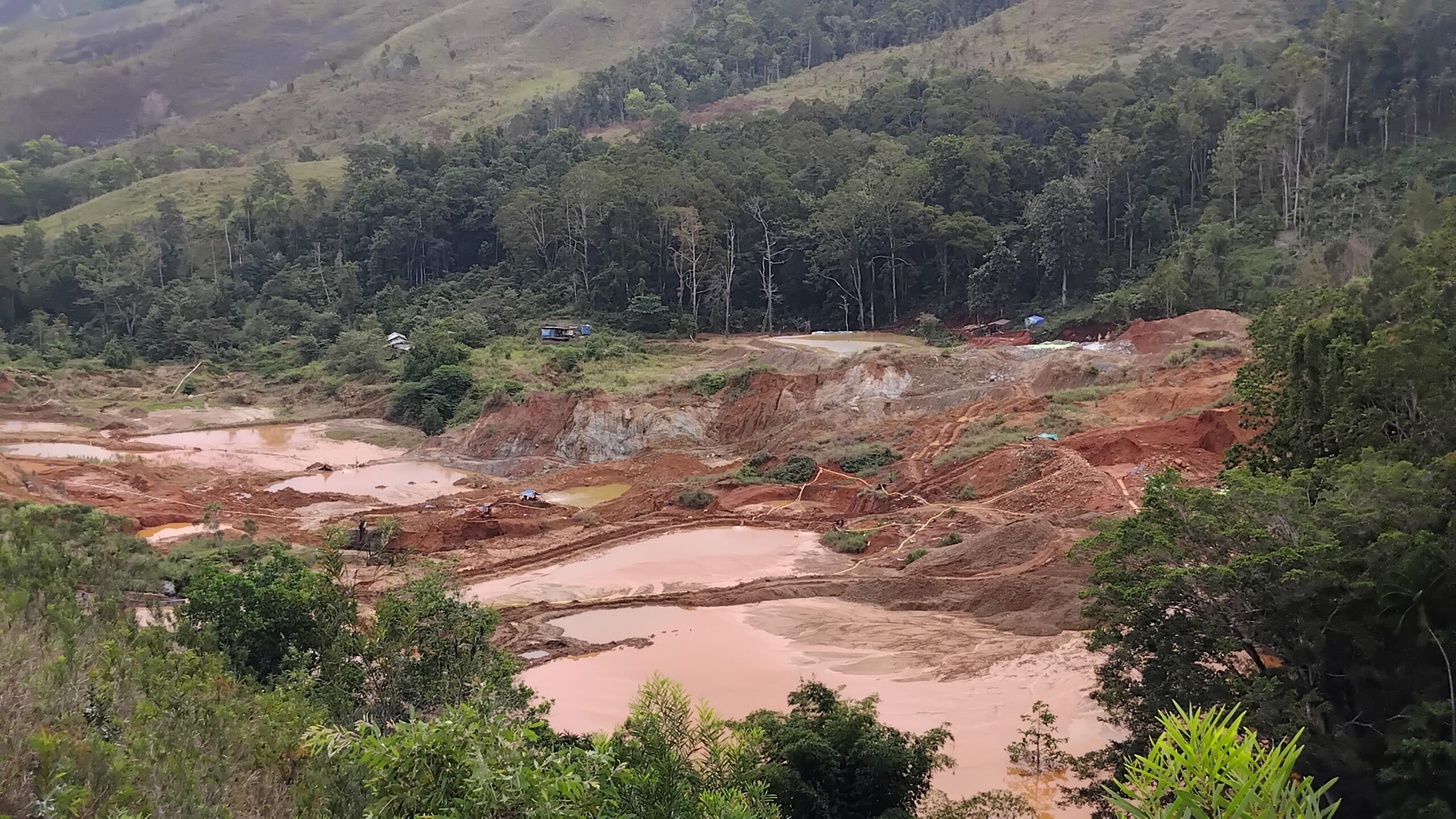
Illegal gold mining in Papua is facing a stronger government response after the Papua Provincial Government and the Papua Legislative Council, or DPR Papua, called for coordinated enforcement against unlicensed mining activities that officials estimate could cost the region and the state around Rp2.3 trillion each year.
The figure has put the issue firmly on the economic and environmental agenda in Jayapura. During a coordination meeting on August 27, Papua Energy and Mineral Resources Agency, or ESDM, officials outlined plans for a new enforcement operation, while the DPR Papua’s Commission IV backed stronger action against mining operations conducted without permits. The discussion also highlighted a broader question: how Papua can turn its mineral wealth into legitimate economic benefits without sacrificing forests, waterways, and the livelihoods of communities living around mining areas.
The debate comes as evidence of environmental pressure continues to emerge around areas such as the upper watershed of Lake Sentani. A recent investigation by Jubi documented muddy water, sedimentation, and concerns about heavy metal contamination associated with mining activity around Buper Waena and the Cycloop foothills.
For the provincial government, the challenge is therefore larger than shutting down illegal mining sites. It is about establishing a system in which natural resources can contribute to public services, local economic growth, and community welfare while remaining subject to environmental and safety standards.
A Rp2.3 Trillion Economic Warning
The scale of the potential economic loss was emphasized by Joni Y. Betaubun, chairman of Commission IV of DPR Papua, during a coordination meeting with the Papua ESDM Agency.
According to Teraspapua, Betaubun said illegal mining could represent potential losses of approximately Rp2.3 trillion annually. He argued that Papua’s natural wealth should be capable of generating greater benefits for the region rather than disappearing through unlicensed economic activity.
The figure should be understood as an estimate of potential economic value associated with mineral production that could otherwise be managed legally, rather than as a confirmed cash loss from a single government account. Papua ESDM officials explained that the estimate relates to mineral production that could enter the formal taxation and revenue system if mining activities were properly licensed and regulated.
That distinction matters because illegal mining affects government finances in several ways. Unlicensed operations can bypass taxes and other public revenues, while government agencies may still face the costs of environmental degradation, public safety risks, and infrastructure damage.
Betaubun said legal mining would provide a clearer mechanism for government oversight and allow economic benefits to contribute to regional budgets and public services. DPR Papua has also expressed support for regulations concerning mineral and coal mining, although implementation will depend partly on available funding.
For Papua, this creates an important policy dilemma. Gold and other minerals represent economic opportunities, but the value of those resources depends on whether extraction can be governed effectively.
Government Prepares a Coordinated Enforcement Operation
The Papua Provincial Government says it does not intend to address the problem through enforcement alone.
Papua ESDM is preparing an operation described by the agency as “Operasi Sabuk Bersih,” or a clean sweep operation, initially targeting illegal mining activities in Jayapura City and Jayapura Regency before potentially expanding to other parts of the province.
The operation is expected to combine law enforcement with community engagement, including public education, assistance, and facilitation for minors who may be eligible to obtain the required permits.
Plt. Head of Papua ESDM Karsudi said illegal mining had become too complex for one institution to resolve independently. The agency is seeking cooperation from DPR Papua, law enforcement authorities, and other stakeholders.
“Penanganan pertambangan tanpa izin tidak bisa berjalan sendiri,” Karsudi said, emphasizing the need for cooperation between government institutions and law enforcement.
This approach is significant because enforcement in remote mining areas can be difficult. A purely punitive response may close individual sites without addressing why illegal mining continues to attract workers and investors.
By combining enforcement with licensing assistance and public education, authorities are attempting to create a pathway from informal mining toward regulated economic activity.
Regulation Must Reach the Ground
DPR Papua has also warned that government policy cannot stop at coordination meetings or new regulations.
Betaubun said the legislature supports the formation of a team to conduct enforcement operations and expects concrete action in the field. He also called for miners operating without permits to pursue legal status in accordance with applicable regulations.
The issue is particularly relevant to Papua’s special autonomy framework. DPR Papua member Alberth Merauje argued that natural resource management should involve Indigenous communities and clarify the respective responsibilities of central, provincial, and district governments.
He emphasized that communities with customary land rights should not simply become observers while resources are extracted from areas connected to their livelihoods.
That perspective adds an important social dimension to the enforcement debate. Illegal mining is not always simply a confrontation between government authorities and criminal operators. In some locations, local communities economically benefit from mining, while others face environmental consequences without receiving comparable advantages.
A durable policy therefore requires authorities to distinguish between different actors and circumstances while maintaining a clear legal standard.
Environmental Costs Are Becoming More Visible
The economic argument is just one aspect of the overall narrative.
A recent Jubi investigation found that mining activity in the upper areas of the Hubay River has contributed to muddy water and sediment flowing toward Lake Sentani. Residents interviewed by the publication described difficulties catching fish and changes in the condition of waterways they have depended on for years.
Lake Sentani is particularly important because its value extends beyond fishing. The lake supports ecological functions and has social, economic, tourism, and transportation roles for communities around Jayapura.
Jubi reported that Lake Sentani covers about 9,360 hectares and that at least 24 surrounding villages depend on its natural resources. Data from Papua’s fisheries and marine affairs authorities cited by Jubi recorded 892 capture fishers on the lake in 2023.
This illustrates why illegal mining can become a development issue far beyond the boundaries of a mining site.
Sediment carried downstream can affect waterways, fisheries, and settlements. In the case of Lake Sentani, residents interviewed by Jubi reported that muddy water had affected fishing and fish farming activities. During heavy rainfall, sedimentation was also reported to contribute to flooding around parts of the watershed.
The environmental consequences can therefore translate into economic consequences for households.
Heavy Metals Add Another Concern
The environmental debate has also raised concerns about mercury and other heavy metals.
Jubi reported that a 2025 study by researchers at Cenderawasih University examined six heavy metals in 11 locations around Lake Sentani, as well as several freshwater fish species. The study found cadmium levels above applicable thresholds at all sampled locations, while mercury, nickel, and zinc exceeded thresholds at some sites. Some fish samples also showed levels of several metals above thresholds.
These findings do not mean that every part of Lake Sentani faces the same level of contamination. However, they reinforce the importance of monitoring water quality and the food chain, particularly where mining activity occurs upstream.
The issue is also linked to the use of mercury in gold processing. Jubi quoted environmental activists who said mining operations using heavy equipment and water pumps could transport mining waste downstream, with mercury potentially creating additional ecological risks.
For policymakers, the implication is straightforward: shutting down illegal operations is only one part of environmental protection. Restoration, water monitoring, and rehabilitation of affected landscapes may also be necessary.
Protecting Communities While Restoring Legal Mining
The Papua government’s proposed strategy emphasizes an increasingly important principle in natural resource governance: pairing enforcement with viable alternatives.
Karsudi said the planned operation would include law enforcement, community guidance, socialization, assistance, and facilitation of licensing.
This matters because some people involved in informal mining may depend on the activity for income. Closing a site without addressing livelihoods could simply move the problem elsewhere.
At the same time, allowing illegal operations to continue indefinitely carries its own costs. The government loses potential revenue, communities face environmental risks, and legitimate businesses may find themselves competing with operators who do not carry the same regulatory costs.
The answer lies in establishing predictable rules. Mining that meets legal, environmental, and safety requirements can be supervised. Mining that operates outside the law can be subject to enforcement.
This distinction also gives Indigenous communities a clearer role. DPR Papua member Alberth Merauje called for stronger engagement with customary landowners and better public education so communities understand both the economic potential of their resources and the risks of uncontrolled exploitation.
Such participation could become an important element of Papua’s development strategy. If local communities are involved in decisions about resource management, enforcement may gain greater legitimacy, and economic benefits can be more closely connected to local priorities.
A Test for Papua’s Resource Governance
The latest measures represent more than another enforcement campaign against illegal mining.
They are also a test of whether Papua can strengthen the governance of its natural resources under the framework of regional autonomy.
For the provincial government, the potential Rp2.3 trillion in annual economic value cited by officials represents an opportunity to strengthen public finances. But that opportunity will only become meaningful if the resources are managed transparently, legally, and sustainably.
For communities, the stakes are equally practical. Clean water, functioning fisheries, safe working conditions, and protection of customary land are not abstract policy objectives. They directly affect household incomes and quality of life.
The experience around Lake Sentani demonstrates how environmental impacts can travel downstream and affect people who are not directly involved in mining. Jubi’s reporting shows that sedimentation and water quality have already become concerns for communities dependent on the lake.
This makes prevention particularly important. Environmental damage can be much harder and more expensive to reverse than preventing it in the first place.
What Comes Next
The immediate priority will be translating the provincial government’s announced operation into measurable action.
That means identifying illegal sites, determining the legal status of mining operations, enforcing regulations consistently, and monitoring environmental impacts. It also means ensuring that legitimate mining opportunities are not unnecessarily obstructed by unclear procedures.
The role of DPR Papua will be equally important. The legislature can provide oversight, push for adequate funding, and help establish regulations that clarify responsibilities between levels of government.
Meanwhile, law enforcement agencies will be needed when violations require criminal or administrative action.
Perhaps most importantly, local communities need to remain part of the process. The future of Papua’s mineral resources cannot be separated from the future of the forests, rivers, and lakes where those resources are found.
For international readers following Papua’s development, the illegal mining debate offers a broader lesson. Resource-rich regions do not automatically become prosperous regions. The difference is often determined by governance, transparency, environmental protection, and whether local communities receive meaningful economic benefits.
Conclusion
Papua’s decision to intensify action against illegal gold mining reflects a growing recognition that natural resources must serve long-term development rather than short-term extraction.
The Rp2.3 trillion potential annual economic value cited by Papua officials underscores the financial stakes, while the reported environmental pressure around Lake Sentani shows the cost of allowing unregulated mining to continue.
The proposed enforcement operation will therefore be judged not simply by the number of mining sites closed. Its broader measure of success will be whether Papua can establish a credible system in which mining is legal, communities are protected, environmental damage is controlled, and resource revenues contribute to public welfare.
If the provincial government, DPR Papua, law enforcement agencies, and Indigenous communities can sustain that cooperation, the current crackdown could become more than a temporary enforcement campaign. It could mark a step toward stronger natural resource governance and a more sustainable economic future for Papua.

