
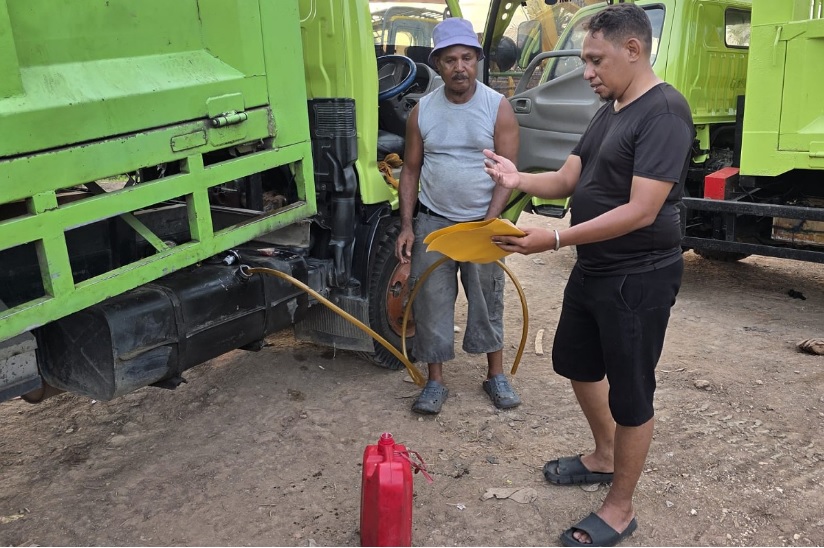
The seizure of 850 litres of subsidised diesel in Sorong has put the spotlight on efforts to protect Indonesia’s fuel distribution system from illegal diversions. Papua Barat Daya (Southwest Papua) Regional Police, known as Polda Papua Barat Daya, arrested a suspected fuel collector and confiscated a truck after an investigation uncovered repeated purchases at several filling stations using different vehicle registration numbers and QR codes.
The operation, conducted by the police’s Special Criminal Investigation Directorate, represents a significant enforcement step in a region where access to affordable fuel is important for household activities, transport and local businesses. Investigators are now seeking to establish who was expected to receive the collected diesel and whether other parties were involved.
The case also highlights a broader challenge facing Indonesia’s subsidised energy programme: ensuring that public assistance reaches eligible consumers rather than being diverted into unauthorised commercial channels.
Police Investigation Traces Repeated Diesel Purchases
According to information released by the National Police’s Tribrata News portal and Indonesia’s state news agency ANTARA, the investigation began after officers noticed suspicious patterns at several public fuel stations, known locally as SPBUs.
Police became concerned about vehicles suspected of filling their tanks more than once by changing their registration plates and using different QR codes. The practice raised questions about whether the vehicles were attempting to bypass controls designed to regulate access to subsidised diesel.
AKBP Erwin Togar Hasian Situmorang, Head of Sub-Directorate IV of the Papua Barat Daya Police Special Criminal Investigation Directorate, said officers subsequently conducted surveillance to establish how the suspected activity was being carried out.
The investigation led officers to identify suspected fuel collection activity in the Jalan Baru area. After the vehicle had accumulated sufficient fuel, the diesel was transported to the Salawati area, Erwin explained during a statement in Aimas, Sorong Regency, on November 10, 2026.
The findings indicated that the suspected operation was not simply an isolated purchase at a filling station. Investigators believed that diesel was being collected through repeated transactions before being gathered and sold again.
Erwin said the suspect had initially told investigators that he operated independently. According to the preliminary account, fuel purchased from filling stations was stored at a residence until a certain quantity had accumulated, after which it was offered for resale.
These statements remain part of the ongoing investigation. Police have not yet established the full extent of the suspected operation or identified every person who may have benefited from it.
Surveillance Leads Police to a Workshop in Tanjung Kasuari
Local reporting provides further detail about the operation that brought the suspected activity to police attention.
According to Tabura Pos, officers from Sub-Directorate IV followed a green Hino dump truck suspected of repeatedly purchasing fuel at several filling stations in Sorong. The vehicle was reportedly monitored between November 7 and 8, 2026.
The surveillance led officers to a workshop belonging to PT Salawati Motorindo on Jalan Tanjung Kasuari, in Sorong Barat District, Sorong City.
At the location, officers reportedly witnessed drums containing subsidised diesel being unloaded from the truck. The intervention took place while the unloading process was under way, allowing investigators to secure the vehicle and the fuel.
The subsequent police operation resulted in the seizure of four drums containing approximately 850 litres of subsidised diesel, along with one truck. A man identified by the police only by the initial A was also arrested and named as a suspect.
The sequence described by local media places the suspected collection activity at several filling stations before the truck reached the workshop. It also helps explain why the police focused their investigation not only on the person transporting the fuel but also on the possible destination and intended recipients.
The quantity of fuel reported in the initial local coverage differed slightly from the later official figure. A Tabura Pos report published on November 9 referred to approximately 800 litres, while the police confirmation reported on November 10 and 11 and the ANTARA account put the seized quantity at approximately 850 litres. The later figure is therefore used in this report, consistent with the subsequent police and national news agency statements.
The difference illustrates why official updates and the results of evidence measurement are important in cases involving seized goods. Tabura Pos also reported that investigators involved the Sorong City Trade Office in sampling and measuring the seized fuel.
Police Examine the Possible Buyers and Company Connection
Although one suspect has been arrested, investigators have made clear that the inquiry is not over.
Police are examining who was supposed to receive or purchase the diesel. One of the central questions is whether the intended recipient knowingly sought subsidised fuel or whether there could have been a discrepancy between the type of fuel ordered and the product delivered.
Erwin said investigators were still examining those possibilities.
“We are still investigating who received the fuel. The investigation will determine whether the individuals deliberately purchased subsidised goods or if they ordered non-subsidised fuel but received a different product. We still need to examine that,” he said, as reported by ANTARA.
A company employee identified by the initial H has also been questioned, according to the police statement. Investigators have not ruled out summoning other individuals who may have information or responsibility relevant to the case.
This distinction is important. The presence of the truck and seized fuel at a workshop provides investigators with a basis to examine the possible destination of the shipment. It does not, by itself, establish that the company or its management committed a criminal offence.
The investigation must determine who ordered the fuel, who handled the transactions, who received the goods and whether any party knowingly participated in the misuse of subsidised diesel.
Tabura Pos also reported that an earlier subsidised-fuel case had been discussed during proceedings at the Sorong District Court, with witnesses in that separate case referring to purchases involving the same company. Those statements formed part of the earlier court proceedings and should not be treated as proof of guilt in the present investigation. Police have separately stated that they have not yet established a direct connection between the current case and the previous fuel-misuse case.
A careful examination of the evidence will therefore be essential to ensure that responsibility is determined on the basis of verified facts rather than association or speculation.
How the Suspected Modus Operandi Exploited Fuel Controls
The case has drawn attention to the methods allegedly used to obtain subsidised diesel in repeated transactions.
Indonesia has introduced QR-code-based controls at fuel stations to help monitor the purchase of subsidised fuel. The system is intended to make distribution more transparent and to reduce the possibility of fuel being acquired in quantities or through methods inconsistent with the applicable rules.
Erwin said police had conducted preventive outreach at several filling stations since October, following instructions from the National Police headquarters to strengthen supervision of subsidised fuel distribution.
Some filling stations had also introduced restrictions under which a vehicle could purchase subsidised diesel only once within a two-day period, using the relevant barcode controls.
However, investigators suspected that the individual involved in the Sorong case attempted to get around these restrictions by changing vehicle registration plates and using different QR codes. Police noted that the photograph associated with the vehicle remained the same despite the changes.
That detail is particularly relevant to the investigation. It suggests that effective monitoring requires more than checking the registration number or QR code presented during a transaction. Comparing vehicle images, transaction records and repeated purchasing patterns may help identify suspicious activity that would otherwise escape attention.
The case could consequently provide useful lessons for cooperation between police, fuel station operators and the authorities responsible for monitoring subsidised energy distribution.
Why Subsidised Diesel Protection Matters to Local Communities
Subsidised diesel is part of Indonesia’s broader effort to make essential energy more accessible to eligible consumers. Its availability can influence the operating costs of transport services, small businesses and other activities that depend on fuel.
In regions such as Papua Barat Daya, where communities and economic centres are spread across a geographically challenging area, reliable access to energy is an important component of daily economic life.
When subsidised fuel is diverted for unauthorised resale, the consequences can extend beyond the value of the fuel itself. Eligible consumers may face greater difficulty obtaining supplies, while public funds intended to support affordable energy risk being used for purposes outside the programme’s objectives.
The alleged stockpiling in Sorong therefore raises an issue of public interest. The 850 litres seized by police represent fuel that investigators suspect was collected for resale rather than being used through the intended distribution channels.
However, the precise financial loss to the state or the economic impact on consumers has not been quantified in the available reports. It would be premature to assign a monetary value to the alleged losses without information about the purchase prices, intended resale prices, subsidy component and other relevant evidence.
The wider concern is nevertheless clear: a subsidy programme can only achieve its purpose when its distribution is properly monitored and its benefits reach the people and sectors for which it was designed.
Legal Process and Continued Enforcement
The suspect faces investigation under Article 55 of Law No. 22 of 2001 on Oil and Natural Gas. According to the police and ANTARA reports, the provision carries a maximum prison sentence of five years.
The legal process will determine whether the evidence is sufficient to establish the suspect’s criminal responsibility. Any additional individuals or organisations found to have a role in the suspected activity must also be examined through the appropriate legal procedures.
Polda Papua Barat Daya has said it will continue developing the investigation to identify any other individuals or networks potentially involved in the misuse of subsidised fuel.
The police have also stressed the importance of maintaining supervision at filling stations and ensuring that subsidised diesel is distributed to eligible users.
For the authorities, the challenge is not limited to making arrests after suspected violations occur. Effective enforcement also requires prevention, accurate transaction monitoring, coordination with relevant agencies and a transparent process for investigating the supply chain.
The involvement of fuel station operators and other relevant institutions will be important in closing potential gaps in the system. Better verification of vehicle identities, more consistent monitoring of QR-code transactions and timely reporting of suspicious purchasing patterns could strengthen the safeguards already in place.
A Test of Accountability in Papua Barat Daya
The Sorong case demonstrates why the protection of subsidised fuel remains an important public policy issue in Indonesia. The government allocates public resources to support access to essential energy, but the effectiveness of that support depends on the integrity of the distribution process.
The action taken by Polda Papua Barat Daya shows the role of law enforcement in responding to suspected attempts to divert those resources. By conducting surveillance, following the suspected vehicle and securing the fuel before the investigation was completed, officers established an important starting point for uncovering the movement of the diesel.
The next stage will be equally significant. Investigators need to establish the origin of the fuel, identify its intended buyers and determine whether the suspected activity involved additional participants. Any findings concerning the workshop or other parties must be supported by evidence and assessed through the legal process.
For residents and legitimate businesses in Sorong, the broader expectation is straightforward: subsidised fuel should remain accessible to those entitled to receive it, rather than becoming a source of unauthorised profit.
Ultimately, the success of this enforcement effort will be measured not only by the 850 litres seized or the arrest of one suspect but also by whether the investigation can establish accountability and help prevent similar practices from recurring. Stronger oversight, consistent law enforcement and cooperation between public institutions and fuel distributors will be essential to maintaining public confidence in Indonesia’s subsidised energy programme.
Conclusion
The seizure of 850 litres of subsidised diesel in Sorong sends an important message that the misuse of public energy subsidies will not go unchecked. The operation by Southwest Papua Regional Police demonstrates the importance of effective law enforcement, coordinated monitoring and continued vigilance in protecting resources intended for eligible communities and businesses.
As the investigation proceeds, establishing the full chain of responsibility will be essential, particularly in identifying the intended buyers and determining whether other parties were involved. Equally important is ensuring that every allegation is assessed through a transparent legal process based on verifiable evidence.
Ultimately, safeguarding subsidised diesel is not merely a matter of enforcing fuel regulations. It is about protecting public funds, maintaining fair access to essential energy and supporting economic stability in Southwest Papua. Consistent enforcement, stronger oversight and cooperation between authorities and fuel distributors will be critical to guaranteeing that government subsidies deliver their intended benefits to the people.
Read Also
Papua Police Crack Down on Illegal Fuel Diversion
Fuel Subsidy Misuse Uncovered in Merauke

