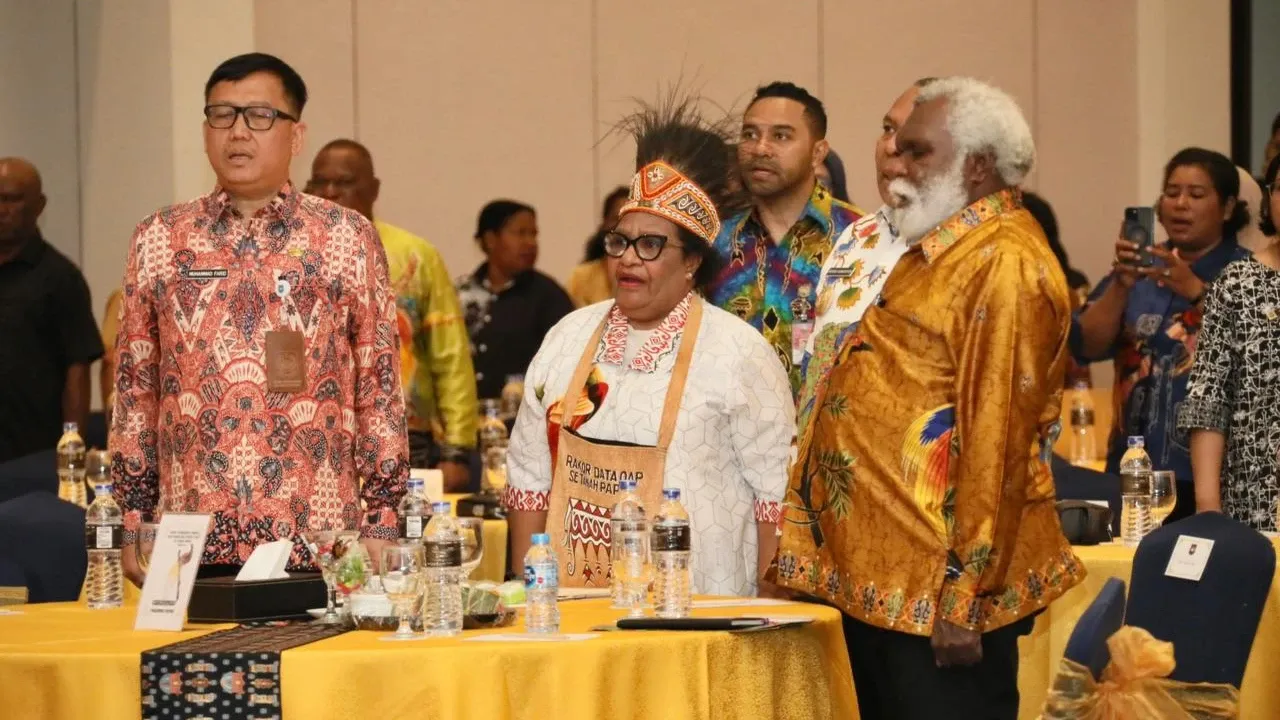
People were still taking seats when the discussion began.
Regional officials arrived carrying folders and printed documents. Others quietly exchanged notes inside Hotel Suni in Abepura, Jayapura, where representatives from provinces and districts across Papua gathered to discuss something that had already become widely debated outside the meeting room.
Data.
More specifically, data about Indigenous Papuans, commonly known by the Indonesian abbreviation OAP.
By the time Vice Minister of Home Affairs Ribka Haluk began speaking on May 21, public discussions surrounding the issue had already spread through social media groups, community forums, and local conversations across Papua.
Some people questioned why the government suddenly needed new data.
Others interpreted the effort as evidence of demographic changes.
Ribka used much of her time making remarks trying to address those assumptions.
“The current data cannot yet become the basis for concluding Indigenous Papuans have become minorities,” she said while addressing officials participating in the coordination meeting.
Her message was repeated several times throughout discussions.
The government, she said, is still collecting information.
Officials Say Public Perceptions Need Correction
Government Says Data Collection Is Still Ongoing
According to Ribka Haluk, one problem facing policymakers is that conversations about OAP data have moved faster than the data collection itself.
She said many conclusions circulating publicly are being drawn before the process has even been completed.
“We must straighten public perception,” Ribka said during discussions cited by several national media outlets following the meeting.
Officials explained that current databases remain incomplete and fragmented.
Different agencies hold different records.
Provincial governments maintain separate systems.
District administrations often use their own datasets.
As a result, officials argue that existing information still cannot provide a comprehensive picture.
That fragmentation, policymakers say, creates difficulties in designing programmes.
Data Collection Linked to Welfare Programmes
Throughout the meeting, Ribka repeatedly connected OAP data collection with social policy.
According to her explanation, the primary objective is not classification.
It is policy.
“The data will become the basis for welfare policies and distribution of special autonomy funds,” she told participants.
Officials argued that without clearer information, governments risk distributing programmes inefficiently.
Education assistance.
Healthcare programmes.
Economic support.
Social protection.
Many of these programmes increasingly depend on population data.
For policymakers, the argument appears straightforward.
Better information should produce better targeting.
Why OAP Data Has Become Increasingly Sensitive
Discussions surrounding Indigenous Papuan data rarely stay technical for long.
Population figures in Papua often intertwine with broader discussions about representation, welfare, development, and resource distribution.
That partly explains why misinformation surrounding OAP data spread quickly.
Several claims circulating publicly suggested that current data collection already proves particular demographic outcomes.
Government officials rejected those interpretations.
Ribka repeatedly emphasised the need to wait for the completion of the collection process before drawing any conclusions.
Officials participating in the meeting also argued that partial information creates risks because incomplete numbers are easily misunderstood.
Local Governments Asked to Accelerate Process
The Home Affairs Ministry used the meeting to encourage regional administrations across Papua to accelerate data collection efforts.
Officials argued that delays could slow future policy implementation.
Collecting data across Papua presents challenges.
Distances remain large.
Transportation costs remain high.
Some regions remain difficult to access.
Because of these challenges, local governments increasingly become central actors in implementation.
Several regional representatives attending the meeting acknowledged that gathering information across diverse geographical conditions requires coordination beyond central government institutions.
Officials Say Accurate Data Matters More as Papua Changes
Government officials increasingly describe population data as part of development infrastructure.
Without reliable information, policymakers argue, designing programmes becomes harder.
Several participants at the coordination meeting emphasised that Papua continues to experience social and administrative changes.
New provinces.
New districts.
Expanding infrastructure.
Changing population patterns.
These developments increase demand for more reliable information.
Officials therefore argue that updating databases is becoming increasingly necessary rather than optional.
Debate Continues Beyond Government Meetings
Outside official discussions, questions remain.
Some community members continue asking how data will be used.
Others question implementation.
Government officials acknowledged these concerns.
But they also argued that misinformation itself has become part of the problem.
According to Ribka, public discussions should distinguish between data collection and conclusions derived from data.
Officials repeatedly stressed that the process currently remains in the first stage.
Gathering information.
Not drawing final interpretations.
Conclusion
By late afternoon, officials gradually left Hotel Suni carrying documents and meeting materials.
Outside, public conversations surrounding OAP data continued.
The coordination meeting did not eliminate debate.
That was never likely.
What government officials attempted instead was narrower.
Clarify the purpose.
Reduce misunderstanding.
Accelerate collection.
For policymakers, the argument remains simple.
Programmes become easier to design when governments know more about the communities they serve.
Whether those explanations reduce public scepticism may become clearer only after the numbers themselves begin to shape policies across Papua.