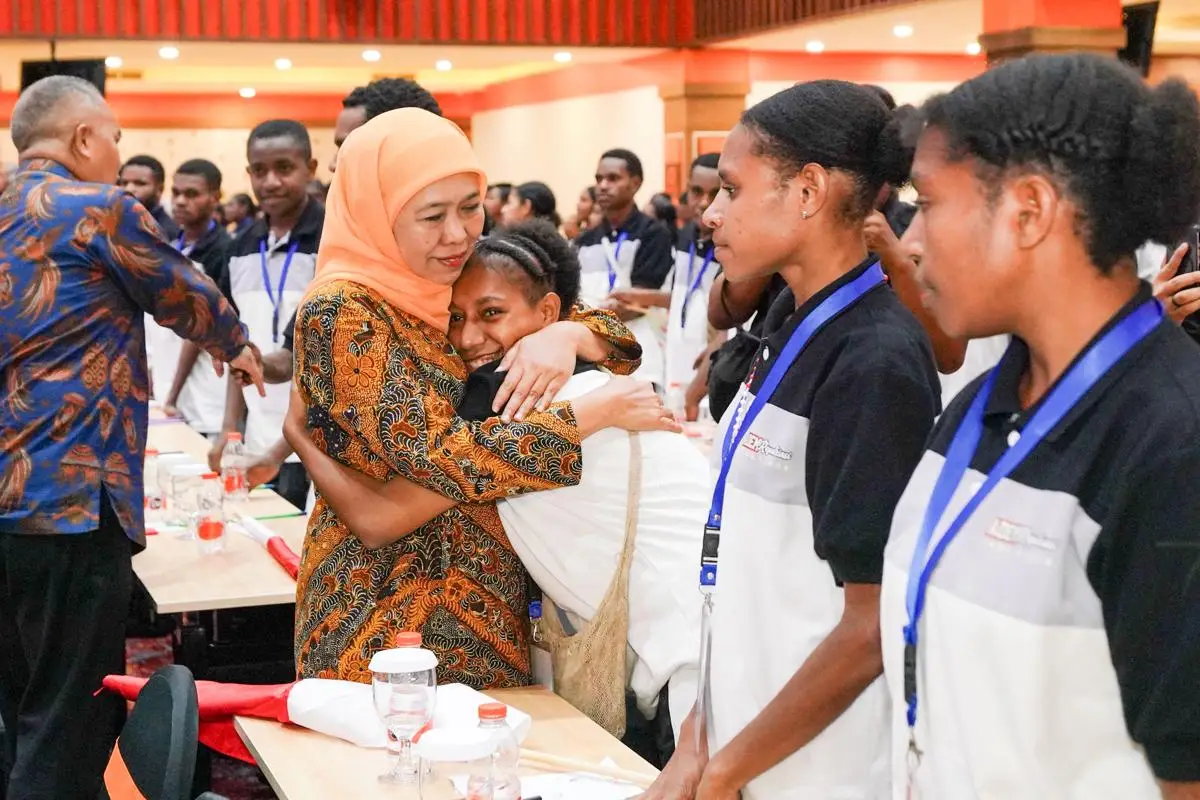
The new academic year has begun with renewed optimism for 152 students from Papua who arrived in Jawa Timur (East Java) with the Secondary Education Affirmation Programme (ADEM) of Indonesia, which aims to expand educational opportunities for young people from Papua and other priority regions.
Jawa Timur Governor Khofifah Indar Parawansa officially welcomed the students and encouraged them to pursue their education confidently and assured them that Jawa Timur would be a supporting environment during their years of study.
In her speech to the students, Khofifah delivered a message that drew public attention. “I am your mother while you are studying in Jawa Timur,” she said. She stressed that the provincial government, schools, teachers and local communities are committed to giving equal educational opportunities, guidance and care to each student during the programme.
Starting the next day, the scholarship recipients were scheduled to attend schools in 10 regencies and cities in Jawa Timur, where they will continue their senior secondary education with students from other parts of Indonesia.
More than educational assistance for policymakers, the programme represents and demonstrates Indonesia’s long-term commitment to developing human capital, increasing access to quality education and providing opportunities for talented students from Papua to develop their academic potential in various learning environments.
ADEM Expands Access to Quality Education
ADEM (the Affirmative Programme for Secondary Education) has been one of the flagship programmes of the Indonesian government to increase access to quality secondary education for students from Papua and other regions with educational disparities.
The programme allows selected students to finish their senior high school education in provinces with available educational infrastructure without having to permanently transfer to other areas, thus retaining strong ties with their home communities.
Selection is an academic and administrative process and is designed to select those students who have the potential to receive benefit from expanded educational opportunities.
The goal, officials say, is more than academic success.
Students are encouraged to interact with peers from different cultural and regional backgrounds to improve their leadership skills, broaden their perspectives, enhance their communication skills, and acquire valuable experience.
According to education experts, mobility programmes allow students to adapt to a new environment while developing independence, resilience and confidence.
Such experiences can often become valuable assets as participants move on to higher education or professional careers.
Jawa Timur Schools Prepare a Supportive Learning Environment
The arrival of the Papuan students has been preceded by extensive preparations which have involved provincial authorities, school administrators, teachers and local education offices.
Governor Khofifah also stressed that schools participating in the ADEM programme should not only provide academic learning but also full guidance to make students feel comfortable in their new environment.
She urged teachers to maximise their mentoring role by providing academic, emotional, and social support to students throughout their studies.
Education officials think successful learning needs more than just classroom teaching.
Students who travel great distances from home often require orientation, counselling and ongoing encouragement as they adapt to different school systems, communities and daily routines.
All participating districts have thus established mentoring mechanisms in schools to facilitate students’ integration into school life and to maintain their academic motivation.
Officials also emphasised the need for inclusive school climates where students from different cultural backgrounds can learn together in an atmosphere of mutual respect and cooperation.
Learning Across Regions Builds Broader Perspectives
One of the hallmarks of the ADEM programme is its emphasis on cross-regional educational exchanges.
By studying with fellow students from other provinces, Papuan students can experience new ways of learning, expand their social networks and develop intercultural communication skills, which are increasingly important in today’s interconnected society.
Furthermore, the students in the host schools benefit from interacting with their Papua schoolmates.
Such interactions can build deeper understanding of Indonesia’s cultural diversity while, at the same time, nurturing a spirit of mutual respect among young people coming from different regions.
Education researchers often note that face-to-face contact is one of the most powerful ways to break down stereotypes and build social cohesion.
Classrooms where students learn together are where real interaction, not just assumptions, creates friendships. Such environments foster openness, empathy, and collaboration.
For many of the ADEM participants, this is the first time they are experiencing daily life in a different province by living and studying outside Papua.
Likewise, friendships formed in school introduce many students from Jawa Timur to Papua for the first time.
These experiences contribute to stronger national connections while enhancing the educational journey of all involved.
Investing in Papua’s Future Human Resources
Education is repeatedly cited by government officials as one of the most critical long-term investments for Papua’s development.
The ADEM programme, in addition to scholarship programmes, vocational education, teacher development, digital learning, and university partnerships, is part of a wider strategy to strengthen the quality of Papua’s human resources.
Increased access to quality secondary education offers students the opportunity to pursue higher education, professional careers, entrepreneurship and public service.
Such investments over time lead to a larger pool of skilled professionals who can support development across sectors such as health, education, engineering, agriculture, business, technology and public administration.
“The ultimate goal is not just to educate, but to prepare young Papuans to become future leaders who can make a positive impact on their communities once they have completed their education,” officials said.
The success of previous ADEM alumni has proved how far-reaching the effects of educational opportunity can be, well beyond the classroom.
Education as a Bridge for National Development
Programmes such as ADEM demonstrate how education can overcome geographic divides between regions while offering young people equal opportunities.
Geographically, Indonesia’s diversity creates special challenges in education, particularly for students in remote areas.
Educational mobility programmes are one way to increase access to learning and foster more interaction among students from different provinces.
Development specialists frequently emphasise the importance of investing in human capital for sustainable economic growth, as well as inclusive national development.
By investing in young people today, governments want to prepare future generations able to contribute to innovation, social progress and regional prosperity.
The arrival of the 152 Papuan students in Jawa Timur is therefore not only the beginning of a new academic year but also another chapter in Indonesia’s ongoing efforts to expand educational opportunity across the archipelago.
Learning Together Across Indonesia
One of the most distinct qualities of the ADEM programme is the ability to generate a cooperative educational environment for students from different areas, cultures and social classes. Although academic achievement remains the programme’s principal focus, studying away from their home province enables Papuan students to develop adaptability, independence and intercultural communication skills that are increasingly relevant in a globalised world.
Daily encounters with fellow students, teachers and host communities offer the chance for sharing perspectives and building enduring friendships beyond regional divides for the 152 students starting their education in Jawa Timur. Meanwhile, students in Jawa Timur can directly interact with students from Papua so that they can better understand the cultural diversity that characterises Indonesia.
“Education experts know that sustained interaction among students of different backgrounds fosters empathy, cooperation and mutual respect. Rather than perceptions formed at a distance or through social media, students gain first-hand knowledge from common classroom experiences, extracurricular activities, and everyday social interactions.
Programmes like ADEM, therefore, not only help to increase educational attainment but also help to strengthen social cohesion by encouraging young Indonesians to appreciate diversity through personal experience.
Education Encourages Inclusion and Equal Opportunity
Papuan students’ presence in Jawa Timur also shows Indonesia’s commitment to ensure equal access to education for everyone, no matter their location.
The government is committed to equal opportunities for students from remote and underdeveloped areas with talent in the form of affirmative education policies, guaranteeing that they have the same opportunities as their peers elsewhere in the country.
Governor Khofifah Indar Parawansa emphasised that each student’s experience in joining this programme should be welcoming, respectful and fully supported along the way of their education journey. In a message to teachers, she highlighted the need for continued academic direction and helping students adjust socially and emotionally to their new environment.
This focus on inclusion shows that success in education is not solely about curriculum and resources but about creating schools in which all students feel safe, valued and empowered to reach their full potential.
Other examples of how educational mobility programmes can open up opportunities for Papuan youth are found in the experiences of past ADEM participants. Since then many alumni have gone on to universities, vocational institutions, careers in public service, entrepreneurship and professional sectors, demonstrating the long-term impact of sustained educational investment.
These are concrete examples of how affirmative education policies can create human capital and provide opportunities for young people in Papua.
Investing in Papua’s Future Human Resources
Papua’s long-term development strategy still includes human resource development as one of the main pillars.
In addition to scholarship programmes, ADEM has teacher development, vocational education, healthcare improvement and digital learning programmes to help build a generation of young Papuans who have the knowledge and skills to support future regional development.
Education economists repeatedly rank investment in human capital as one of the most powerful engines for sustainable economic growth.
Quality education generally provides students with more career opportunities and makes them more productive and better able to contribute to innovation and community development.
These investments are especially important for Papua because they help train future professionals in education, health, engineering, agriculture, information technology, public administration, business, and many other sectors needed to support regional development.
Provincial and national authorities have repeatedly stressed that expanding educational access continues to be one of the most effective long-term strategies for improving community welfare.
ADEM is one of several government programmes, including scholarship schemes, skills development programmes and improvements to educational infrastructure, all aimed at improving the quality of Papua’s future workforce.
Real Experiences Foster Greater Understanding
Papua is a topic that has been widely discussed on the internet in recent years, where information can quickly become viral without necessarily reflecting the complete reality of everyday life. Exchange programmes like ADEM offer a different perspective, giving students from different regions a chance to meet each other face to face.
For many participants, these experiences are an opportunity to make friends, collaborate on academic projects and learn from each other in a context constructed around shared educational goals. With such experiences, students can learn about themselves by participating in daily life, not just reading the stories on the Internet.
Education researchers have frequently discovered that positive contact with people can help diminish prejudice, foster empathy, and develop social trust. Within the ADEM Programme context, these interactions show how inclusive education environments can help young Indonesians from different cultural backgrounds to develop better relationships.
The programme doesn’t offer abstract concepts of diversity but rather gives students the opportunity to practise cooperation and mutual respect in concrete ways that often leave lasting impressions on their educational and professional lives.
Looking Ahead
The new academic year has begun, with 152 ADEM students from Papua embarking on an educational journey that will shape their personal development and future careers. The commitment of Jawa Timur to academic guidance, mentoring, and creating an inclusive learning environment echoes the broader objective of empowering all participants to flourish regardless of their geographic background. “Graduates of this programme are expected to return with increased knowledge, improved leadership skills and broader professional networks to contribute to the long-term development of communities across Papua,” policymakers say.
Conclusion
The arrival of 152 Papuan students in Jawa Timur under Indonesia’s Secondary Education Affirmation Programme (ADEM) is a sign of the country’s continued investment in expanding educational opportunity and building human capital. The programme, backed by provincial authorities, teachers and host schools, provides students with quality education while fostering intercultural understanding, leadership and academic excellence. Beyond improving individual educational outcomes, ADEM is an example of how affirmative education policies can increase inclusion, expand opportunities for youth from remote regions, and enhance ties among communities across Indonesia. These students not only commence their studies but also embody the growing capacity of Papua’s next generation to make a meaningful contribution to regional and national development.