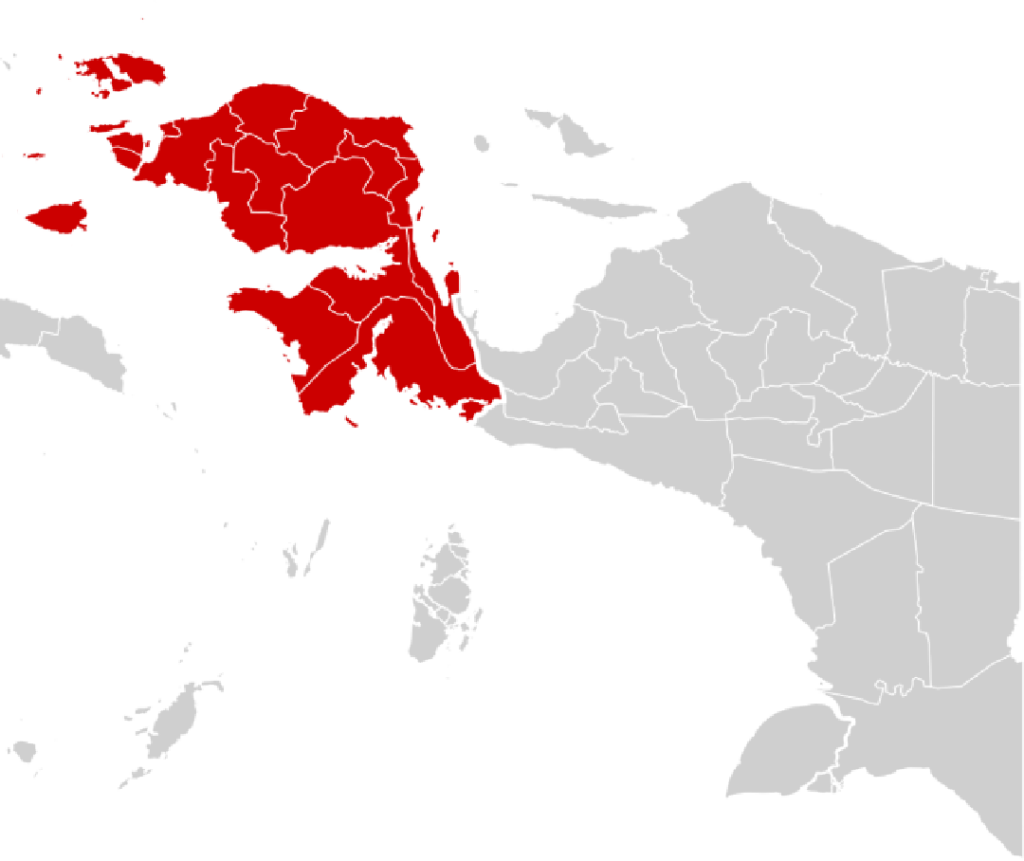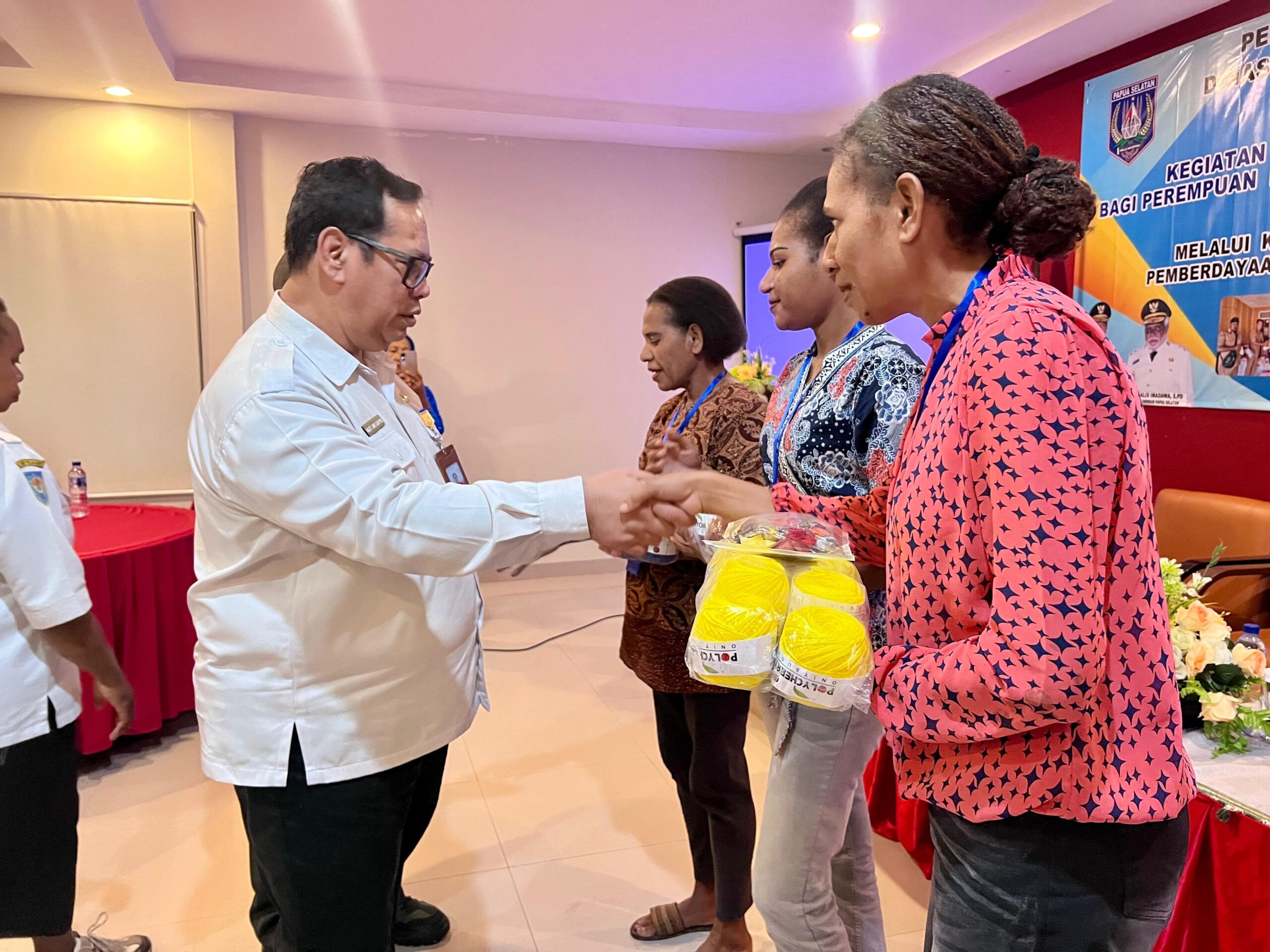
The Papua Selatan (South Papua) Provincial Government has launched a training programme to strengthen the weaving skills of Indigenous Papuan women with a commitment to protecting cultural heritage and expanding economic opportunities for local communities.
Organised by the provincial government, the initiative aims to provide women with practical weaving skills that can provide additional household income, while ensuring that one of Papua’s most iconic cultural traditions continues to be passed from one generation to the next.
The programme is part of a broader strategy to promote community-based economic development through the integration of cultural preservation and entrepreneurship, officials said. The training is expected not only to teach weaving techniques but also to help participants enhance product quality, increase competitiveness in the market, and generate new opportunities in the growing creative economy in Papua.
For many communities across Papua, a noken is a lot more than a handmade bag. It embodies cultural identity, traditional knowledge, social values and the close relationship of Indigenous Papuans with their natural environment.
The provincial government believes that by investing in women’s skills, this unique cultural heritage will continue to thrive while contributing to sustainable local development.
Noken Represents a Living Cultural Heritage
Noken occupies a special place in Papuan society.
The woven bag, traditionally hand-made from natural fibres from forest plants, has been used for generations to carry agricultural produce, firewood, hunting equipment, household goods and even infants during daily activities.
But its practical role is only one side of its importance.
Noken also symbolises responsibility, community solidarity, respect for tradition, and the passing down of ancestral knowledge among Indigenous communities across Papua.
In 2012, UNESCO inscribed Papua’s Noken, a multifunctional knotted or woven bag handcrafted by the people of Papua, on the Representative List of the Intangible Cultural Heritage of Humanity, acknowledging its exceptional cultural value.
The international recognition acknowledged the craftsmanship but also the cultural values, social practices and intergenerational learning that go with the tradition.
The preservation of the noken has now become more and more important as communities try to ensure that the younger generations are still connected to their cultural heritage while adapting to changing social and economic conditions.
Women Play a Central Role in Preserving Tradition
Women have traditionally been the primary keepers of the noken weaving tradition in Papua.
The skills of preparing natural fibres, making complex weaving patterns, and producing durable hand-made bags traditionally have been transmitted from mothers to daughters through direct practice in families and communities.
The Papua Selatan training programme is designed to strengthen this long-lasting tradition by providing structured learning opportunities that integrate traditional craftsmanship with practical economic skills.
Participants are guided not only in weaving techniques but also in improving their craftsmanship, maintaining product quality, and building greater confidence to market their products more widely.
Empowering women leads to stronger households and more resilient communities,’ programme officials said.
Development specialists often say that when women gain skills, entrepreneurship opportunities and income-generating activities, the benefits often extend to children’s education, family health and community welfare.
Therefore, women’s economic empowerment has become an increasingly important element of sustainable development strategies across Indonesia and many other countries.
Traditional Crafts Support Community Livelihoods
Noken has great potential in the economy besides being a significant cultural symbol.
There is an increasing demand from consumers, both at home and abroad, for handcrafted products which are authentic cultural items made by traditional methods.
For many Indigenous artisans, weaving is a way to supplement their income while maintaining practices that are intrinsically linked to the local culture.
The Papua Selatan provincial government hopes that by strengthening the weaving skills, it can encourage the growth of community-based businesses and support the development of the creative economy in the region.
Artisans can add value to their product while preserving their cultural authenticity by improving the quality of the product, the finishing techniques, the attractiveness of the packaging and access to wider markets.
Experts of the creative economy say traditional crafts can generate more value in the long term if they are supported by training, marketing help, development of cooperatives and better access to national and international markets.
Together, cultural preservation and entrepreneurship can help communities develop local economies and keep traditional knowledge alive in the modern world.
Building Skills for Long-Term Economic Independence
The training programme is also a model of a broader commitment to improving human resource development through practical vocational skills.
Community-based entrepreneurship allows participants to develop independent income streams from locally available knowledge and natural resources instead of being dependent on traditional employment opportunities.
Officials hope that the women who complete the programme will go on to start home-based businesses, join artisan cooperatives or sell cultural products to tourism markets and creative industry exhibitions.
Such activities contribute to household income generation and also motivate younger generations to appreciate traditional craftsmanship as an important economic resource.
Development economists often speak of the importance of small-scale creative enterprises to inclusive economic growth because they tap into local resources, protect cultural identity and distribute income more widely across communities.
Supporting Indigenous women through vocational training, then, is an investment in cultural sustainability and long-term community resilience for Papua Selatan.
Culture and Development Can Advance Together
Papua Selatan demonstrates that cultural preservation and economic development need not be viewed as mutually exclusive objectives.
Instead, the two can go hand-in-hand when traditional knowledge is reinforced by education, skills development and community empowerment.
Increasingly, many governments worldwide are aware of the role of indigenous crafts not only in the preservation of cultural diversity but also in employment, tourism, creative industries and sustainable local economies.
In Papua, where cultural heritage is still an integral part of everyday life, the revival of traditional craftsmanship helps to promote a sense of identity and economic well-being.
This integrated approach is reflected in the noken weaving programme that keeps cultural values alive, but also provides practical means for Indigenous women to be more involved in regional development.
Preserving Culture Through Economic Empowerment
“The noken weaving programme is not a mere cultural preservation programme,” said the South Papua provincial government. It also intends to improve the economic resilience of Papuan indigenous families by converting traditional knowledge to sustainable livelihood opportunities.
Many of the participants have found weaving to be a flexible income that can be combined with house duties, farming activities or other jobs in the community. Training enhances the technical ability of the artisans and the quality of the product so that they are able to make handicrafts that have more commercial value while maintaining authenticity according to the Papuan cultural products.
Those who worked on the programme stressed that the direct effect of teaching women vocational skills is an improvement in the household economies. The additional income generated through handicrafts can be used to pay for children’s education, improve nutrition, pay for healthcare and increase financial stability.
Development experts talk a lot about the ripple effect of investing in women’s economic participation in communities. Women’s access to productive skills and markets often provides benefits far beyond individual households, contributing to stronger local economies and more inclusive development.
Supporting Indigenous women to use traditional crafts to create sustainable microenterprises is a fundamental aspect of community-based economic development based on local identity in Papua Selatan.
Creative Economy Opens New Opportunities
The provincial government initiative also backs Indonesia’s broader push to grow the creative economy, which is increasingly considered a source of jobs while maintaining cultural diversity.
Unlike mass-produced goods, the noken is a product of individual artistry, traditional methods, and cultural stories that are difficult to reproduce through industrial manufacturing. These characteristics make genuine Papuan handicrafts sought after in the domestic and international markets.
Traditional handicrafts are becoming a more and more important part of sustainable tourism and creative industries worldwide. Japan, Peru, Mexico, New Zealand and other countries have managed to regenerate rural economies by promoting indigenous craftsmanship and preserving cultural authenticity.
Papua Selatan will also try to create similar opportunities by helping local artisans improve production quality, product presentation and market readiness without losing the cultural value of noken.
Officials believe that better collaboration between artisan groups, cooperatives, cultural institutions, educational organisations and local governments can enhance market access while keeping economic benefits within Indigenous communities.
As tourism and cultural exchanges continue to increase across Papua, authentic handicrafts such as noken are likely to become increasingly important symbols of regional identity and contribute to community incomes.
Passing Indigenous Knowledge to Future Generations
Perhaps the greatest success of the programme is that it is a tool for intergenerational knowledge transfer.
In traditional weaving techniques, the passing down of methods has been through direct instruction within families, with mothers and grandmothers passing down to younger family members the materials, patterns and cultural meanings associated with noken.
But recent social and economic change has created new challenges to the maintenance of these traditions. Younger generations are more exposed to urban lifestyles and digital technology, so structured cultural education is becoming more important.
The provincial training programme helps fill this void and provides an opportunity for experienced artisans to transfer their knowledge to younger participants in a formalised learning environment.
Not only do participants learn the weaving techniques, they also learn about the historical significance of noken, the values it represents and its function within Indigenous Papuan communities.
Experts in cultural preservation frequently stress that protecting intangible cultural heritage necessitates the active participation of younger generations. A tradition is only alive if it is still being practised, responsibly adapted, and appreciated in our modern society.
In honing today’s weaving skills, Papua Selatan is investing in the transmission of cultural knowledge that has defined Indigenous Papuan identity for generations.
Cultural Heritage Supports Sustainable Development
The noken weaving programme also reflects a broader recognition of the potential importance of cultural heritage in sustainable development.
International organisations are increasingly recognising that the protection of traditional knowledge can be a way to simultaneously support a number of development objectives, including poverty reduction, gender equality, education, cultural diversity and responsible economic growth.
Culture preservation relates to community resilience for Papua.
Traditional crafts promote sustainable use of natural materials, which are locally available, and promote respect for Indigenous knowledge systems that have evolved over centuries.
Continued support of cultural education and development of artisans is expected to increase pride within the community and encourage wider public appreciation of the many cultural traditions of Papua, they said.
Papua Selatan shows that traditional heritage is still very relevant in facing the challenges of contemporary development by integrating cultural preservation in economic development policies.
Looking Ahead
The Papua Selatan provincial government is expected to continue to develop programmes that combine vocational training with cultural preservation in its broader strategy of empowering the community. In the future, there may be advanced skills development, cooperative strengthening, entrepreneurship mentoring, digital marketing assistance, participation in national and international craft exhibitions and partnerships with tourism stakeholders. Through continued collaboration between government agencies, Indigenous groups, educational organisations, and cultural practitioners, officials hope that noken weaving will continue to provide economic opportunities while preserving one of Papua’s most cherished cultural traditions.
Conclusion
This is manifested in the noken weaving training programme held by the Papua Selatan Provincial Government, where cultural preservation and economic empowerment can progress hand in hand. The initiative enhances the skills of Indigenous Papuan women, preserving a tradition that is recognised worldwide by UNESCO, while creating new opportunities for entrepreneurship, household income and community development. The programme is not only helping to preserve an important symbol of Papuan identity but is also contributing to the development of the creative economy, the transfer of Indigenous knowledge to younger generations and more inclusive regional development. Papua’s investment in education, culture and local enterprise continues, and this initiative shows how traditional heritage can still be a valuable foundation for sustainable economic progress in this modern era.