As part of a broader strategy to strengthen border governance, improve legal cross border trade with Papua New Guinea (PNG) and increase regional own source revenue (Pendapatan Asli Daerah/PAD) through enhanced economic engagement with neighboring Pacific countries, the Papua Provincial Government is seeking closer cooperation with the Indonesian Ministry of Immigration and Corrections.
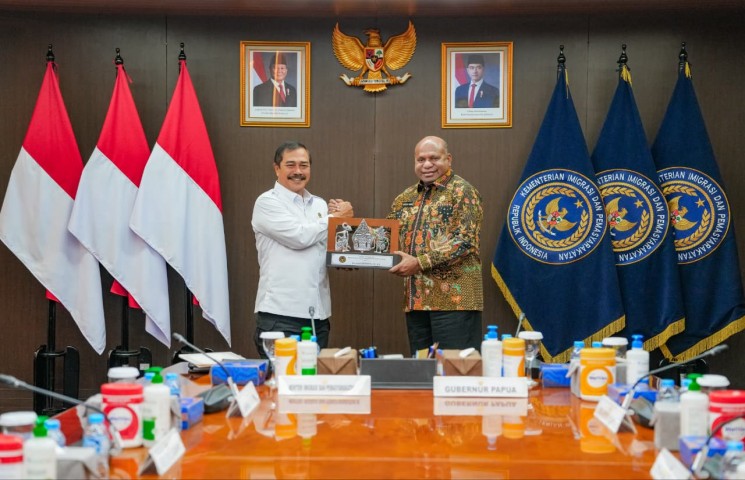
In talks with officials from the Minister Agus Adrianto, Governor Mathius D. Fakhiri recently put forward several proposals, noting that Papua’s strategic position on Indonesia’s eastern edge offers the chance not only to enhance border security but also to develop legitimate economic activity.
One of the proposals is the possibility of assigning provincial civil servants with relevant expertise to strengthen immigration services in Papua, so that government institutions can improve administrative capacity while supporting the increasingly growing movement of people and goods across the international border.
The initiative reflects a more integrated approach to border management where economic development, public services and security are viewed as mutually reinforcing goals rather than as separate policy areas.
For Papua, bolstering institutional cooperation on the ground could open the door for greater economic opportunities while keeping cross-border activities within the legal and regulatory framework of Indonesia.
Papua’s Strategic Position as Indonesia’s Pacific Gateway
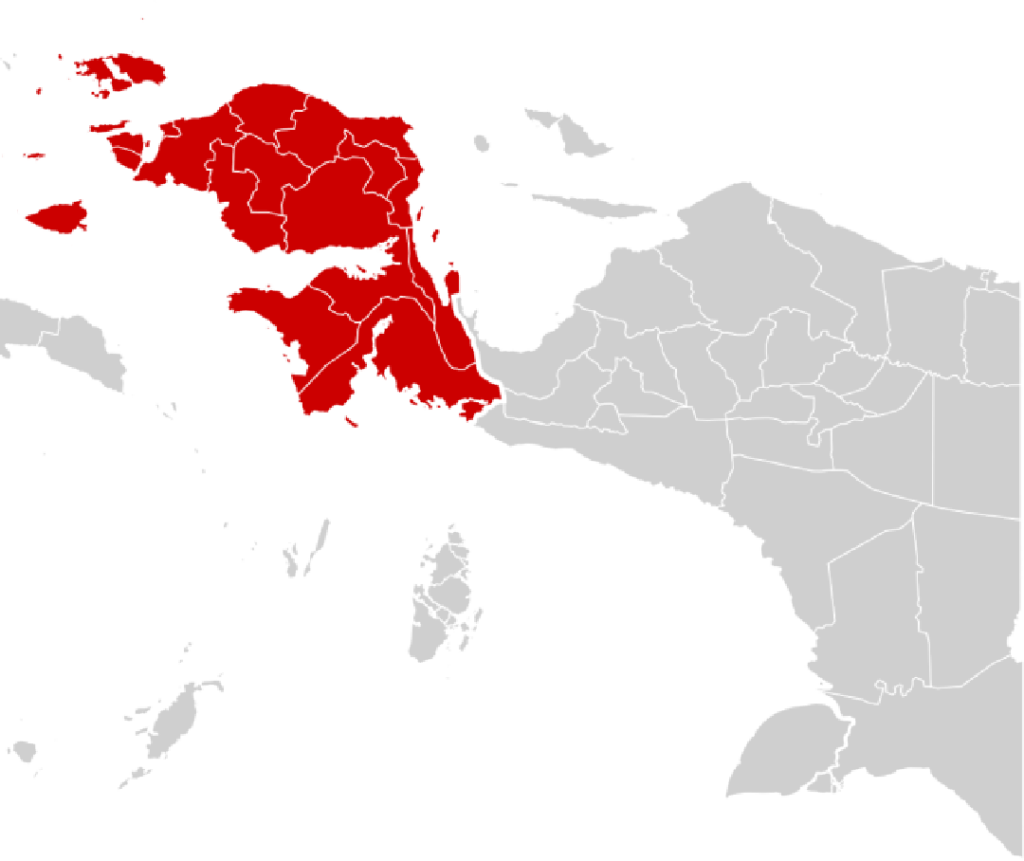
Papua has a special geopolitical position, as it is located on the eastern frontier of Indonesia.
Papua New Guinea shares a long land border with the province and its proximity to the wider Pacific region presents opportunities for expanding regional connectivity, commerce and people to people exchanges.
More and more, Papua is being seen by government officials not just as a border province, but as Indonesia’s gateway to the Pacific, where regulated and mutually beneficial cooperation can sustain more robust economic relations with neighboring countries.
Governor Fakhiri has argued that this strategic location should be used more effectively to develop more regional economic activity and generate more revenue for Papua.
Cross border trade through official channels could help local businesses, promote investment, generate jobs and facilitate economic integration between neighbouring communities.
Economists say border regions can become engines of regional growth if backed by efficient customs procedures, reliable infrastructure, modern immigration services and transparent regulatory systems.
For Papua, bolstering these institutional foundations could enhance its role as an important economic bridge between Indonesia and the Pacific.
Immigration Capacity Supports Economic Growth
The Papua Provincial Government’s main proposal is to improve institutional capacity in border areas through more robust cooperation with the Ministry of Immigration and Corrections.
Provincial civil servants with relevant administrative experience could support immigration functions through closer institutional coordination, helping improve service quality while responding to increasing demands associated with cross border activities, Governor Fakhiri said.
The officials said the proposal aims to optimize existing human resources while maintaining immigration services that support legal travel, business activities and administrative processes efficiently.
Modern immigration systems do a lot more than just control passports.
They promote tourism, business travel, labor mobility, education, investment, and international cooperation, while protecting national sovereignty and enforcing immigration laws.
Specialists in development often point out that good management of immigration has a direct impact on economic competitiveness by lowering administrative barriers to legitimate cross-border activity.
Thus, further institutional capacity building in Papua could support both the delivery of public services and regional economic development.
Expanding Legal Trade With Papua New Guinea and the Pacific
Governor Fakhiri has also stressed the importance of increasing legal trade with Papua New Guinea and other Pacific nations to strengthen Papua’s economy and generate more regional revenue.
Historically, communities on international borders have had social, cultural and economic relations.
Today, government officials believe these historic ties can be preserved through well-regulated commercial activities that serve the interests of both sides of the border and are in accordance with national laws.
The opening of official trade channels would enable local agricultural products, fisheries, small manufactured goods and other commodities to access wider regional markets under transparent customs and immigration processes.
In addition, increased institutional oversight helps to distinguish legitimate commerce from illicit cross border activities, such as smuggling or illegal trade.
Trade economists have generally concluded that border areas tend to do best when governments liberalize legal economic exchange but keep a close regulatory eye on cross-border activity.
This approach is a proper balance between economic development and safeguarding national interests and complying with the relevant laws.
Increasing Regional Revenue Through Cross Border Commerce
The proposal is also expected to boost the growth of Papua’s Regional Own Source Revenue (PAD).
As with many regional governments, Papua still seeks to increase local fiscal capacity through sustainable economic development rather than relying solely on intergovernmental transfers.
Officials believe that expanding formal trading with neighboring countries could create additional economic activity that would be good for transportation providers, logistics companies, warehouses, exporters, retailers, financial services and local producers.
Regional governments may also benefit from broader economic growth through legally established taxes, service fees and business expansion as commercial activity increases.
Papua’s economic diversification is an increasing objective, with investments ongoing in infrastructure, agriculture, fisheries, tourism, education and public services.
Strengthening international trade relations with the neighbouring Pacific markets could thus complement these broader development initiatives by increasing Papua’s role in the regional economy of eastern Indonesia.
Modern Border Management Goes Beyond Security
Government officials stressed that an increase in immigration cooperation should not be viewed purely as a security initiative.
Today, border governance is increasingly a mix of security, economic facilitation, public administration, digital services and regional cooperation in one integrated framework.
Immigration authorities play a vital role in facilitating legitimate travel, supporting tourism, processing international business visitors, protecting national sovereignty, combating transnational crime and enforcing immigration laws.
When they are supported by effective institutional coordination, these functions contribute to national security and economic development at the same time.
International experience shows that well managed borders can encourage investment, expand regional trade and strengthen public confidence, while maintaining effective law enforcement.
Papua’s proposal reflects this wider understanding of border management as the basis for sustainable regional growth.
Border Security and Economic Development Go Hand in Hand
The Papua Provincial Government’s proposal is a sign of the increasing international awareness that good border management is not only about protecting sovereignty. Modern border governance also promotes economic growth by facilitating legitimate trade, investment, tourism and movement of people through transparent and efficient administrative systems.
For Papua, which shares one of Indonesia’s longest international land borders with Papua New Guinea (PNG), better immigration services has economic as well as security implications.
Efficient immigration administration enables businesses, traders, students, tourists and cross border communities to travel through official channels while allowing authorities to monitor movements in line with national laws.
Simultaneously, increased institutional capacity improves the government’s capacity to prevent transnational crimes including illegal immigration, human trafficking, document fraud, narcotics trafficking, weapons smuggling, and other cross border criminal activities.
Security analysts often claim that well managed borders promote legitimate economic activity and reduce opportunities for illegal networks to exploit administrative weaknesses.
Rather than seeing economic development and border security as competing priorities, Papua’s proposal recognizes that both can be achieved at the same time through stronger institutions and more interagency collaboration.
Expanding Papua’s Economic Role in the Pacific Region
Governor Mathius D. Fakhiri has repeatedly emphasized Papua’s strategic location as an important asset in developing Indonesia’s relations with the Pacific region.
Papua occupies a unique geographical position, connecting Indonesia with Papua New Guinea and the wider Pacific, which creates opportunities for greater regional cooperation in trade, logistics, transportation, fisheries, tourism, education, and investment.
Officials believe that boosting formal commercial exchanges with neighbouring Pacific economies could help build stronger regional integration and create further economic opportunities for local communities.
Cross border trade has been an important livelihood among communities living along the Indonesia PNG frontier.
The provincial government hopes to encourage more economic activities to be conducted through official channels by improving institutional support, simplifying administrative procedures and strengthening immigration services.
Trade experts say border economies tend to thrive when governments pair up effective customs processes, dependable transport infrastructure, transparent regulations, and professional immigration services.
These factors increase investor confidence and reduce transaction costs for legitimate businesses.
For Papua, deepening economic cooperation with neighbors in the Pacific market also complements Indonesia’s broader policy of deepening engagement with Pacific island countries through mutually beneficial economic partnerships.
Building Modern Border Governance
One of the most prominent features of the Governor Fakhiri’s proposal is his suggestion to optimize human resources between Papua Provincial Government and Ministry of Immigration and Corrections to strengthen the institutional cooperation.
“The border provinces typically need extra administrative capacity because of their special operational responsibilities,” the proposal states.
The modern immigration services are much more than just issuing passports or border checks.
Immigration institutions are increasingly supportive of digital documentation systems, international mobility, investment facilitation, visa administration, international education, labor mobility, humanitarian coordination, and border management.
Therefore, building human resource capacity directly contributes to the improvement of the quality of public services and to the achievement of wider national development objectives.
Governance experts often note that good institutions are still among the most important pillars for sustainable economic development.
Open procedures, competent personnel, digital public services and proper coordination between government agencies increase public confidence and enhance administrative efficiency.
Working more closely with the Ministry of Immigration and Corrections could help support these goals for Papua, while also strengthening service delivery in one of Indonesia’s most strategically important border regions.
Integrated Development Strengthens Border Communities
The proposal is also in line with Indonesia’s broader approach to developing the border areas through integrated infrastructure, public services and economic empowerment.
National and provincial governments have made investments in recent years in transportation infrastructure, cross border facilities, telecommunications, education, healthcare and agricultural development across Papua.
Investing in immigration services to build institutional capacity alongside physical infrastructure is a natural complement to such investments.
Border development specialists often cite the success of communities located near international borders where infrastructure, public administration, economic opportunities and security are developed in tandem.
Roads, border posts, ports, digital connectivity, customs services and immigration facilities function best when they are part of a coordinated regional development strategy.
Papua’s proposal reflects this increasingly comprehensive strategy, recognising that modern border regions should not only act as security buffers but also as gateways to legitimate trade, regional cooperation and inclusive economic growth.
Looking Ahead
The Papua Provincial Government and the Ministry of Immigration and Corrections are expected to continue discussions as the two institutions consider opportunities for improving border governance and fostering regional economic development. If implemented through appropriate regulatory mechanisms and institutional coordination, the proposed collaboration could improve immigration services, facilitate legal cross border trade, strengthen administrative capacity and contribute to higher regional revenue. Officials also say better border management will back up Indonesia’s long-term plans to turn Papua into a key economic gateway linking the country with Papua New Guinea and the wider Pacific region.
Conclusion
The Papua Provincial Government’s proposal to strengthen cooperation with the Ministry of Immigration and Corrections signals a forward looking approach to border governance that brings together economic development, public administration and national security. The initiative is to maximise Papua’s strategic geographic position while improving public services and increasing regional own source revenue through enhancing immigration capacity, promoting legal trade with Papua New Guinea and neighbouring Pacific countries and expanding opportunities for regional economic growth. With transparent governance, good coordination between institutions, and continued investment in border infrastructure, the proposal has the potential to enhance Papua’s role as Indonesia’s eastern gateway to the Pacific, while contributing to sustainable and inclusive regional development.