
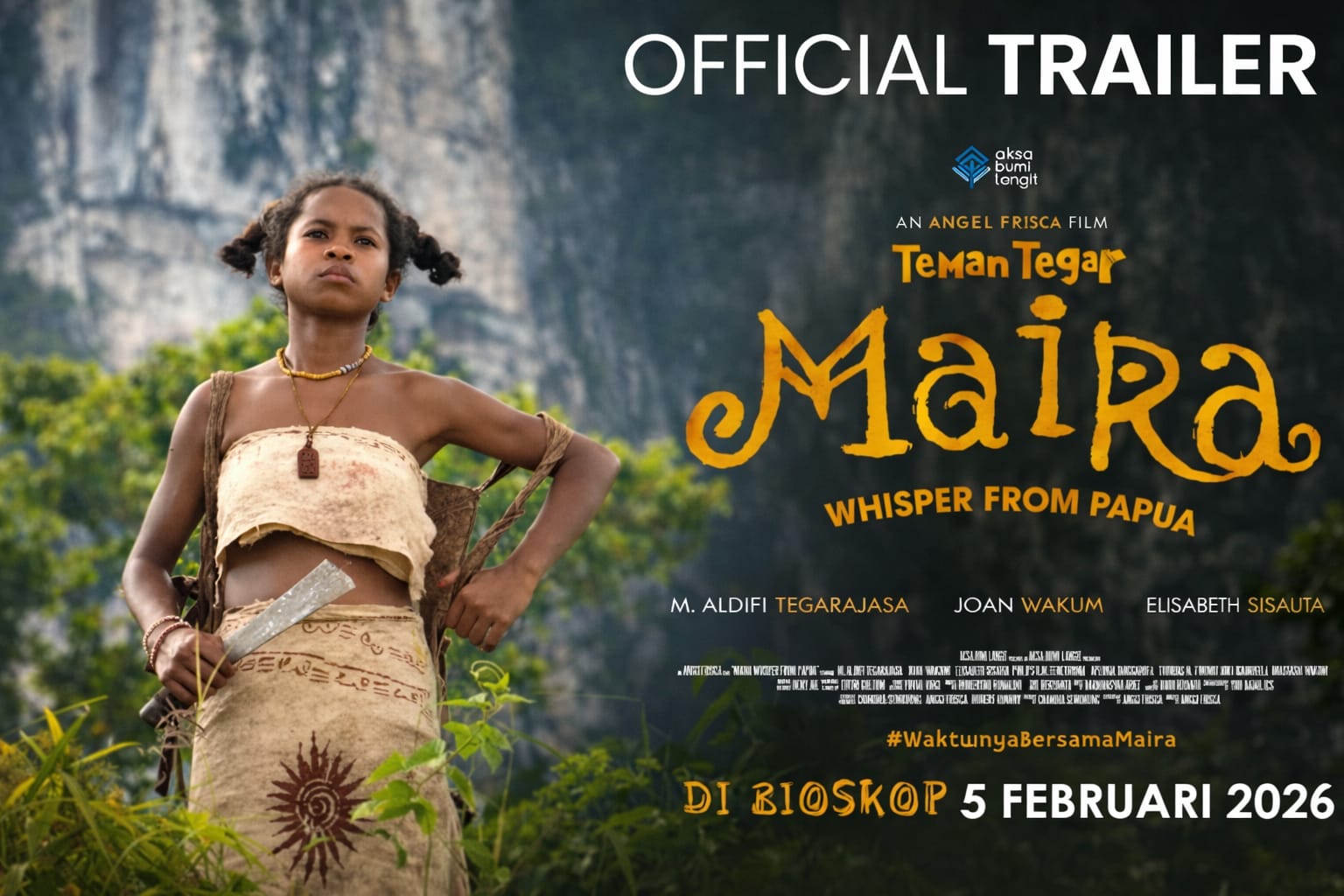
An Indonesian children’s film rooted in Papua’s forests and cultural traditions is preparing to reach a wider international audience after winning the Global Peace and Friendship award at the 2026 Universal Kids Film Festival. Teman Tegar: Maira: Whisper from Papua, directed by Anggi Frisca and produced by PT Aksa Bumi Langit, received the award announced on October 12, 2026. Its next scheduled stop is Europe, where screenings are planned in Belgium and Luxembourg from November 2 to 7.
The recognition gives the film an opportunity to introduce international audiences to Papua through the experiences of its young characters, rather than relying solely on images of mountains, forests, and wildlife. At the heart of the story is the relationship between children and the natural environment, alongside the knowledge, identity, and livelihoods of Indigenous communities who live closely with the forest.
The film aims to do more than entertain Frisca. It invites young audiences to consider how environmental change affects people, why local knowledge matters, and why children should have a voice in conversations about their future.
The award also adds to the international visibility of Indonesian children’s cinema. As the film prepares for European screenings, its journey illustrates how stories rooted in a particular place can open conversations about friendship, cultural diversity, peace, and environmental responsibility across national boundaries.
From Papua’s Forests to an International Audience
A Story Told Through the Friendship of Two Children
Teman Tegar: Maira: Whisper from Papua centres on the friendship between Tegar, an 11-year-old boy from the city who has a physical disability, and Maira, a courageous 12-year-old girl from an Indigenous community in Papua. Their journey begins with Tegar’s curiosity about the bird of paradise, a species closely associated with Papua’s rich natural heritage, before developing into a story about protecting the forest and the lives connected to it.
Maira lives in a forest environment that is central to her community’s daily life. Tegar arrives with a different background and a desire to explore the landscape his grandfather once described. Their friendship brings these different experiences together and allows the audience to discover Papua through the eyes of children.
The film’s central conflict concerns the threat to the forest from people seeking to control it for their own interests. As the story unfolds, the children encounter questions about belonging, responsibility, and the future of the environment that sustains the community.
The forest is therefore more than a scenic backdrop. It is presented as a source of food, medicine, knowledge, and cultural identity. Its condition impacts wildlife, plants, and the lives and futures of those who rely on it.
This approach gives the environmental message a human dimension. Instead of presenting forest conservation as an abstract subject, the film connects it to friendship, family, everyday experience, and the concerns of children who want to protect a place they love.
Why the Perspective of Children Matters
Children’s films can introduce difficult subjects through experiences that young audiences understand. Friendship, fear, curiosity, and the desire to protect something important can create an accessible starting point for discussing wider questions about environmental change and cultural respect.
Frisca believes cinema can help children ask questions about the people who live in a particular place, the changes affecting their environment, and whether their voices are being heard.
“Films cannot explain the entire history and pressures faced by Indigenous communities. But they can foster empathy and raise questions: who lives there, what is happening to them, and are their voices being heard?” Frisca said, according to a statement published by Jubi.
The director’s approach recognizes both the possibilities and the limits of storytelling. A feature film cannot represent every experience across Papua, whose communities have different histories, languages, and traditions. It can, however, encourage audiences to listen more carefully and seek a more profound understanding beyond what appears on screen.
For international viewers, the film provides an entry point into a conversation about the relationship between environmental sustainability and the rights, knowledge, and aspirations of the people who live in forest areas.
Anggi Frisca’s Vision: “The Forest Is a Mother”
Connecting Environmental Protection with Everyday Life
Frisca’s phrase, “The forest is a mother,” encapsulates one of the film’s central ideas. The image describes a relationship of mutual care: the forest sustains human life, while the people who depend on it have a responsibility to protect it.
The film’s main idea is that “the forest is a mother.” The film portrays a relationship of mutual care and responsibility. Frisca stated, “The damage to the forest also threatens the lives, knowledge, and future of children growing up with it.”
The statement reflects the film’s effort to connect environmental concerns with the continuity of community life. Forest loss can affect access to food and traditional materials, disrupt familiar landscapes, and weaken opportunities to pass knowledge from one generation to another.
The film also highlights the importance of local knowledge. Indigenous communities may develop knowledge of plants, wildlife, seasonal changes, and resource management through generations of experience. Such knowledge is not identical across communities, and Frisca emphasizes that it should not be treated as a single, uniform tradition.
Respecting local knowledge means listening to the people who hold it and recognizing their role in decisions affecting their surroundings. The film uses Maira’s character to show that children learn not only in classrooms but also through their families, their environment, and daily interactions with their community.
That message is particularly relevant to young audiences who may encounter environmental issues primarily through news reports or classroom materials. Through Maira’s experiences, the film seeks to make the relationship between nature and human life more immediate.
Showing Papua as a Place Where People Live and Shape Their Future
The film’s creators have also sought to portray Papua through its people, rather than presenting the region only as a landscape to be admired.
Frisca said she hopes audiences will remember Maira’s voice and struggle, not merely the scenery. She described the film as one way of getting to know Papua, rather than a complete representation of the region’s diverse communities and experiences.
That distinction is relevant for an international audience. Papua is often discussed through broad descriptions of its natural resources or geography, yet its cultural life is shaped by communities with their knowledge, aspirations, and relationships with the land.
By giving Maira agency within the story, the film invites viewers to consider her as a character with her ideas, relationships, and ambitions. Her role is not simply to guide Tegar through an unfamiliar landscape but to express a perspective formed by the place where she lives.
The film’s production also involved local creative talent. Jubi reported in January that approximately 60 percent of the production crew were local people, while the story’s setting and performances drew on the region’s landscapes and cultural context.
Local participation can create opportunities for regional artists and technicians to gain experience in the film industry. It also helps connect a production’s creative process with the place and communities it seeks to portray.
The Film’s Journey Before the International Award
From Indonesian Cinema to Festival Recognition
The international recognition follows the film’s earlier release journey in Indonesia. In January 2026, Jubi reported that Teman Tegar: Maira: Whisper from Papua was scheduled to open in cinemas across Indonesia on February 5, 2026. The film had also been introduced to audiences in Papua through screenings in Jayapura and Sorong.
These screenings created opportunities for local audiences to encounter a story that uses Papua as more than a geographical setting. The film’s themes include cultural knowledge, forest conservation, and the importance of making room for Papuan children to express themselves through the arts.
The production is directed by Anggi Frisca under PT Aksa Bumi Langit. It develops the earlier Tegar story, which focused on inclusion, by shifting attention to the relationship between children, Indigenous communities, and the environment.
The Global Peace and Friendship Award was announced on October 12 at the Universal Kids Film Festival 2026. The award provides international recognition for the film’s themes of friendship, peace, and respect for different communities.
The recognition is an achievement for the film’s creative team, but its broader impact will depend on whether the award leads to additional screenings, discussions, and opportunities for Indonesian and Papuan stories to reach new audiences.
European Screenings Scheduled for November
Belgium: A New Audience for the Story
Following the festival award “Teman Tegar: Maira: Whisper from Papua” is scheduled to have its European premiere at Tegar: Maira: Whisper from Papua through the International Film Festival for Young Audiences. The film has also been selected in the CIFEJ Award feature-film category. The announced schedule includes a screening in Ghent and at Bozar in Brussels on November 3.
The program also includes a screening of Tegar at Cinema Flagey in Brussels on November 2, arranged through the Embassy of the Republic of Indonesia. This provides an additional opportunity to introduce European viewers to the earlier film and the wider creative project.
Festival screenings can create a different viewing experience from a conventional cinema release. They bring films into a setting where young audiences, educators, filmmakers, and families may discuss the themes and ideas presented on screen.
For a film dealing with environmental protection and Indigenous knowledge, such conversations can help connect the story to questions that extend beyond Papua. Young viewers may compare the film’s themes with their experiences of nature, community, and responsibility.
The festival setting also gives the Indonesian production an opportunity to engage with international children’s cinema and demonstrate how stories rooted in local cultures can contribute to global discussions.
Luxembourg: Continuing the European Programme
The film is scheduled to screen at Utopia Cinema in Luxembourg on November 7, completing the announced European program running from November 2 to 7.
The screenings in Belgium and Luxembourg will bring the story of Tegar and Maira to audiences outside Indonesia and create opportunities for discussion about friendship, environmental sustainability, and cultural diversity.
The European program should be understood as a series of scheduled screenings, rather than evidence that the film has already completed its international run. As of October 21, 2026, the dates remain in the future.
The next stage will be to see how audiences respond and whether the film generates opportunities for further festival participation, educational screenings, or partnerships. Any such developments would extend the film’s reach beyond the award itself.
Cinema as a Bridge Between Cultures
Encouraging Dialogue in Schools and Communities
Frisca hopes the film can become a starting point for conversations in schools, families, and communities. She sees children’s cinema as a way to build empathy through familiar emotional experiences, while encouraging viewers to think more deeply about environmental change and the lives of people affected by it.
This educational potential is particularly relevant because children often form their understanding of unfamiliar places through stories, images, and personal encounters. A film can prompt questions that extend into classroom discussion, reading, and further exploration.
Teachers could use the story to discuss biodiversity, Indigenous knowledge, the importance of forests, and the ways communities depend on natural environments. Families could use it to talk about friendship, inclusion, and respect for cultural differences.
Such uses would not require the film to provide a complete account of Papua’s history or environmental challenges. Its value may instead lie in prompting curiosity and encouraging audiences to seek additional perspectives.
The director has also stressed that children should have a meaningful place in discussions about their future. “Their future needs to be discussed together with them,” she said.
That principle connects the film’s message of friendship with a broader idea of participation: children are not merely the future beneficiaries of decisions made by adults. Their experiences, questions, and aspirations also deserve to be heard.
Conclusion
The Global Peace and Friendship award for Teman Tegar: Maira: Whisper from Papua marks an important milestone for the Indonesian children’s film and its creative team. Directed by Anggi Frisca and produced by PT Aksa Bumi Langit, the film uses the friendship of Tegar and Maira to explore the connections between forest conservation, Indigenous knowledge, cultural identity, and the future of young people.
Its planned screenings in Belgium and Luxembourg from November 2 to 7 offer an opportunity to bring these themes to European audiences. The selection for the CIFEJ Award feature-film category and the European premiere through Filem’On add further international platforms for the production.
The award does not, by itself, resolve the environmental challenges or questions of cultural representation that the film raises. Nor can a single film capture the full diversity of Papua. Its contribution is more specific: it offers a human story that may encourage viewers to listen, learn, and consider how environmental change affects communities and children.
For Indonesia’s film industry, the journey demonstrates how locally grounded stories can travel internationally when they connect particular experiences with themes that audiences across cultures can understand. For Papua, it creates a platform for a young character whose knowledge, courage, and aspirations are central to the narrative.
The next measure of success will be the conversations that follow the screenings, the opportunities created for local creative talent, and the continued space available for Papuan stories to be told by people who know the communities they portray. If the film encourages audiences to remember Maira’s voice as well as the forest around her, its international journey will have achieved more than a festival accolade.
Read Also
Nabire Hosts Papua Reggae Festival and MURI Milestone
Papua Tengah Celebrates Alda Callista’s Win at Miss Indonesia 2026

