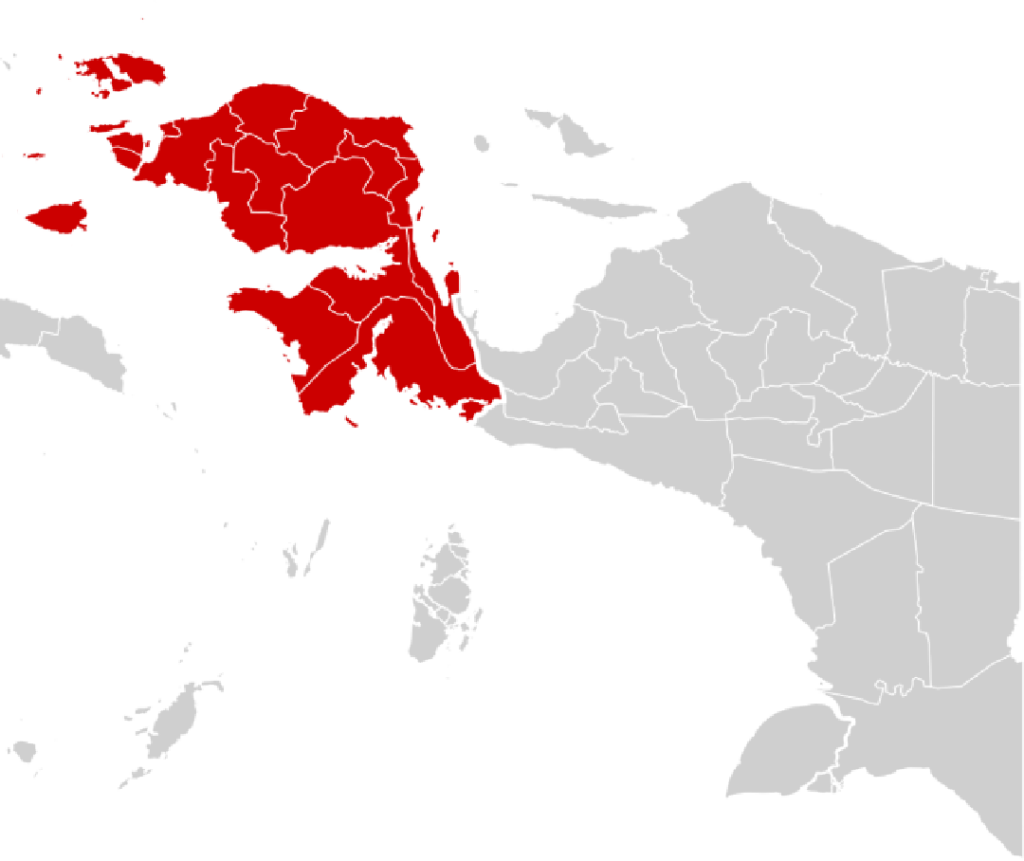
From the south of Papua, where there are vast stretches of flat land and rivers that flow into the Arafura Sea, Indonesia’s ambitious food estate project is slowly taking form.
To supporters, the development is more than an agricultural investment. It is being hailed as a long-term strategy to boost national food security while creating new economic opportunities in one of Indonesia’s easternmost provinces.
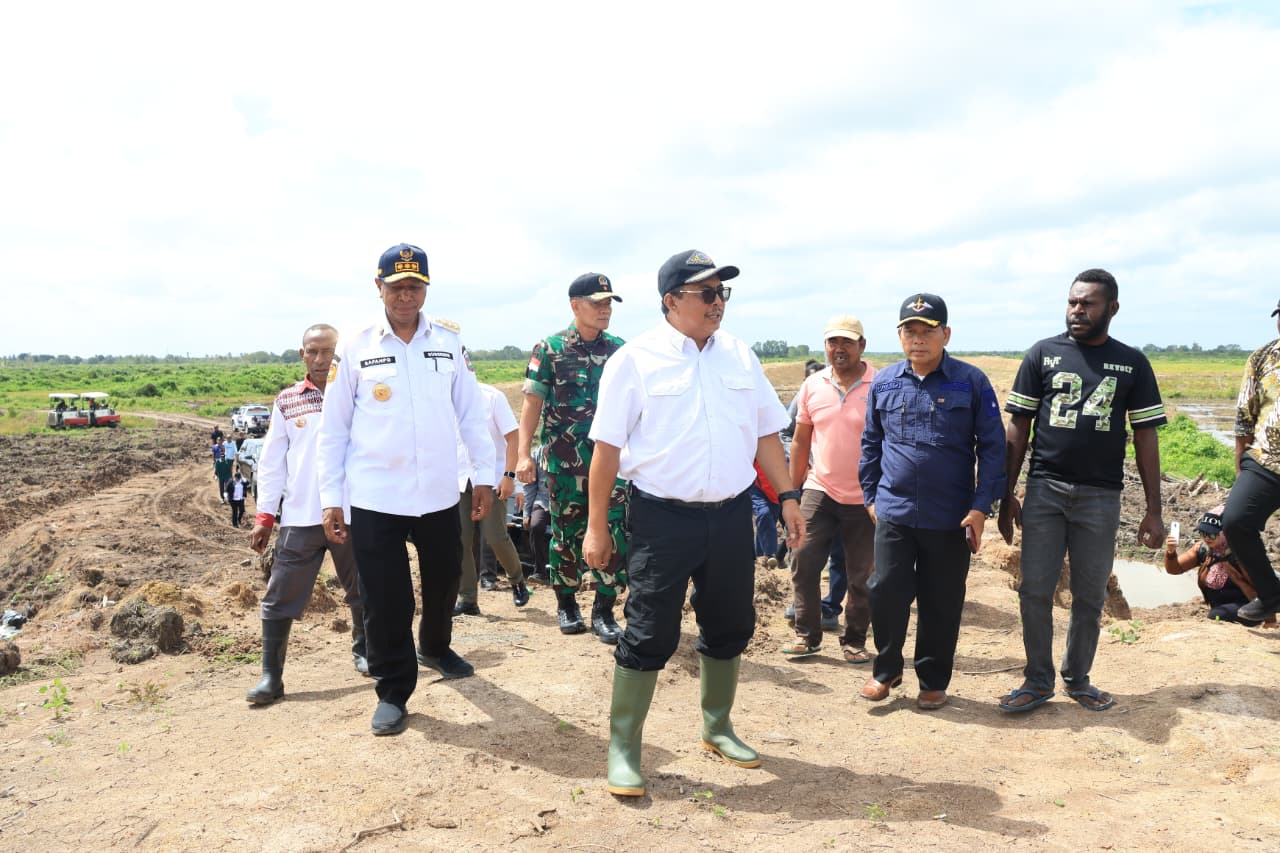
Papua Selatan (South Papua) Governor Apolo Safanpo echoed this message this week, saying the National Strategic Project (PSN) in Wanam District, Merauke Regency, is an instrument to improve community welfare, expand employment opportunities, and accelerate regional economic growth.
Safanpo dismissed claims that the project would threaten Indigenous communities, speaking June 10. Instead, he said the large-scale agricultural and energy development project should be considered an opportunity for local residents, especially the Indigenous Papuans or those known as Orang Asli Papua (OAP), to be part of a growing economic sector.” “The project is meant to improve people’s welfare,” Safanpo was quoted as saying by several Indonesian media outlets. Its presence should bring economic benefits and create job opportunities for the local community.
The governor’s remarks coincide with ongoing construction and land development in parts of Merauke, an area increasingly considered by policymakers to be one of Indonesia’s most strategic agricultural regions because of its vast land resources and relatively low population density.
The discussion around the Wanam project has gained interest not only in Papua but also at the national level as Indonesia seeks to attain food resilience in the face of increasing climate uncertainty, global supply chain disruption, and concern over future food availability.
Why Wanam Has Become Central to Indonesia’s Food Security Plans
The Wanam area enjoys a unique position in the long-term development planning of Indonesia.
The area, in Papua Selatan Province, has large land resources that policymakers believe can support large-scale agricultural production. Recently, the attention of the central government has increasingly focused on Merauke as a potential food production center capable of meeting the country’s food needs.
The project is part of a wider effort to mitigate vulnerability to global food shocks, officials say.
Recent climate disruptions, including concerns about a return to El Niño conditions, have increased awareness of the need to maintain stable domestic food supplies.
In this regard, we have increasingly highlighted the agricultural potential of Papua Selatan.
This is not just a project to grow more rice or corn for Jakarta. The project also links to wider objectives in food security, energy resilience, logistics, and regional development.
A Strategic Region for Agriculture and Energy
Officials say the project merged food production and energy development, creating a more integrated economic ecosystem, said Governor Safanpo.
This approach reflects the shifting priorities of the national development policy.
Planners are shifting focus away from a single commodity to try to link agriculture to downstream industries, energy infrastructure, transportation networks, and workforce development.
Supporters feel that this model could have wider economic benefits for local communities through creating multiple sources of employment rather than relying solely on farming activities.
Employment Opportunities Become a Key Selling Point
The creation of jobs is one of the most persuasive arguments put forward by provincial authorities.
Government officials expect the Wanam project to provide work for thousands of people as it is developed and operated.
National media quoted reports that say employment absorption can reach about 15 thousand workers by 2027.
The figure has become a key part of the government’s public messaging for a province that still struggles with development challenges and a lack of private-sector jobs in some areas.
The project should give local residents a real chance to take part in economic activity and not just watch it, Safanpo said.
That is a point that has become more important as many Papuans have always asked for development programs that directly improve the livelihood of the community.
Opportunities for Indigenous Papuans
The provincial authorities have repeatedly stressed that the Indigenous Papuans should be active participants in the project.
Safarpo argues that economic development should ultimately benefit local communities by providing jobs, business opportunities, skills training, and higher income.
The success of such implementation will depend a lot on ensuring meaningful local participation, observers say.
Big projects often involve a close examination of how local communities share the benefits. Therefore, commitments to local employment have evolved into an important indicator by which residents measure development initiatives.
Government officials say the food estate can be an incubator for workforce development, providing experience in agriculture, logistics, processing industries, and related sectors.
The Wanam Project Serves as a Catalyst for Regional Growth
The Wanam project could affect more than just food production.
Economists often observe that large investments in agriculture create secondary economic activity in the form of transportation services, equipment supply, housing, retail trade, and supporting industries.
The provincial government believes the project could act as a catalyst for wider economic transformation in Merauke.
We also expect demand for roads, storage facilities, distribution networks, and local services to grow as production grows.
It’s this multiplier effect that has provincial leaders still supporting the initiative even as the public debate over how to implement it rages on.
Supporting Local Business Development
Small and medium enterprises may also benefit if the economic activity in the project area expands.
Local entrepreneurs could be involved through food supply chains, transport services, accommodation, equipment servicing, and retail.
For many communities, these indirect opportunities can at times produce just as significant benefits as direct employment.
Analysts say the challenge will be ensuring local businesses have the capacity and access to participate in emerging economic opportunities.
Food Security in an Era of Climate Uncertainty
The governor’s backing for the project comes at a time when climate concerns are playing a larger part in development planning across the Pacific region.
Meteorological agencies have warned of the potential impact of El Niño conditions on rainfall patterns in parts of Papua and neighboring countries.
International organizations also cited the vulnerability of several Pacific nations to food insecurity from climate variability.
Indonesia is presenting its drive to increase domestic agricultural production as an economic initiative but also as a resilience strategy in that context.
The government has recently talked a lot about the need to keep reliable supplies of food in the face of unpredictable weather patterns and fluctuations in world market conditions.
For policymakers, projects like Wanam are part of a longer-term response to those challenges.
Balancing Development and Community Expectations
Provincial leaders admit that even with official support, big projects will raise questions from local communities.
Environmental management, land use, and community participation are still relevant topics for public discussion.
Safanpo emphasizes that dialogue and transparent implementation, rather than misinformation, should resolve these issues.
“The primary objective of the project is to improve welfare and at the same time create sustainable economic opportunities for the population,” he says.
But ultimately, the results on the ground will determine the success of that objective.
Residents will judge the project’s success by whether the promised jobs come to fruition, local businesses are provided opportunities, and economic benefits are distributed to nearby communities.
Development is a Long-Term Process
Guangnan officials emphasize that the Wanam project represents a long-term initiative rather than a short-term intervention.
To drive agriculture development at this scale, you need infrastructure, a prepared workforce, investment, and coordination among a host of stakeholders.”
Therefore, we expect the economic impacts to gradually unfold over several years.
It’s a reality that signals the need for ongoing implementation and continued engagement with local communities.
Conclusion
The support of Papua Selatan Governor Apolo Safanpo for the Wanam food estate is a reflection of the belief that large-scale agricultural development can be a driver of economic growth, food security, and employment creation.
Local leaders see the plan as a way to boost local welfare and help Indonesia’s wider goal of resilience for food and energy. They project that the Wanam food estate project could create around 15,000 jobs by 2027.
With further development, the long-term success of the project will probably depend on how well economic benefits are turned into real opportunities for Indigenous Papuans and local communities in Papua Selatan.