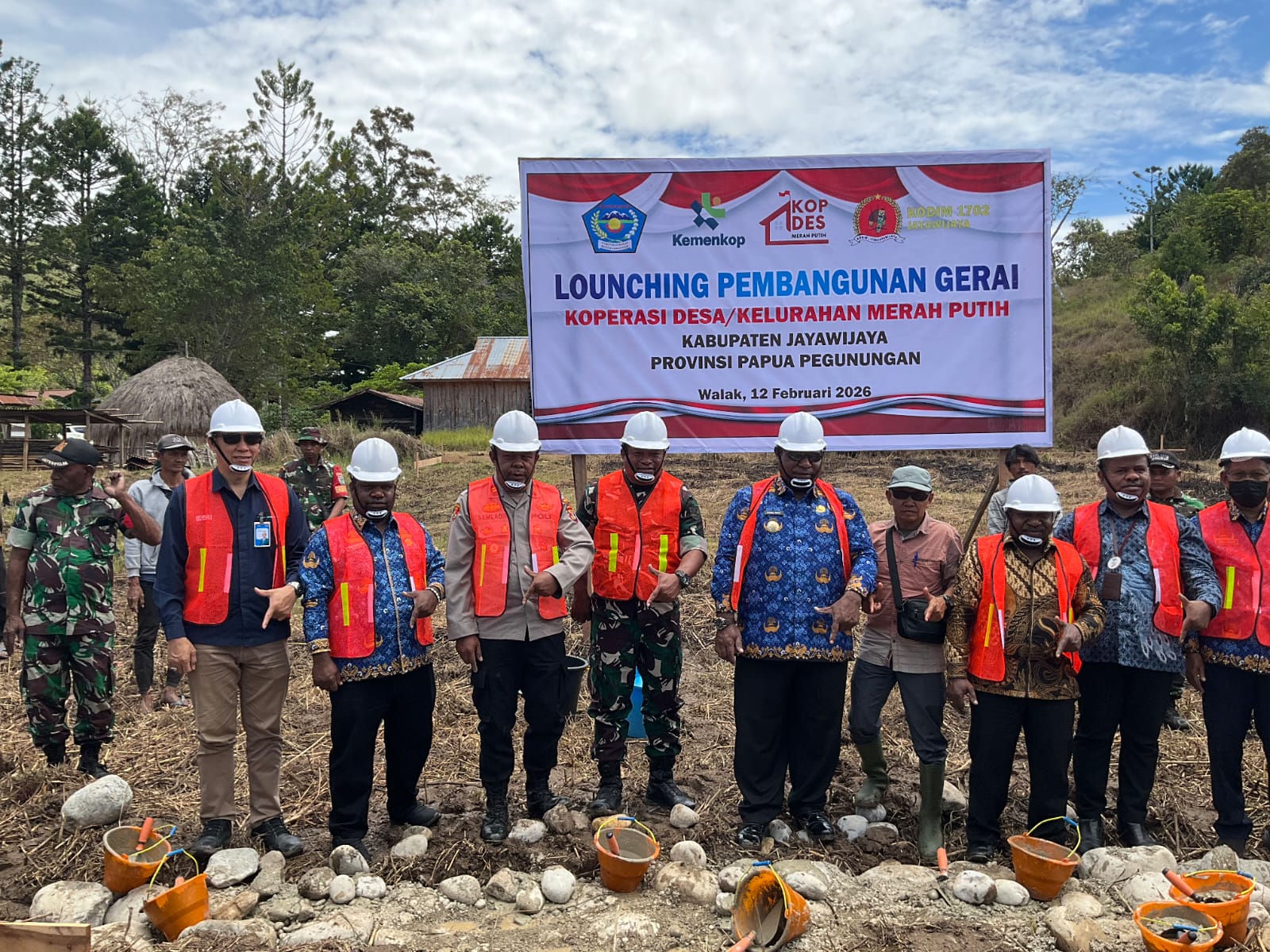
The Papua Pegunungan Provincial Government is intensifying the expansion of Papua Pegunungan cooperatives by encouraging the rapid establishment of 18 Red and White Village Cooperative (KDMP) outlets in Jayawijaya Regency, which is an important step towards the long-term target of the province to develop more than 1,000 community cooperatives across the region.
Provincial officials see the initiative as a strategic investment in grassroots economic development, aimed at strengthening village-based enterprises, improving access to essential goods and services, and opening up greater market opportunities for Indigenous Papuan communities.
The cooperatives are expected to develop from retail outlets to community economic centres that connect farmers, small businesses, artisans and local producers to larger regional markets and support more efficient distribution systems.
For Papua Pegunungan, where many of the communities are in mountainous and geographically isolated areas, strengthening local economic institutions is considered an important foundation for sustainable and inclusive development.
The programme is also a reflection of Indonesia’s broader commitment to promote cooperative-based economic growth while ensuring that development reaches remote communities throughout Papua.
Jayawijaya Takes the Lead
The first phase of implementation will be focused on Jayawijaya Regency, the main administrative and commercial centre of Papua Pegunungan.
The local government has designated 18 strategic points as the initial network of outlets for the Red and White Village Cooperative, which will be a system that can serve the nearby villages.
Provincial officials said Jayawijaya is among the early areas of implementation because of its central role in regional trade, transportation and public services.
The regency’s position allows cooperative networks established there to support wider economic activity across neighbouring districts and serve as a model for future expansion throughout Papua Pegunungan.
Officials said preparations require close coordination between the provincial government, Jayawijaya Regency administration, village administrations, cooperative institutions and community organisations.
The model is designed to enable each cooperative to respond to local economic conditions but also remain financially viable over the long term.
By involving local communities in the planning process, the authorities hope the cooperatives will grow according to actual village needs and not according to a uniform administrative model.
Cooperatives as Engines of Inclusive Economic Growth
Cooperatives are one of the most effective instruments for inclusive economic development, especially in rural areas where access to financial services and commercial markets can still be limited,” government officials say.
Cooperatives are different from conventional businesses that are driven mostly by private ownership. Cooperatives adhere to the principles of collective participation, shared benefits, and community-based decision-making.
Membership in cooperatives enables farmers, traders, artisans, livestock producers and micro-entrepreneurs to strengthen their bargaining position and cut operational costs through collective buying and marketing.
Officials expect the new cooperative outlets will give communities easier access to basic consumer goods, agricultural inputs, financial services and marketing channels for locally produced commodities.
The initiative also aims to shorten supply chains that often lead to higher prices in remote highland communities.
Better distribution systems could also help stabilise prices and make important household items more accessible to village residents.
Stronger village cooperatives, economic planners say, can gradually stimulate broader economic activity by fostering local production, raising household incomes, and expanding job opportunities in rural communities.
Supporting Indigenous Entrepreneurship
The programme’s main objectives are to empower the Indigenous entrepreneurship across Papua Pegunungan.
Agriculture, horticulture, livestock, handicrafts and small-scale trading are the main sources of income for many Indigenous Papuan families.
Local businesses are often less profitable because of poor transport infrastructure, fragmented markets and high logistics costs.
The provincial government feels that building stronger cooperative institutions will give local producers better opportunities to sell coffee, vegetables, sweet potatoes, fruits, traditional crafts, woven products, livestock and other village commodities.
Officials also expect that cooperatives will spur greater participation by women entrepreneurs and youth eager to start small businesses in their communities.
Village cooperatives can also offer training, financial literacy programmes, business management assistance, and market information to enhance the competitiveness of entrepreneurs.
Longer-term, such initiatives are expected to enhance local business ecosystems and reduce reliance on external suppliers.
Strengthening Village-Based Economic Institutions
The heads of the provinces emphasise that the development of the regions can only be successful with strong local institutions that can take care of the economy on their own.
Village cooperatives are thus more than commercial organisations.
They are community institutions that promote cooperation, mutual assistance and shared responsibility for local development.
Cooperatives have long been an important part of many rural areas of Indonesia, helping to raise farm output, assist small businesses, and increase the availability of low-cost consumer goods.
Papua Pegunungan aims to adapt these principles, taking into account the unique geographic, cultural and socio-economic conditions found throughout the province.
Officials admit the difficult terrain creates logistical problems, unlike in many other parts of Indonesia.
Therefore, cooperative development will require more investments in transport infrastructure, digital connectivity, agricultural support services and human resource development to enable the local economic institutions to function effectively.
Improving Rural Market Access
Provincial leaders stress that for regional development to be successful, strong local institutions are needed to independently manage economic activities.
Village cooperatives are thus more than just commercial organisations.
They operate as community institutions that foster cooperation, mutual aid and a shared sense of responsibility for local development.
In many rural areas across Indonesia, cooperatives have played a role in enhancing agricultural productivity, assisting small enterprises, and increasing access to affordable consumer goods.
Papua Pegunungan is aiming to adapt these principles with a focus on the unique geographical, cultural and socio-economic conditions across the province.
Officials admit mountainous terrain poses logistical challenges not found in many other parts of Indonesia.
Therefore, cooperative development will be accompanied by wider investments in transport infrastructure, digital connectivity, agricultural support services and human resource development to ensure that local economic institutions can operate effectively.
Building More Than 1,000 Cooperatives Across Papua Pegunungan
The opening of 18 Red and White Village Cooperative outlets in Jayawijaya is only a first step in a much broader provincial strategy. The Papua Pegunungan Provincial Government has ambitions to establish more than 1,000 cooperatives throughout the province, creating an extensive community-based economic network that can reach villages across the province.
The expansion of the cooperative movement will help to narrow economic gaps between the city and remote highland areas, giving the latter equal access to markets, business opportunities and basic services, officials say.
The programme is not about concentrating economic activity in big towns but about stimulating economic growth right in villages so that villagers can be more active in regional development without having to leave their homes.
Provincial leaders have stressed that each district has a different economic potential. The highland areas produce coffee, sweet potatoes, vegetables, fruits and livestock. Local artisans continue to preserve traditional crafts that can generate additional income with the support of stronger marketing systems.
The hope is that through a large cooperative network, these local strengths can be transformed into sustainable economic opportunities for the Indigenous communities of Papua Pegunungan, the authorities said.
The long-term vision is also aligned with Indonesia’s broader rural development agenda, which places village institutions at the core of economic transformation through enhanced community participation and local ownership.
Strong Local Economies Strengthen Regional Development
Economists often observe that resilient regional economies usually start with strong local institutions.
Village cooperatives can be an important part of raising household purchasing power, building business confidence and stimulating investment at the community level.
For Papua Pegunungan, strengthening village economies is particularly important given the relatively high transportation expenses and geographic isolation of many communities.
Cooperatives can help to reduce the price of basic goods and create market opportunities for agricultural producers and small businesses by shortening supply chains and improving local distribution networks.
Officials also say that stronger village economies will encourage young people to become entrepreneurs in their communities.
Enhanced availability of business services, financial literacy schemes, cooperative finance and market information can help create an enabling environment for innovation and local enterprise development.
With rising household incomes, local demand for education, health care, transport, communications and other services should also expand, with positive multiplier effects throughout the regional economy.
Development planners view this cycle as critical for building long-term economic resilience and reducing dependence on external aid.
Cooperative Development Aligns with Global Best Practices
Papua Pegunungan is a model of development that has worked in many parts of the world.
Countries like Japan, Finland, New Zealand, South Korea and Germany have demonstrated how cooperatives can strengthen rural economies via increased bargaining power for farmers, enhanced market access, support to local industries and financial inclusion.
Agricultural cooperatives have helped producers purchase equipment together, negotiate better prices, obtain financing, and improve product quality, while keeping economic enterprises under local ownership.
International development organisations have also identified cooperative institutions as effective mechanisms for fostering inclusive growth, as they integrate economic objectives with community engagement.
Instead of concentrating profits with a small group of investors, cooperative models share benefits with members while also promoting democratic decision-making and shared responsibility.
Papua Pegunungan attempts to adapt these internationally recognised principles into local conditions by emphasising community participation, Indigenous entrepreneurship and village-based economic empowerment.
They say that by blending the best practice globally with Papua’s unique cultural and geographic context, stronger and more sustainable local institutions will emerge.
Economic Empowerment Supports Social Development
In addition to income improvement, cooperative development is anticipated to create broader social progress in Papua Pegunungan.
Education, healthcare, nutrition and community welfare investments tend to be better supported on the basis of stable local economies.
Families with more stable incomes are more likely to be able to support children’s education, improve household nutrition, and participate in local development initiatives.
The provincial authorities thus see the expansion of cooperatives not just as an economic programme but as part of a larger strategy to build human capital throughout Papua Pegunungan.
The initiative adds to the ongoing investments in education, digital connectivity, agricultural modernisation, transportation infrastructure, health services and community empowerment programmes across the province.
Together, these policies are intended to promote a climate where economic opportunity and improvements in quality of life and social well-being are complementary.
Officials also anticipate that the cooperative movement will encourage collaboration among villages through mutual assistance, knowledge sharing and collective problem-solving that has long been part of Indigenous Papuan social values.
Looking Ahead
The opening of 18 Red and White Village Cooperative outlets in Jayawijaya is an important milestone in Papua Pegunungan’s broader efforts to build a resilient and inclusive rural economy. The provincial government’s long-term goal of developing more than 1,000 village cooperatives will increasingly be focused on strengthening institutional capacity, expanding business services, improving logistics, and ensuring that cooperatives remain financially sustainable. Done right, the initiative has the potential to become one of the province’s most significant community-based economic development programmes, providing new opportunities for Indigenous entrepreneurs and supporting balanced regional growth.
Conclusion
The Papua Pegunungan Provincial Government’s effort to accelerate the development of 18 Red and White Village Cooperative outlets in Jayawijaya is a strategic step to strengthen the village economy through community-based institutions. The initiative is part of an ambitious plan to set up more than 1,000 cooperatives across the province to improve market access, empower Indigenous entrepreneurs, expand employment opportunities and enhance economic resilience in remote highland communities. Papua Pegunungan is preparing the ground for more inclusive and sustainable economic growth by combining local participation with broader development investments in infrastructure, education, agriculture, and digital connectivity. The programme also reflects internationally accepted principles of cooperation, showing how locally driven institutions can contribute to long-term prosperity while maintaining the spirit of cooperation that has long been a feature of Papuan communities.