
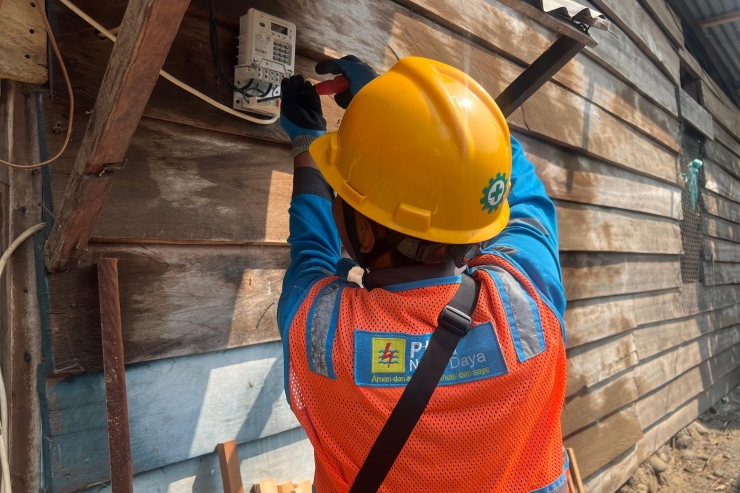
Electricity is becoming more than a basic household necessity in Papua. Reliable power capacity is increasingly essential for families using more electronic appliances, students studying through digital platforms, and small businesses looking to expand production, as it directly impacts their everyday productivity.
That changing reality was reflected in the response to the PLN Merdeka Daya programme, which attracted 1,528 customers across Tanah Papua before the promotional period ended on August 31, 2026. The figure reached 114 per cent of the target set by PT PLN (Persero) Unit Induk Wilayah Papua and Papua Barat.
The result is notable not simply because the programme exceeded its numerical target. It also offers a glimpse into the changing energy needs of households and businesses in Papua, where electricity consumption is increasingly connected to education, digital services, household equipment and small-scale economic activity.
For a region spread across large and geographically challenging areas, improvements in electricity access and capacity have implications that extend beyond individual homes. They are part of a broader development story involving connectivity, economic participation and quality of life.
A Response to Rising Demand for Electricity
PLN introduced Merdeka Daya as a special electricity capacity upgrade programme during Indonesia’s 81st Independence Anniversary period.
The programme offered a 50 percent discount on the cost of increasing electricity capacity for eligible customers. It was initially scheduled for August 17 to 25, 2026, but PLN extended the promotion until August 31 following strong customer interest. RRI reported that 1,039 customers had already used the programme by August 25, prompting the extension.
By the time the programme closed, participation had risen to 1,528 customers.
According to PLN UIW Papua and Papua Barat General Manager Roberth Rumsaur, the number represented 114 per cent of the target. He said the result demonstrated both growing demand for electricity reliability and public confidence in PLN’s services.
The programme applied to single-phase low-voltage customers with an initial capacity between 450 volts amperes, or VA, and 5,500 VA. Customers could increase their capacity to as much as 7,700 VA.
That range covers a significant portion of ordinary residential users and small businesses.
For a family that has gradually accumulated refrigerators, water pumps, computers, air conditioners or other electrical appliances, the difference between a lower and higher capacity connection can be felt every day.
Adequate electricity can determine whether a small business can operate its equipment simultaneously or whether it has to interrupt production.
Why Capacity Matters as Papua Modernises
The distinction between electricity access and electricity capacity is important.
A household may already have an electricity connection, but its existing capacity may not be sufficient for its current needs. As incomes, technology use and business activity change, electricity requirements can increase.
A family that once used electricity primarily for lighting and basic appliances may now rely on computers, internet equipment, refrigerators, freezers, washing machines and other devices.
Similarly, a home-based business may require additional power for food processing, refrigeration, printing, sewing or other productive activities.
The Merdeka Daya figures therefore provide a useful indicator of changing consumption patterns.
PLN previously reported that more than 1,039 customers in Tanah Papua had used the programme by August 25. At that point, the utility said the strong response showed demand for greater electricity capacity among residents.
The final figure of 1,528 customers suggests that demand remained strong even during the extension period.
Jayapura, Sorong and Merauke Lead Participation
Participation was distributed across PLN’s operational areas in Papua and West Papua.
The three customer service units with the highest numbers were UP3 Jayapura, with 280 customers; UP3 Sorong, with 252 customers; and UP3 Merauke, with 217 customers, according to PLN data reported by ANTARA.
The geographic spread is significant.
Jayapura is the provincial capital and one of Papua’s major administrative, educational and commercial centres. Sorong serves as an important economic and transportation gateway in the western part of the region, while Merauke is a major centre in southern Papua.
The participation from all three areas indicates that demand for higher electricity capacity is not concentrated in a single urban location.
Instead, it reflects a broader need across different economic and geographic environments.
For policymakers, the issue is an important consideration. Electricity infrastructure must keep pace not only with population growth but also with changing economic activity.
Electricity and household quality of life
For many households, the benefits of additional electricity capacity are relatively ordinary.
A refrigerator can operate alongside other appliances. A water pump can run without requiring other equipment to be switched off. A family can use computers and household appliances at the same time.
Yet these small improvements can change daily life.
A household with sufficient capacity has more flexibility in how it organises work, education and domestic activities.
Students can study using computers or other digital devices. Parents can work from home. Families can use refrigeration more effectively for food storage.
In areas where economic activity is increasingly connected to digital technology, electricity reliability also supports access to the wider digital economy.
This is why electricity development should not be measured only in terms of the number of connections.
The quality and capacity of those connections matter as well.
Supporting Papua’s Small Businesses
The economic significance of the programme extends beyond households.
PLN has specifically described Merdeka Daya as a way to support productive activities and businesses in Tanah Papua. The utility said the increasing participation reflected demand for greater capacity to support community activities and business operations.
For micro and small enterprises, electricity can be an important production input.
A small food producer may need refrigeration. A café may need additional equipment. A home-based entrepreneur may require computers, printers or production machinery. A workshop may depend on electrically powered tools.
Higher capacity does not automatically create a successful business, but it removes one potential constraint.
This matters in Papua, where strengthening local enterprises is an important part of diversifying economic activity beyond large-scale industries.
Electricity can therefore become part of a wider development chain.
Reliable power supports productive equipment. Productive equipment can increase output. Higher output can support income and employment.
The process is gradual, but infrastructure often works in precisely this way.
Digital Services Are Changing Electricity Needs
Papua’s economic landscape is also becoming increasingly digital.
Government services, education, communication, commerce and financial transactions are increasingly dependent on electronic devices and telecommunications infrastructure.
That trend creates a relationship between electricity and digital connectivity.
A strong internet connection has limited value if households or businesses cannot reliably power their routers, computers and other devices.
The same applies to schools, offices, health facilities and public service institutions.
Electricity capacity is therefore one layer of the infrastructure required for Papua’s digital transformation.
The issue is particularly relevant as national and regional governments continue to promote digital public services and greater connectivity across eastern Indonesia.
A Practical Form of Infrastructure Development
Large infrastructure projects often dominate discussions about development in Papua.
Roads, airports, ports and telecommunications networks receive significant attention because their economic impact can be visible at a regional scale.
Electricity upgrades are different.
Their impact is often distributed across thousands of individual decisions and households.
A customer who upgrades from 900 VA to 2,200 VA may not appear in a major infrastructure statistic. Yet the change can make a practical difference to the household’s ability to use electrical equipment.
A previous RRI report gave the example of a customer in Fakfak who increased capacity from 900 VA to 2,200 VA through the Merdeka Daya promotion. The customer said the higher capacity helped prevent the circuit breaker from frequently tripping when multiple appliances were operating.
That example illustrates why capacity matters.
Development is not always about building something entirely new. Sometimes it is about making an existing service more capable of meeting people’s current needs.
The Programme Also Reflects Growing Customer Engagement
Another feature of Merdeka Daya was its digital application process.
Eligible customers could participate through the PLN Mobile application. Earlier reports explained that customers could make a payment or purchase electricity tokens through the application and receive an electronic voucher for the discount.
The use of a digital channel is relevant to the modernisation of public utility services.
It reduces the need for customers to visit a physical office simply to initiate the process. It also creates a more direct relationship between the utility and its customers.
For a geographically dispersed region such as Papua, digital service delivery can be particularly useful, although reliable telecommunications access remains an important prerequisite.
The success of a digital service therefore depends on more than the application itself. Connectivity, digital literacy and customer support must develop alongside it.
From a Promotional Campaign to a Development Indicator
Merdeka Daya was designed as a limited promotional programme, not as a comprehensive electricity development policy.
Nevertheless, the participation figures offer useful information.
The 1,528 customers who upgraded their capacity made an individual decision to invest in greater electricity availability when a discount reduced the cost.
Their choices collectively indicate that a segment of the market sees sufficient value in higher capacity to make the upgrade worthwhile.
That can help PLN understand where demand is emerging.
If similar demand continues in particular areas, it may provide useful input for future service planning, network reinforcement and customer programmes.
The 114 per cent achievement is therefore more than a headline figure.
It is also a signal about consumption.
Reliable Power Must Accompany Increased Capacity
There is, however, an important distinction between increasing customer capacity and strengthening the electricity system itself.
A customer can request a higher connection capacity, but the broader network must have sufficient generation, transmission and distribution capability to support increasing demand.
PLN reported in May 2026 that available electricity supply capacity across Tanah Papua reached 440.5 megawatts, compared with a peak load of 302.5 MW, leaving a reserve margin of about 138 MW, or 31 per cent, at that time.
That reserve provides context for the discussion about additional customer demand.
As more households and businesses increase electricity consumption, PLN will need to continue ensuring that generation capacity, substations, distribution networks and maintenance systems develop accordingly.
The objective is not simply to sell more electricity.
It is to provide electricity that is reliable enough for households, businesses and public institutions to plan their activities with confidence.
Electricity As Part of Papua’s Broader Development
Placing the Merdeka Daya programme within Papua’s broader development agenda clarifies its significance.
The region is undergoing changes in infrastructure, tourism, agriculture, fisheries, public services and small business activity.
Each sector has an energy component.
A tourism business needs refrigeration, lighting and communication equipment. A fishery business may require cold storage. Agricultural processing can depend on machinery. Schools require electricity for computers and digital learning. Health facilities need reliable power for medical equipment and cold chains.
In this context, electricity is not an isolated utility.
It is an enabling infrastructure.
The Indonesian government’s broader development approach in Papua has increasingly emphasised improving basic services and economic opportunities alongside physical infrastructure.
Programmes that make existing electricity services more accessible or suitable for modern needs fit within that larger effort.
The Importance of Equitable Access
The final challenge is to ensure that major urban centres do not monopolise improvements in electricity services.
Jayapura, Sorong and Merauke recorded the highest participation in Merdeka Daya, but Papua’s geography means that many communities live far from major urban areas.
Remote settlements face different infrastructure challenges, including difficult terrain, transportation expenses and limited network reach.
Future electricity policy therefore needs to combine urban network strengthening with continued expansion and improvement of service in less connected communities.
Different technologies may also play complementary roles, including grid expansion, renewable energy systems and localised generation where conventional network connections are difficult.
The goal should be practical and measurable: more households and productive activities should have access to reliable electricity at a reasonable cost.
A Foundation for Better Quality of Life
The 1,528 customers who participated in Merdeka Daya represent a relatively small number when viewed against the entire population of Tanah Papua.
Yet the programme illustrates how infrastructure can influence quality of life at the household level.
An increase in electrical capacity can mean fewer interruptions caused by overloaded connections. It can make household appliances easier to use. It can support home-based businesses and allow families to adopt new technologies.
These changes may appear modest.
Taken together, however, they contribute to a gradual improvement in living conditions.
That is one reason the response to the programme is worth noting beyond the promotional campaign itself.
Conclusion
The PLN Merdeka Daya programme ended with 1,528 customers across Tanah Papua taking advantage of discounted electricity capacity upgrades, equivalent to 114 percent of PLN’s target. The strongest participation came from UP3 Jayapura, UP3 Sorong and UP3 Merauke.
The result provides a useful snapshot of a region whose electricity needs are changing alongside its economy and society.
For households, higher capacity can improve convenience and reduce problems associated with overloaded connections. For small businesses, it can support productive equipment and expansion. For students and workers, it can make digital tools easier to use.
The broader lesson reveals a close connection between electricity infrastructure and quality of life.
Papua’s development will require more than large infrastructure projects. It will also depend on whether ordinary households, entrepreneurs, schools and community institutions can access services that allow them to participate fully in a modern economy.
The success of Merdeka Daya suggests that demand already exists.
The next step is to turn that demand into a longer-term commitment to reliable, affordable and increasingly accessible electricity across the region.
For PLN, that means continuing to strengthen the network as consumption grows. For policymakers, it means ensuring that electricity development reaches communities beyond major urban centres. For households and businesses, reliable electricity creates room to work, study, produce and grow.
In that sense, the 1,528 customers are more than just a programme statistic.
They represent thousands of individual decisions to invest in greater electricity capacity and, potentially, in a more productive daily life.
As Papua continues its economic and social transformation, that extra capacity can become part of something larger: an energy foundation for better services, stronger local businesses and improved quality of life across Tanah Papua.
Read Also
128 Papua Villages Gain Electricity in 2026
Solar Power Expands Electricity Access in Papua
Papua Electrification Drive Targets Universal Power Access
Indonesia and PNG Strengthen Border Electricity Cooperation

