
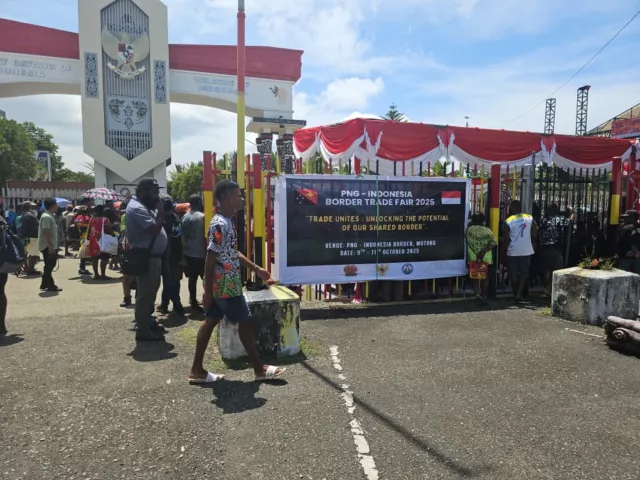
The Border Trade Fair 2026 is entering its final preparation stage in Papua as the provincial government moves to strengthen economic links with neighboring Papua New Guinea (PNG) and create new market opportunities for local businesses.
Scheduled for October 8 to 10, the three-day event will place selected Papua-based micro, small, and medium enterprises, or MSMEs, at the center of a cross-border economic forum that officials hope will generate more than short-term sales. The broader objective is to expand market access, introduce Papua’s products to buyers across the border, and strengthen Indonesia-Papua New Guinea economic cooperation.
For Papua, where the Indonesia-PNG border is not simply a line on a map but a space where communities, families, and traders interact, the trade fair carries significance beyond a conventional business exhibition.
The provincial government has been preparing the event through a series of meetings and evaluations involving government agencies, business representatives, and border-related institutions. The process has also highlighted a practical challenge: turning opportunities that already exist into trade relationships that can continue after the exhibition closes.
From Early Planning to Final Preparations
The preparations for the 2026 Border Trade Fair began months before the October event.
On June 30, Papua officials held an initial coordination meeting at the Governor’s Office in Jayapura. The meeting was led by Papua Regional Secretary’s Assistant for Administration and General Affairs, Suzana Wanggai, and brought together relevant institutions to discuss preparations for the fifth edition of the cross-border trade event.
The initial meeting was significant because the provincial government had prior experience to build upon. Officials were able to draw on four previous years of experience, including feedback from businesses that had participated in earlier editions.
Suzana said the provincial government was evaluating previous implementation as part of efforts to make the 2026 event more effective. The evaluation was aimed particularly at strengthening the ability of Papua’s MSMEs to participate in cross-border trade.
At the time, officials were still discussing the timing and format of the event with their counterparts in Papua New Guinea, particularly the Government of West Sepik Province. In July, RRI reported that the preparation process included plans for further coordination with the Papua New Guinea side.
The approach reflected the nature of the event itself. Because the Border Trade Fair involves two countries, the preparations require coordination beyond the provincial government.
Lessons from Previous Trade Fairs
One of the most revealing developments during the preparation process came from the businesses themselves.
In July, Papua officials reported that participating MSMEs had proposed extending the trade fair from three days to five days. The proposal was based on their experience with previous events, where businesses saw value in product promotion and transactions during the fair.
Suzana described the request as evidence that participants had experienced benefits from the earlier events.
“There was a positive response and an impact they felt,” she said, explaining why businesses wanted additional time for the exhibition.
The proposal did not automatically become the final schedule. Instead, it became part of the government’s evaluation and coordination process.
That distinction is important. By late September, the provincial government had confirmed the event for October 8 to 10, meaning the 2026 edition would remain scheduled for three days unless further coordination produced another decision.
The schedule’s evolution illustrates the event’s development through consultation rather than its treatment solely as a government program.
Papua’s MSMEs Take Center Stage
As the October date approaches, local MSMEs have become the central focus of preparations.
The provincial government has selected local Papua businesses to participate, with preparations covering both the participating enterprises and the practical requirements of the exhibition.
Triwarno Purnomo, head of the Papua Provincial Border Management Agency, said the event would involve selected local MSMEs as the main participants.
The objective, he explained, is to provide businesses with an opportunity to introduce their products and explore new markets through economic cooperation between Indonesia and Papua New Guinea.
“To increase economic cooperation and expand markets,” Triwarno said, summarizing the main purpose of the event.
The focus on MSMEs reflects a wider economic challenge for the border region. Having a product with commercial potential is only one part of entering an international market. Businesses also need consistent production capacity, adequate packaging, reliable supply, market knowledge, and the ability to maintain relationships with buyers.
Papua officials have acknowledged this gap.
Suzana previously said Papua’s MSME products had opportunities to enter the PNG market, but businesses still required stronger support in areas including business development, production readiness, and sustained market access.
This gap makes the trade fair potentially significant as a business development platform rather than simply an exhibition.
Government Agencies Coordinate Behind the Scenes
While MSMEs will be the public face of the event, preparations involve a broader institutional network.
According to the provincial government, meetings have involved various regional government organizations, the Indonesian Chamber of Commerce and Industry, or Kadin, and Customs and Excise officials. Their coordination covers participant readiness and other requirements needed to ensure the event operates according to plan.
The involvement of Customs and Excise is particularly relevant to the cross-border character of the event. Products displayed or traded in an international setting require appropriate procedures, while coordination among institutions helps businesses understand the requirements associated with cross-border commerce.
Triwarno said the provincial government was continuing coordination with stakeholders so the BTF could provide benefits for MSMEs while supporting Indonesia-PNG economic cooperation.
This institutional coordination also reflects the legal and diplomatic dimension of the event.
When officials discussed the possibility of extending the fair beyond the planned three days, Triwarno stressed that the provincial government could not make such a decision independently because the event involves two countries and therefore requires coordination with the central government.
“Because the event concerns two countries, it cannot be decided at the regional level,” Triwarno said.
The statement underlines the distinction between a provincial economic program and an activity that forms part of Indonesia’s broader cross-border relations with PNG.
A Border Economy with Untapped Potential
The geography of Papua closely connects to the economic rationale behind the Border Trade Fair.
The Indonesia-PNG border provides Papua with a direct connection to a neighboring country and, potentially, a wider Pacific market. Yet geographical proximity alone does not guarantee sustainable trade.
Papua’s provincial government has acknowledged that cross-border export potential already exists, but previous activity has not yet become fully sustainable. This is why officials have placed greater emphasis on developing MSMEs and improving marketing efforts.
Suzana has warned against allowing the Border Trade Fair to become merely ceremonial. The government’s stated aim is for the event to produce tangible economic benefits for people living in border communities.
That objective gives the 2026 event a practical test.
We should not measure a successful trade fair solely by the number of visitors or the attractiveness of exhibition booths. More meaningful indicators could include business contacts established, follow-up orders, repeat buyers, new distribution channels, and the ability of participating MSMEs to maintain sales relationships after the event.
The provincial government’s emphasis on evaluation indicates that officials are increasingly viewing the event in terms of long-term outcomes.
The October 8 to 10 Schedule
By the end of September, the preparations had entered a more concrete phase.
The provincial government announced that the Border Trade Fair Indonesia-PNG would take place from October 8 to 10, 2026, featuring selected MSMEs from Papua.
Triwarno anticipated the attendance of Papua Governor Matius Fakhiri and the Indonesian Ambassador to Papua New Guinea at the closing ceremony on October 10.
The presence of senior Indonesian representatives gives the event an additional diplomatic dimension. At the same time, its practical center remains commercial, helping local businesses present their products and find opportunities in the neighboring PNG market.
The provincial government has therefore positioned the fair at the intersection of economic development and bilateral cooperation.
It is an approach that fits Papua’s unique position within eastern Indonesia. Economic interaction with PNG can support local businesses while also creating a channel for stronger institutional and community-level engagement across the border.
Beyond the Exhibition Hall
The most important question facing the Border Trade Fair 2026 will come after the final day.
A three-day exhibition can create visibility, but sustained economic growth requires businesses to convert that visibility into continuing commercial relationships.
This is why the lessons from earlier BTF editions matter. The request from MSMEs for a longer event suggests that businesses see value in direct engagement with consumers and potential buyers. At the same time, the government’s own assessment that production capacity and market continuity need strengthening shows that officials recognize the work required beyond the event itself.
For Papua’s border communities, the potential gains are therefore broader than individual transactions.
If local producers can secure repeat customers in PNG, improve product quality, strengthen supply chains, and gradually develop the capacity to meet cross-border demand, the trade fair could become one component of a more durable border economy.
That process will take time. It will also require continued cooperation among provincial and central government institutions, business associations, customs and other agencies, as well as counterparts in Papua New Guinea.
A Test of Papua’s Cross-Border Economic Strategy
The 2026 Border Trade Fair arrives at a moment when Papua is seeking to strengthen the economic role of its border areas.
The provincial government’s preparations show an effort to build the event around previous experience, business feedback, and inter-agency coordination. The participation of selected MSMEs gives local entrepreneurs a direct role, while the involvement of Customs, Kadin, and government agencies provides the institutional framework needed for a cross-border event.
For Indonesia, stronger economic activity along the Papua-PNG border can also contribute to a broader strategy of developing eastern Indonesia and connecting local producers with neighboring markets.
For local businesses, however, the calculation is more immediate. A successful meeting with a buyer, a new order, or a distribution agreement can be more meaningful than any headline about the event itself.
That is ultimately where the Border Trade Fair 2026 will be judged.
Conclusion
As Papua prepares to welcome participants for the October 8 to 10 Border Trade Fair, the event represents a practical effort to bring cross-border economic cooperation closer to the people who produce and sell goods locally.
The provincial government has moved from an initial planning meeting in June, through evaluation and consultation with MSMEs, to detailed coordination involving regional agencies, Kadin, and Customs. The final schedule has now been set, while selected Papua MSMEs prepare to showcase their products.
The larger ambition is clear: to transform proximity to Papua New Guinea into meaningful market access.
Whether that ambition translates into lasting economic gains will depend on what follows the exhibition. If new commercial relationships continue after October, if businesses improve their production capacity and if market access becomes more predictable, the Border Trade Fair could evolve from an annual event into a practical instrument for strengthening the border economy.
For Papua’s entrepreneurs, the opportunity begins with three days in October. The real measure of success, however, will be whether those three days open doors that remain open long after the exhibition closes.
Read Also
BNPP Accelerates Papua Border Development
Papua Moves to Regulate Traditional RI-PNG Border Routes
RRI Expands Information Access Across Papua Border

