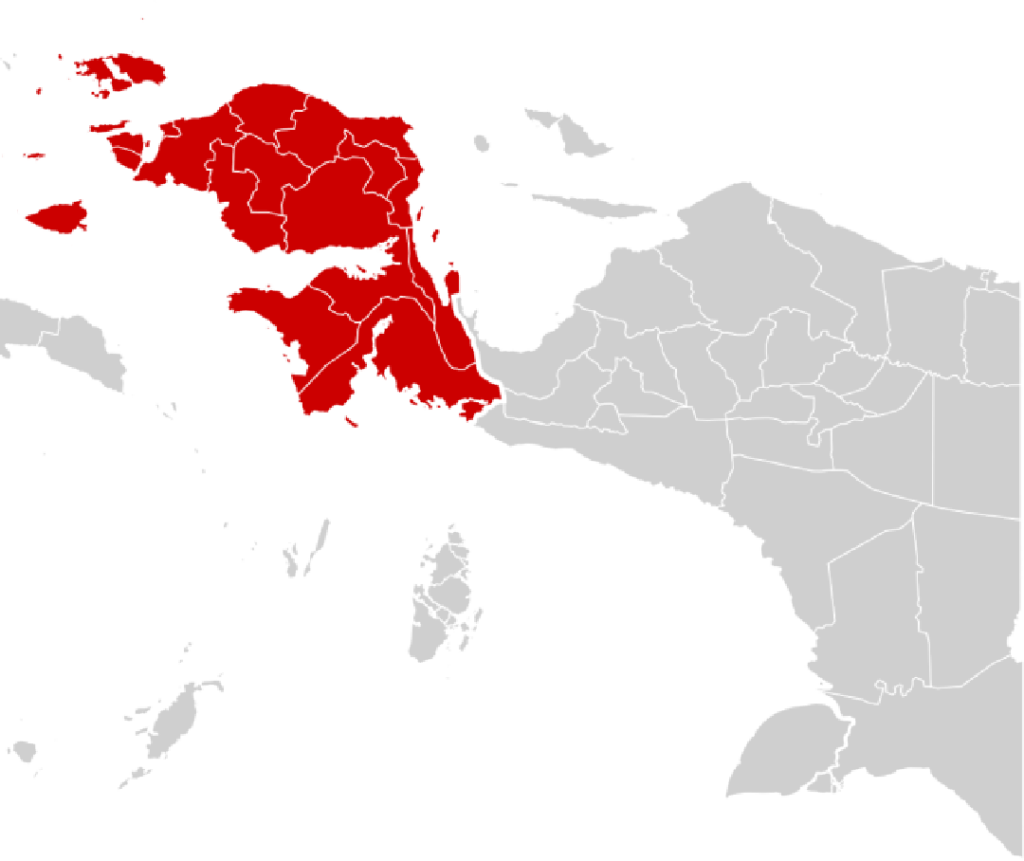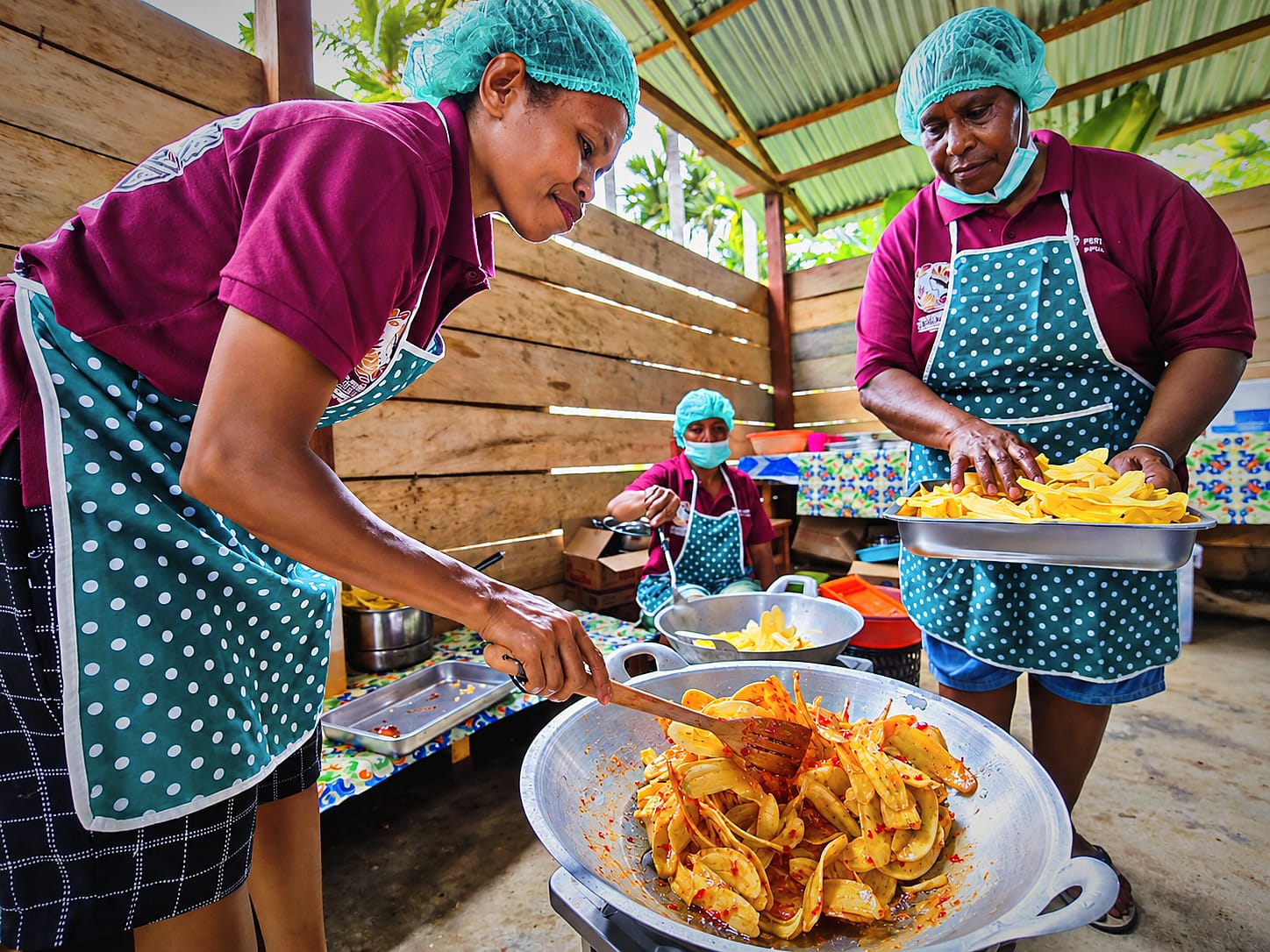
The sound of a blender fills a modest production room in Kampung Seget, Sorong Regency, Papua Barat Daya (Southwest Papua). Around it, women wearing hair caps, gloves and aprons prepare fish, crush spices and arrange food products for packaging. Their work may look ordinary, but for the members of the Krekban micro, small and medium enterprise group, it represents the beginning of a new economic opportunity.
In Seget, women are turning locally available food into banana chips, sago flour and shredded fish products. The initiative is being developed with support from PT Pertamina Patra Niaga Refinery Unit Kasim through its corporate social responsibility and community empowerment programme. Rather than starting with a ready-made business model imposed from outside, the programme grew from discussions with residents about what they already had and what they needed.
The result is still modest. Krekban was only established in July 2026, production remains relatively small and most products are sold through pre-orders or within the village. But the story unfolding in Seget offers a glimpse of how community-based economic development can begin with something as simple as a bunch of bananas, a catch of fish or locally available sago.
From a Village Discussion to a Women’s Enterprise
The story began several months before Krekban formally existed.
In January 2026, Pertamina held a forum group discussion with residents of Seget. The meeting was designed to gather ideas about community needs and potential development opportunities. Agriculture, small businesses and health were among the issues raised.
For the women who would later form Krekban, the discussion created an opening to turn everyday resources into economic products.
According to Bambang Imawan, Officer for Communication, Relations, CSR and Compliance at Pertamina Patra Niaga RU Kasim, the company did not begin by deciding what the community should produce. Instead, residents proposed ideas based on the resources available around them.
One of the suggestions was to process fish and other local food products into goods that could be sold.
The approach is important because it places local knowledge at the centre of the programme. Rather than treating community members simply as recipients of assistance, the initiative seeks to make them participants in deciding what kind of enterprise can work in their environment.
The next stage came in early August.
On Aug. 4, residents received training in processing sago, bananas and fish. The programme was carried out by Pertamina Patra Niaga RU Kasim in cooperation with Sinagi Papua, a local MSME development group. Participants were introduced to raw-material selection, hygienic production techniques and packaging.
The training was led by Sinagi Papua instructor Yuliance Yunita Basom Ulim, who encouraged the women to become more independent and use the skills they had acquired to develop new businesses.
The training eventually developed into three product lines: sago flour, banana chips and shredded fish.
How Bananas Became a Business
Among the products, banana chips have a particularly personal beginning.
Sonia Lusia Wanea, 49, a mother of five, had already been making banana chips on her before Krekban was formed. She sold them from the small roadside stall where she also sold betel nuts.
It was a very small operation, but people passing through the area could see and buy the chips.
Sonia then suggested that the activity could become part of a larger women’s group. Through her younger brother, who worked at the refinery, the idea eventually reached Pertamina.
That small personal business became part of the wider Krekban initiative.
The women use kepok bananas and a local variety known as pisang abu-abu. When supplies from their surroundings are insufficient, they purchase bananas from other residents. A bunch costs roughly Rp50,000 to Rp70,000.
The bananas are processed into chips and offered in several flavours: cheese, sweet and spicy, chocolate, sweet and balado.
The products are packed in 150-gram pouches.
For now, the market remains close to home.
Sonia said the chips are mainly sold from her stall in the village. Children are among the regular customers, with balado and cheese reportedly proving particularly popular.
There is no claim yet of a large commercial operation. The significance lies elsewhere. A product that once existed as one mother’s small side business is now becoming part of a collective enterprise involving other women.
For Sonia, the activity also has a direct household dimension. As a mother of five, she sees the business as a way to contribute to family income while developing something together with other women in the village.
Fish From the Coast Becomes Shredded Fish
The second major product is abon ikan, or seasoned shredded fish.
Nelce Kumuai, who leads the Krekban fish-processing group, said many of the women involved previously had no regular employment.
The new activity has given them a chance to learn a practical skill and explore an additional source of income.
The group uses several types of fish, including skipjack tuna, tuna, toki-toki, a local name for ribbonfish, and Spanish mackerel. But obtaining raw materials is not always straightforward.
When strong winds make fishing difficult, some fish, particularly skipjack and tuna, have to be brought in from Sorong City.
That challenge illustrates one of the realities facing village-based enterprises. Having access to natural resources does not automatically guarantee a stable supply chain. Weather, transportation and distance from larger markets can all affect production.
The women therefore have to balance local sourcing with purchases from outside the village.
Their shredded fish is currently packaged in 150-gram pouches and sold for around Rp50,000 per package. Like the banana chips, the product remains at an early stage of market development.
Photographs published by ANTARA on Aug. 31 showed members of Krekban processing skipjack tuna in Seget. ANTARA reported that Pertamina’s community programme was training and assisting women in producing shredded fish and banana chips, with average production reported at around 5 to 10 kilograms per day.
For Nelce, the immediate goal is straightforward: keep the business running and generate additional income for the women involved.
Sago Adds Another Layer to the Enterprise
Bananas and fish may be the products most visible from the group’s early activities, but sago is another important part of the programme.
Krekban currently has 40 members. Eighteen are involved in shredded fish, 11 focus on banana chips and another 11 work on sago flour.
The three product lines reflect the wider idea behind the programme: use resources that already exist in or around Seget and give them additional economic value through processing, packaging and marketing.
This is particularly relevant in communities where access to urban markets can be difficult.
Seget is some distance from Sorong City, while heavy rain can make roads more difficult to use and can cause flooding. Developing products within the village therefore has a practical dimension beyond simply creating new businesses.
If local raw materials can be processed locally, some of the economic value can remain within the community rather than leaving the village in the form of unprocessed commodities.
Pertamina’s Role: From Assistance to Local Economic Circulation
Pertamina’s support extends beyond training.
According to Bambang Imawan, the company is providing assistance during the first year, including raw materials and packaging. But the model is designed to avoid making the group permanently dependent on external assistance.
Income generated from sales is collected into the group’s cash fund and can later be used to purchase additional production materials.
The idea is to create a cycle in which products generate revenue, revenue supports new production, and new production creates opportunities for members.
Bambang described the focus as empowerment, with the goal of enabling women in Seget to generate income.
The company also sees the initiative as part of a broader local economic ecosystem.
Agricultural production could eventually supply ingredients needed by Krekban. Crops such as garlic, shallots and pepper could be cultivated locally and then purchased by the women’s group.
In that model, agriculture and food processing would reinforce one another.
The ambition, Bambang said, is for Seget to move toward greater food self-sufficiency.
That vision is particularly relevant because the refinery itself provides a potential early market.
Bambang said the refinery employs around 1,000 workers and could initially absorb some products from the group, helping maintain economic circulation while Krekban develops its external market.
Pertamina has also indicated that it could help explore wider markets if production grows and the products meet the specifications required by potential buyers.
Training Is Only the First Step
The early experience in Seget also highlights an important distinction between training and sustainable enterprise.
Teaching people how to make food products is only the beginning. A small business also needs consistent raw materials, quality control, packaging, legal requirements, reliable production, market access and sufficient demand.
Krekban is still working through these stages.
Its products are not yet widely distributed. The group is still coordinating with a company minimarket about possible sales, while current distribution largely remains within the village and surrounding area.
That means the long-term success of the initiative cannot yet be measured simply by the number of products made.
The more important question is whether the women can gradually build a stable business capable of operating beyond the initial support period.
The structure now being developed offers one possible foundation. The women have divided themselves into product groups, received technical training, established production activities and begun testing the market.
The next challenge is to turn those first steps into a dependable business.
Women at the Centre of Village Economic Development
There is also a wider social dimension to what is happening in Seget.
Krekban’s name comes from the Moi language, where “Krekban” means woman. The group reflects its identity: most members are mothers and housewives, while some are young women who have recently completed high school.
Their work does not take place in a modern industrial kitchen.
It happens in a relatively simple production room where women divide tasks, prepare ingredients, cook, mix seasonings and package products. They wear gloves, masks, aprons and hair coverings as part of their effort to maintain hygiene during production.
That simplicity is part of the story.
Economic development in remote communities does not always begin with a factory, a large investment or a sophisticated supply chain. Sometimes it begins with a household skill that is shared with neighbours and gradually organized into a collective business.
In Seget, the kitchen has become a small workplace.
It has also become a place where women can learn from one another, experiment with products and make decisions about how their resources can be turned into income.
A Small Enterprise with a Larger Ambition
The government and corporate development agenda in Papua increasingly places emphasis on strengthening local economies and improving the value of local resources.
The Krekban programme fits within that broader development approach without pretending that one village enterprise can solve larger economic challenges on its.
The contribution is more practical.
A banana that was previously sold as raw produce can become a packaged snack. Fish can become a product with a longer shelf life. Sago can be processed into flour. A woman who previously had no formal employment can acquire production skills and participate in a group enterprise.
Each step adds value.
The programme also illustrates why community participation matters. The initial ideas came from residents themselves, while Pertamina provided training, equipment-related support, materials and access to potential markets.
That combination can be more sustainable than a model in which communities simply receive finished programmes.
Kampung Seget Village Head Orgenes Kumuay welcomed the training and expressed hope that the knowledge gained by residents would be used to establish businesses and increase family income.
Williamson Amamehi, Area Manager for Communication, Relations, CSR and Compliance at RU VII Kasim, said the programme was intended to help residents see bananas, fish and sago not simply as natural resources, but as opportunities for economic activity.
He also expressed the longer-term hope that Seget products could become known in Sorong and eventually reach national and international markets.
That ambition remains ahead of the group.
For now, Krekban is still learning how to produce consistently, find customers and maintain its supply of raw materials.
Conclusion
The story of the women of Krekban is not yet a story of a large business success. It is a story of beginnings.
The group was established only in July 2026. Its training followed soon afterward, and production is still relatively small. Banana chips remain closely tied to village sales, while shredded fish is being developed through pre-orders and early market testing. Sago flour is another part of the group’s emerging product portfolio.
Yet those limitations do not diminish the importance of what has started.
For Seget’s women, economic opportunity is being built from resources they already know: bananas, fish and sago. The intervention by Pertamina Patra Niaga RU Kasim has provided training and initial support, while the women themselves are supplying the ideas, labour and local knowledge needed to make the enterprise relevant to their community.
The next phase will depend on whether Krekban can expand its market, strengthen production, secure reliable raw materials and maintain the business cycle after the initial assistance ends.
If those pieces come together, the products may eventually travel much farther than the small production room where they began.
For now, however, the most important change is already visible.
A bunch of bananas is no longer simply a bunch of bananas. In the hands of Seget’s women, it can become a packaged product, a source of income and a reason to believe that economic opportunity can be built from within the village itself.
Read Also
Bank Indonesia Accelerates Digital Growth for Papua’s MSMEs
Papua Halal Certification Drive Supports Local MSMEs Ahead of October 2026 Rule
Papua MSME Festival Boosts Local Creative Economy