
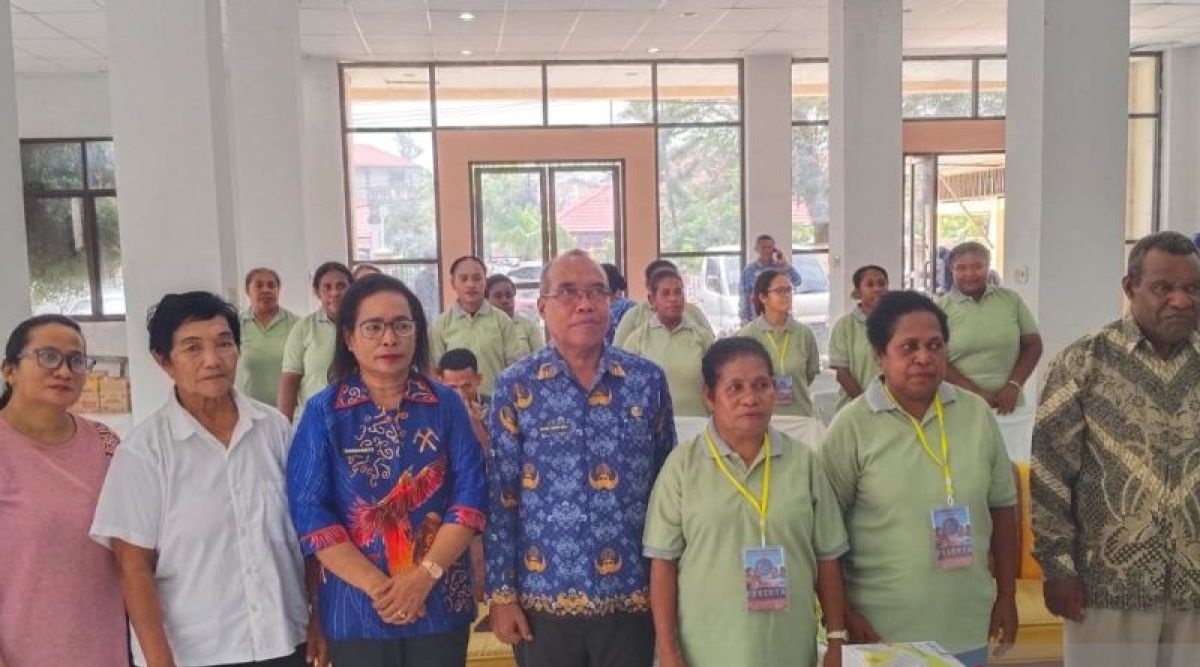
Twelve Indigenous Papuan women are being equipped with practical baking skills through a training programme organised by the Sorong City Industry Office, as local authorities seek to expand women’s participation in small businesses and strengthen household economic independence.
The programme, held on October 29, 2026, focused on making birthday cakes, a product with potential demand for family celebrations, weddings, religious occasions and other social gatherings. Beyond teaching participants how to prepare and decorate cakes, the initiative is intended to introduce them to the commercial skills needed to turn food production into a sustainable source of income.
The training was opened by Abdul Rahim Oeli, Sorong Mayor’s Expert Staff for Government, Law and Politics, and attended by officials from the city administration. Eduard Jitmau, head of the Sorong City Industry Office, said the programme reflected the local government’s commitment to improving the quality of human resources, particularly among Orang Asli Papua (OAP), through community-based economic empowerment.
“This training is not merely about teaching participants how to make birthday cakes. It is a practical step towards opening business opportunities, increasing family income and building economic independence,” Jitmau said, as quoted by ANTARA on October 29.
The initiative reflects a broader development priority in Sorong: ensuring that Indigenous Papuan women have access to practical skills and opportunities to become active participants in the local economy, rather than remaining outside the growth of small businesses.
For the 12 participants, the immediate task is to master the production process. The longer-term challenge will be to turn those skills into products that customers are willing to buy, businesses that can survive and income that can support their families.
A Practical Training Programme with an Economic Purpose
Twelve women begin learning cake production
The training took place on October 29, 2026, and was organised by the Sorong City Industry Office. Twelve Indigenous Papuan women, often referred to locally as mama-mama Papua, took part.
The programme was opened by Abdul Rahim Oeli, who represented the Sorong mayor’s office. The programme’s emphasis on birthday cake production was strategically selected to cater to a diverse market that encompasses various types of celebrations.
Birthday cakes are commonly ordered for family events, children’s celebrations, weddings, religious gatherings and other social occasions. Their production can therefore offer opportunities for small home-based businesses, particularly in urban areas where demand comes from households, community groups and event organisers.
For women who want to establish a small enterprise, cake making can provide an accessible starting point. It does not necessarily require a large commercial premises at the outset, although reliable equipment, ingredients, production space and basic business management are important.
The training was designed to introduce participants to the stages involved in producing a finished cake. These included basic baking techniques, ingredient preparation, mixing and processing, oven use, decoration, packaging and product marketing.
The programme therefore covered more than just food preparation. It introduced participants to a sequence of activities that form the foundation of a small food business.
City government links skills training with community welfare
Eduard Jitmau said the programme was part of the Sorong City Government’s commitment to improving the welfare of Indigenous Papuans.
He explained that the Industry Office had made community empowerment training an annual programme, reflecting the local administration’s intention to develop practical skills among its residents.
The city government also connects the programme to its broader vision of enhancing welfare, especially for Indigenous Papuans.
Jitmau encouraged participants to approach the training seriously, make full use of the instructors’ knowledge and practise the techniques introduced during the sessions.
He said the programme’s value would depend on how participants used what they learned after training.
A short course can introduce a new skill, but turning it into a reliable source of income requires practice, product consistency, customer relationships and the ability to manage costs.
For that reason, Jitmau said the government’s support would not stop with the training itself. Technical agencies would also provide assistance and supervision to help participants develop their skills further.
From Baking Skills to Small Business Opportunities
Learning the production process
The training introduced participants to several stages of birthday cake production, beginning with the selection and preparation of ingredients.
In baking, the quality of the final product depends on a combination of factors. Accurate measurements, ingredient quality, mixing techniques, oven temperature and baking time all influence the texture and appearance of a cake.
Participants were also encouraged to learn how to decorate cakes. This is an important part of the business because customers often choose celebration cakes based not only on taste but also on appearance and the ability to personalise designs for particular occasions.
Packaging was another component of the training. A well-presented product can improve its appeal to customers, help protect it during delivery and strengthen the identity of a small business.
The final stage involved marketing. Participants were encouraged to explore ways to introduce their products to potential buyers and manage orders effectively.
These elements are connected. A business may produce a quality cake, but without suitable packaging, clear pricing and effective promotion, it may struggle to attract customers or compete with established sellers.
The training’s emphasis on the complete process is therefore important. It gives participants an introduction to the practical requirements of running a small food enterprise, rather than limiting their experience to the kitchen.
Social media can widen the customer base
Jitmau also encouraged participants to use social media as a promotional tool.
For small businesses, digital platforms can provide a relatively accessible way to display products, communicate with customers and receive orders. Photographs of finished cakes, price information, product variations and customer testimonials can help a new business build visibility.
Social media can also allow home-based producers to reach customers beyond their immediate neighbourhoods, depending on their ability to manage delivery and maintain product quality.
However, reliable business practices must support digital promotion. Customers expect accurate information, timely responses, consistent products and dependable delivery arrangements.
The Industry Office’s encouragement to use social media therefore points to a wider aspect of entrepreneurship: traditional production skills increasingly need to be combined with basic digital capabilities.
For the participants, learning how to promote their products online could become an important step towards developing a customer base and building a recognisable business identity.
Why Women’s Economic Empowerment Matters in Sorong
The training is part of a wider effort to improve the economic participation of Indigenous Papuan communities.
Women play important roles in household management, community life and local economic activity. Supporting their access to skills and business opportunities can create benefits that extend beyond the individual participants.
A woman who develops a small enterprise may be able to contribute additional income to household expenses, support children’s education, strengthen family financial resilience and build savings.
Small businesses can also create opportunities for other community members. As demand grows, a cake producer may need assistance with ingredient preparation, packaging, delivery, sales or customer service.
Such activities can generate additional work, even when the business begins on a modest scale.
For Indigenous Papuan women, practical skills programmes may also help reduce barriers to entering commercial activities. Access to training, mentoring, information and business networks can make it easier for participants to move from informal production to more organised enterprises.
Although the Sorong programme has only 12 participants, its value extends beyond the number of women attending. The more important question is whether participants can use the skills to establish or strengthen income-generating activities.
That requires continuity after the classroom sessions end.
The Importance of Mentoring After Training
Skills alone are not enough
Jitmau stressed that economic empowerment cannot be achieved through training alone. He emphasised the necessity of mentoring, access to business information, stronger business groups, and marketing support.
This is an important distinction. Many small businesses face difficulties after their owners have completed an initial skills course.
A participant may know how to make a cake but still need guidance on calculating production costs, setting prices, identifying suppliers, managing customer orders and keeping basic financial records.
For example, when determining a selling price, one must consider the costs of ingredients, electricity, packaging, and transport. Overlooking these expenses can lead a business to generate sales without achieving a sustainable profit.
Consistent quality is equally important. Customers who order cakes for special occasions need confidence that the product will be ready on time and meet their expectations.
Mentoring can help participants address these issues through practical advice and follow-up assistance.
The city government’s commitment to continued support from relevant technical agencies could therefore play a significant role in determining the programme’s long-term impact.
Building business groups and cooperation
Jitmau also highlighted the importance of strengthening business groups.
Working together can help small producers share information, coordinate purchases of ingredients, exchange production techniques and explore joint marketing opportunities.
A group of cake producers could also develop a wider product range or coordinate orders during busy periods, such as holidays and major community celebrations.
Cooperation may help participants overcome some of the limitations faced by individual home-based businesses, particularly when it comes to purchasing equipment, obtaining supplies and reaching new customers.
However, effective groups need clear management, transparent financial arrangements and a shared understanding of responsibilities.
The goal should be to create practical networks that support business development, rather than organisations that exist only on paper.
Sorong’s Growing Space for Community-Based Enterprises
Sorong is an important urban centre in Papua Barat Daya (Southwest Papua), serving as a hub for government administration, commerce, transport and services.
Its economic activity creates potential demand for food products and small-scale services. Birthday cakes are one example of a product that can serve households, schools, offices, religious communities and event organisers.
The market opportunity identified by the Industry Office is therefore linked to everyday consumer demand.
For a small producer, the first customers may come from family networks and nearby communities. As experience grows, businesses may seek orders from schools, offices, event organisers and local retailers.
Expanding into these markets requires more than production capacity. Producers must grasp customer preferences, uphold hygiene standards, manage orders, and guarantee the delivery of products in optimal condition.
Food safety is especially important for businesses selling products made with ingredients such as eggs, dairy products and cream. Proper storage, clean equipment and appropriate handling are essential to protect consumers and maintain trust.
As participants develop their skills, these standards will become increasingly important if they want to expand their customer base.
The local government’s role can extend to providing information about food safety, business registration, product standards and other requirements relevant to small food enterprises.
Measuring the Programme’s Long-Term Impact
The October 29 training provides an initial opportunity for 12 women to acquire new production skills. Its wider success, however, will depend on whether those skills lead to measurable improvements.
One useful indicator will be how many participants begin selling cakes or expand an existing business. Another will be whether they can maintain regular orders and generate income after accounting for production costs.
The development of business groups, access to suppliers and the use of social media for promotion could also provide signs of progress.
The city government could strengthen the programme by maintaining contact with participants, documenting their business development and identifying the support they need at different stages.
For example, participants who are ready to begin selling may need assistance with equipment and packaging, while those who have already established a customer base may benefit more from marketing guidance and business management support.
A follow-up approach would allow the Industry Office to tailor assistance rather than assuming that all participants face the same challenges.
It could also help the government assess whether the annual training programme is delivering its intended benefits and identify improvements for future groups.
Conclusion
The training of 12 Indigenous Papuan women in birthday cake production is a practical example of how local government programmes can support women’s economic empowerment through accessible skills development.
Organised by the Sorong City Industry Office and opened by Abdul Rahim Oeli on October 29, 2026, the programme introduced participants to baking, ingredient preparation, oven techniques, cake decoration, packaging and marketing.
Eduard Jitmau’s emphasis on mentoring, business groups and marketing support highlights an important principle: training should be the beginning of an economic opportunity, not the end of a government activity.
The next step is to help participants turn their newly acquired skills into products that meet customer expectations and generate reliable income. Access to business information, digital promotion, suitable equipment and continued guidance will be important in that process.
If the programme is followed by consistent assistance, the 12 women could become examples of how practical training can strengthen household economies and encourage wider participation in local enterprises.
For Sorong, the broader objective is to create an environment in which Indigenous Papuan women have the skills, confidence and support to become active contributors to the city’s economic development.
The value of the initiative will ultimately be measured not by the training session itself, but by what the participants are able to build from it: stronger businesses, more secure household incomes and greater economic independence.
Read Also
Nabire Trains Papuan Women to Make Red Fruit Meatballs
University of Indonesia Team Trains Papua Women in Nutmeg Processing into Sanitizer

