
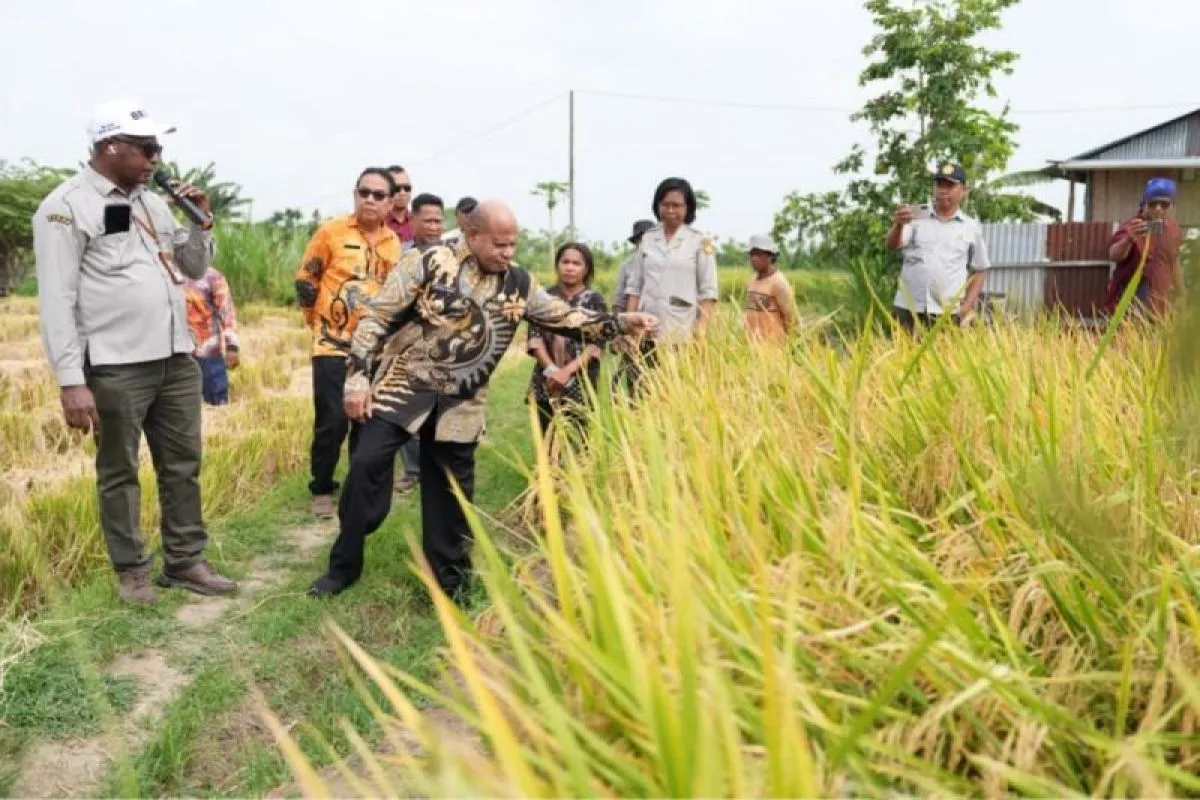
The Papua provincial government is racing to complete a programme to open 3,800 hectares of new rice fields by the end of November, part of a wider effort to strengthen food security and reduce pressure on regional food supplies.
The Papua programme for expanding rice fields has undergone several revisions since its original contract covered approximately 11,000 hectares. Social challenges involving local communities and damaged bridge access have complicated work in the field, forcing officials to reduce the target first to 6,000 hectares and then to 3,800 hectares. As of October 21, about 1,800 hectares had been cleared, leaving roughly 2,000 hectares to complete before the November 30 deadline.
Lunanka V.M.L. Daimboa, acting head of the Papua Provincial Agriculture Office, said the administration remained optimistic that the revised target could be met, provided all parties worked together to accelerate construction.
The programme is being implemented with the involvement of Indonesia’s Ministry of Public Works through a Type II self-managed arrangement. Officials say the immediate objective is to increase the availability of food and support the fulfilment of local rice demands.
The deadline is significant because the provincial government is also preparing a much larger expansion plan for 2027. Papua has been allocated a planned 50,000 hectares for future community rice-field development, with surveys underway to identify suitable locations in six districts and municipalities.
Yet the current programme also illustrates the practical challenges of agricultural expansion in Papua. Revising the target has made the remaining workload more defined, but the outcome will depend on construction progress, access to work sites, cooperation with communities and whether newly cleared land can be developed into productive rice fields.
From 11,000 to 3,800 Hectares: How the Target Changed
The Original Contract and Subsequent Revisions
The current programme began with a contract covering approximately 11,000 hectares of planned rice-field development. As work progressed, however, the provincial administration encountered conditions that made the original scope difficult to complete within the available period.
Lunanka explained that social issues involving communities and the disruption of bridge access affected implementation. The provincial government subsequently revised the contracted area through formal contract amendments, reducing the target to 6,000 hectares before settling on 3,800 hectares.
The revisions were not simply a change in the programme’s headline figures. They reflected the need to adjust the planned workload to conditions encountered on the ground. In areas with disrupted access, moving heavy equipment and construction materials becomes increasingly challenging. Meanwhile, social concerns can affect the timing and feasibility of land preparation.
The reports do not provide a detailed breakdown of how many hectares were removed from the original plan because of each obstacle. They also do not identify every affected site. It would therefore be premature to attribute the entire reduction to a single cause.
What is clear is that the revised target is considerably smaller than the original commitment. The immediate priority has shifted from opening 11,000 hectares to completing the 3,800 hectares included in the latest contract amendments.
Why Contract Adjustments Matter
Changes to public infrastructure and agricultural contracts require careful attention to both physical progress and administrative accountability. A revised target can provide a more realistic basis for completing work, but it also makes transparent reporting essential.
In September, Indonesia’s Ministry of Agriculture held a coordination and evaluation meeting in Jayapura to review rice-field construction across the wider Papua region. The ministry’s inspectorate emphasised that proposed contract amendments should be based on actual field conditions and supported by measurable evidence. It also urged that physical construction in Papua be completed no later than November 30.
That earlier evaluation concerned the broader rice-field programme across Papua and should not be confused with the provincial government’s specific 3,800-hectare target. Nevertheless, it provides useful context for the latest revisions: government agencies were already examining construction progress, administrative arrangements and operational obstacles before the October announcement.
The lesson for the current programme is that revised targets must be accompanied by clear records of work completed, work remaining and the reasons for any further adjustments. This would help the government assess whether the deadline is achievable while maintaining accountability for public resources.
1,800 Hectares Cleared, with 2,000 Still to Go
The Final Weeks Before the Deadline
As of October 21, approximately 1,800 hectares had undergone land clearing under the revised 3,800-hectare programme. That represents just under half of the total target, leaving approximately 2,000 hectares to be completed.
The remaining workload is substantial given the short time available. The government has set November 30 as the latest completion date, making the final weeks of October and November critical to the programme’s progress.
Lunanka expressed confidence that the provincial government could achieve the target within the available timeframe. He urged all parties involved to cooperate in order to ensure timely completion of the work.
The difference between land clearing and completed agricultural production is important, however. Preparing land for rice cultivation is an essential stage, but it does not by itself establish that a field is ready to produce a harvest. Depending on site conditions, additional requirements may include suitable water management, soil preparation, access infrastructure and the availability of seeds and other agricultural inputs.
The reports do not establish how much of the 1,800 hectares already cleared has been planted, nor do they provide a confirmed schedule for the first harvest from the new fields. The November deadline should therefore be understood as the target for completing the land-clearing and construction work, rather than a guarantee that the entire area will immediately produce rice.
The distinction matters for food security. New agricultural land can strengthen future production, but its contribution to local food supplies depends on whether farmers can cultivate it successfully and sustain production over subsequent planting seasons.
Public Works and Agriculture Agencies Coordinate Implementation
A Joint Approach to Land Preparation
The provincial government is involving the Ministry of Public Works through a Type II self-managed implementation arrangement. The mechanism is intended to coordinate the execution of the rice-field development work under the agreed administrative framework.
The participation of public works authorities reflects the practical demands of land preparation. Rice-field development can require more than clearing vegetation. Depending on the location, construction and access arrangements may influence whether machinery can reach a site and whether the land can eventually support agricultural activity.
The bridge access problems cited by Lunanka demonstrate how infrastructure conditions can affect agricultural schedules. Even if a site is chosen for development, work can be delayed if equipment can’t reach it easily or if materials must be moved through disrupted routes.
Coordination between the agriculture and public works authorities can help align construction priorities with agricultural requirements. It can also support clearer assignment of responsibilities, particularly where work involves multiple sites and different local conditions.
For the remaining 2,000 hectares, the key operational questions concern the pace of land clearing, the availability and condition of equipment, access to work sites and the resolution of outstanding community issues. The published reports do not provide a daily production rate or a detailed site-by-site completion schedule, so the likelihood of meeting the deadline cannot be independently calculated from the available figures.
Nonetheless, a focused implementation plan, regular progress reports, and timely decisions regarding unresolved obstacles will be crucial for achieving the target.
Food Security Is the Programme’s Central Objective
Expanding Local Rice Production
The provincial government has presented the programme as an effort to increase food availability and support local rice needs. Lunanka anticipated that the new fields would yield an average productivity of approximately five tonnes of rice per hectare.
Achieving that figure across the planned area would indicate substantial production potential. However, it is a projected productivity figure, not a verified harvest result. Actual output will depend on factors such as soil conditions, water availability, farming practices, seed quality, pest management and seasonal conditions.
It is also important to distinguish potential production from immediate food-security gains. Newly prepared fields need to be cultivated, and crops must pass through the growing and harvesting stages before they can contribute to food supplies. Sustained output will depend on farmers being able to plant repeatedly and manage their fields over time.
For Papua, strengthening local rice production could provide an additional source of food and support the development of agricultural livelihoods. Where local production can meet a greater share of demand, communities may gain more options for obtaining staple foods. The scale of that benefit, however, depends on the relationship between actual harvest volumes, regional consumption and the cost of bringing food to market.
The programme’s success should therefore be measured not only by hectares cleared but also by the number of hectares brought into productive cultivation, the volume and consistency of harvests, and the benefits received by local farmers.
From Land Preparation to a Functioning Agricultural System
Opening new fields is one part of a broader agricultural system. Farmers also need access to seeds, fertilisers where appropriate, equipment, technical guidance, water management and routes for transporting their produce.
Without these supporting elements, newly cleared land may not reach its full production potential. Ensuring that farmers can use the land effectively will be as important as completing construction by the deadline.
The government can strengthen the programme’s long-term value by connecting land development with agricultural extension services, support for farmer groups and practical arrangements for post-harvest handling and distribution. These are important considerations for the next stage, although the latest reports do not detail a comprehensive package of such measures for the 3,800-hectare project.
A clear transition from construction to cultivation would also make it easier to evaluate whether the programme is delivering its intended food-security benefits.
Papua Plans 50,000 Hectares for 2027
Six Areas Under Consideration
Beyond the current programme, Papua has received a planned allocation of 50,000 hectares for further community rice-field development in 2027. According to Lunanka, the plan follows an agreement between the governor of Papua and the minister of agriculture through the ministry’s Directorate General of Agricultural Land and Irrigation. Surveys are underway to determine suitable locations.
The areas being considered include Jayapura Regency, Waropen, the Yapen Islands, Supiori, Mamberamo Raya and Jayapura City. The final locations will depend on the findings of the Survey, Investigation and Design process, commonly known by its Indonesian abbreviation, SID.
The survey process is important because agricultural suitability can vary significantly between sites. Assessments need to establish whether the proposed land can support cultivation and identify the infrastructure and other requirements necessary for development.
The 50,000-hectare figure is a planned allocation, not evidence that all the land has already been surveyed, cleared or approved for construction. The final scope and distribution will depend on the results of the assessment process and subsequent implementation decisions.
Keerom, which has previously received large-scale land development, is no longer listed among the priority locations for the next phase in the reports published on October 23. The proposed shift would direct attention towards other districts and municipalities, subject to survey results.
Why the Next Phase Needs Careful Preparation
The proposed expansion could provide an opportunity to develop agricultural areas in a more systematic way. Survey results can help authorities identify suitable locations, assess access requirements and avoid committing resources to sites where the conditions for sustainable rice cultivation are not established.
The experience of the 2026 programme offers a practical reason to place early planning and community engagement at the centre of the next phase. Social concerns and disrupted access have already affected the current project, contributing to a reduction from 11,000 hectares to 3,800 hectares.
For future projects, identifying local concerns before construction begins could help improve scheduling and reduce the risk of delays. Conducting infrastructure assessments, establishing clear responsibilities, and creating realistic work plans would also facilitate the alignment of contract targets with the specific conditions at each location.
The proposed 50,000 hectares represent a longer-term ambition. Turning that figure into productive farmland will require a series of decisions and stages, from survey and design through land preparation, cultivation and the development of viable farming operations.
Community Engagement and Accountability Will Be Essential
The social challenges cited by the provincial government highlight the importance of working with communities during agricultural development. Local engagement is not simply a procedural matter. It can help authorities understand land use, access arrangements and the concerns of people who live in or depend on areas selected for development.
Clear communication about project boundaries, implementation schedules and responsibilities can help establish a shared understanding before work advances. Where concerns remain unresolved, authorities need practical channels for discussion and resolution.
Accountability is equally important. Public reporting on the progress of land clearing, contract amendments, and expenditure can effectively demonstrate the utilisation of public resources. Identifying delays and determining the need for additional measures can also become easier.
For the current project, a transparent update ahead of the November 30 deadline would help clarify how much of the 3,800-hectare target has been completed and whether any outstanding obstacles remain. After construction, reporting on cultivated areas and harvest outcomes would provide a more complete assessment of the programme’s contribution to food security.
These steps would connect the immediate construction target with the government’s longer-term agricultural objectives.
Conclusion
Papua’s target to complete 3,800 hectares of new rice fields by November 30, 2026, reflects the provincial government’s effort to strengthen local food availability and expand agricultural production. The reduction from the original 11,000-hectare contract followed social and operational challenges, while the approximately 1,800 hectares already cleared provide a measurable starting point for the final phase.
The remaining 2,000 hectares will test the ability of the agencies involved to coordinate construction, address access difficulties and work effectively with local communities. Meeting the deadline would complete an important stage of the programme, but it would not, by itself, guarantee immediate rice production or lasting food-security gains.
The longer-term opportunity lies in connecting land preparation with productive cultivation, support for farmers and reliable distribution. Papua’s planned 50,000-hectare expansion in 2027 could build on the current effort, provided that site selection, infrastructure planning and community engagement are handled carefully.
Ultimately, the value of the programme will be measured not simply in hectares opened, but in rice harvested, farmers supported and the sustained contribution of local agriculture to Papua’s food supply. Achieving the current target on schedule would mark a significant milestone. Ensuring that the new fields remain productive will be the more important test of success.
Read Also
Siam Madu Rice Seed Brings New Hope for Papua’s Food Security
Papua Food Security Strengthens Through National Strategic Projects

