The ceremony had barely started when rain clouds gathered over parts of Jayapura, Papua.
Students adjusted their uniforms.
Government employees moved closer together under tents.
In several districts across Papua, similar scenes unfolded on June 1 as officials, teachers, community organisations, women’s groups, and students gathered to mark Indonesia’s Pancasila Day.
For many participants, the annual commemoration was less about the ceremony itself and more about what comes afterwards.
The focus was on how communities with different ethnic backgrounds, religions, and social realities continue to live together.
Across Papua, where diversity is often visible even within a single neighbourhood, that conversation remains relevant.
This year, messages delivered during commemorations repeatedly returned to the same themes.
Unity.
Tolerance.
Social resilience.
And the need to ensure younger generations remain connected with values many local leaders describe as increasingly important during periods of rapid social change.
Pancasila Day Events Spread Across Papua
In Nabire, Papua Tengah (Central Papua), local government officials, civil servants, students, and community representatives attended ceremonies where speeches focused heavily on social cohesion.
Governor Meki Nawipa used the occasion to remind institutions that Pancasila should not remain symbolic.
He stated that public policies implemented by governments ultimately need to reflect principles connected with justice, inclusion, and public welfare because communities experience development directly rather than theoretically.
Around the same time, similar commemorations took place elsewhere.
In Jayapura.
Sorong.
Manokwari.
Smaller districts.
Government compounds filled with participants wearing different uniforms but hearing largely similar messages.
Pancasila, officials argued, remains relevant precisely because Papua itself remains diverse.
Diversity Becomes Central Theme
Local Leaders Emphasise Social Cohesion
Speakers throughout the day repeatedly referred to Papua’s social complexity.
Hundreds of ethnic groups.
Different local languages.
Multiple religious communities.
Large geographic separation.
The Regent of Jayapura described Pancasila as something functioning beyond constitutional language.
According to local officials, he emphasised that national values continue to help communities manage differences that naturally emerge in diverse societies.
In several ceremonies, participants appeared less interested in ideological debates and more focused on practical questions.
How communities solve disagreements.
How social tensions are prevented.
How diversity becomes manageable.
Several participants interviewed during local coverage described those concerns as more immediate than abstract political discussions.
Women’s Groups Bring Community Perspective
Outside of official ceremonies, public discussions organised by community organisations led to slightly different conversations.
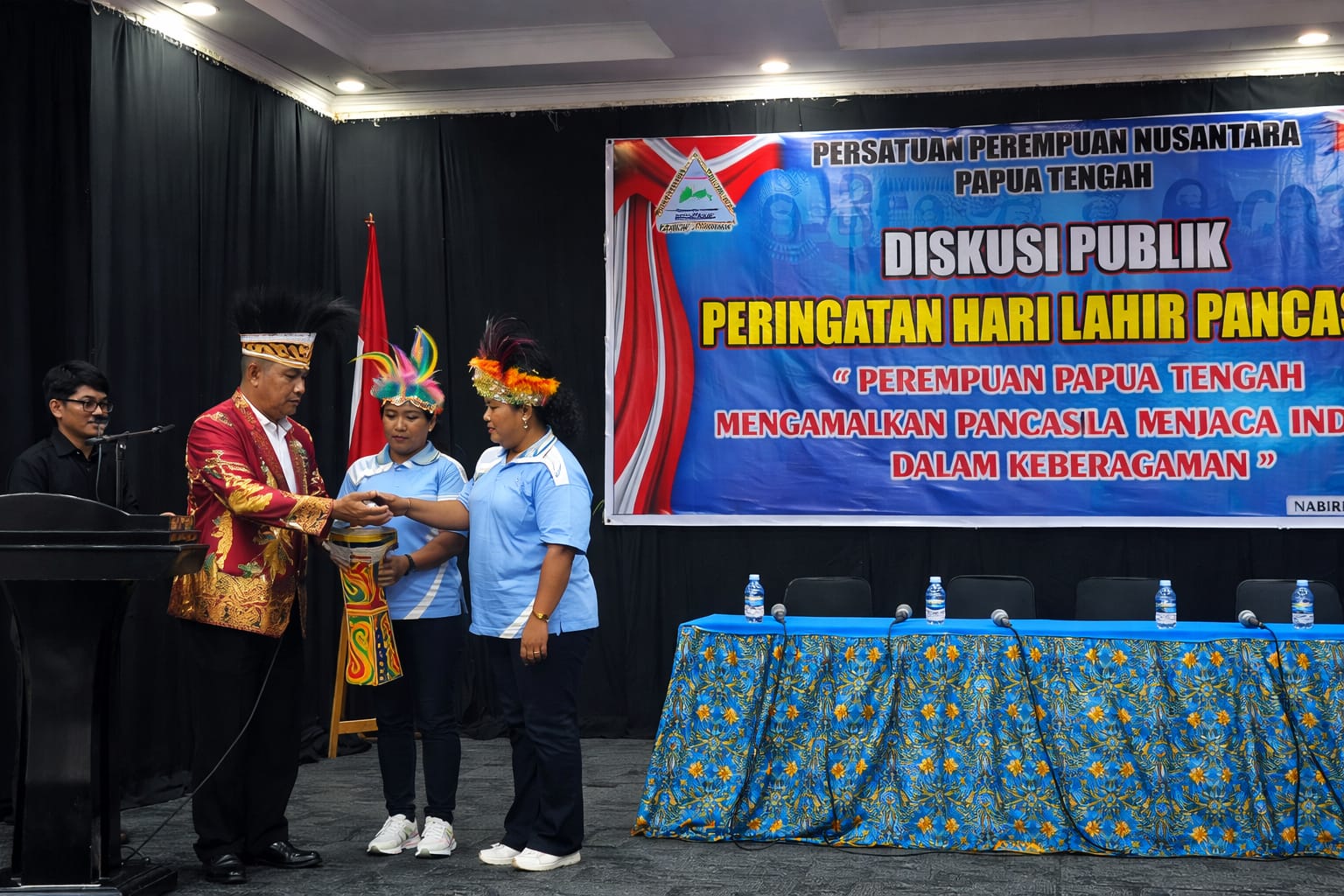
In Nabire, Papua Tengah, women’s organisations gathered for public forums to discuss how families and local communities influence social cohesion.
Speakers repeatedly argued that social resilience often begins long before governments become involved.
Inside households.
Schools.
Religious institutions.
Community gatherings.
Participants argued that women frequently become the first people managing social tensions inside communities, making their role important in maintaining social stability.
The discussions also reflected changing commemorative patterns.
Pancasila Day increasingly involves broader civil society participation rather than remaining exclusively government ceremonies.
Attention Turns Towards Younger Generations
Young people became another major topic throughout the day.
Officials in Manokwari, Papua Barat Daya (Southwest Papua), including Governor Elisa Kambu, encouraged younger Papuans to strengthen understanding of national values while navigating increasingly complex social environments.
The message itself was relatively straightforward.
Younger generations today receive information differently.
Social media moves faster.
Outside influences arrive easier.
Opinions spread instantly.
Several speakers warned that stronger digital connectivity creates opportunities while simultaneously increasing exposure to divisive narratives, extremist messaging, and social polarisation.
Rather than focusing purely on security approaches, many speakers framed ideological resilience as educational work.
Something requiring schools.
Families.
Community organisations.
Not only government institutions.
Security Institutions Also Join Commemorations
Security personnel also participated across several regions.
Units operating in mountain areas and urban centres conducted ceremonies while emphasising community engagement and nationalism.
Military representatives stated that relationships between institutions and communities remain important because security conditions and social trust frequently influence one another.
For many Papuans living in remote areas, government institutions, schools, healthcare programmes, and security institutions often operate within the same limited infrastructure.
That reality partly explains why official messages repeatedly emphasised cooperation rather than institutional separation.
Beyond Formal Speeches, Daily Life Continues
By midday, most ceremonies had ended.
People returned to offices.
Students boarded motorcycles.
Street vendors reopened.
Traffic returned.
Outside government compounds, daily routines continued almost immediately.
Yet discussions around unity remained visible.
Some participants stayed behind taking photographs.
Others continued conversations under tents while waiting for rain to stop.
Several attendees interviewed during local coverage described Pancasila less as political language and more as practical guidance for living together.
That perspective appeared repeatedly throughout the day.
Not through slogans.
Mostly through ordinary conversations.
Conclusion
Pancasila Day in Papua this year looked familiar in many ways.
Flags were raised.
Speeches delivered.
Ceremonies completed.
What stood out instead was how frequently discussions moved beyond protocol.
Across provinces, districts, and community forums, participants returned repeatedly to similar concerns.
Protect social cohesion.
Maintain tolerance.
Prepare younger generations.
For communities living across one of Indonesia’s most diverse regions, those conversations appear unlikely to end once ceremonies finish.