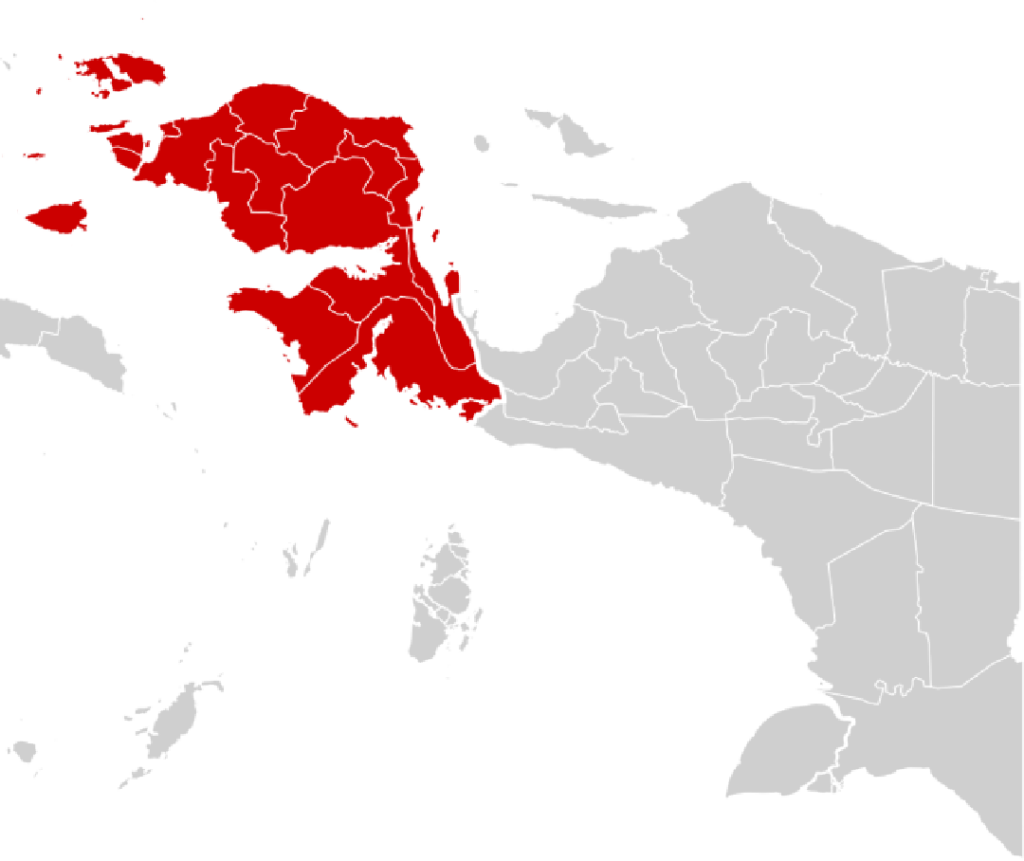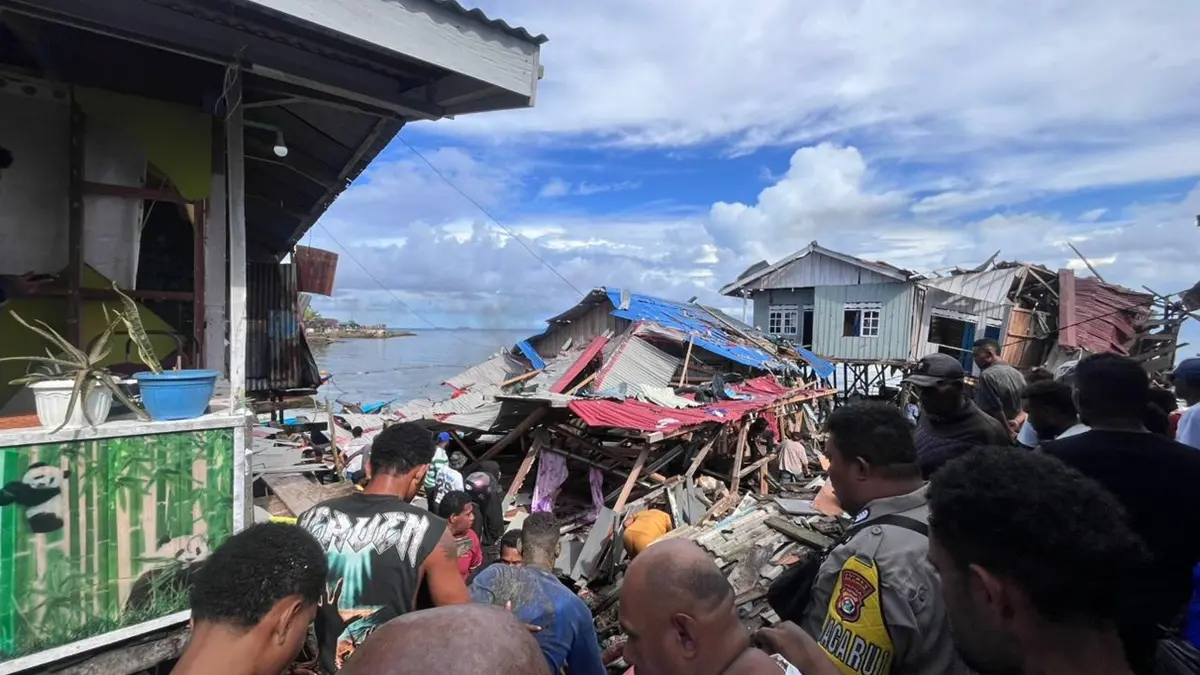
On May 31, 2026, at 02.45 PM local time, the explosion’s intensity echoed far beyond the neighborhood.
People rushed outside houses.
Some thought a fuel storage tank had exploded.
Others believed an earthquake had struck.
Within minutes, residents began running toward smoke rising above homes in Biak Numfor Regency, Papua, where confusion quickly turned into panic.
Neighbors carried victims using motorcycles and private vehicles before ambulances fully arrived.
Several people were still searching for relatives while emergency personnel started securing the area.
What exploded was not a modern device.
Police later said investigators strongly suspected the source was an old World War II bomb.
The incident, which occurred in Biak at the end of May, left five people dead, injured dozens more, damaged homes, and forced residents to leave surrounding areas while authorities searched for additional explosives.
For many Papuans, the tragedy became a painful reminder that although the Pacific War ended more than eighty years ago, some of its consequences remain buried underground.
Explosion Turns Residential Area Into Emergency Scene
Casualties Rise As Rescue Efforts Continue
Authorities confirmed five people died following the blast at Kompleks Perikanan, Walter Mongonsidi Street, Yenures Village, Biak Kota District.
Police and local officials reported that at least nineteen others suffered injuries ranging from burns and fractures to more serious trauma requiring hospital treatment.
Rescue operations continued, and initial reports indicated that several individuals were missing.
Local government officials later confirmed around fifty-five residents temporarily left the area because of concerns about additional unexploded devices.
The blast also damaged surrounding buildings.
Police and local authorities reported that approximately twelve houses and a nearby church building sustained damage.
Residents described windows breaking almost immediately after the explosion.
Several witnesses interviewed by local media said they initially believed aircraft had crashed because of how powerful the sound was.
Authorities Prioritize Medical Response
By evening, emergency teams had shifted attention toward evacuation and medical treatment.
Provincial police officials said victim evacuation became the immediate priority.
Biak Numfor Regent Markus Oktovianus Mansnembra visited affected locations shortly afterward and stated that local government resources would focus on ensuring victims received treatment and logistical assistance.
“We want to make sure every victim receives maximum handling,” local officials quoted the regent as saying while inspecting affected areas.
Medical teams continued working while emergency supplies were distributed for displaced residents.
Bomb Disposal Teams Move In
Hours after the explosion, authorities restricted access.
Police units for bomb disposal began searching surrounding locations.
Investigators feared the device that exploded might not have been the only one.
Officials explained that wartime ordnance is often discovered in groups rather than individually.
Because of this possibility, sterilization efforts continued even after rescue operations slowed.
Police asked residents not to return immediately while investigators conducted searches.
Local military officials also urged communities to report suspicious metallic objects rather than moving them independently.
Several residents admitted the warnings created fresh anxiety.
The explosion itself lasted seconds.
The uncertainty afterward lasted much longer.
Why Biak Still Faces World War II Risks
Papua Was One Of The Pacific War Frontlines
Biak occupies an important place in World War II history.
During 1944, fierce fighting occurred across the island as Allied forces attempted to seize strategic positions from Japanese troops.
Airfields were built.
Military tunnels expanded.
Coastal defenses constructed.
Large quantities of weapons and explosives arrived.
Historians frequently describe Biak as one of the important battle zones during the Pacific campaign because control of the island significantly influenced military operations across eastern Indonesia and the wider Pacific.
The war eventually ended.
Some things remained.
Wartime Relics Still Appear Decades Later
Residents across Papua occasionally discover remnants from that period.
Sometimes while clearing land.
Sometimes during construction.
Sometimes accidentally.
Old ammunition, artillery shells, aircraft fragments, and explosives have periodically been discovered in multiple areas historically connected with wartime operations.
Officials acknowledged that some unexploded devices buried during the 1940s remain unlocated.
That reality partly explains why authorities repeatedly remind communities living around historical battle sites to remain cautious.
Communities Confront More Than Physical Damage
For families affected by the conflict, casualty statistics provide only a partial account of the situation.
Several families suddenly lost relatives.
Children witnessed rescue operations.
Residents temporarily left homes uncertain whether surrounding land remained safe.
Community leaders spent much of the following day helping calm residents while emergency teams continued working.
People returned repeatedly to similar questions.
Could additional explosives still exist?
How many remain underground?
How could something buried for decades suddenly explode now?
Investigators continue examining those questions.
Government Assistance Continues After Initial Response
Authorities emphasized that support efforts would continue beyond emergency evacuations.
Medical treatment continued.
Temporary assistance for displaced residents remained available.
Police maintained restricted zones around affected locations while bomb disposal teams completed searches.
Officials also increasingly discussed prevention.
Several authorities suggested stronger public awareness campaigns may become necessary in areas historically connected with wartime operations.
The goal, according to officials, is straightforward.
Prevent historical remnants from becoming future tragedies.
A War That Never Fully Disappeared
Visitors coming to Biak often encounter reminders of World War II.
Old runways.
Military caves.
Historic bunkers.
Rusting equipment is hidden in forests.
Many have become tourist attractions.
The explosion revealed another reality.
Some remnants remain dangerous.
Not inside museums.
Not protected behind barriers.
Simply buried.
Waiting.
Conclusion
By the following day, police lines still surrounded parts of the affected area.
Investigators continued searching.
Families continued grieving.
Residents waited for permission to return fully.
The explosion in Biak was not simply an accident involving old explosives.
It exposed how history sometimes remains physically present long after people assume it has disappeared.
For communities living around former battlefields in Papua, the Pacific War remains part of local memory.
Now, it has become part of present reality again.